Uber Turned Hidden Whitespace Into Territory Its RevOps Team Could Act On
Territory Visibility
Across EMEA, APAC & LATAM
Buying Groups
Full stakeholder mapping across enterprise accunts
Hierarchy Accuracy
Clean, actionable account relationships
Challenge
Uber's RevOps team suspected there was revenue sitting in territories they couldn't see clearly. Duplicate records and incomplete account hierarchies were hiding whitespace and making account prioritization unreliable.
Outcome
Uber used SMARTe's data foundation to clean up account hierarchies and map buying groups across regions. With SMARTe as a hands-on partner, Uber's RevOps team surfaced untapped whitespace across EMEA, APAC, and LATAM.
Oops! Something went wrong while submitting the form.
Enterprise RevOps teams rarely lose pipeline all at once. It hides instead, buried under duplicate accounts and broken hierarchies, until a team realizes it's been working a partial map of its own territory.
SMARTe exists to close that gap. The platform gives global GTM teams a single, compliant source of truth across contacts, company data, and buying signals. It's built for enterprise scale: 289M+ verified contacts, 66M+ company profiles, coverage across 200+ countries.
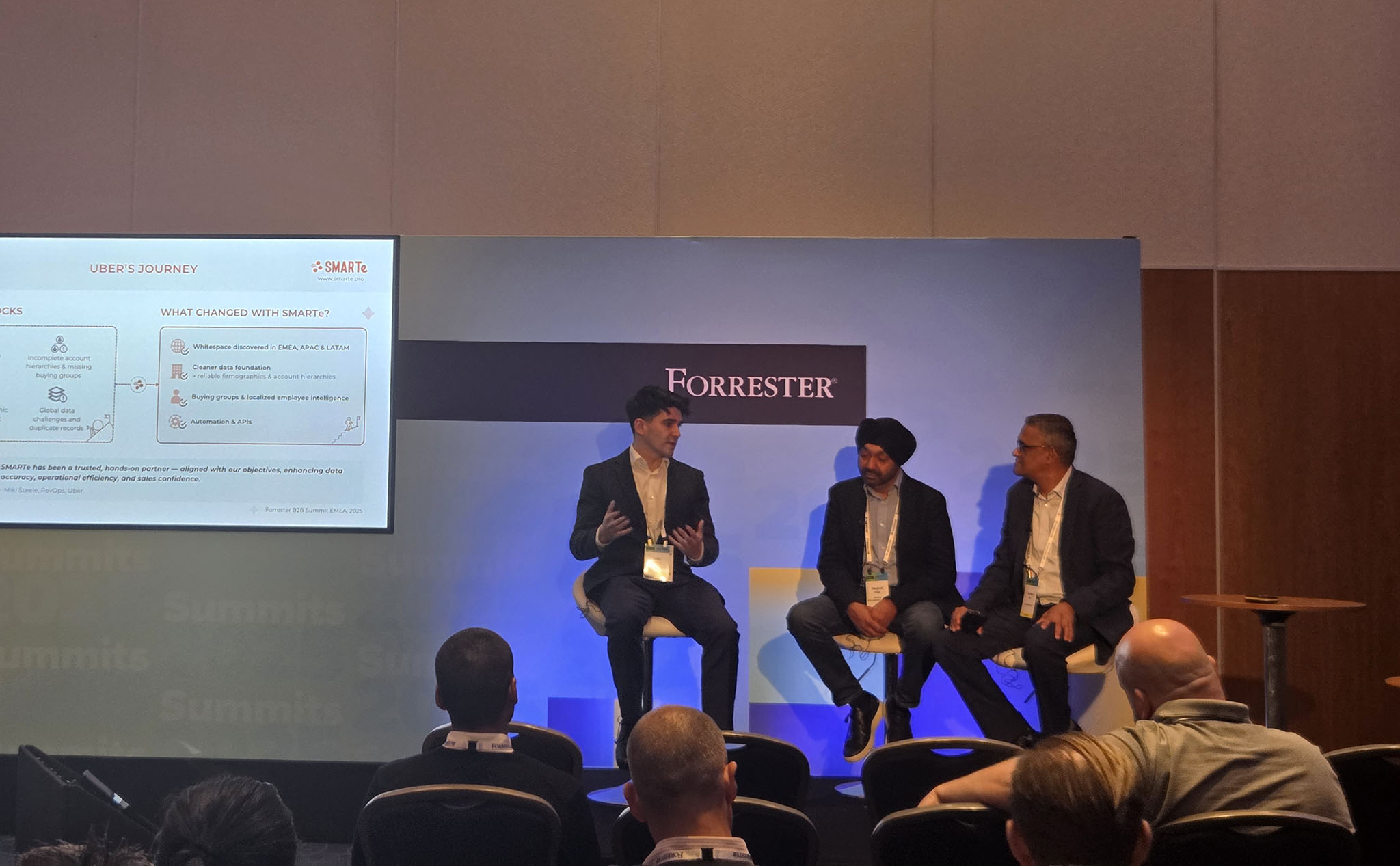
At Forrester's B2B Summit EMEA 2025, Uber's Revenue Operations team shared how that foundation changed what they could see in their own book of business.
"SMARTe has been a trusted, hands-on partner, aligned with our objectives, enhancing data accuracy, operational efficiency, and sales confidence." Miki Steele, Revenue Operations, Uber
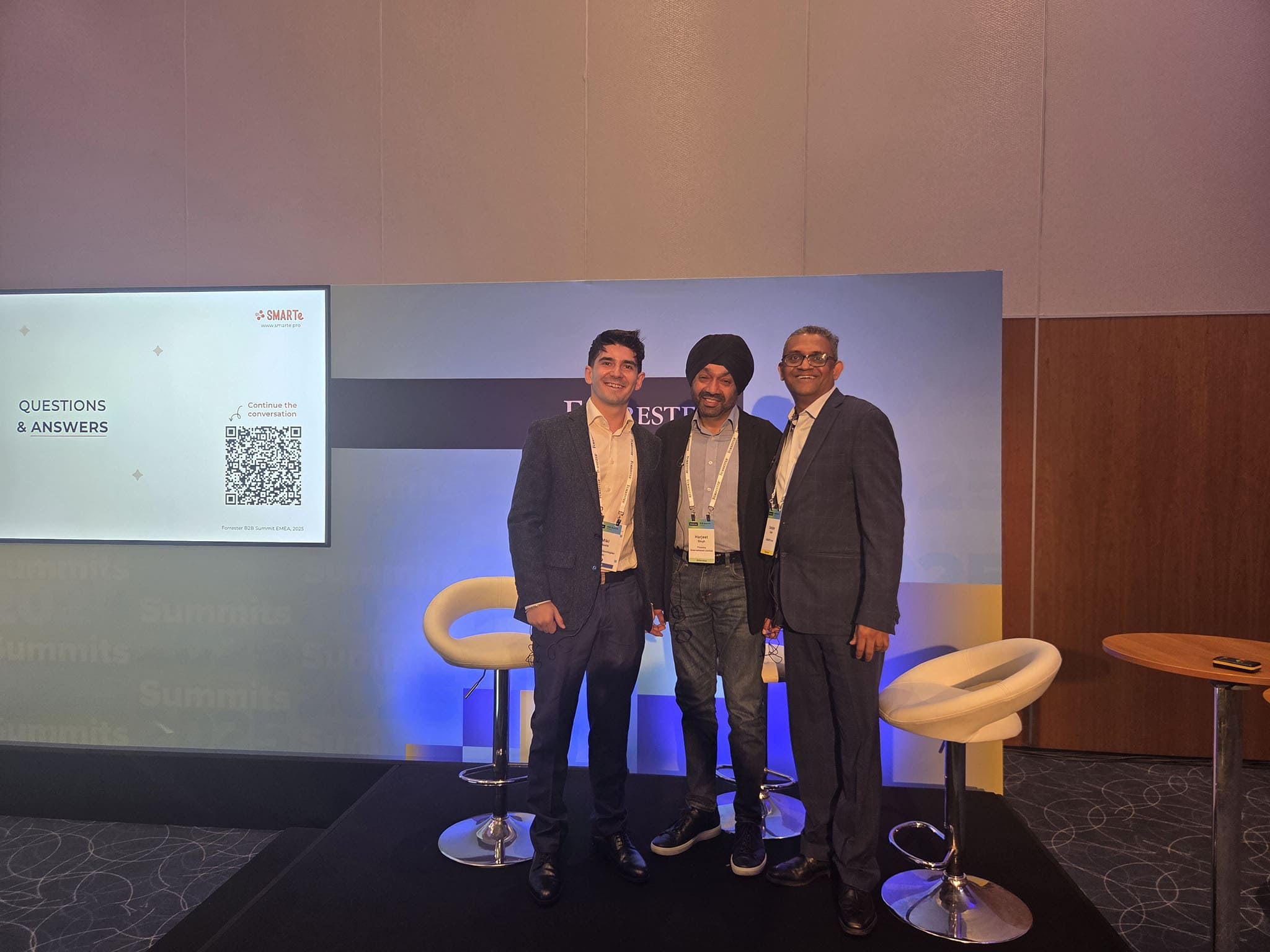
SMARTe Founder and CEO Sanjay Gala (extreme right) with Miki Steele, Uber (extreme left) at Forrester's B2B Summit EMEA 2025.
The Drive to Find Hidden Pipeline
Uber runs GTM across dozens of countries, and at that scale, small data problems compound fast. The RevOps team suspected there was revenue sitting in territories they couldn't see clearly. Incomplete account hierarchies and missing buying groups meant reps were working partial pictures of their own accounts, often multithreading the wrong stakeholders or missing them entirely.
Inaccurate firmographic data made prioritization worse, not better, pushing reps toward accounts that looked bigger on paper than they actually were. That's a quiet cost most RevOps teams underestimate. A rep chasing an inflated account isn't just wasting a call. They're not chasing the real account sitting one row down that never got flagged as a priority.
A Cleaner Data Foundation, Built for Uber's Scale
The fix started with the foundation itself. Accurate firmographics and real account hierarchies replaced the guesswork the team had been working around, giving RevOps a version of the account map they could actually plan against instead of one they had to double-check.
Buying group mapping and localized employee intelligence came layered directly on top. Reps could finally see who sits inside an account and how accounts connect across regions. For a company selling into local markets everywhere it operates, that regional layer mattered as much as the mapping itself. A buying group in one country doesn't look like a buying group in another.
Automation and API access meant this wasn't a one-time cleanup. It became part of how the RevOps team operates every day, with the data foundation staying current as accounts and org charts change, instead of drifting back into the same gaps six months later.
The Fast Lane to Visible Territory
Whitespace surfaced across EMEA, APAC, and LATAM: territory Uber already had access to but couldn't previously see. That's the part worth sitting with. This wasn't new market entry. It was revenue the team was already positioned to capture, sitting unclaimed because the data couldn't show it to them.
For the first time, the team had real visibility into the buying groups sitting inside those accounts. A single contact record became a full picture of who influences a deal. That shift changes how a rep opens a conversation, from guessing who else needs to be looped in to already knowing.
The result wasn't a single feature. It was a data foundation built to hold up at enterprise scale, across every region Uber operates in.
A Foundation Built for What's Next
The whitespace SMARTe surfaced isn't a one-time discovery. It's now part of how Uber's RevOps team plans territory coverage going forward, with buying group intelligence built into the process instead of reconstructed deal by deal. That's the difference between finding whitespace once and having a process that keeps finding it.
No items found.
About
Uber
Industry
Technology & Transportation
Location
San Francisco
Company type
Enterprise
Uber operates a global technology platform connecting riders, drivers, and delivery partners across ride-hailing, food delivery, and freight. Headquartered in San Francisco, Uber runs GTM and revenue operations across dozens of countries and regulatory environments.
Ready to fix deliverability without adding compliance risk?