TL;DR:
Agentic GTM is a go-to-market approach where autonomous AI agents run your entire revenue operation at once. Sales agents prospect and prioritise. Marketing agents personalise and execute campaigns. Customer success agents flag churn and trigger expansions. RevOps agents govern data quality and route intelligence across all functions. The agents coordinate with each other in real time.
- 76% of B2B organisations are deploying agentic AI in GTM functions, but 88% of pilots never reach production. Adoption and results are not the same number
- The real readiness gap is not the AI. It's the GTM infrastructure underneath it (fragmented data, siloed systems, no governance model)
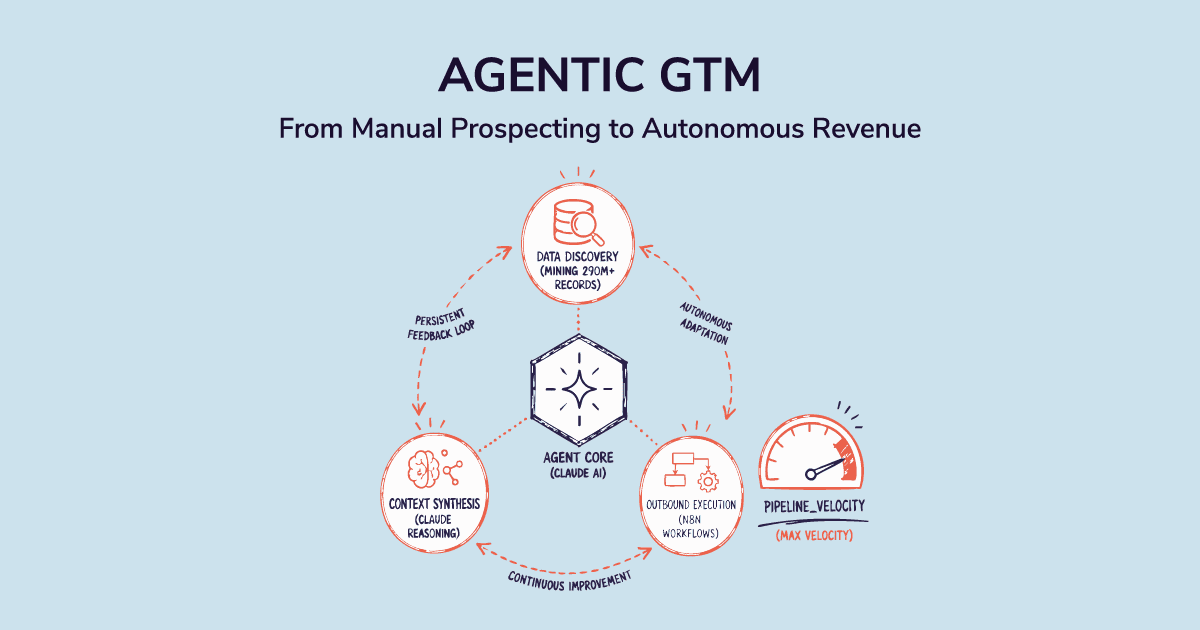
- Four layers make it work: data ingestion, AI reasoning, multi-channel execution, and continuous learning. Skipping any one breaks the others
- Gartner predicts 40%+ of agentic AI projects will fail by 2027. Most failures trace back to infrastructure and data quality, not the agents
- You need a unified data layer, real-time verified contact records, and clear ownership before deploying at scale
- Start with one workflow, prove it, then expand. Teams that go fully agentic across all functions at once have no way to isolate what's breaking
Agentic GTM is a go-to-market approach where autonomous AI agents run the full revenue motion across sales, marketing, customer success, and RevOps simultaneously. The agents detect buying signals, prioritise accounts, personalise outreach, execute multi-channel campaigns, monitor pipeline health, predict churn, and route intelligence across all GTM functions without waiting for human instruction at each step.
Agentic outbound replaces the manual outbound workflow for one team. Agentic GTM replaces the manual coordination layer between all revenue teams. The scope is different and so are the requirements.
Here is where things stand in 2026. A January 2026 study by RevSure and Ascend2 of 306 senior B2B GTM leaders found 76% of organisations are already deploying agentic AI in marketing, sales, or RevOps. 41% are in full implementation. 35% are in active rollout. And yet, per Forrester and Anaconda data, 88% of agent pilots never graduate to production. The adoption numbers and the results are not telling the same story.
What Is Agentic GTM?
Agentic GTM is the orchestration of autonomous AI agents across your entire go-to-market operation. Unlike traditional automation, which follows predefined rules, or generative AI, which produces outputs when asked, agentic systems set goals and figure out how to reach them. They act without being told what to do at each step.
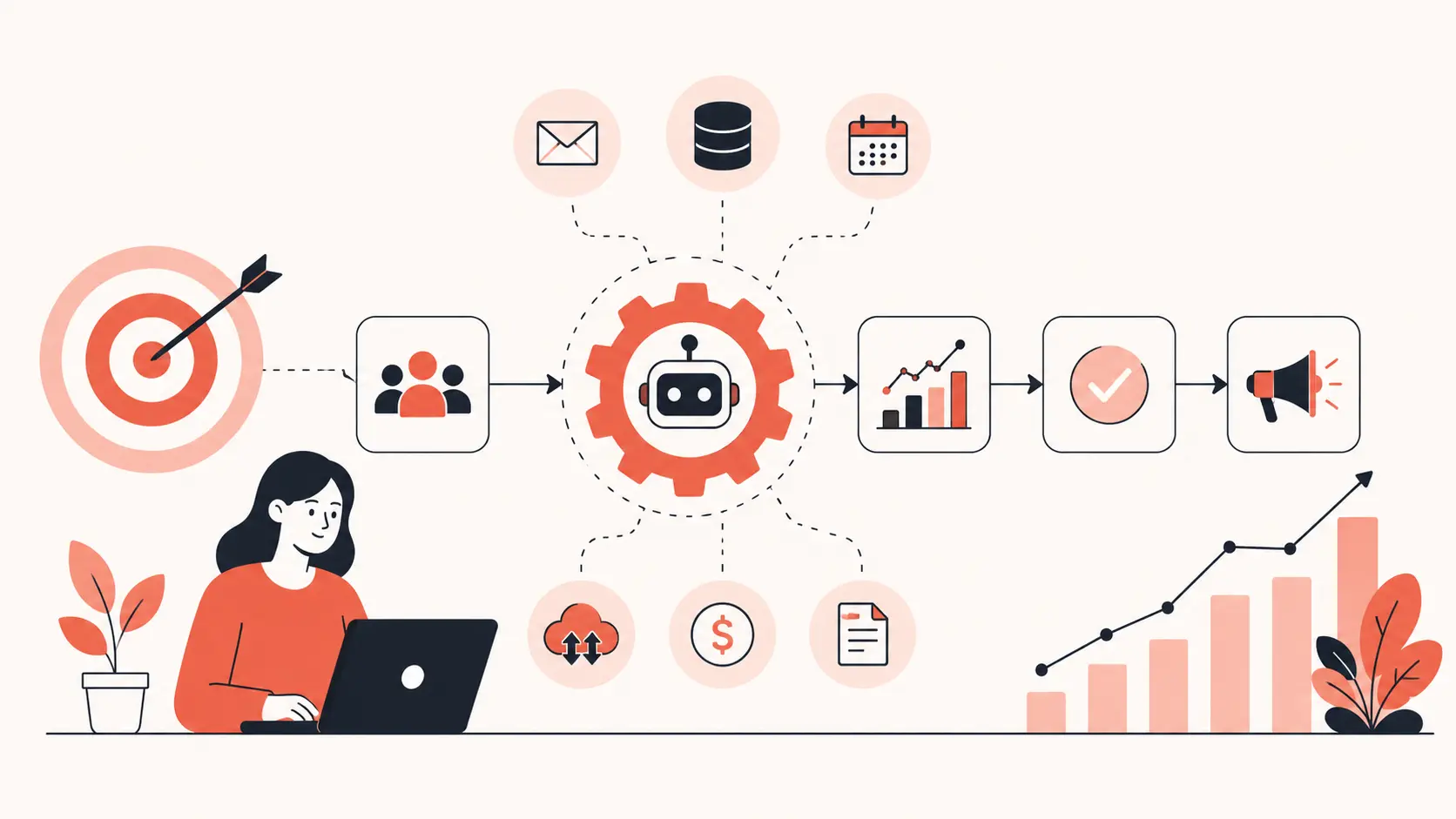
A full agentic GTM system looks something like this. A prospecting agent monitors target accounts for buying signals and routes high-priority accounts to sales. A marketing agent personalises campaign content and channel mix based on account-level behaviour. A customer success agent flags churn risk 60 days before renewal and triggers expansion workflows when usage signals align. A RevOps agent reconciles data across systems, maintains forecast accuracy, and routes signal intelligence to whoever needs to act on it.
Each agent runs continuously. Each learns from outcomes. None require a human to manage individual steps.
What makes this agentic GTM rather than a collection of AI tools is orchestration. The agents coordinate with each other and share signal intelligence. When the marketing agent detects a buying signal, the sales agent picks up the account with context already in place. That connection between functions is what separates a genuine agentic GTM motion from four separate AI experiments running in parallel.

SMARTe GTM Intelligence
Start Smarter Prospecting Today
How Agentic AI GTM Differs From What You Already Have
Marketing automation, agentic outbound, and agentic GTM get conflated constantly. They are genuinely different things.
Marketing automation follows pre-built sequences. An account reaches a threshold (opens three emails, visits the pricing page) and a workflow fires. The trigger and the response are pre-defined by a human. The system does not adapt based on what it learns.
Agentic outbound replaces the manual outbound motion for a sales team. The AI agent handles prospecting, research, personalisation, multi-channel execution, reply triage, and meeting booking autonomously. One function. One team. One workflow.
Agentic GTM sits above both. It orchestrates the full revenue motion across sales, marketing, CS, and RevOps, with agents in each function sharing intelligence and coordinating actions. When CS detects a churn risk, RevOps is updated and the expansion motion adjusts accordingly. The connections between functions are what make it agentic GTM rather than a collection of individual agentic tools.
The Four Layers Every Agentic GTM System Runs On
Understanding the architecture before buying any tool matters. Most organisations that fail at agentic GTM skip one of these four layers.
Layer 1: Data and Signal Ingestion
Every agent starts here. The system pulls data from every source that touches the revenue cycle:
- CRM records and contact data
- Marketing automation engagement history
- Sales engagement activity and reply signals
- Product usage and customer health data
- Intent data platforms (Bombora, G2, etc.)
- Funding databases and leadership change feeds
- External data enrichment providers
The agents cannot sense an opportunity they cannot see. And they cannot act reliably on signals that are inaccurate. Per the RevSure and Ascend2 research, the most common bottleneck stopping agentic GTM from delivering results is not the AI. It is the fragmented, inconsistent data the AI has to work with. Fragmented signals, disconnected channels, and data that changes depending on who pulls it produce inconsistent agent behaviour.
Layer 2: AI Reasoning and Decision-Making
Once signals are ingested, something has to decide what to do with them. The reasoning layer evaluates account readiness, scores buying intent, identifies the right next action, and determines which team or workflow to route the account to.
The quality of these decisions depends directly on the signals feeding them. Clean, real-time data produces accurate prioritisation. Stale or fragmented data produces confident wrong decisions at scale. A sophisticated reasoning layer does not compensate for bad inputs. It just processes them faster.
Layer 3: Multi-Channel Orchestration and Execution
This is where the agents act. Typical execution across a working agentic GTM system includes:
- Sequenced outreach across email, LinkedIn, phone, and display
- Campaign adjustments triggered by real-time account behaviour
- CS workflows that fire when usage signals drop below a threshold
- Signal routing to the right rep or team at the right moment
- Personalised follow-up based on previous touchpoints and engagement history
Companies now use an average of 10 different channels to engage customers, and nearly a third of B2B deals close without any in-person meetings, per Landbase research. Coordinating all of those touchpoints consistently across a buying group of 10 or more stakeholders is not something a manual team can sustain at scale.
Layer 4: Continuous Learning
A working agentic GTM system gets better over time. It tracks which outreach generated replies, which signals predicted close, which churn indicators proved accurate, and which campaign messages drove engagement. That feedback adjusts priorities and approaches automatically.
This layer only works if the measurement infrastructure is in place first. If the agents cannot tell which actions led to pipeline, they cannot learn from those outcomes. Teams that skip measurement end up paying for autonomy they are not actually benefiting from.
What Agentic GTM Changes for Each Revenue Function
Sales
Sales agents handle account prioritisation, research, personalised outreach, reply triage, and meeting booking. In a full agentic GTM setup, the sales agent also receives real-time intelligence from the marketing agent (which accounts are engaging with content) and the CS agent (which existing customers are showing expansion signals). Reps step into conversations with full context rather than building it manually before each call.
The shift is from reps managing their own pipelines to reps executing inside a system that is managing the pipeline for them.
Marketing
Marketing agents run personalised campaigns at the account and contact level. They adjust channel mix, message, and timing based on real-time engagement signals. They trigger sequences when intent spikes appear and pause them when accounts go cold.
In my experience, this is where organisations see the first clear productivity gain. Campaign execution that used to require a team of four running manual processes gets handled by agents optimising continuously. The marketing team shifts from execution to strategy: defining goals, evaluating performance, and making the calls the agent surfaces for human judgement.
Customer Success
CS agents monitor product usage, support interactions, NPS signals, contract renewal timelines, and stakeholder engagement to flag at-risk accounts 60 to 90 days before churn. They trigger expansion workflows when usage signals indicate the account is ready for a bigger footprint.
Clean contact and account data matters more here than anywhere else in the system. A CS agent monitoring the wrong person at an account (because a stakeholder changed roles and the record was never updated) misses the churn signal entirely. The agent fires on a ghost.
RevOps
RevOps agents maintain forecast accuracy, reconcile data across systems, flag pipeline anomalies in real time, and route signal intelligence across the GTM stack. They replace the manual data hygiene work that consumes 46% of a typical RevOps team's time, per Prospeo research.
The RevOps agent is also the connective tissue of the whole system. It makes sure the signals marketing generates reach sales at the right moment, that the context from CS conversations flows into renewal forecasting, and that the data model every other agent relies on stays current.
Why Most Agentic AI GTM Implementations Stall
Gartner predicts more than 40% of agentic AI projects will fail by 2027. Most of those failures will not be agent failures. They will be infrastructure failures. The agents are ready. The GTM operating model underneath them is not.
1. The infrastructure gap. Most GTM operations are built for manual coordination. Siloed data. Tool-hopping between systems. Reporting that produces different numbers depending on who pulls it. You cannot run autonomous intelligence on infrastructure built for human interpretation. The agents inherit all the fragmentation and make it move faster.
2. The data gap. Agentic GTM requires complete, accurate, timely data across every system the agents monitor. Most organisations have four or five data sources that disagree with each other. The agents process all of them and generate inconsistent outputs because the inputs are inconsistent. Honestly, I think this is the most underestimated problem in the entire category.
3. The governance gap. Only 1 in 5 companies has a mature governance model for autonomous AI agents, per Deloitte 2026 research. That means 80% of organisations deploying agents are doing so without clear ownership of what the agents decide, accountability for their outputs, or guardrails for when they act incorrectly. When an agent makes a bad decision autonomously at scale, the damage compounds before anyone notices.
What You Need Before You Start Building
Most implementation guides skip this part. Here is the checklist that actually determines whether a deployment works.
A unified data layer. Every agent in your GTM stack should pull from the same source of truth. CRM, intent data, product usage, marketing engagement, and CS health signals all need to flow into one governed layer. Isolated snapshots from four disconnected systems produce four disconnected agent behaviours.
Real-time data verification. Batch data refreshes are not fast enough for agentic systems. When an agent detects a buying signal and fires on an account, the contact records it routes to need to be accurate at that moment, not from a refresh that ran last week. B2B contact data decays at roughly 22.5% per year. An agentic system running on a quarterly refresh is already operating on partially wrong data from day one.
A clear ownership model. Someone owns each agent's behaviour and the decisions it makes. Not the vendor. Someone inside your organisation. Who approves a campaign the marketing agent generates? Who reviews the accounts a sales agent prioritises? Without ownership, there is no accountability and no learning loop.
Signal quality standards. Define what qualifies as a Tier 1 signal before the agents go live. If your buying signals are noisy, the agents prioritise the wrong accounts at scale. The quality of the input directly determines the quality of the output.
How to Build Agentic GTM Without Building Everything at Once
63% of revenue leaders expect a single agentic system to own sequencing, research, reply triage, and meeting briefs by the end of 2027, collapsing today's stack of 6 to 8 point tools, per Forrester Predictions 2027. That is the destination. Starting there is not.
Start with one workflow. Pick the highest-ROI use case in your current GTM motion. For most teams, that is either the agentic outbound motion (sales) or the churn prediction and expansion trigger workflow (CS). Run one. Measure it. Prove it before moving to the next.
Fix the data before touching the agents. Run CRM data enrichment against your active accounts. Verify contact records in real time. Audit your intent data provider's false-positive rate. Every agent you deploy inherits the quality of your data layer. Fix the layer first.
Pilot with a measurement framework. Set specific leading indicators before the pilot starts. What win rate, pipeline velocity, or churn rate would prove the agent is adding value? If you cannot define success before the pilot, you cannot evaluate the results during it.
Then scale. Once one workflow proves out, add the next. Organisations that try to go fully agentic across all four GTM functions simultaneously have no way to attribute results and no way to fix what is breaking. Start narrow. Expand from evidence.
The Data Foundation Agentic GTM Runs On
RevSure's 306-leader research flagged this directly: you cannot run autonomous intelligence on infrastructure built for manual operations. The real readiness gap in 2026 is not AI capability. It is the GTM operating model meant to support it.
Every agent acts on data. The prospecting agent acts on contact records and intent signals. The marketing agent acts on account engagement data. The CS agent acts on product usage and stakeholder records. The RevOps agent acts on pipeline and CRM data.
When those records are stale, wrong, or fragmented across disconnected systems, every agent in the stack produces stale, wrong, or fragmented outputs. At autonomous speed. At scale. Before a human catches the error.
AI-ready B2B data means contact records verified at the point of use, not refreshed on a schedule. It means buying signal data accurate enough for agents to prioritise correctly without human correction. And it means a unified account view that every agent pulls from, not four systems producing four answers.
SMARTe's 289M+ verified contacts run through real-time verification and surface through the SMARTe MCP (Model Context Protocol), which gives AI agents direct access to live B2B data without a tab switch or a data export. Bombora intent signals, job changes, funding events, and technographic installs all in one place, with contact records verified at the moment the agent fires. That is what makes agentic GTM reliable in production instead of impressive in the pilot.
Agentic GTM Is an Architecture Decision, Not a Tool Decision
The organisations that win the agentic era will not be the ones with the most AI tools. They will be the ones with the strongest operating model for autonomous intelligence, per RevSure's research of 306 GTM leaders.
A unified data layer. A clear ownership model. Signal quality standards. A governance framework. A data foundation accurate enough for agents to act on without a human reviewing every output.
The technology is ready. Most GTM operations are not. The teams that use the next 12 months to rebuild the infrastructure before scaling the agents will be significantly ahead of the ones that buy more tools and hope the results follow.
Fix the operating model. Then run the agents.
Try SMARTe free and see what agentic GTM looks like when the data underneath every agent is verified in real time.
.png)