Three companies in your ICP raised Series B funding this quarter. One brought in a new VP of Sales just six weeks ago. Another recently started researching your top competitor. Meanwhile, your SDR team has no visibility into any of it. They are still working from a static list built months ago, reaching out to contacts whose roles, priorities, or even employment status may have already changed.
By the time most outbound teams realize an account is actively evaluating solutions, the buying window is already narrowing. Budgets are being discussed, vendors are being shortlisted, and internal conversations are already happening without them in the room.
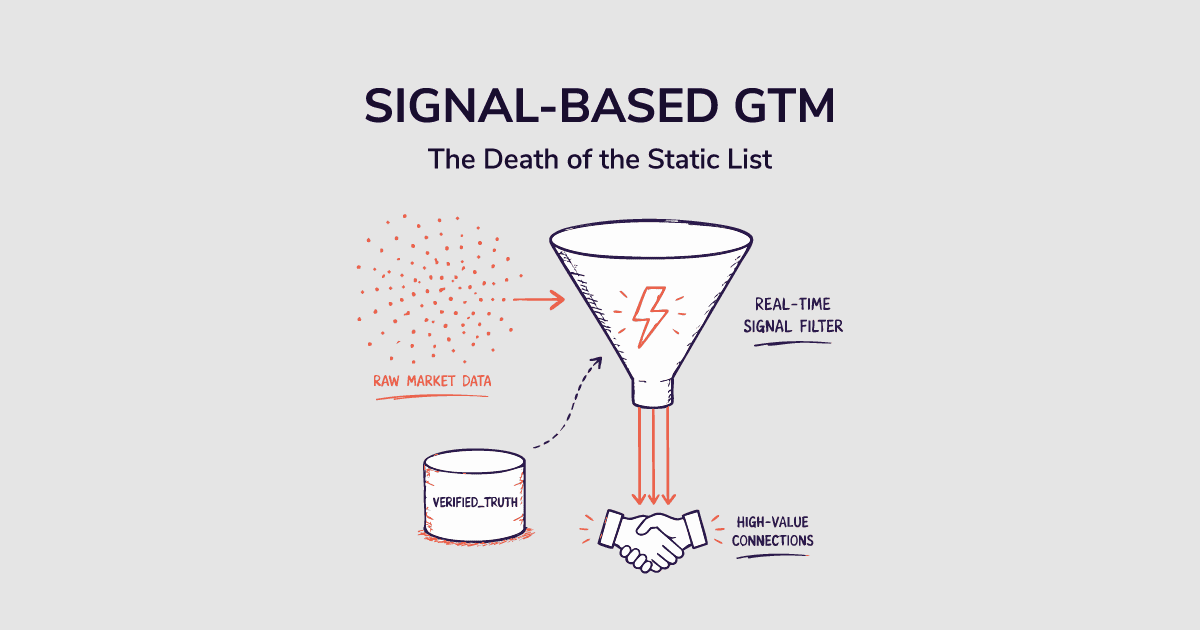
Signal-based GTM changes that dynamic. Instead of prospecting only based on who matches your ICP, teams prioritize accounts that match the ICP and are already showing signs of movement in the market right now.
Most outbound organizations still operate on static targeting, even when they talk about being data-driven. The teams creating consistent pipeline are usually the ones acting while the signal is fresh, not weeks after the moment has passed.
What Separates Signal-Based GTM From Regular Outbound
The Old Model: Spray, Pray, and Stale Data
Traditional outbound prospecting looks clean on paper. Pull accounts that match your ICP. Build sequences. Start dialing. The theory is solid. The execution breaks at the data layer, not the messaging layer.
B2B data decay erodes roughly 25 to 30 percent of a contact database every year. People change jobs. Get promoted. Leave the company entirely. Phone numbers go cold. The static list your team built in Q1 doesn't update itself.
So reps reach the right company but the wrong person. Or the right person, six months after they moved on. Or three months before the contract renewal that would have made the conversation relevant. The sequence runs. The results disappoint. Everyone assumes it's a copy problem.
It's almost never a copy problem.

SMARTe GTM Intelligence
Start Smarter Prospecting Today
What "Signal-Based" Actually Means
Signal-based GTM replaces the static list with a live one. Instead of sourcing accounts from a spreadsheet, you surface them based on observed behavior: what they're researching, what's changing inside their org, what technology they just adopted or dropped.
Buying signals are the digital footprints of a company moving toward a purchase decision. They don't tell you everything. They tell you enough to know when to reach out and when to wait.
I think the most important mindset shift here isn't tactical. Your ICP list and your in-market list are two different things. Building both, and knowing which one actually drives pipeline, changes how you allocate rep time completely. Most teams treat them as the same list. They're not.
The Four Signals That Consistently Predict Pipeline
Not all signals are equal. Some are noise. Some are gold. Here are the four that show up most reliably in accounts that close.

Intent Signals (Content Consumption Patterns)
Intent data tracks what a company's employees are consuming across the web — not just on your site, but across thousands of B2B media properties, review sites, and research forums. When multiple people at one company suddenly start researching "B2B data providers" or "sales intelligence platforms," that behavioral cluster is a buying signal.
Bombora's intent methodology tracks this across a co-op network of B2B publishing sites. When research activity around a topic spikes at an account above its normal baseline, that's a surge. That surge is your opening. You can read more about how the methodology works in SMARTe's breakdown of Bombora intent data.
One honest caveat here: intent data is a leading indicator, not a guarantee. I've seen teams act on surge signals and find accounts that were doing competitive research for a conference deck, not an active purchase. Treat intent as a qualifier, not a closer. It tells you who to watch. It doesn't always tell you who to call today.
What to do: Layer intent signals on top of firmographic fit. An account surging on "sales intelligence tools" that also matches your ideal customer profile on headcount, industry, and tech stack is worth fast-tracking. An account surging with no ICP match is mostly noise.
Trigger Events: Funding, Hiring, and Leadership Changes
A company that just raised a Series B is building infrastructure. They're hiring. They need tools to scale. Their stack decisions happen in the next 60 to 90 days. After that, the new systems are in, the budgets are locked, and the window closes.
A new VP of Sales walking in the door is one of the most reliable buying triggers in B2B. New leaders evaluate their inherited tech stack fast. They bring in tools they've used before. They're also trying to establish credibility quickly, which means they're open to switching. Reaching them in the first 30 days, before their preferences set, is the window most reps never see.
What to do: Build a trigger event watchlist for your top 200 target accounts. Any time one of those accounts hits a funding announcement or a VP-level hire, that account moves to the top of the queue. Not the weekly review queue. The same-day queue.
Technographic Shifts
Technographics tell you what technology an account is running and, more importantly, what they just added or dropped.
A company that just adopted Salesforce is almost certainly also evaluating data enrichment tools, sequencing platforms, and revenue intelligence software, because those tools integrate with Salesforce and Salesforce customers almost always need them. A company that just dropped a competitor's product has a gap and a timeline.
Technographic segmentation is one of the most underused signals in outbound. Most teams know about intent data. Far fewer use tech stack changes as a prospecting trigger. That gap is a real edge for the teams that act on it.
What to do: Identify the 5 to 10 technologies whose adoption or removal most reliably predicts that an account needs your product. Filter your prospect universe by those tech signals first. Layer ICP fit on top.
Job Change Tracking
Champion tracking is one of the most overlooked revenue opportunities in B2B. A contact who evaluated you at their last company and nearly closed, or who was a customer before churning, just moved to a new role. They already know your product. They already have some level of trust.
Tracking job changes across your engaged-but-didn't-close pipeline and your churned customer base surfaces warm opportunities inside cold-looking accounts. I've seen teams add 15 to 20 percent of their quarterly pipeline from this signal alone, not by outbounding net-new contacts but by following the people they'd already built relationships with.
What to do: Set up alerts for job changes among your closed-lost contacts, churned customers, and late-stage prospects who went dark. When someone moves to a new company, route them to a rep within 48 hours. The window is short.
Why Most Teams Still Get Signal-Based GTM Wrong
Most teams know signals exist. Many of them have access to some form of intent or trigger data. And most still aren't seeing the pipeline lift they expected.
Here's why.
Signals Without Verified Contact Data Are Worthless
You can know an account is surging on your category. You can know they just hired a new CRO. None of it matters if you can't reach anyone there.
Bad CRM data is the execution-layer failure that signal-based GTM consistently exposes. A signal tells you when to engage. It doesn't hand you a working direct dial for the person who joined six weeks ago. If your contact coverage is thin, especially for mobile numbers, your signal-to-meeting conversion rate stays flat no matter how precise the signal feed is.
This is the part most vendors skip when they sell you intent data. The signal is the starting pistol. Verified contact data is the track you run on.
The Timing Gap: From Trigger to Outreach
Speed matters more in signal-based outreach than in almost any other kind.
Most trigger events open a buying window of 30 to 90 days. Inside that window, the first credible vendor to reach the right person has a structural advantage. Not because early always wins (it doesn't), but because you get more conversations, deeper discovery, and more time to build a relationship before the account is evaluating three shortlisted options.
Most teams have a 5 to 10 day lag between a signal firing and a rep acting on it. That's a routing and prioritization failure, not a motivation problem. Signals pile up in dashboards nobody checks every day.
Routing Problems Kill Reaction Speed
Signal-based GTM breaks down when there's no system connecting a signal to a rep action.
A trigger fires and lands in a shared Slack channel that everyone glances at and nobody owns. Or it goes into a CRM field reviewed at the weekly pipeline call. By then, you've already missed the window.
I honestly think this is where more signal-based GTM motions die than anywhere else. Teams invest in the data layer and skip the workflow layer entirely. The signal fires. Nobody catches it in time. The team writes off intent data as "not working."
The signal worked fine. The process didn't.
Building the Signal-Based GTM Motion in Practice
Picking the Two or Three Signals That Actually Match Your ICP
Don't try to act on every signal type at once. That overwhelms reps and dilutes the motion.
Start with the signal that has the highest historical correlation to closed-won in your specific business. Pull your last 50 to 75 closed-won accounts. Look at what was happening in those accounts in the 60 to 90 days before first contact. There's almost always a pattern: a funding event, a leadership change, a tech adoption. That pattern is your signal priority.
Build your sales prospecting strategies around two signals max until the motion runs cleanly. Add layers once you know the first ones work.
Connecting Signals to Verified, Real-Time Contact Data
Once you've identified the signal, you need the people. Specifically, you need verified direct dials and emails for the right contacts inside those accounts, mapped to your B2B buying group profile.
This is where data freshness becomes the execution difference. If you're pulling contacts from a static database last refreshed six months ago, the signal fires and you reach out to an email that bounced and a phone number that's been reassigned. Real-time verification isn't a nice-to-have here. It's the thing that makes the signal actually work.
Automating the Handoff to Reps
Signals should trigger rep actions without a human manually reviewing a dashboard in between.
The motion looks like this. Signal fires. Account is scored against your ICP criteria. Contacts are pulled and verified in real time. The account and contact data surface in your CRM with a task assigned to the right rep. The rep gets an alert. From signal to rep action in under 24 hours, ideally under four.
Most strong pipeline generation motions have this wired. The ones that don't have teams spending Monday mornings triaging a week's worth of signals that are already half-stale. You lose the edge the moment the motion goes manual.
How SMARTe Fits Into a Signal-Based GTM Motion

SMARTe was built for the execution layer of this problem. Not just as a signal source, but as the data foundation that makes signals work.
Bombora intent signals are built directly into SMARTe's platform. No separate subscription to manage. No manual data export to run. When an account in your watchlist starts surging on a category-relevant topic, that signal surfaces in the same place you pull the contacts.
Those contacts come from a database of 283M+ verified B2B profiles, with 75%+ US mobile coverage. That coverage number matters more than it sounds. If your SDR team is calling into US accounts and your data provider can't supply a direct dial for most contacts, your connect rates stay in the 2 to 4 percent range regardless of how good the signal is. The trigger fires. The rep hits a gatekeeper. The window closes.
SMARTe also tracks leadership changes and hiring signals automatically, so you're not running manual searches to find out which of your target accounts just brought in a new VP. The signal surfaces in your workflow alongside the verified contact data.
On the RevOps side, CRM data enrichment runs in the background at 90 percent match rates, so the accounts you're acting on are current. Not a snapshot from Q4.
Book a demo to run a live coverage test on your target account list and see what SMARTe surfaces.
The Teams Winning Outbound Right Now Aren't Outworking Everyone Else
They're outreading the room.
Signal-based GTM doesn't make sales easier. It makes it more precise. And precision compounds across a full quarter: fewer wasted conversations, more meetings with accounts that are actually moving, shorter cycles because you showed up when the window was open instead of after it closed.
The signals exist. The data exists. What most teams are still missing is the system that connects those signals to a rep action in real time, backed by contact data that's actually current. Build that system and your outbound motion stops feeling like a numbers game.
It starts feeling like good timing.