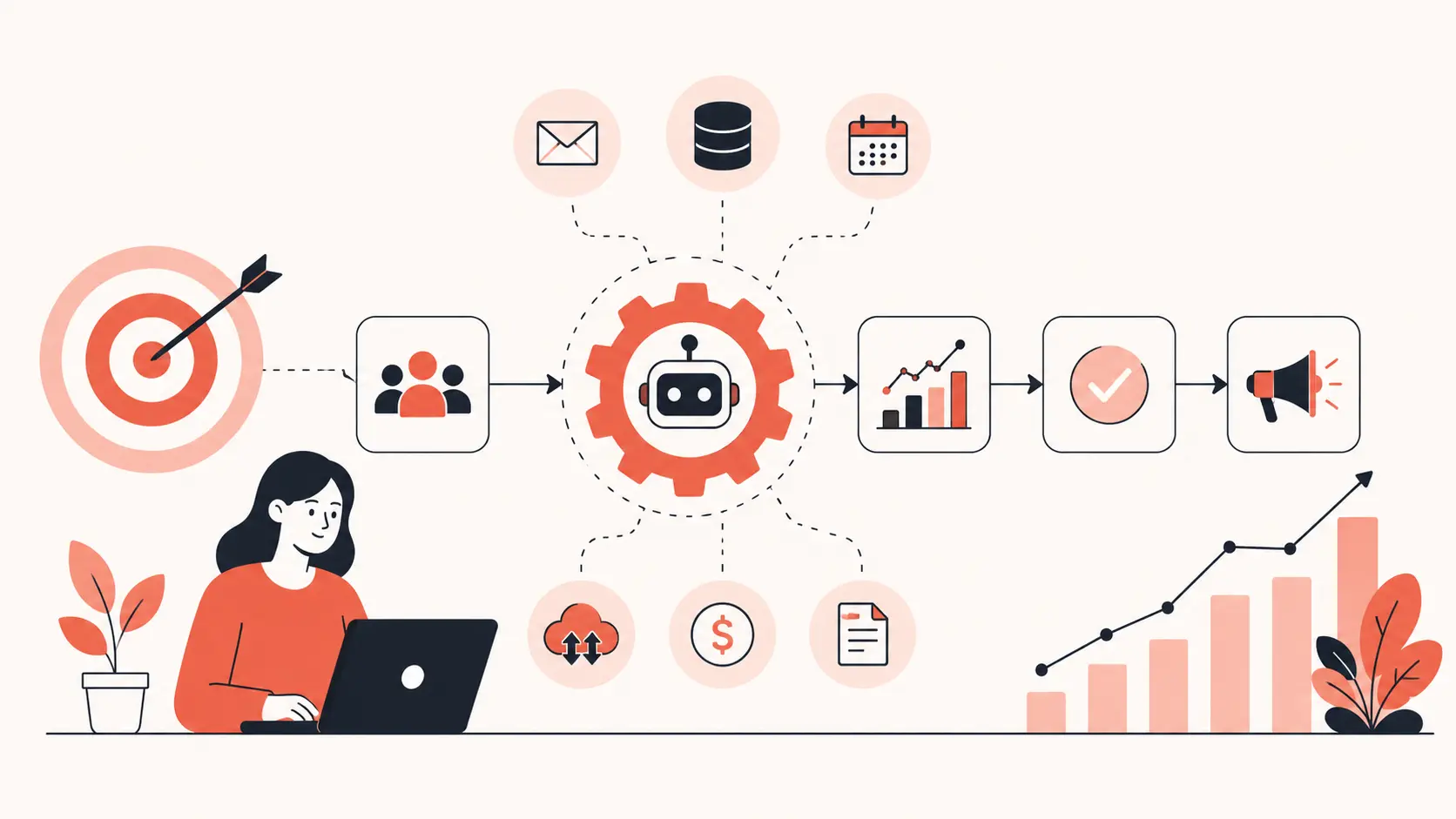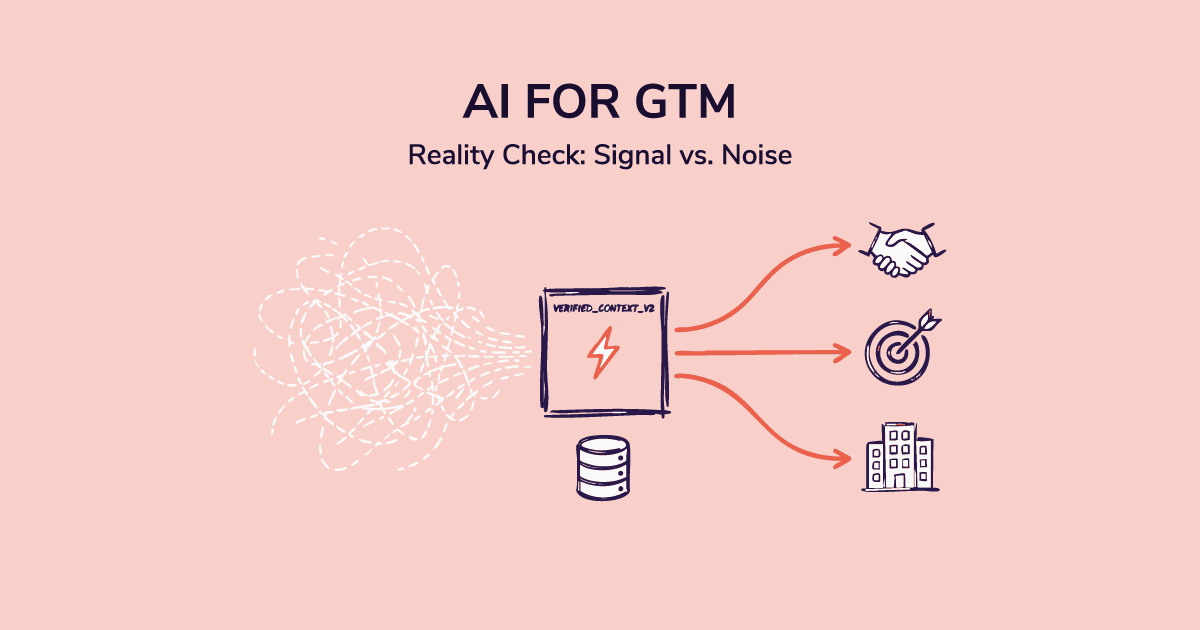
Nearly every GTM leader says their team uses AI. More than half cannot show any ROI from it.
That gap is not about access to tools. The problem is that most teams apply AI to individual tasks while the underlying GTM motion stays exactly the same.
This article covers where AI actually moves the needle in a go-to-market context, how to build a real AI-powered workflow, and which platforms are worth your time.
What Does "AI for GTM" Actually Mean?
A lot of what gets sold as "AI for GTM" is not really that.
A dashboard with an "AI insights" tab is not GTM AI. A chatbot that queries your CRM but cannot explain why deals are stalling is not GTM AI. Lead scoring with no next action attached is not GTM AI.
Here is a working definition: GTM AI is artificial intelligence that connects your revenue data across functions, surfaces buying signals, and helps your sales, marketing, and RevOps teams act faster than they could manually.
The real distinction is between task automation and system-level intelligence.
Task automation means using AI to do individual jobs faster: writing an email, summarizing a call, enriching a contact. Useful, but limited. System-level intelligence means AI that treats your full go-to-market strategy as one connected system, finds what breaks between functions, and helps you act before a gap becomes a missed quarter.
Most teams sit at task automation today. That is a fine starting point. Understanding the difference tells you what to build toward.
(Worth saying upfront: most tools claiming to offer system-level GTM AI are still doing task automation with a better marketing page. Test claims before you commit.)
Where AI Makes a Real Difference in Your GTM Motion
1) ICP Definition and Market Research
ICP documents get written once, go into a shared folder, and nobody reads them again after the launch quarter.
AI changes the inputs. Feed your CRM data, your closed-won and closed-lost patterns, and your most common objections into a model. Ask it what your best customers actually have in common.
The output is more honest than what comes out of a strategy session. The catch: if your CRM data is inconsistent, the analysis reflects that. Data quality has to come before AI analysis. Building a tight ideal customer profile before running this kind of analysis makes a real difference.
2) Account Prioritization and Buying Signal Detection
The question every SDR faces every morning: out of these 500 accounts, which ones do I actually contact today?
AI answers by combining multiple signals at once. Website visits, content consumption, job postings, funding events, leadership changes, and technology shifts. Layer those signals together and you find accounts in active research mode before they ever fill out a form.
The best setups route those signals automatically. A target account hits your pricing page three times in a week, the right SDR gets an alert, the account gets prioritized, and a research brief gets drafted. No manual decision required at any step.
One honest note: buying signals only work when the underlying data is fresh. Stale signal data creates false positives. Chasing false positives burns rep time.
3) Outreach Personalization at Scale
Personalization based on company size and industry is not personalization. It is segmentation with a first name field.
Real personalization connects something specific (a recent hire, a funding round, a technology change) to the exact problem your product solves. AI can surface those signals and structure the message. A human still needs to check whether the connection is genuine before anything goes out.
Teams winning here use AI for research and first drafts, then apply human judgment before sending. Full automation produces volume. Human-reviewed outreach produces replies.
4) Pipeline Health and Forecasting
Sales forecasting is historically an exercise in optimism. Reps report how they feel about a deal. Managers add a buffer. Everyone agrees the number looks fine.
AI changes the inputs by pulling from real behavioral signals: email reply rates, meeting frequency, stakeholder involvement, and time since the last meaningful exchange. These patterns surface stalled deals far earlier than anything a rep self-reports.
For RevOps teams, AI also removes a lot of manual reporting work. What used to require hours of Salesforce exports and slide building can now run automatically with consistent data. This is how pipeline generation becomes more predictable rather than just more active.
5) Sales Enablement and Content Creation
AI accelerates the production of battle cards, objection guides, discovery questions, and account research briefs. Work that took a PMM team days now takes hours.
The quality ceiling is real. AI content without a human edit tends to read as generic in ways experienced buyers notice immediately. Use AI as the first draft. Use a human as the final call.
Smarter teams also feed existing content into AI: call recordings, customer interviews, podcast transcripts. The AI extracts patterns, objections, and expert insights. You get more mileage from content you already have without starting from scratch.
Where General-Purpose AI Tools Fit In
ChatGPT and Claude are reasoning tools, not go to market tools. That distinction matters.
They do not connect to your CRM or track buying signals. What they do is help you work through complex, unstructured problems and produce structured output from messy inputs.
ChatGPT handles short-form iteration well. Subject lines, ad copy, outreach angles, and quick research all benefit from its speed. The ability to analyze uploaded files (CSVs and spreadsheets) is genuinely useful for processing CRM exports and campaign data. Read the full breakdown of using ChatGPT for sales.
Claude handles longer, more complex work. When you need to hold a large body of context (a competitive analysis, a positioning document, a full GTM playbook) without the model losing the thread, Claude is the stronger choice. Read more on Claude for prospecting for specific use cases.
Both tools produce generic output when you give them no context. Give them your actual customer data, your real objections, and your specific positioning and they produce something worth editing.
Neither tool replaces purpose-built GTM software. They cover the thinking and planning layer. The tools below handle execution.
How to Build an AI-Powered GTM Workflow
Most articles tell you which tools exist. This section shows how to connect them into a workflow that runs without constant manual intervention.
Here is a practical setup using SMARTe, Clay, and n8n.
Step 1: Build a verified contact list with SMARTe
Start with your ICP defined: industry, company size, geography, job title, and intent signals. Pull a list of matching contacts from SMARTe. Because SMARTe verifies data in real time, the emails and direct dials you export are current, not recycled from a months-old batch.
Export the list with verified contact data, intent signals, firmographic filters, and technographic data.
Step 2: Enrich and personalize with Clay
Bring the SMARTe list into Clay. Use Clay's AI research agents to pull additional context for each contact: recent LinkedIn activity, company news, open job postings, and technology stack. Clay then generates a personalized opening line for each prospect based on what the research finds.
You now have a list with verified contact data and a tailored hook for each person. No manual research. No switching between tabs.
Step 3: Automate the handoff with n8n
n8n connects everything in the middle. When a new enriched row appears in Clay, n8n triggers a sequence of actions automatically.
It creates or updates the contact record in your CRM. It adds the contact to the right outreach sequence in your email tool. It sends a Slack message to the assigned SDR with the personalized research brief and a direct link to the contact record.
The SDR starts the day with a queue of verified, researched, and sequence-enrolled contacts. Everything is ready. Nothing needs to be manually entered.
Step 4: Measure and tighten the ICP
After two weeks, pull sequence performance data. Look at which contact attributes (industry, seniority, company size, tech stack) correlate with positive replies.
Feed those learnings back into your SMARTe search filters. The ICP gets tighter. The workflow improves with each cycle.
This is what AI sales prospecting looks like in practice. Not one tool doing everything but a stack of specialized tools each doing their job, connected by an automation layer. You can explore the best MCP servers to extend what AI assistants can do inside this kind of workflow, and read more about building out your GTM tech stack for the full picture.
Purpose-Built GTM AI Tools Worth Knowing
Organized by function. Each entry covers what the tool does, key features, and pricing.
Data and Contact Intelligence
1. SMARTe
SMARTe is a B2B sales intelligence platform built for outbound-first revenue teams. It covers 283M+ verified contacts globally with 75%+ US mobile (direct dial) coverage and 50%+ global mobile coverage for international markets. Data goes through real-time verification rather than periodic batch updates, which matters when you are running sequences against it daily.
The platform includes Bombora intent signals, CRM enrichment at 90%+ match rates, technographic data across 64K+ tracked products, and a Chrome extension for prospecting from LinkedIn. For teams selling into LATAM and APAC where larger legacy vendors run thin, SMARTe covers those regions with genuine depth.
Key Features
- 283M+ verified global contacts
- 75%+ US direct dial coverage
- 50%+ global mobile coverage
- Real-time data verification (not batch refreshes)
- Bombora intent data built in
- CRM enrichment at 90%+ match rates
- Technographic data across 64K+ products
- Chrome extension for LinkedIn prospecting
- Native Salesforce and Outreach integrations
- MCP integration for AI assistants like ChatGPT and Claude
Pricing
Enterprise: starts at $15,000, volume pricing at $0.30 per credit
2. Apollo.io
Apollo combines a B2B contact database with built-in email sequencing in one platform. A popular choice for teams that want prospecting and outreach in a single tool. The database is broad. Data quality in non-US markets can vary depending on your target region.
Key Features
- Contact and company database with email and phone data
- Built-in email sequencing with A/B testing
- Chrome extension for SDRs
- Salesforce and HubSpot integration
- AI-powered lead scoring on paid plans
- Call recording and tracking
Pricing
- Free plan available
- Paid plans from approximately $49 per month
- Contact Apollo for enterprise pricing
Enrichment and Workflow Orchestration
3. Clay
Clay is not a database. It is a data orchestration tool that pulls from multiple providers through waterfall enrichment, querying sources in sequence until it finds what it needs. Its AI research agents gather company info, surface contact details, and draft personalized outreach based on what they find. It connects directly with SMARTe exports as part of the workflow described in Section 4.
Key Features
- Waterfall enrichment across 75+ data providers
- AI research agents for automated prospect research
- Spreadsheet-style interface
- Personalized outreach line generation from research
- CRM and sequencing tool integrations
- Workflow building without code
Pricing
- Free: 100 credits per month
- Starter: $149 per month
- Explorer: $349 per month
- Pro: $800 per month
- Enterprise: contact Clay for pricing
Revenue and Pipeline Intelligence
4. Gong
Gong records and analyzes every sales interaction across calls, emails, and video meetings. It surfaces which talk tracks correlate with closed business, which deals show risk signals based on engagement patterns, and where reps need coaching. Its forecast layer uses actual conversation signals rather than manually entered deal stages, making it more reliable than anything built on rep-reported data.
Key Features
- Automatic call recording and transcription
- Deal risk identification from conversation patterns
- Competitor mention tracking
- Coaching insights and rep benchmarking
- Pipeline analytics and forecast tracking
- CRM activity sync
Pricing
- Contact Gong for custom pricing
5. Salesloft (with Clari)
Salesloft handles outbound cadences and sales engagement. After merging with Clari, it now includes revenue forecasting and pipeline management on the same platform. Teams looking to consolidate engagement and forecasting will find the combined capability useful, though the integration is still maturing.
Key Features
- Multi-step outreach cadences across email, phone, and LinkedIn
- Deal intelligence and risk identification
- Revenue forecasting
- Conversation intelligence integration
- Salesforce integration with activity sync
- Rep performance analytics
Pricing
- Contact Salesloft for custom pricing
Intent Data and Account-Based GTM
6. 6sense
6sense identifies anonymous website visitors, predicts which accounts are in an active buying cycle, and helps orchestrate campaigns toward those accounts. Its predictive scoring is strong. Running it well requires technical and operational investment.
Key Features
- Anonymous buyer identification and account matching
- Predictive account scoring by buying stage
- Intent data across topic-level research activity
- Account-based advertising
- Marketing automation integration
- Segment building and campaign orchestration
Pricing
- Contact 6sense for custom pricing
7. Demandbase
Demandbase runs the only demand-side platform built specifically for B2B advertising. You can run account-targeted display, video, and LinkedIn campaigns directly inside the platform, tied to your intent data and ABM motion. Strong for enterprise teams with dedicated marketing ops support.
Key Features
- Account intelligence and intent data
- Proprietary B2B DSP for account-targeted advertising
- Website personalization by visiting company
- ABM program measurement
- CRM and marketing automation integration
- AI-powered buying group mapping
Pricing
- Contact Demandbase for custom pricing
Outreach and Sales Engagement
8. Outreach
Outreach automates multi-channel sales sequences across email, phone, and LinkedIn. AI features suggest subject lines and message content based on performance data. Built for enterprise sales development teams that run structured, high-volume outreach at scale.
Key Features
- Multi-channel sequence automation
- AI email optimization and subject line suggestions
- Meeting scheduler and calendar integration
- Call recording and tracking
- Deep Salesforce integration
- A/B testing for sequences and messaging
Pricing
- Contact Outreach for custom pricing
9. HubSpot
HubSpot covers CRM, marketing automation, email sequencing, and AI content generation in one platform. For teams that want consolidated tooling rather than a collection of point solutions, HubSpot is often the most practical starting point. Its AI features do not require deep technical configuration to get value from.
Key Features
- Free CRM with contact and deal management
- AI content generation for emails and campaigns
- Predictive lead scoring
- Marketing automation workflows
- Email sequencing for sales teams
- Chatbot with AI responses
Pricing
- Free CRM available
- Starter: from $20 per month
- Professional: from $890 per month
- Enterprise: from $3,600 per month
Sales Training and Competitive Intelligence
10. Hyperbound
Hyperbound is an AI sales coach that lets SDRs practice cold calls against a simulated buyer without burning through real prospects. The AI delivers realistic objections, responds in conversation, and gives post-call feedback. A genuinely better onboarding tool than scripted role-plays with a manager who has a full calendar.
Key Features
- AI buyer simulation for live cold call practice
- Realistic objection handling and conversation flow
- Post-call feedback and coaching
- Customizable buyer personas
- Performance tracking across the team
Pricing
- Contact Hyperbound for pricing
11. Crayon
Crayon tracks competitor activity in real time: website changes, pricing updates, product announcements, and review site movements. It surfaces that intelligence into Slack and your CRM so reps can get current answers rather than relying on a battlecard from eight months ago.
Key Features
- Real-time competitor tracking across web and review sites
- Slack and CRM integration for competitive alerts
- Searchable competitive intelligence database
- Automated competitive digest emails
- Win/loss analysis support
Pricing
- Contact Crayon for pricing
The Data Problem AI Cannot Fix on Its Own
Every capability in this article breaks down when the contact data underneath it is wrong.
Think through what happens in practice. Your AI personalization generates a message referencing a job title that changed six months ago. Your buying signal detection surfaces a great account, and your SDR dials a number that went cold last quarter. Your CRM enrichment fills in company information for a subsidiary that no longer operates.
AI amplifies what is in your data. Good data makes your GTM motion faster. Bad data makes it faster at producing the wrong results.
B2B contact data decays at a meaningful rate every year. People change jobs, get promoted, and leave companies. For outbound teams running high-volume sequences, stale data shows up as bounce rates, declined calls, and wasted rep hours. Read more about B2B data decay and how it affects outbound performance.
There is also a geographic coverage problem most vendors do not advertise honestly. A platform that looks strong in North America may have sparse, unverified coverage in LATAM, APAC, or Southern Europe. If your ICP crosses regions, verify actual coverage before committing. Understanding what separates good B2B data from the rest saves a lot of wasted spend.
SMARTe built its platform around this reality. 283M+ verified contacts, 75%+ US mobile coverage, 50%+ global direct dial coverage, and real-time verification at the point of use rather than periodic batch updates.
If the AI motion you are building needs clean, current contact data to work (and it does), start with the foundation.
Conclusion
AI does not fix a broken GTM motion. It accelerates a disciplined one.
The teams winning with AI right now are the ones that were already clear about their ICP, honest about their data quality, and consistent about feedback loops between marketing and sales. AI gives those teams an edge. For everyone else, it adds expense to the same problems they already had.
Start with your most painful GTM bottleneck. Research time before every call. Unreliable pipeline visibility. High outreach volume but low connect rates. Find the specific problem. Pick the tool built for it. Test it against a real metric over 60 to 90 days.
That is the process that produces results. And it is the one most teams skip.
.png)