Firmographic data is how you describe a company on paper: its industry, headcount, revenue range, and funding stage. Think of it as the B2B answer to "who exactly am I calling" before you ever dial.
Most sales teams have firmographics baked into their ICP. They just don't always call it that. And that's fine until the data behind those filters is eight months stale and you're dialing dead numbers wondering if your CRM was maintained by a time traveler.
The part most vendors skip: firmographics are a starting layer, not a complete strategy. This piece covers what they actually include, why freshness matters more than most admit, and why pairing them with intent and technographic signals turns a list into a pipeline.
What is Firmographic Data?
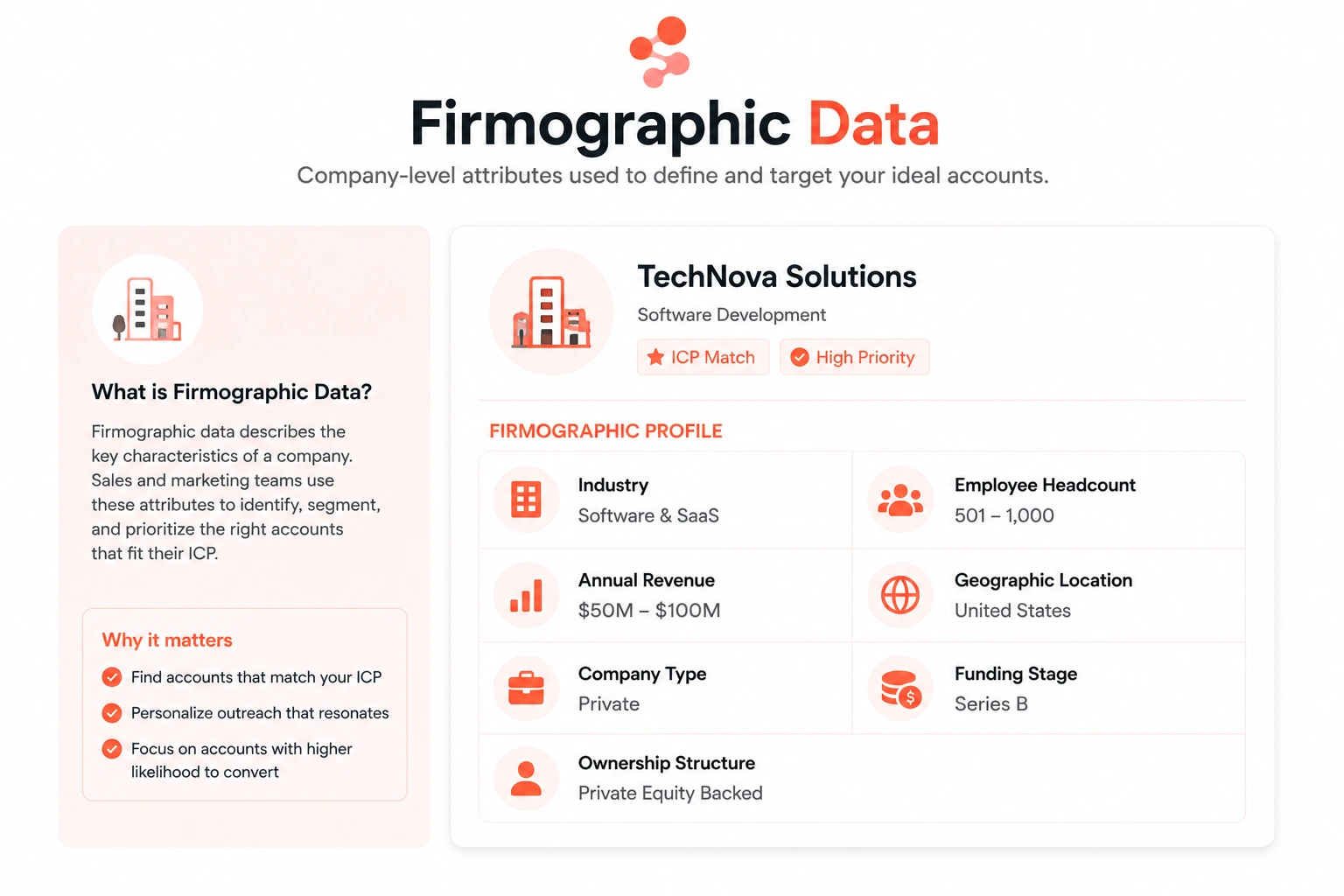
Firmographic data is the set of company-level attributes that tell you what kind of business you're looking at. Industry, employee count, annual revenue, location, funding stage, ownership structure. The basics. The stuff that separates "a company" from "a company we should actually be talking to."
Every B2B ICP ever written runs on firmographic criteria. Most teams just don't label it that way. When your targeting doc says "Series B SaaS companies, 100 to 500 employees, North America, revenue between $10M and $50M" — that's a firmographic profile. You built one. You're already using one.
The problem isn't awareness. It's rigor. Because the moment you treat firmographic data as a one-time filter rather than something that needs to stay current, your whole ICP quietly drifts out of sync with reality.
The Seven Core Firmographic Attributes
Seven data points drive most B2B targeting decisions:
- Industry (SIC or NAICS codes, though many modern databases run their own proprietary taxonomy)
- Employee headcount (this shifts more often than most teams account for, especially at growth-stage companies)
- Annual revenue (usually modeled from funding data, public filings, or third-party estimates)
- Geographic location (country, region, HQ city, or HQ vs. subsidiary designation)
- Company type (public, private, nonprofit, government, or PE-backed)
- Funding stage and growth trajectory (seed, Series A, Series B, bootstrapped, post-IPO)
- Ownership structure (independent, acquired, or subsidiary of a larger enterprise)
Revenue and company type matter most to enterprise AEs. Headcount and funding stage matter most to SDRs building weekly call lists. RevOps teams can’t afford to care about just one: firmographic accuracy is what the whole CRM hygiene model runs on, and stale data at that layer creates problems that compound downstream.
Firmographics vs. Demographics vs. Psychographics
Simple version: demographics describe the person, firmographics describe the company. A VP of Sales at a 300-person SaaS company is a demographic target. The 300-person SaaS company itself is a firmographic target.
Psychographics in B2B targeting (which get far less attention than they should) go one level deeper: motivations, attitudes, how decisions actually get made inside the org.
Honestly, I think the mistake most teams make is treating firmographics as sufficient for targeting when they’re actually just a precondition. You’ve identified the right type of company. You haven’t found the right moment or the right person inside it. That takes more than a company-size filter.
The Data Decay Problem Nobody Talks About
This is the part I wish more data vendors were honest about. Most firmographic databases aren’t wrong.
They were right. Six months ago. Maybe twelve.
B2B data goes stale faster than most teams expect. Industry estimates put the decay rate at 20 to 30% annually, and that number climbs in fast-moving segments like SaaS and tech, where headcount, funding stage, and core business model can all shift in a single quarter. Someone buys them. They cross employee count thresholds that push them out of your ICP bracket. They change their primary industry classification. A company that fit your filter perfectly 12 months ago might not fit it today.
According to Salesforce’s State of Sales research, reps spend less than 30% of their time actually selling. A significant chunk of everything else is administrative work, including fixing contact and account records that were accurate when someone first logged them and drifted since. Firmographic inaccuracy drives a meaningful share of that.
How Batch Databases Compound the Problem
Most firmographic data vendors run batch update cycles: quarterly, semi-annually, or annually. That means the employee count you pulled on Tuesday could reflect that company’s headcount from eight or nine months ago.
For fast-moving segments (Series A and B SaaS, companies mid-acquisition, teams in a headcount scaling phase), that lag completely undercuts your ICP filter. You end up running sequences at companies that no longer look like your best-fit buyers. The filter was fine. The snapshot was old.
Real-Time Verification vs. Static Snapshots
There’s a meaningful difference between a database that refreshes on a batch schedule and one that verifies data at the point of use. Real-time verification means that when you search for “SaaS companies with 200 to 300 employees in Austin, Texas,” the system checks current signals before returning results. Not a cached snapshot. What’s true right now.
(This distinction rarely comes up in vendor demos. You have to ask for it directly.)
For any outbound motion with a tight ICP, starting from real-time verified firmographic data changes your list quality in ways that compound across every step of your sequence.
How B2B Teams Use Firmographic Segmentation
Most teams do firmographic segmentation without naming it. You split your accounts by industry, size, and revenue range. You build different sequences for each group. That’s it. The failure isn’t in the concept. It’s in applying the right criteria too broadly.
“Mid-market SaaS companies with 200 to 500 employees” is a firmographic segment. But without geographic precision, funding stage context, or growth signals on top of it, that segment could hold 4,000 accounts with completely different needs, budgets, and buying timelines.
In my experience, teams that struggle with firmographic segmentation aren’t getting the attributes wrong. They’re not going specific enough with the ones they’ve picked.
Building Your ICP with Firmographic Filters
Building your ideal customer profile starts with firmographics. What does the company look like? Employee count, industry, revenue range, geography, ownership. That’s the filter for who belongs in the conversation at all.
Most teams run this exercise once (usually during initial go-to-market planning) and don’t revisit it until pipeline starts to slip. But if you locked in your ICP 18 months ago on data that was already partially stale, the segment you’re targeting today doesn’t actually represent your best-fit customers. It represents your best guess from a while back.
Treat ICP refinement as a quarterly exercise. Your most recent closed-won accounts are the most accurate firmographic input you have.
Account-Based Marketing and Outbound List Building
Account-based marketing and outbound prospecting use firmographics differently.
In ABM, firmographic filters determine which accounts land in your tier-one, tier-two, and tier-three buckets. A tier-one account might be a publicly traded company with 2,000-plus employees in a specific vertical with recent funding activity. The tier classification then drives how much resource you put in: ads spend, direct mail, AE involvement, executive outreach. Every one of those selection inputs is firmographic.
In outbound list building, the filtering is more granular and needs refreshing more often. An SDR building a weekly call list isn’t just running an industry and size filter. They’re looking at employee growth rate, funding recency, and territory geography. All firmographic inputs. All pointing toward accounts where something relevant is probably happening right now.
Firmographic Fit Scores in RevOps Workflows
Lead scoring models in RevOps-managed CRMs almost always include a firmographic fit component. A contact at a company that matches your firmographic ICP starts with a higher base score before any behavioral data layers on top.
Without firmographic fit scoring in the model, reps treat a perfect-fit account and a borderline account as equally worth calling. They default to gut feel. That’s not a rep problem. It’s a data infrastructure problem, and it shows up in connect rates and close rates before it shows up anywhere else.
The Signal Stack: Firmographics + Intent + Technographics
Firmographics get you to the right account. They don’t get you to the right moment.
That’s the distinction most articles on this topic miss. I think it’s the most important thing to understand about firmographic data in 2026: it’s a required layer, but it’s not the whole model. Firmographics narrow the field. They don’t tell you who’s actively in the market.

Why Firmographics Alone Isn’t Enough
Run this scenario. You filter for “cybersecurity SaaS companies, 100 to 300 employees, Series B, based in the US.” You get 600 accounts that all match your ICP.
Which 60 of those 600 are actively evaluating vendors right now? Which ones just hired a new CISO who’s rebuilding the security stack? Which ones are running on a competitor that just raised prices? Firmographic data can’t answer any of that.
That’s where intent data and buying signals come in. Not to replace firmographic targeting. To make it usable.
Layering Intent Data on Firmographic Segments
Intent signals tell you which companies in your firmographic segment are actively researching your product category right now. If a company fits your firmographic ICP and is spiking on Bombora intent topics tied to your solution, the call to that account isn’t cold. It’s warm, with a specific reason.
Layering intent on top of a firmographic segment typically cuts a 600-account list to 60 to 80 accounts. Those 60 to 80 have a materially better response rate than the full 600 would. That’s not a small improvement. It changes the productivity math for your entire outbound function.
The best intent data providers let you layer intent filters directly on top of a firmographic search in one workflow, not as a two-step export-and-match process across separate tools. That’s the setup worth pushing for.
Adding Technographic Filters
Technographic data tells you what a company runs in its tech stack. Combine it with firmographic profile data and you get your most precise ICP slice.
Concrete example: a mid-market manufacturing company with 300 employees that uses Salesforce but has no outbound sequencing tool is a specific firmographic plus technographic target for a sales engagement platform. You know their size, their industry, their tech spend appetite, and the gap in their tooling. That conversation opens very differently than a cold touch built on industry and headcount alone.
Technographic segmentation built into your ICP criteria from the start changes which accounts make it into your sequences and what you actually say to them. For a side-by-side look at how these two data layers compare, the piece on the difference between firmographic and technographic data covers it well.
Firmographic Data and AI Agents in 2026
In 2024, most sales teams used firmographic data reactively. You built a list, ran a search, applied filters by hand. In 2026, AI sales agents use firmographic criteria to do that work continuously, without anyone queuing the search.
How AI Agents Apply Firmographic Filters
AI-powered sales prospecting built on live firmographic data means your pipeline gets fed by accounts that match your ICP today. Not accounts that matched it when someone last ran a list three weeks ago.
AI agents monitor trigger events and match them against your firmographic ICP in real time. A company crosses the headcount threshold that moves them into your target employee count range. A funding announcement puts a startup that was previously too small into your revenue bracket. A leadership change brings in a new decision-maker whose background fits your persona profile.
When those buying triggers surface, an AI agent flags the account. No manual search queued. No weekly list-building session. The firmographic filter runs continuously in the background as a monitoring criteria, not a one-time export.
Buying Group Discovery Using Firmographic Criteria
Mapping a B2B buying group is one of the most underestimated uses of firmographic data.
Once you know an account fits your firmographic profile, the question shifts: who inside it actually matters? Company size, industry, and org structure tell you a lot about what the buying committee is likely to look like. A 500-person healthcare SaaS company has a different committee structure than a 50-person logistics startup. Firmographic data tells you which personas to map before you contact anyone.
According to LinkedIn’s B2B Institute research, the average B2B purchase now involves six to ten stakeholders. That’s not a sales headcount problem. It’s a targeting problem. Firmographic-driven persona mapping is how you approach it with any precision.
SMARTe’s AI Agents handle this automatically: they identify and map buying group contacts against verified contact data, so SDRs spend their time on conversations, not on building org charts across five browser tabs.
What to Look for in a Firmographic Data Provider
Not all firmographic databases are equal. The gap between the best and the rest shows up fast once your team runs sequences at any real volume.
Five questions worth asking any vendor before committing:

1) How often is your data updated, and how does verification work?
Batch-refresh quarterly or annually means the data you pull is already aging when you use it. Real-time verification at the point of query is what you want. Vendors who can’t answer this clearly are telling you something important.
2) What is your geographic coverage outside North America?
Most major databases have solid US firmographic depth. LATAM and APAC are a different story. If your GTM motion touches any international markets, push on match rates by region, not just total database size. SMARTe covers 200-plus countries with 283M-plus verified contacts, with actual depth in LATAM and APAC rather than US-first coverage stretched thin.
3) What is your CRM enrichment match rate?
When you push firmographic data into your CRM to update existing records, what percentage actually get a match? Below 80% means your hygiene project leaves meaningful gaps. SMARTe’s match rate runs at 90-plus percent for B2B data enrichment at scale.
4) How do you handle ownership and subsidiary structures?
A company that looks independent on the surface might be a subsidiary of a Fortune 500. That changes the buyer, the budget, and the entire decision-making process.
5) Can you layer firmographic, intent, and technographic filters in a single search?
If the answer is no, you’re running three separate workflows to do what should take one. That friction costs time and introduces errors.
What makes good B2B data isn’t just the number of records. It’s how fresh those records are, how they’re verified, and whether you can combine data types without stitching together separate tools. Sales intelligence platforms that bring firmographic, technographic, and intent into the same search are where serious GTM teams have moved.
CRM data enrichment built on real-time firmographic verification means your CRM reflects your accounts as they exist today, not six months into the past.
Where This Leaves You
Firmographics aren’t optional. Skip them and you’re picking accounts on gut feel.
But the teams actually winning pipeline right now aren’t the ones with the tightest firmographic filter in isolation. They treat firmographics as layer one of a multi-signal model. Firmographics define the pool. Intent signals identify the timing. Technographics sharpen the message. Real-time verified data keeps all of it from being eight months out of date the moment you use it.
If your outbound results are flat and the messaging feels right, check the foundation before rewriting any copy. Stale firmographic data quietly kills sequences that would otherwise work.
Try SMARTe free (no credit card required) and see what your firmographic segments actually look like when there’s real-time verified data behind them.