It’s Monday morning. You have 90 accounts to work, a full day of dials, three follow-ups overdue, and a manager asking why pipeline is thin. You open ChatGPT for sales. You type “write me a cold email for a VP of Sales.” You get something back. You send it. Nothing happens.
That's not a ChatGPT problem. That's a usage problem.
Most reps treat ChatGPT like a slightly smarter copy-paste tool. They use it for one thing — usually email — and ignore the other fifteen ways it can save them hours every week. Research, ICP definition, account briefs, call prep, objection role-play, post-call CRM notes, outbound sequences — ChatGPT handles all of it. But only if you know how to prompt it correctly.
This isn't a list of prompts to copy. This is a guide to actually using ChatGPT across your entire sales workflow — so you can stop spending your best hours on admin and start spending them on conversations that close.
Let's get into it.
Why Most Reps Use ChatGPT for Sales Wrong
Here is the thing. ChatGPT is not a prospecting tool. It's not a contact database. It can't tell you who's in-market right now, what tech stack your prospect is running, or whether the email address you have is still valid.
It is a language engine. A very good one. And when you understand that distinction — language vs. data — you stop being frustrated by what it can't do and start getting serious value from what it can.
The copy-paste trap
The most common mistake I see is reps using ChatGPT reactively. They have a blank email to write, so they open it. They have a script to build, so they ask for one. They use it as a faster version of staring at a blank screen.
That's fine. It works, technically. But it's leaving most of the value on the table.
The reps who actually move pipeline with ChatGPT use it proactively — as a research partner, a prep assistant, a sequence builder, a qualification coach. It's built into their workflow, not bolted on at the end.
According to HubSpot's 2024 State of AI in Sales report, 43% of sales professionals now use AI at work. Of those, 47% use generative AI tools like ChatGPT specifically for content creation. That's a lot of people using a powerful engine in first gear.
What ChatGPT is actually built to do
It's built to take inputs — context, data, instructions — and produce structured language output. The quality of the output is almost entirely determined by the quality of the input. Garbage in, garbage out. That's not a cliché, it's the actual mechanic.
Which means the more context you give it — about your product, your prospect, their role, their company, their pain points, their likely objections — the more useful the output. A vague prompt returns a vague email. A specific prompt returns something you might actually send.
This is true for how AI is already reshaping B2B sales at a structural level. The teams building real pipelines with it are not using it more — they're using it smarter.

SMARTe GTM Intelligence
Start Smarter Prospecting Today
The data problem nobody talks about
ChatGPT cannot build you a contact list. It cannot verify a phone number. It doesn't know that your prospect changed jobs three months ago. Ask it for a list of VPs of Sales at Series B SaaS companies in Austin and it will either refuse or give you names that don't exist.
This is the ceiling every AI-powered outbound motion hits eventually. The language side works. The data side breaks it. We'll come back to this — it's the most important thing in this article.
What to do: Before you build any ChatGPT workflow, audit your contact data. If your bounce rate is above 5%, even the best prompts won't save your sequences. The language engine only works when the data underneath it is real.
How to Use ChatGPT for Sales Prospecting and Account Research
This is where ChatGPT earns its place — before you write a single email or make a single call. Good outbound prospecting starts with understanding your accounts deeply. ChatGPT compresses that research from hours to minutes.
Gartner projects that 95% of seller research workflows will begin with AI by 2027, up from less than 20% in 2024. That shift is already happening. The question is whether you're ahead of it or behind it.
Define your ICP before you prompt anything
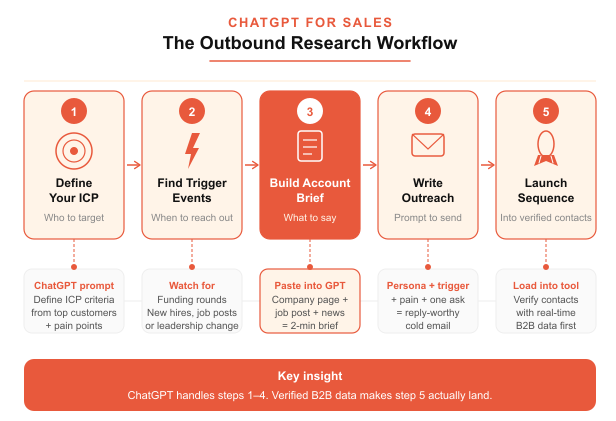
This is step one. Always. If you don't know exactly who you're targeting, ChatGPT will just write to everyone — which means writing to no one.
Building a sharp ideal customer profile is the foundation of every good outbound motion. ChatGPT can help you define it, stress-test it, and translate it into the specific filters you'd apply inside a contact database.
Here's a prompt to start with:
You are a B2B sales strategist. My product is [describe it in one sentence]. My three best customers are [describe them briefly]. Build me a precise ICP for this product. Include: - Industry and sub-industry - Company size (headcount and revenue range) - Tech stack signals that indicate fit - The specific role and seniority I should target - Their top 3 daily frustrations that my product solves - The buying triggers I should watch for
The output isn't just useful for ChatGPT. It's useful for your whole sales prospecting strategy — territory planning, segmentation, ABM campaigns. Build it once. Use it everywhere.
Account research in minutes instead of hours
Here's the workflow I'd recommend before any cold touch. Copy the company's LinkedIn About section, a recent press release or funding announcement, and any relevant job postings. Paste them into ChatGPT and run this:
Based on this information about [Company], give me: 1. Their top 3 likely business priorities right now 2. The specific challenges their [target role] is probably dealing with 3. Three personalization angles I can use in cold outreach 4. Two buying triggers visible in this data 5. The objections they'll likely raise and how to address them
You get a full account brief in under two minutes. Your rep walks into any call looking like they've done two hours of homework. (And honestly? Most competitors haven't done any.)
This pairs directly with AI-powered sales prospecting tools that pull live data to feed those prompts. Context in, insight out.
Market mapping and finding new verticals
ChatGPT is also solid at helping you figure out where else your ICP lives. If you've had success in one vertical, use it to map adjacent ones:
I've closed deals with [describe 3 best customers: industry, size, role]. What adjacent verticals or company types would likely face the same problems? For each new vertical, give me: the specific pain point overlap, the role to target, and one personalization angle for cold outreach.
That's market expansion on demand. Outbound lead generation used to require weeks of analysis. With ChatGPT it takes an afternoon.
What to do: Set up ChatGPT Custom Instructions with your ICP, your product's one-sentence value prop, and your top three customer pain points. Every prompt you run after that will be calibrated to your business — not a generic B2B company.
Also Read: How to use Claude for prospecting
ChatGPT Cold Email and LinkedIn Outreach That Actually Gets Replies
This is the section everyone comes for. And it's legitimately where ChatGPT saves the most time per week — if you know how to use it. Salespeople spend 21% of their working week writing emails. ChatGPT doesn't eliminate that entirely, but it compresses it dramatically.
The anatomy of a prompt that produces real output
The difference between a 2% reply rate and a 15% reply rate isn't the quality of your writing. It's the relevance of your message to what the prospect actually cares about right now.
Generic prompt → generic output → generic email → zero replies.
Every prompt you write for cold outreach needs five things:
- Who you are: Your role, your company, what you sell in one sentence
- Who they are: The prospect's exact role, company type, size, industry
- The trigger: What just happened — funding, hiring, leadership change, expansion
- The pain: The specific problem this person has right now
- The ask: One specific outcome — a reply, a question answered, a 15-minute call
Without all five, ChatGPT defaults to generic. With all five, you get something that sounds like a real person wrote it — because you gave it the materials to think like one.
Cold email examples by persona
Here's a prompt I'd use for an SDR targeting a VP of Sales who just posted eight new SDR roles:
Write a cold email from an SDR at a B2B data company to a VP of Sales at a 200-person SaaS company who just posted 8 new SDR roles. Our product gives SDRs verified mobile numbers so they stop wasting dials on gatekeepers and dead numbers. Keep it under 90 words. One pain point. No fluff. End with a single specific question — not a generic 'do you have 15 minutes?'
And for RevOps, targeting a Director dealing with CRM data decay:
Write a cold email from a sales intelligence company to a Director of RevOps at a B2B SaaS company with 300+ employees. Their pain: they spent Q1 cleaning CRM data manually and still have a 30% bounce rate. Our product automates enrichment with 90%+ match rates. Under 80 words. Lead with their pain. One CTA: a specific question about their current process.
The difference between these prompts and the vague ones isn't complexity — it's specificity. You can learn more about writing cold email that converts and get B2B cold email templates to use as starting points before you feed them into ChatGPT.
LinkedIn messages and follow-up sequences
LinkedIn outreach is a different beast. Shorter. More conversational. Less selling, more connecting.
For a connection request note:
Write a LinkedIn connection request note (under 280 characters) from an SDR to a VP of Sales who just posted about missing Q1 pipeline targets. No pitch. Find common ground. Sound human, not automated.
For the follow-up sequence after someone accepts your connection:
Write a 3-message LinkedIn DM sequence for a VP of Sales who just accepted my connection request. Space them 4 days apart. Message 1: value, no pitch. Message 2: a relevant insight or resource. Message 3: a soft ask for a call. Each message under 60 words.
If you want to go deeper on LinkedIn prospecting tactics or need LinkedIn messaging templates to start from, those cover the strategic layer ChatGPT can then execute on.
And don't skip the follow-up. Most replies come after the second or third touch. There's a reason follow-up email strategy is its own discipline — ChatGPT can build out your full follow-up logic in one sitting if you set the cadence correctly.
What to do: Build a shared 'context doc' for your team — a one-page brief with your ICP, value prop, top three pain points, and three buyer personas. Paste it into every ChatGPT session before prompting. Your whole team's output gets better immediately.
How to Use ChatGPT to Prepare for Sales Calls and Handle Objections
Here's an underrated use case. Most reps use ChatGPT for writing. Fewer use it to prepare for conversations. That's a gap — because call prep is where the biggest rep-to-rep performance differences show up.
Pre-call research brief in 10 minutes
Before any discovery call or demo, run this prompt. Paste in the company's About page, a recent news item, and the prospect's LinkedIn headline:
I'm calling [Name], [Title] at [Company] in 20 minutes. Here's what I know: [paste context]. Give me: 1. Their top 3 likely priorities this quarter 2. Five discovery questions to open the call — ordered by importance 3. Two objections they'll probably raise and a one-sentence response to each 4. One personalisation hook to open with Format it as a quick-reference brief I can read in 3 minutes.
Ten minutes of prep. Your rep walks in sharp, specific, and ready. That's not a marginal improvement — it's the difference between a call that books a next step and one that ends with 'send me some info.'
Objection handling role-play
This one is genuinely underused. ChatGPT is an excellent sparring partner for sales objections — especially for reps who don't have a seasoned manager running mock calls with them every week.
Play the role of a skeptical VP of Sales at a 150-person SaaS company. You're already using ZoomInfo and you think switching data providers is too much hassle. Push back hard on: - Pricing and ROI - Integration complexity - Data quality claims Raise one objection at a time. Wait for my response before continuing. After 5 exchanges, give me feedback on where my responses were weak.
Run this before every big demo. Your reps stop being surprised by objections on live calls because they've already heard them — and answered them — six times in practice. This is what good sales productivity actually looks like: building the skill, not just the content.
Post-call: CRM notes, follow-ups, and next steps
After a call, most reps have a mix of messy notes and a fading memory. Paste your rough notes into ChatGPT and run:
Here are my notes from a 30-minute discovery call: [paste notes]. Give me: 1. A 3-sentence CRM summary (pain points, timeline, next step) 2. A follow-up email referencing the three things they specifically mentioned 3. BANT assessment: what we know, what we're missing, what to ask next time 4. Recommended next step and who owns it
That's 20 minutes of post-call admin compressed to 90 seconds. Across a team of ten SDRs running five calls a day, that's hours of selling time recovered every single week.
What to do: Make post-call ChatGPT prompts part of your team's standard process — not a personal hack. Put the prompt template in your sales playbook alongside your call guide. Consistency is what turns individual efficiency into team-wide pipeline improvement.
How to Build Outbound Sequences and Score Leads with ChatGPT
Individual prompts are useful. A system is what actually moves pipeline. Here's how to take everything above and turn it into a repeatable outbound motion — and where that motion hits its ceiling.
Building a full outbound cadence with ChatGPT
A five-touch outbound sequence — email, LinkedIn, email, call, email — used to take a good SDR half a day to build. With ChatGPT, it takes 25 minutes.
Here's how to prompt a complete sales cadence in one go:
Build a 5-touch outbound sequence for a VP of Sales at a 100-200 person SaaS company. Trigger: they just posted 6 new SDR roles. My product: [one sentence description]. Sequence structure: - Day 1: Cold email (under 80 words) - Day 3: LinkedIn connection request (under 250 chars) - Day 6: Follow-up email — different angle, no 'just checking in' - Day 10: LinkedIn DM (under 60 words) - Day 14: Break-up email with a soft ask Vary the angle every touch. No fluff. No generic CTAs.
You get a full multi-touch sequence in one output. Review it, add your specifics, load it into your sequencing tool. That's the workflow. It's not magic — it's just removing the time cost of building from a blank page.
Lead scoring and qualification with ChatGPT prompts
ChatGPT is also useful for lead scoring — especially for teams who rely on gut feel rather than a structured framework. Feed it your discovery call notes and have it assess against BANT or MEDDIC:
Score this lead against the BANT framework. Here are my discovery call notes: [paste notes]. For each criterion (Budget, Authority, Need, Timeline), rate it 1-5 and explain why based only on what I've shared. Flag what's missing. Tell me the one question I should ask next to advance this deal.
It's fast, structured, and forces your reps to review every deal against the same criteria. That consistency compounds over time — your pipeline becomes cleaner, your forecasts become more accurate, and you stop spending cycles on deals that were never real.
Where the pipeline motion breaks without real data
Here's the honest part. And it matters more than any prompt in this article.
All of this works when your sequences run on verified, current contact data. When they don't, you're generating polished outreach that lands in bounced inboxes, reaches people who left the company, or dials numbers that go straight to the wrong voicemail.
According to LinkedIn's 2025 data, sales professionals who use AI daily are twice as likely to hit quota — but that stat assumes the AI is working on accurate inputs. Bad data poisons the whole motion.
I've talked to sales managers who built exactly the right ChatGPT workflow — good ICP, sharp sequences, tight qualification scoring — and still couldn't move their numbers. The prompts were excellent. The contact data was 18 months stale. Every other email bounced.
This is where outbound lead generation with AI breaks down. The language layer fires perfectly. Nothing lands. Because the data underneath it was never right.
And it's also why pipeline generation with ChatGPT alone has a ceiling that most teams don't see coming until they've already hit it.
What to do: Before you scale any AI-powered sequence, verify your contact list against a real-time B2B database. Every bounce is a wasted rep-hour. Every stale record is a sequence that never had a chance.
Why ChatGPT Needs Real B2B Data to Actually Work — And How SMARTe Fixes That
Everything in this guide is useful. Research, cold email, call prep, cadence building, objection role-play — ChatGPT handles all of it well.
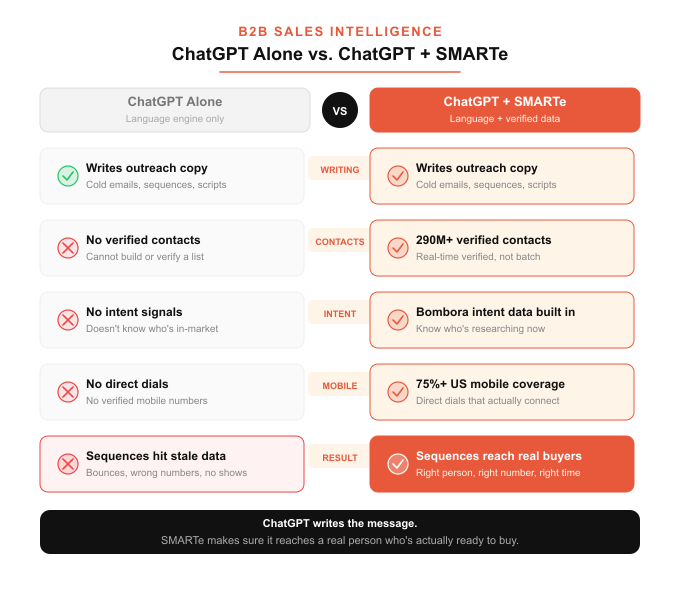
But there's a structural problem sitting underneath every AI-powered sales motion. ChatGPT is a language engine. It doesn't know who to send that language to. It doesn't know if the person is in-market right now. It can't verify the phone number is real or that the email address still works.
That's the gap. And it's where most teams are quietly losing pipeline they'll never see.
What SMARTe MCP actually does
SMARTe built a Model Context Protocol integration — SMARTe MCP — that gives AI tools including ChatGPT real-time access to verified B2B contact data. Not a static export. Not a CSV from three months ago. Live, verified data at the point of use.
That means when your rep builds a prompt, the AI isn't working from memory or scraped web data. It's pulling from AI-ready B2B data — 290M+ verified contacts, real-time job change tracking, and buying signals that tell you which accounts are actually in an active buying cycle right now.
The data layer includes:
- 290M+ verified B2B contacts globally, real-time verified — not batch processed
- 75%+ US mobile coverage — direct dials that actually connect, not switchboard numbers
- Bombora intent data built in — so you know which accounts are researching your category today
- 59K+ technographic signals — map exactly what your prospect is running before you call
- Automated job change tracking — so you're never selling to someone who left
This is what intent data looks like when it's built into a platform designed for the AI era — not bolted on as an afterthought.
Intent signals + verified contacts + AI = outreach that actually lands
Here's what the workflow looks like when SMARTe is in the stack:
- ChatGPT defines your ICP criteria and builds your sequence copy
- SMARTe pulls verified contacts matching those exact criteria from 290M+ profiles
- Intent data signals flag which of those accounts are actively researching right now
- Your sequence launches to real people, on real verified numbers, with relevant timing
- Your SDR's first call lands. The number connects. The conversation happens.
That's a different result than what most teams are getting. Not because the prompts are better — the prompts are exactly the same. Because the data underneath them is clean, verified, and real-time.
What this looks like for SDRs, RevOps, and Sales leaders
For SDRs: stop burning dials on dead numbers. SMARTe's 75%+ US mobile coverage means the majority of your contacts include a verified direct dial — not a switchboard that routes to a gatekeeper. You get past the gatekeeper because you have the number that bypasses them entirely.
For RevOps: SMARTe's enrichment delivers 90%+ CRM match rates and reduces manual data work by 60%+. You stop cleaning lists by hand. You stop chasing stale records. You start with data that's already verified, and your best AI sales tools actually have something solid to work with.
For Sales leaders: when your reps' ChatGPT sequences run on SMARTe data, you get predictable pipeline — not just better-written emails going nowhere. The inputs are clean. The outputs are meetings. The AI sales agents SMARTe has built natively handle account research, buying group mapping, and signal monitoring — so your reps spend their time on conversations, not prep work.
The Bottom Line
ChatGPT is genuinely useful for sales. Not as a shortcut — as a force multiplier. Research faster. Write better. Prep harder. Qualify more consistently. Build sequences your whole team can use. All of that is real and available right now.
But speed without accuracy is just noise at scale. The reps who will win with AI aren't the ones with the cleverest prompts. They're the ones who pointed those prompts at verified, real-time intelligence — and built a workflow where the language engine and the data engine work together.
ChatGPT handles the language. SMARTe handles the data. Together, your sequences reach real people who are actually in-market. That's what pipeline generation looks like in 2026.
.png)