TL;DR:
Agentic outbound is a B2B sales motion where AI agents run your full outbound sequence autonomously. The agent finds accounts, researches contacts, writes messages, sends outreach across channels, and books meetings without step-by-step human input. You set the rules. The agent executes inside them.
- Outbound volume from AI-assisted teams is 6.4x higher than human-only teams, but raw reply rates fell 38% — more activity, worse results for most
- Four things cause most failures: stale contact data, bad targeting the AI amplifies at scale, sender reputation collapse within 90 days, and intent data with a 31–47% false-positive rate
- Most deployments look fine in month one — the failure shows up between months four and twelve
- Teams getting results stack three or more buying signals before the agent fires, not just one trigger
- The agent doesn't know your data is wrong — it runs on whatever you give it, at scale
- Fix the contact data before you deploy anything else — that's the part that determines whether the whole system works
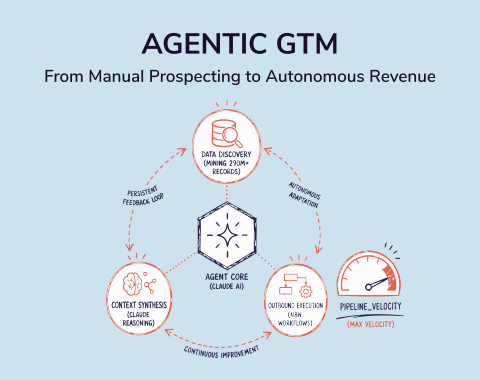
Agentic outbound is a B2B sales motion where autonomous AI agents handle the full outbound sequence without step-by-step human instruction. Prospecting, research, personalisation, multi-channel execution, reply triage, and meeting booking all run on autopilot. The rep supervises the system. The system does the work.
Sounds like the answer to every SDR manager's problem. And yet the data tells a different story.
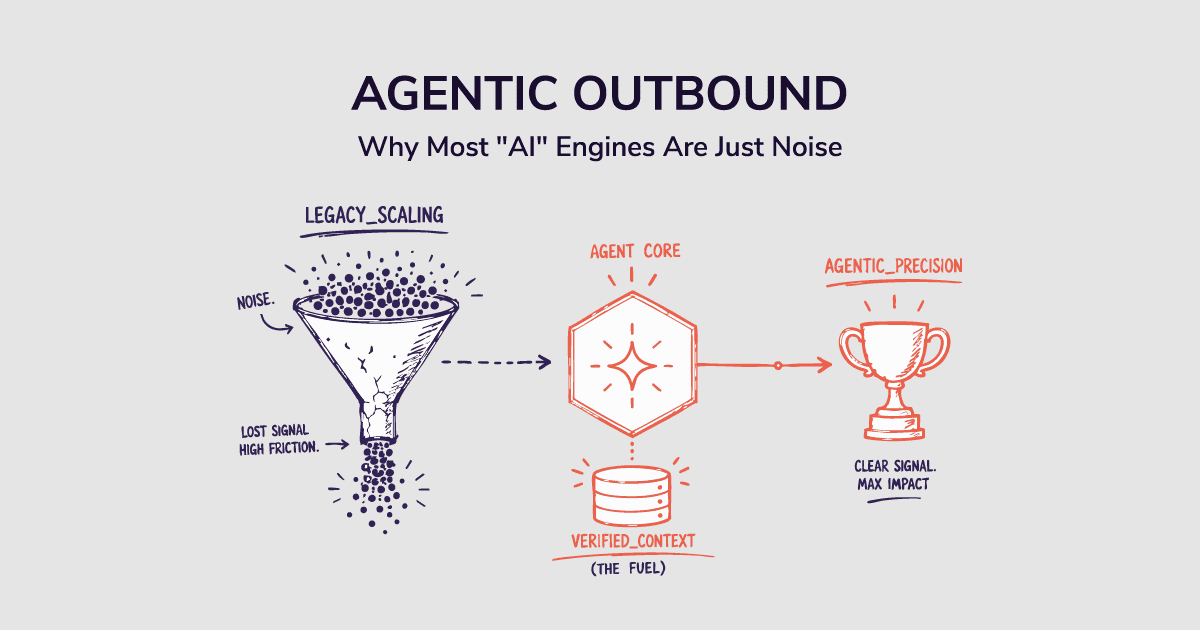
Outbound volume from AI-assisted teams rose 6.4 times compared to human-only baselines in 2026, according to Apollo and ZoomInfo outbound benchmarks. Raw reply rates fell 38% over the same period. More emails. Fewer replies. Something is breaking between the deployment and the result, and the vendors selling agentic outbound tools are not the ones who will tell you what it is.
This article covers what agentic outbound actually is, how it works, why so many deployments fail, and what the teams getting results have in common.
What Is Agentic Outbound?
Agentic outbound is a specific application of agentic AI inside the outbound sales motion. Unlike traditional sales automation, which follows pre-built rules and static sequences, an agentic outbound system sets goals and figures out how to reach them. It monitors signals, selects accounts, researches prospects, generates personalised messages, picks the right channel and timing, handles replies, and routes qualified conversations to human reps.
The key distinction from an AI SDR is autonomy. An AI SDR usually augments a human SDR, handling specific tasks like drafting emails or suggesting call scripts. An agentic outbound system runs the workflow end to end. The human defines the ICP, sets the guardrails, and reviews what the system is doing. The agent handles the execution.
Three things agentic outbound can do that no manual team can:
Run 24/7 without fatigue, forget, or inconsistency. Personalise at the account and contact level across thousands of records simultaneously. Learn from outcomes and adjust strategy without requiring a manager to diagnose what changed.
The catch: all of this depends on the quality of the data the agent operates on. And most teams skip that part.

SMARTe GTM Intelligence
Start Smarter Prospecting Today
How Agentic Outbound Actually Works
A working agentic outbound system runs across four interconnected stages. Understanding each one matters because failure usually happens inside one of them, not across all four.
Stage 1: Signal Detection and Account Prioritisation
The agent monitors a defined set of accounts continuously. Funding events, leadership changes, job postings, intent spikes, technographic changes, and engagement signals all feed into a prioritisation model. When signals converge on an account, it moves up the queue.
This stage is where buying signals and data quality intersect most directly. An agent monitoring the wrong contacts (people who left the company six months ago) will fire signals on dead accounts. An agent monitoring the right contacts with stale phone numbers and bounced emails will route perfect signals to dead ends.
Stage 2: Account Research and ICP Matching
Before reaching out, the agent researches the account. It pulls firmographic data, technographic data, recent news, and contact-level information. It checks the account against the defined ICP and scores the contacts for relevance.
This stage breaks when the underlying data is incomplete. Missing job titles, outdated company information, incorrect decision-maker mapping. The agent does not know what it does not know. It will research confidently and personalise accurately to information that is months out of date.
Stage 3: Multi-Channel Execution
The agent builds and sends personalised outreach across email, LinkedIn, and sometimes phone and direct mail. It sequences the touchpoints, adjusts timing based on engagement signals, and generates follow-up messages based on what happened in previous touches.
This is the stage most teams optimise first. It is also not the stage that determines whether the system works. Message quality is irrelevant if the contact record is wrong.
Stage 4: Reply Triage and Handoff
Replies come back. The agent sorts them: interested, not now, wrong person, unsubscribe. Interested replies get routed to a human rep with a brief including the account research, the conversation history, and suggested talking points.
Done well, this stage is where the real productivity gain shows up. A human rep stepping into a qualified, researched, warmed conversation is far more likely to book a meeting than a rep making a cold dial from a static list.
Why Teams Are Buying Agentic Outbound Right Now
The economics make a compelling case. Cost per qualified opportunity dropped 54% in hybrid AI plus human pod configurations compared to human-only teams, according to Bridge Group SDR Metrics 2026. Ramp time for an AI-assisted outbound seat is 24 days versus 142 days for a new human SDR hire. For scaling sales teams, that gap is significant.
41% of enterprise B2B teams report running at least one AI SDR or agentic outbound system in production as of Q1 2026, up from 12% one year earlier, per Salesforce State of Sales 2026. Adoption is no longer early-stage. The question is no longer whether to deploy. It is whether the deployment actually works.
Why Most Agentic Outbound Deployments Fail
Here is the part the case studies skip. The deployment looks great in month one. The failure shows up in months four through twelve. And by then, the team has signed an annual contract and built their workflow around a tool that is quietly breaking.
The Stale Data Problem
Agentic outbound systems run on contact records. If those records are wrong, every stage of the system produces wrong outputs. Personalised emails go to people who left the company. Calls go to disconnected numbers. Signals fire on contacts who changed roles before the buying window opened.
B2B contact data decays at roughly 22.5% per year. In fast-moving SaaS markets where people change roles every 12 to 18 months, that figure is probably conservative. One in five records in your CRM is wrong right now. An agentic system running on that database does not produce slightly degraded results. It produces confident wrong outputs at scale, compounding every error across thousands of automated touchpoints.
The Targeting Amplification Problem
AI does not fix bad targeting. It amplifies it faster.
If your ICP definition is too broad, an agentic outbound system will reach the wrong companies at the wrong time with higher velocity than any human team ever could. Bad CRM data means bad targeting inputs. Bad targeting inputs mean the agent prioritises accounts with no real buying signal and routes the best outbound capacity to accounts that will never convert.
One analysis of 14 B2B SaaS organisations running agentic prospecting through intent data found a 31 to 47% false-positive rate: accounts flagged as in-market when they were not. At manual outbound volumes, false positives are expensive. At agentic volumes, they are catastrophic.
The Deliverability Collapse
This one is slow and invisible until it is too late.
Domains running AI-SDR outbound at production volume drop sender reputation sharply within 90 days. The median observed drop is 38 points on major reputation scales, per Smartlead and Instantly deliverability research. Email providers are pattern-matching the structural signatures of AI-generated outreach. More emails are going to spam. The reply rate decline is not just a targeting problem. Some of it is a delivery problem the vendor does not tell you about at the sales stage.
And there is a longer-term decay too. Reply rates on AI-driven outbound campaigns decay 60% or more within 18 months as recipients pattern-match the AI voice and filter before they even read the message.
The Intent Data Noise Problem
Most agentic outbound systems are wired to intent data as a primary signal source. The problem: intent data is less reliable than the vendors suggest.
An audit of top-4 intent data providers found false-positive rates between 31 and 47%. Accounts flagged as in-market based on intent signals that were either misclassified or driven by non-buying behaviour. When an agentic system uses noisy intent signals as the trigger, the highest-quality outbound capacity gets consumed by accounts that were never actually in a buying window.
I think this is the failure mode nobody talks about because it implicates the intent data vendors, the agentic platform vendors, and the RevOps leaders who signed both contracts.
What the Working 2% Actually Do Differently
Honest take: agentic outbound works for some teams. The ones I've seen get results consistently share three things.
1. Clean, real-time data at the foundation. Not a database refreshed quarterly. Not enrichment run when the team remembers to run it. Real-time verification at the point of use, so when the agent fires on an account, the contact record reflects who is actually there today. This is not a nice-to-have. It is the prerequisite.
2. A tight ICP that the agent can actually operationalise. "Mid-market B2B SaaS companies" is not an ICP an agent can use. "Series B SaaS companies with 50 to 200 employees, running Salesforce, with a VP of Sales hired in the last 90 days and a Bombora intent surge on your category" is. The more specific the definition, the more accurately the agent can score and prioritise. Vague ICPs produce high-volume misdirected outreach.
3. Signal stacking, not single triggers. The deployments that hold up over time are not firing on a single buying signal. They're stacking three or more independent signals on the same account before triggering outreach. A funding event alone is noise. A funding event plus a new VP Sales hire plus a Bombora intent surge is a genuine buying window worth the agent's attention.
How to Deploy Agentic Outbound Without Creating an Expensive Failure
Step 1: Audit Your Contact Data Before Touching the Agent Settings
Pull 200 records from your active outbound accounts. Check job titles, email deliverability, and phone connectivity. If the error rate sits above 15%, your agent will launch on a broken foundation. Run CRM data enrichment against a real-time verified source before configuring anything else.
In my experience, this is the step teams skip most often because it feels like maintenance work rather than deployment work. It is the most important step.
Step 2: Define Your ICP With Signals, Not Demographics
Work backward from your last 20 closed-won deals. What signals were present six to eight weeks before each one closed? Funding events? Leadership changes? Technographic fit? Job posting patterns? Those signals become the inputs your agent monitors. Demographics (company size, industry, revenue range) are starting filters. Signals are what the agent acts on.
Step 3: Stack Signals Before Triggering Outreach
Set a minimum threshold before the agent fires. Two Tier 1 signals minimum, or one Tier 1 plus two Tier 2. (A Tier 1 signal is something like a funding event or new VP hire. A Tier 2 signal is something like a relevant job posting or Bombora category surge.) An outbound prospecting motion built on stacked signals runs at a fraction of the volume of spray-and-pray agentic outbound. It produces meaningfully higher reply rates.
Step 4: Start With One Workflow, Not Five
Pick the highest-converting segment from your human outbound data. Run the agent on that segment only, with a narrow ICP definition and tight signal requirements. Run it for 60 days. Measure. Adjust. Then scale to a second segment. Teams that try to run agentic outbound across every segment simultaneously end up with five failing workflows instead of one working one.
The Part the Vendors Don't Talk About
Every agentic outbound platform will show you a case study with strong numbers from month one. Very few will show you what happens in month twelve when:
The sender reputation has degraded. The recipient population has pattern-matched the AI voice. The intent data false-positive rate has consumed a quarter of the best outbound capacity. The contact records the system launched on are 20% stale because nobody enriched them after the initial setup.
AI-ready B2B data is not about having the biggest database. It is about having a database that is accurate at the point of use, every time the agent fires. The difference between a deployment that holds up at month 12 and one that quietly falls apart is almost always the data layer, not the agent.
SMARTe's 283M+ verified contacts run through real-time verification. When the agent fires on an account, the mobile numbers your reps dial and the emails your agent sends are current. That is the 75%+ US direct dial coverage and 90%+ CRM match rate in practice. Not a stat in a deck. The reason the reply rates hold.
Agentic Outbound Is Not the Problem. The Setup Is.
Most teams that fail at agentic outbound are not using the wrong tool. They are using the right tool on the wrong foundation.
The agent is not going to fix a stale database. It is not going to correct a broad ICP. It is not going to overcome 38-point sender reputation drops from day-one high-volume deployment. What it will do is execute whatever you give it to work with, at scale, and at speed.
Give it clean data, a tight ICP, and a proper signal stack. It will book meetings. Give it everything else and it will confidently send personalised emails to contacts who left their jobs six months ago.
Fix the foundation first. The agent does the rest.
Try SMARTe free and see what agentic outbound looks like when the contact data underneath it is actually verified.