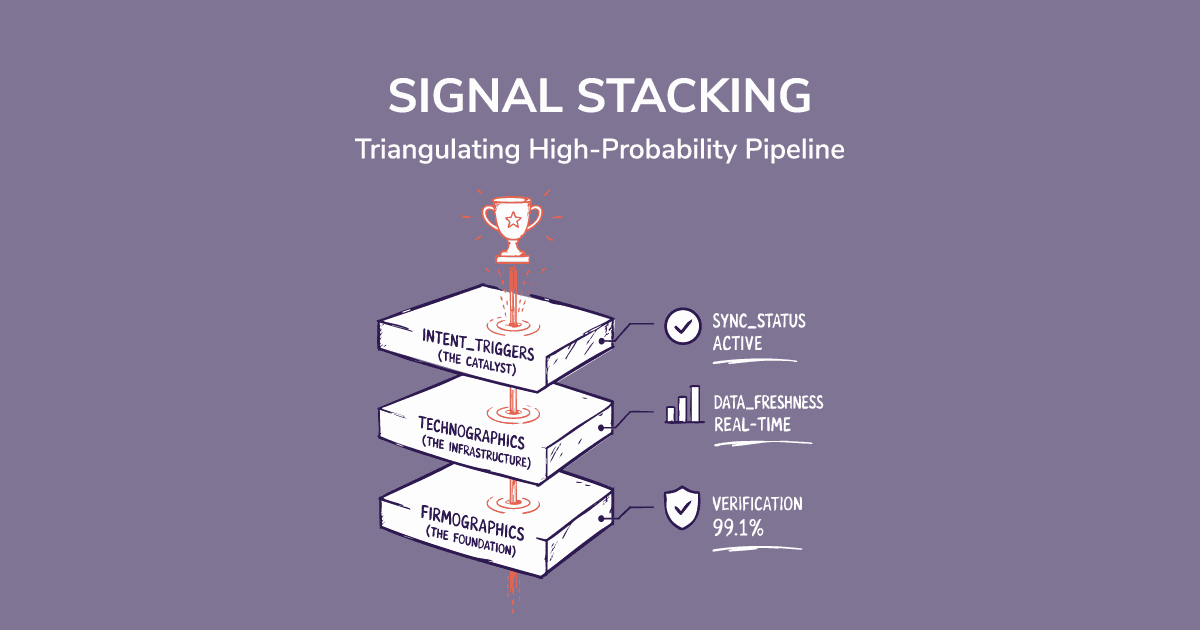
Signal stacking is a B2B sales methodology that combines two or more independent buying signals on the same account before triggering outreach. Instead of acting on a single data point, such as a funding round, a new executive hire, or an intent surge, you wait until multiple signals converge on the same account in the same window. The result: outreach that reaches the right company at the exact moment they're most likely to buy.
The problem signal stacking solves is timing. Generic single-signal outreach averages a 1–5% reply rate. Multi-signal stacked outreach, where you layer three signals before reaching out, drives 25–40% reply rates based on 2026 outreach benchmark data. That gap isn't about copy quality. It's about knowing when to send.
This guide covers the three signal categories worth stacking, the five highest-converting signal combinations in 2026, and how to build a workflow your team can run without a dedicated RevOps function.
What Is Signal Stacking?
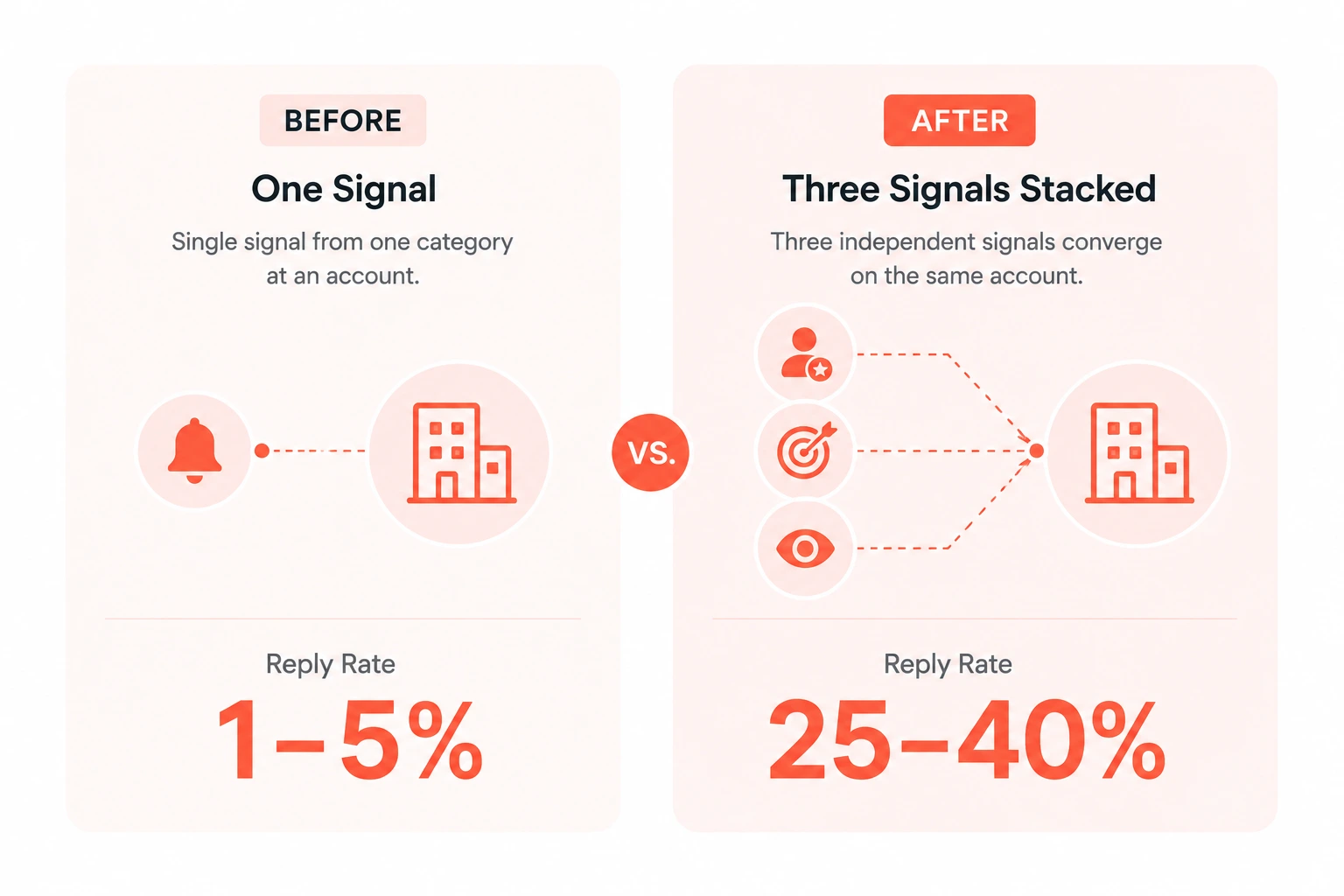
Signal stacking is the practice of layering two or three independent buying signals on the same target account before reaching out. A single signal tells you something happened at a company. Stacked signals tell you a buying window is open right now.
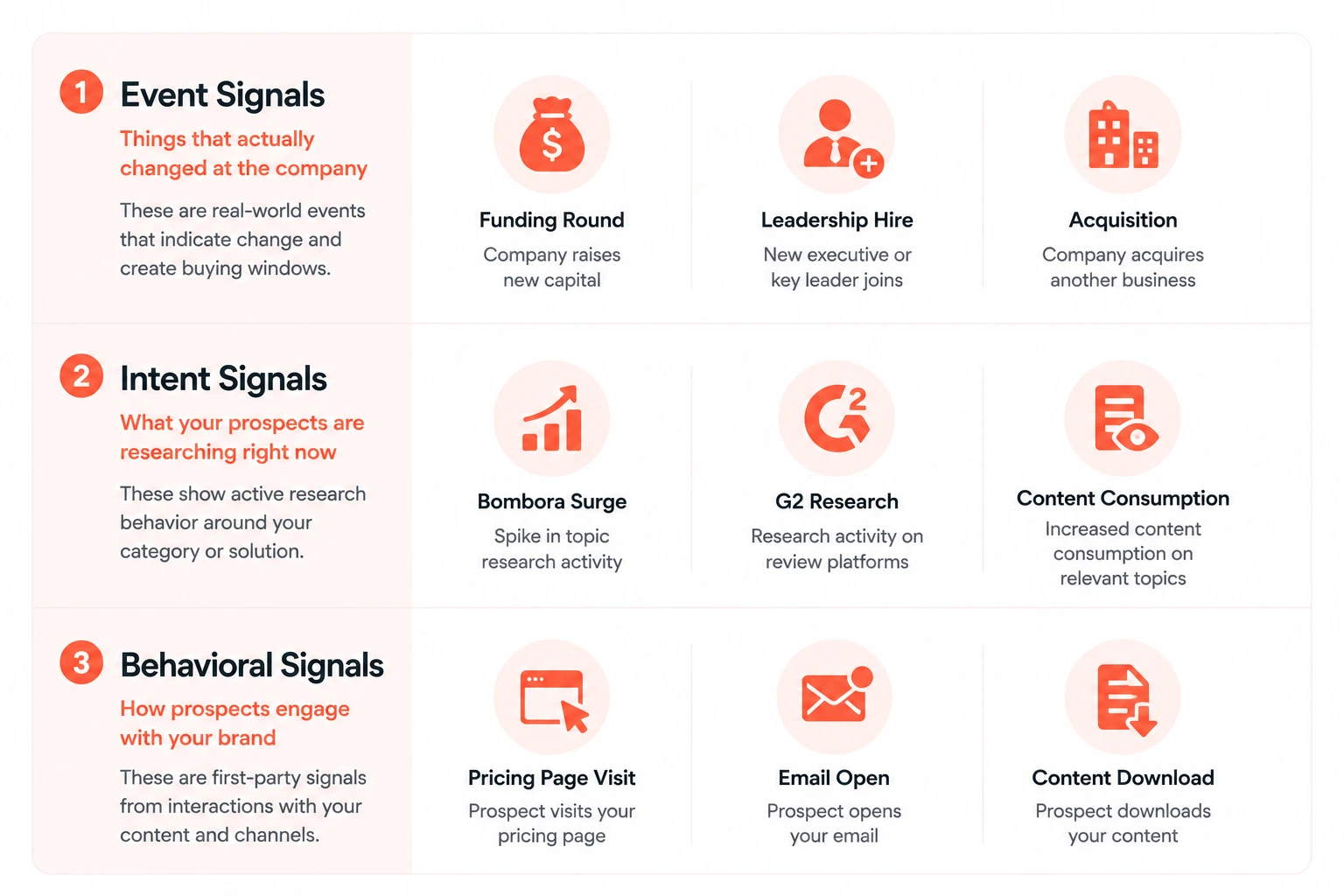
The three signal categories that produce the strongest stacks are event signals (leadership changes, funding rounds, acquisitions), intent signals (third-party research activity tracked through tools like Bombora), and behavioral signals (first-party engagement with your own content or website). When signals from two or three of these categories converge on the same account in the same week, that account moves to the top of your priority list, not the general call queue.
According to 6sense research, 94% of buying groups finalize their vendor shortlist before ever contacting a supplier. Signal stacking is how you get into that shortlist conversation before it closes.

SMARTe GTM Intelligence
Start Smarter Prospecting Today
Why Single Buying Signals Miss the Mark
How One Trigger Can Mislead Your Outreach
A funding round tells you a company got money. That's it.
It doesn't tell you they're evaluating vendors in your category, that someone with actual authority is involved, or that the timing aligns with their planning cycle. Plenty of funded companies spend the first six months reorganizing internally before they talk to a single new vendor.
Job changes carry the same problem. A new VP of Sales joins. Interesting. But are they re-evaluating the tech stack or inheriting the roadmap the last person built? You can't tell from the hire alone.
I think most teams treat buying signals the way they treat lead scores: a single number that tells you whether to pick up the phone. It doesn't work that way. A signal without context is a data point, and data points in isolation mislead as often as they guide.
What Changes When Signals Stack Together
When two independent signals converge on the same account, the confidence level changes. When three converge, you've got a priority call.
Take this scenario. Account X closes a Series B and hires a new CRO. That's two independent signals pointing at the same conclusion: new money, new executive, almost certainly a mandate to rebuild the GTM stack. Add a third: Bombora shows that company researching "sales intelligence" and "contact data" at significantly above their baseline. Three signals, three categories, same account, same week.
That's not a cold call. That's your number-one call this week, and you already know what to lead with.
The logic is simple. One signal: add the account to a watch list. Two signals from different categories: move it to the top of your queue. Three or more: act fast, because buying windows don't stay open indefinitely.
The Three Types of Buying Signals Worth Stacking
Not all signals belong in the same bucket. I'd argue this is where most teams get signal-based selling wrong. They track plenty of signals, but the signals all come from one category, which means they're stacking correlated noise rather than independent confirmation.
The three categories worth building around are deliberately different from each other.
Event Signals: Things That Actually Changed at the Company
These are things that actually happened. A funding round closes. A new CMO joins. An acquisition gets announced. Headcount grows 15% in 90 days. A public company reports earnings and the CEO mentions "sales transformation" in the call.
Event signals are the strongest predictor of a buying window because they represent change, and change is what drives purchasing decisions. A company that hasn't changed is unlikely to change its vendors. (This is why job postings alone rank poorly as a buying signal; they indicate growth but not urgency, and they correlate with buying behavior at a fraction of the rate that leadership changes and funding events do.)
Before building your signal tier list, it's worth understanding how buying triggers differ from intent signals at a structural level. They operate on different timelines and require different response windows.
Intent Signals: What Your Prospects Are Researching Right Now
Intent signals tell you what a company is actively researching, even when they haven't raised their hand with you directly. Bombora's intent data works by measuring when a company's content consumption around a specific topic significantly outpaces its normal baseline. If that topic matches your category, someone at that account is doing the research right now.
G2 research activity signals the same thing from a different angle. A target company spending time on review pages in your category isn't casual browsing. They're building a shortlist.
Intent signals confirm that a buying window isn't theoretical. Paired with an event signal, they tell you an account has both the motivation and the active behavior. That combination is rare. When you find it, act on it.
Behavioral Signals: How Prospects Engage With Your Brand
Behavioral signals are first-party data from your own properties. Pricing page visits. Multiple content downloads in the same week. Opens on an email sequence that went cold three months ago.
These carry high fidelity because they're direct engagement with your brand, not inferred third-party data. But they're weak when standing alone. (Someone visits your pricing page and disappears. That could mean anything.) Their role in a stack is to raise confidence when an event signal and an intent signal are already in play. A third independent data source pointing at the same account is meaningful. On its own, it's a curiosity.
You can explore the full taxonomy of buying signals to build out each category for your specific ICP.
Five Signal Stacks That Book Meetings in 2026
These are the combinations that produce the highest reply rates based on 2026 outreach data. The five below cover most of the buying window scenarios your team will encounter.
The New Leader Stack
Signals: New VP of Sales or CRO hire, plus a Bombora intent surge in your category, plus headcount growth in the sales function.
Why it works: New executives bring a mandate. Research shows new buyers spend the majority of their budget in the first 100 days and re-evaluate everything their predecessor built. The Bombora surge confirms someone at the company is already doing research. The headcount growth tells you they're scaling, not cutting.
Shelf life: 30 to 90 days from the hire date. Don't wait past 30 if you can help it. You want to be the first vendor they evaluate, not the fifth. First-mover advantage in this window is real.
What to do: Lead with the executive's likely mandate, not your product. Reference the company's growth trajectory and what typically breaks when a team scales fast. Save the pitch for the second exchange.
The Funding Plus Intent Stack
Signals: Series A or later funding announcement, plus a Bombora intent surge in your category, plus any first-party engagement (pricing page visit, content download, email open on a previous sequence).
Why it works: Fresh capital means new buying authority. An intent surge confirms a problem they're actively working to solve. First-party engagement means they already know you exist, which changes the dynamic entirely.
Shelf life: 2 to 4 weeks from the announcement. Funding rounds trigger a wave of generic "congrats on the raise" outreach from every rep covering that account. Speed matters here. The window to differentiate closes fast.
What to do: Reference the funding specifically and tie your value prop to what comes after a raise. Every funded company is trying to build pipeline faster without proportionally growing headcount. Start there. That's the actual pressure they're feeling.
The Tech Displacement Stack
Signals: Target company currently using a direct competitor, plus a Bombora intent surge on your category or the competitor's brand, plus a job posting for a RevOps Manager or Sales Operations Lead.
Why it works: Displacement opportunities have a natural entry point. Something is wrong with the current vendor, or the price just went up, or the contract is expiring. The intent surge confirms they're evaluating alternatives. The RevOps hire tells you someone now has the mandate to fix the stack.
Technographic data is the starting layer here. Knowing what tools a company runs, and which contracts are likely approaching renewal, gives you an entry point that most reps competing for the same account will never see.
Shelf life: 60 days. These opportunities build slowly until they move fast. Stay on the account even if early outreach doesn't land.
The Hiring Signal Stack
Signals: 10 or more open roles in a single department over 90 days, plus intent data on tools in your category, plus a leadership change in that department.
Why it works: A team scaling at that pace needs infrastructure to support it. If their Head of Sales just changed and they're hiring 15 SDRs, they're re-evaluating their prospecting, data, and sequencing stack. All of it, usually at the same time.
Shelf life: 90 days from the start of the surge. These windows are longer because the urgency builds gradually, then becomes urgent all at once.
What to do: Lead with what rapid headcount growth consistently breaks. The data quality degrades. The sequences that worked for a team of five fall apart at twenty. That's the problem, and it's one they're probably already feeling.
The Re-Engagement Stack
Signals: A previously closed-lost account, plus a champion from that deal who moved to a new company, plus a Bombora intent surge at their new employer.
Why it works: Someone who went through an evaluation with you already knows what you do. When they change roles and their new company shows active intent signals, you have a warm entry point no cold rep covering that account can replicate. Half the education work is already done.
Tracking job changes in real time is how you catch these moves before the window closes. Most teams miss re-engagement opportunities because they're watching for new signals at new accounts rather than watching where their existing champions land.
What to do: Reference the previous conversation directly. "Last time we spoke you were at [Company]. I saw you moved to [New Company] and noticed they've been researching [category]. Thought it was worth reaching back out." That's not cold outreach. That's a continuation.
How to Build a Signal Stacking Workflow Without a RevOps Team
Most signal stacking guides assume you have a dedicated RevOps function, a data team, and four intent platforms wired together. In my experience, most SDRs and sales managers don't have any of that. Here's a simpler framework.
Step 1: Build Your Signal Tier List
Not all signals carry equal weight. Rank them before you build anything else.
Tier 1, highest confidence: Funding events, C-suite or VP-level hires, Bombora category surge, a competitor's contract renewal window approaching.
Tier 2, moderate confidence: Relevant job postings, headcount growth above 10% in 90 days, G2 research activity in your category, first-party content downloads. When choosing your Tier 1 and Tier 2 intent sources, the right intent data providers make a significant difference in signal quality.
Tier 3, low confidence alone: Email opens, LinkedIn engagement, generic website visits.
Tier 3 signals should never trigger outreach on their own. They add weight to a confirmed stack. Nothing more.
Step 2: Set a Minimum Stack Threshold
I'd never reach out on fewer than two Tier 1 signals or one Tier 1 plus two Tier 2 signals on the same account. Below that threshold, you're acting on incomplete information, and your outreach will feel like a guess because it is one.
It sounds like a high bar. It isn't. Per Salesforce's State of Sales research, sales reps spend just 28% of their working week actually selling. The rest disappears into research, admin, and trying to figure out which accounts to prioritize. A clear threshold removes the decision fatigue from prioritization and puts that time back into actual outreach.
Accounts that hit the threshold are worth calling. Accounts that don't are worth monitoring.
Step 3: Act Inside the Signal Decay Window
Every signal has a shelf life. Act outside it and the relevance disappears.
Funding announcements: act within 2 to 4 weeks. New VP hire: ideally within 30 days. Bombora intent surge: 1 to 2 weeks, these spikes are short-lived. Tech stack changes: 60 days.
Build these windows into your outbound prospecting process so that when an account hits the threshold, it moves to the top of the queue immediately, not to the next available slot in the sales cadence. A missed decay window isn't a data problem. It's a workflow problem.
Why Your Signal Stack Is Only as Good as Your Underlying Data
Here's something most signal stacking guides skip entirely.
Signal stacking fails when the contact data underneath it is wrong.
You identify the right account. Three signals converge in the same week. You build precise outreach referencing the new CRO hire, the Bombora surge, and the funding round. Then you dial a number that stopped working six months ago or send to an email address for someone who left the company before the funding round even closed.
The stack was right. The data was wrong.
B2B contact data decays at roughly 22.5% per year. Honestly, in SaaS markets where people change roles constantly, I think that figure is conservative. That means roughly one in five contacts in your database is stale right now. If your signal stacking workflow routes you to those contacts, you're not missing a deal. You're burning outreach effort on a ghost.
This is why what makes B2B data actually reliable matters more to signal stacking than most SDRs realize. Real-time verification at the point of use is the difference between a signal that routes you to a live decision-maker and one that routes you to a dead end. Batch refreshes that ran six months ago don't cut it.
AI-ready B2B data is the term people are starting to use for this: contact records that are verified, current, and structured in a way that signal-based workflows can actually operate on. Without it, your stack fires on stale information and the 25–40% reply rate stays theoretical.
SMARTe surfaces Bombora intent signals, job changes, funding events, and technographic installs across 64,000+ tracked products in a single view. The contact records run through real-time verification, not pulled from a static snapshot built months ago. When a signal stack fires on an account, the number you dial and the email you send are current. That's what turns the benchmark reply rate into an actual result on your call sheet.
The Timing Problem Is More Fixable Than the Messaging Problem
Most outbound teams that struggle think they have a messaging problem. They rewrite the sequence. A/B test the subject line. Hire a better copywriter.
What they actually have is a timing problem.
Signal stacking doesn't make you a better writer. It puts your message in front of the right person at a company in the right moment of change, with enough context to sound like you actually understand what's happening inside their business. That's what drives replies. Not cleverer copy.
And if you want those signals to connect to contacts who actually pick up, the data underneath the stack has to be current. A signal stack running on stale contacts is a precise machine pointed at nothing.
See how SMARTe surfaces Bombora intent, job changes, funding events, and tech installs in a single view, with verified contacts underneath every account.