Most CIO email list providers will tell you their data is fresh. It isn't.
Here's what I see constantly with outbound teams selling into IT. They spend real money on a verified list. Titles look right. Companies match the ICP. They build a sequence, hit send, and watch bounce rates climb to 8%, 12%, sometimes higher. They rewrite copy. They split-test subject lines. But the messaging was never the issue.
CIOs change jobs faster than almost any other C-suite title. When they move, their old email is dead. Most databases haven't caught up yet. Your sequence is chasing ghosts.
This article shows you what separates a good CIO email list provider from a list broker selling yesterday's data. Let's get into it.
What Is a CIO Email List (and Why It's Harder to Get Right Than You Think)
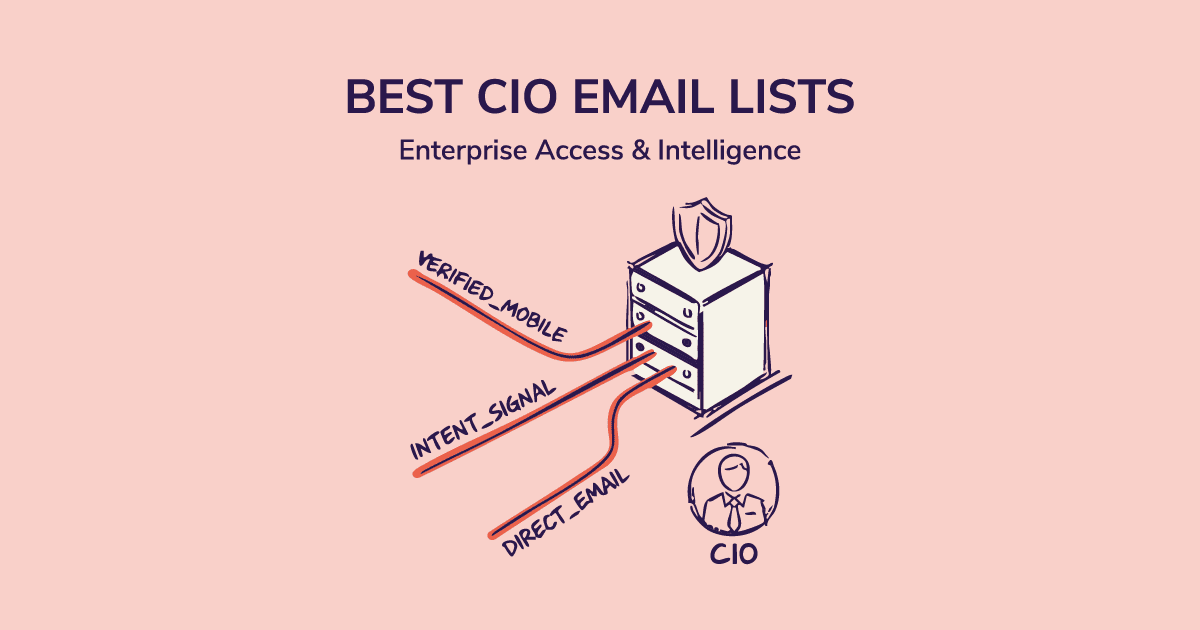
A CIO email list is a database of chief information officers with verified contact information, including work emails, direct dials, and firmographic data like company size, industry, and location. Sales teams use these lists to build targeted outreach campaigns for technology buyers with IT purchasing authority. (If you're also building lists for other decision-maker roles, check out our guide to IT decision makers email lists for the broader picture.)
Simple concept. Messy in practice.
Why CIO contact data decays faster than any other C-suite title
CIOs sit at the center of every digital transformation initiative a company runs. That makes them valuable. It also makes them mobile.
Average CIO tenure at large enterprises runs around four to five years. At mid-market companies it's often shorter. And when a CIO moves, their old email is dead. Their new one isn't in most databases yet. There's a lag, sometimes 90 days, sometimes six months, between when someone changes roles and when a data vendor picks it up.
That's why B2B data decay is such a real problem for this specific title. According to independent deliverability research, non-validated datasets produce bounce rates of 5 to 7 percent. Verified, actively maintained contact data keeps bounces below 1 percent. For C-suite contacts specifically, the gap is wider.
The buying group problem nobody talks about
Here's what almost nobody in the 'CIO email list' conversation addresses: CIOs rarely buy alone.
Enterprise technology purchases involve 6 to 10 stakeholders on average. The CIO might be the champion or the final approver. But the IT Director runs the evaluation. The CISO has veto power on anything touching security. The VP of IT owns the budget conversation. The CTO might have an opinion on architecture.
If your entire outbound motion runs through one CIO email address, you're threading a needle that doesn't need to be that thin. The real advantage comes when you can map the full buying group around the CIO, not just find their email.
(And yes, that changes how you evaluate a data provider. You're not just looking for one contact. You're looking for depth of coverage across the whole account.)
For comparison, see how the same logic applies to other C-suite roles in our guides to CEO email lists and CMO email lists.
What to Look for in a CIO Email List Provider
Not all CIO email list providers are built the same. Some are genuine sales intelligence platforms with real-time verification. Others are list brokers reselling scraped data from three years ago with a shiny front end.
Here's how to tell them apart before you spend a dollar.
Real-time verification vs. static databases
This is the most important question you can ask a vendor: how often is your data refreshed?
Static databases are exactly what they sound like. A vendor acquires data in bulk, runs it through a verification pass, and sells it as-is. The data was accurate at the point of verification. It starts decaying the moment it leaves the server.
Real-time verification works differently. Every time a contact record is queried, it goes through a live check before it's returned to you. You get data that was accurate at the moment you pulled it, not the moment it was collected. This matters most for C-suite contacts. You can compare B2B contact database providers on this specific dimension before you shortlist.
Mobile and direct dial coverage (not just email)
Most articles about CIO email lists focus exclusively on email. But email-only outreach to a C-suite audience is a losing game. CIOs get a lot of vendor email. They get far fewer cold calls to their direct mobile.
If a provider claims strong CIO coverage, ask specifically about direct dial and mobile coverage. Not general phone numbers that route through a switchboard. Verified direct dials that connect you to the person. Our breakdown of B2B direct dials covers why this matters for C-suite outreach specifically.
Filtering depth: firmographics, technographics, and intent signals
A name and an email address isn't a strategy. You need to slice the list by what matters to your ICP.
Firmographic filters are table stakes. Revenue, headcount, industry, geography. Any serious provider has these.
Technographic filters are where things get more interesting. If you sell a data management platform, you want to know which CIOs are running specific infrastructure stacks. If you're displacing a competitor, technographics tell you who's already using them. Our guide to technographic data covers how to use this in ICP targeting.
Intent signals are the layer that most generic list providers don't offer. They tell you which CIOs are actively researching a problem you solve right now, not just which ones match your ICP on paper. Layering in buying signals before you reach out is what separates a warm sequence from a cold blast.
Compliance: GDPR, CCPA, CAN-SPAM
Non-negotiable. Especially if you're selling into Europe.
Any legitimate CIO email list provider should tell you exactly how they source data, how they maintain GDPR and CCPA compliance, and how they handle opt-out requests. If they can't answer that clearly, walk away. The liability risk isn't worth a cheap list.
The Best CIO Email List Providers in 2026
Here are the providers worth evaluating, based on data quality, coverage, filtering depth, and what they actually do well.
1. SMARTe
SMARTe is a B2B sales intelligence platform with 289M+ verified contacts and 75%+ US mobile coverage, one of the highest direct dial rates in the industry. It's built specifically for outbound-first teams, which means the platform is designed around the workflows SDRs and BDRs actually run. (Check the best sales intelligence tools for a broader comparison across the category.)
What makes SMARTe different for CIO-level targeting:
- Real-time verification, not batch processing. CIO contacts are accurate at the moment you pull them, not when they were collected.
- 75%+ US mobile coverage means you can run a true multi-channel sequence, email and direct dial, not just email.
- Bombora intent signals built in. Filter for CIOs actively researching your category before you send a single email.
- Technographics covering 64K+ products. Target CIOs by what's already in their stack.
- AI-powered buying group mapping. Identify the full stakeholder map around the CIO, not just the CIO.
- 200+ country coverage for global outbound teams.
- SOC 2 Type II certified, GDPR aligned, and CCPA compliant.
Worth being straight about the trade-off: SMARTe is enterprise only, starting at $15,000 a year, with credits from $0.30 each and no per-seat fees. There's no self-serve tier, so a two-person team isn't the right fit. If you want to check coverage in your specific target accounts first, ask for a sample run against your ICP before you commit to anything.
SMARTe also offers an MCP (Model Context Protocol) server that lets AI tools like Claude and ChatGPT connect directly to live verified contact data. Useful if you're building AI-assisted prospecting workflows.
2. ZoomInfo
ZoomInfo has the largest B2B database on the market and strong enterprise coverage. If you're an enterprise team with a big budget and a primarily North American ICP, ZoomInfo's depth is hard to argue with.
Where it gets complicated: the model tends toward annual contracts with seat-based costs stacked on top of the platform fee, and renewal increases are a common complaint. For teams with international ICPs, coverage thins out noticeably outside North America. See our breakdown of ZoomInfo alternatives if you're evaluating other options in the category.
3. Cognism
Cognism's strength is European coverage and GDPR compliance. If your CIO outreach runs into EMEA, Cognism is one of the few providers with genuine regional depth there. Their Diamond Data is phone-verified by humans, a real differentiator for mobile accuracy.
Trade-offs: less deep in APAC and LATAM. Better for compliance-first teams than high-volume outbound teams running large sequences.
4. Apollo.io
Apollo has a large database and a freemium model that makes it easy to get started. It's popular with early-stage teams and self-serve buyers.
The honest caveat: bounce rates with Apollo data can run higher than the platform advertises, particularly at the C-suite level where data changes fast. Some users report 20 to 30 percent bounce rates on executive contacts. For CIO outreach specifically, where every contact matters, this is worth stress-testing before you build a full sequence around it.
5. Lusha
Lusha works well for individual prospecting via browser extension, especially on LinkedIn. For SDRs doing account-level research on specific targets, it's a fast tool. It's less suited to bulk list-building or large-scale CIO database pulls.
If you need 500 verified CIO contacts across a segment, you'll outgrow it fast. Our roundup of Lusha alternatives covers what to evaluate when you hit that ceiling.
6. UpLead
UpLead runs real-time email verification at the point of export, a genuine quality differentiator. Their 95% accuracy guarantee is among the strongest in the market. Coverage is thinner at true enterprise scale, but for SMB and mid-market CIO targeting, it's a solid option worth testing.
How to Evaluate Any CIO Email List Before You Buy
Don't take a vendor's accuracy claim at face value. Every provider says 95% accuracy. Test it.
Ask for a sample and test it
Any serious provider will give you a sample. Pull 50 to 100 CIO contacts in your ICP. Run them through an email verification tool before you import them into your sequence. A legitimate provider should come in above 90%. If you're seeing 70% or lower on a sample, the full list will be worse.
Check for intent signal layering
A list of CIO emails is a starting point. A list of CIOs actively researching your category right now is a pipeline opportunity. Ask the vendor whether they have intent data built in or integrated. If they do, ask which third-party provider they use and how fresh the signals are. Stale intent data is worse than no intent data.
Verify the mobile number coverage claim
Ask specifically: what percentage of your CIO contacts include a verified direct dial or mobile number? Then ask how they define 'verified.' There's a big difference between a provider that includes a general office number and one with a confirmed direct mobile. Push on this before you sign anything.
How to Use a CIO Email List Effectively (So It Doesn't Die in a Sequence)
Getting the list is step one. Using it right is where most teams lose the value.
Pair email with direct dials for multi-channel outreach
Email alone to a CIO audience is low-percentage. CIOs manage large teams and get a lot of vendor email. The ones who respond to cold outreach often do so because something else caught their attention first: a LinkedIn touchpoint, a direct call, a piece of content they were already engaging with. Outbound prospecting done well is a multi-touch motion, not a batch email campaign.
Multi-channel sequences consistently outperform single-channel email. If your CIO email list doesn't include direct dial coverage, you're running at half power.
Layer in buying signals before you send
Don't reach out to every CIO on your list at the same time with the same message. Prioritize the ones showing active buying intent. Which companies just hired a new CIO? Which ones are expanding IT headcount? Which ones are researching your category on Bombora or G2?
Buying signals let you prioritize by likelihood to convert, not just ICP match. The CIO who matches your ideal customer profile but is perfectly happy with their current vendor is a different prospect than the one who's mid-evaluation and publishing RFP criteria.
Map the full buying group, not just the CIO
This is the step most outbound teams skip. And it's the one that actually moves deals forward.
Once you have a CIO contact in your target account, use that as a starting point to map the full buying committee. Who's the IT Director? Who handles the vendor evaluation process? Does the company have a CISO who will weigh in on data security? What about the VP of IT?
If you're selling to enterprise accounts, your deal will stall if you've only contacted the CIO. Building relationships across the buying group from the start is how you generate real pipeline, not just meetings.
(Think of it this way: a CIO email list is the front door. The buying group map is the whole floor plan.)
The Bottom Line
A CIO email list is only as good as the data underneath it and the strategy behind it.
If you're buying a static export from a list broker, you're starting with decay built in. If you're pulling from a real-time verified database with direct dial coverage and intent signal layering, you're starting with a genuine advantage.
But data is just the input. The teams that win CIO-level deals are the ones who map the full buying group, run true multi-channel sequences, and reach out at the moment when the account is actually in-market. That combination is rare. And it's exactly what separates a pipeline full of booked meetings from a sequence that burns out in week two.
At the end of the day, the best CIO contact list in the world is useless if you're sending to the wrong person at the wrong time with the wrong message. The data unlocks the door. Your team still has to walk through it.