TL;DR:
Lusha works fine for small teams doing light email-first prospecting. The credit-based pricing scales fast once you add phone numbers or a second seat. The strongest alternatives fall into three groups. Verified contact databases with broader mobile coverage: SMARTe, Cognism, UpLead. All-in-one prospecting and outreach platforms: Apollo.io, Saleshandy. Enterprise intelligence suites: ZoomInfo, 6sense. Below are 13 options with current pricing, verified G2 ratings, and what each one is for.
- Best overall value: SMARTe. Global mobile coverage at roughly half the cost of enterprise tools.
- Best for EMEA phone-verified data: Cognism. Pricing is quote-only and starts in five figures, though.
- Best all-in-one platform: Apollo.io, combining a contact database with sequencing and a dialer.
- Best for data accuracy guarantees: UpLead, backed by a 95% email accuracy guarantee.
- Best enterprise-grade suite: ZoomInfo, if your budget supports a five-figure annual contract.
Are you frustrated with outdated contact information? Lusha has been a popular choice for B2B data, but it might not be the best option anymore. Sales pros need fresh, accurate data to stay ahead. Using the wrong tools can lead to missed opportunities and lost deals.
Many sales teams are struggling to keep up with the competition. They're wasting time on bad lead data and failing to connect with decision-makers.
But don't worry, there's hope. The market is full of powerful Lusha alternatives that could transform your sales process. These tools offer more accurate data, better features, and smarter insights.
In this guide, we'll explore the top 13 best Lusha competitors. We'll break down their key features, pricing, and what makes them stand out.
Let's dive into the top 13 Lusha alternatives that are making waves in the B2B data space:
Quick Comparison: Top Lusha Alternatives at a Glance
Top 13 Best Lusha Alternatives in 2026
1. SMARTe

SMARTe is a global B2B data platform. It solves one specific problem. Finding a verified mobile number for a contact outside North America. A lot of "global" databases quietly thin out once you leave the US and UK. SMARTe's coverage was built for LATAM, APAC, and EMEA from the start.
Key Features
- Access to 289M+ verified B2B contacts across 200+ countries, with 66M+ company profiles.
- 75%+ verified mobile and direct dial coverage in the US. 50%+ globally. Well above the category average for credit-based tools.
- Native technographic data for tailoring outreach around a prospect's existing tech stack.
- Real-time enrichment with job change alerts. Records stay current instead of decaying quietly.
- SOC 2 Type II certified, GDPR-aligned, and CCPA compliant.
- A browser extension for pulling verified contacts directly from LinkedIn and company sites.
What I Like About SMARTe
- Mobile coverage that holds up outside North America. Budget tools commonly thin out fast there.
- Roughly half the per-credit cost of the enterprise-tier tools further down this list.
- Job change alerts baked into enrichment, so a contact record doesn't quietly go stale.
- B2B data coverage across cold calling-friendly markets, not just email.
- Fast setup, according to G2 reviewers: lookups working within minutes of activation.
What Could Be Better
- A smaller G2 review base (25 reviews) than category giants like Apollo. The sample size is thinner.
- Occasional data gaps on niche or smaller accounts, per user feedback.
- EMEA and APAC direct-dial depth still trails North America in some sub-regions.
- The UI is functional but a few reviewers describe it as less polished than competitors.
Pricing
SMARTe runs a simple credit model:
- Free: 10 credits a month, no card required.
- Pro: $25/month for 50 credits ($0.50/credit).
- Enterprise: From $15,000/year. Per-credit cost drops to $0.30, falling further to $0.20 at 1M+ credits for high-volume teams.
User Review:
"SMARTe made getting started quick and easy, with lookups available within minutes. The platform integrates seamlessly into our workflow, and customer support is very responsive... read full review on G2."
2. Cognism

Cognism built its reputation on phone-verified mobile data, and it earned it. Does your team run a calling-heavy motion into the UK or wider EMEA? Cognism's Diamond Data tier is worth a look. It remains one of the more reliable phone-verified datasets in the category. Our full Cognism review breaks down data accuracy and support in more detail.
Key Features
- Diamond Data: an on-demand, phone-verified mobile number dataset.
- Intent data powered by Bombora.
- Coverage across EMEA, North America, and APAC.
- Database checked against global Do Not Call lists.
- GDPR and CCPA-compliant data collection.
What I Like About Cognism
- Phone-verification that's more rigorous than the category average.
- Strong compliance posture for GDPR-sensitive cold calling into EMEA markets.
- Broad multi-region coverage (EMEA, North America, APAC) in a single dataset.
- Bombora intent data bundled in on higher tiers. No need to pay for a second vendor.
What Could Be Better
- No published pricing anywhere. Every deal requires a sales call. Our breakdown of Cognism's pricing walks through what real contracts look like.
- No free trial and no self-serve tier at any team size.
- Real-world contracts for small teams commonly start at $15,000 a year. That's out of reach for lean budgets.
- Diamond Data access reportedly adds a premium on top of the base platform fee.
Pricing
Cognism is 100% quote-based. Reported real-world contracts for small teams (5 to 10 seats) land between $15,000 and $25,000 a year. Per-seat licensing and a Diamond Data premium add to that base platform fee. There's no self-serve option at any team size. Weighing Cognism against the enterprise route specifically? Cognism vs ZoomInfo breaks down where each one wins.
Is phone-verified EMEA data not your specific problem? It's worth comparing Cognism alternatives first.
3. RocketReach

RocketReach is a straightforward contact search tool. Type in a name or company. Get back an email, phone number, and social profiles where available.
Key Features
- A large database of professional profiles with email and phone lookups.
- Salesforce, HubSpot, and Zapier integrations.
- Basic technographic data.
- A Chrome extension for LinkedIn-based lookups.
What I Like About RocketReach
- Multiple contact methods surfaced for the same person: email, phone, social. That raises reach-out odds.
- A simple, fast Chrome extension for LinkedIn-based lookups.
- A good fit for teams that also use a broader sales intelligence stack. Handy if you just need a lightweight lookup layer.
- Annual billing brings the effective monthly cost down meaningfully versus paying month to month.
What Could Be Better
- Credits are allotted annually rather than refreshing monthly. There's less flexibility if usage is uneven.
- The entry Essentials tier is email-only. Phone data requires upgrading to Pro.
- Monthly billing runs 50 to 100%+ higher than the annual rate on every tier.
- No permanent free tier for ongoing use, only a limited trial.
Pricing
RocketReach runs three tiers, billed annually for the best rate. Essentials (email only) starts around $27 to $33/month. Pro (email and phone) runs roughly $62 to $83/month. Ultimate scales to $128 to $209/month depending on lookup volume. Month-to-month billing runs meaningfully higher on every tier.
G2 lists RocketReach at 4.4/5. If the lookup-based model doesn't fit your workflow, RocketReach alternatives is worth a look.
4. Apollo.io

Apollo.io has grown from a contact database into a full prospecting and engagement platform. Database, sequencing, and a dialer, all in one place. Some teams want to consolidate tools rather than stitch multiple tools together. This stands out as the fullest option here. Weighing it directly against Lusha itself? Lusha vs Apollo covers that specific matchup.
Key Features
- A free tier with real database access and basic sequencing.
- A Chrome extension for prospecting directly from LinkedIn.
- Built-in lead generation tools including automated list building and multi-channel sequences.
- Call recording and a built-in dialer on paid tiers.
- Native data enrichment for filling gaps in existing CRM records.
- AI-assisted persona and account research.
What I Like About Apollo.io
- A free tier that's unusually usable for testing. That's rare in this category.
- Database, sequencing, and dialing all live under one login, cutting down on tool-switching.
- One of the largest review bases in the category. That makes the 4.7/5 rating a more reliable signal.
- AI-assisted persona and account research baked directly into prospecting workflows.
What Could Be Better
- Mobile number reveals and CRM exports draw from a separate, capped pool. It doesn't roll over.
- Per-seat pricing multiplies fast. A 10-person team pays for 10 full seats, not a shared pool.
- Dialer and calling features reportedly lag behind dedicated calling tools, per user reviews.
- Heavy outbound teams often hit mobile credit caps before the seat price becomes the real cap.
Pricing
Apollo runs four tiers on annual billing. Free is $0. Basic runs $49/user/month. Professional runs $79/user/month. Organization runs $119/user/month, with a minimum of 3 seats. Monthly billing adds roughly 20 to 25% to every paid tier. Our Apollo.io pricing breakdown covers the credit system in more detail. The seat price alone doesn't tell the whole story. G2 puts Apollo at 4.7/5 across more than 9,300 reviews. That's among the highest review counts in this category.
If Apollo's per-seat credit structure doesn't fit your team, Apollo.io competitors has more on the field. Is the enterprise route still on the table? Apollo vs ZoomInfo lays out that comparison directly.
5. ZoomInfo

ZoomInfo is the enterprise default in B2B data, and its database depth is the reason. It's less a single tool than a suite. Contact data, company data, intent signals, call insights, workflow tools. All under one contract.
Key Features
- Deep company profile data spanning revenue, tech stack, and headcount.
- Intent data for surfacing active buyers.
- ZoomInfo Copilot, an AI layer. It flags disengaged decision-makers and drafts account-specific talking points.
- Native data enrichment for keeping existing CRM records current.
- A free ZoomInfo Lite tier with limited monthly export credits.
- Chrome extension for in-browser lookups.
What I Like About ZoomInfo
- Database depth and integration coverage that few competitors match at enterprise scale.
- A free ZoomInfo Lite tier for testing basic functionality before committing.
- Copilot layers AI-driven account insights on top of the raw data. Reps get a next step, not just a name and number.
- Deep, mature integrations across a wide range of CRM and marketing automation platforms.
What Could Be Better
- ZoomInfo's pricing is entirely custom and never published, which makes budgeting difficult upfront.
- A three-seat minimum and annual contract apply regardless of team size.
- Reported auto-renewal complaints are common in G2 and community reviews.
- Small teams (under 10 seats) often pay a platform fee that costs more than a full year elsewhere on this list.
Pricing
ZoomInfo doesn't publish pricing. Reported contracts for small teams start around $15,000/year for the entry Professional tier. Mid-market packages commonly land between $25,000 and $35,000/year. That's once seats and add-ons like intent data are included. A free ZoomInfo Lite tier exists, with a small monthly export allotment and no card required. G2 lists ZoomInfo's current listing at 4.5/5 across more than 8,800 reviews. It's now branded GTM Workspace, Powered by ZoomInfo.
Budget doesn't stretch that far for every team. That's exactly why ZoomInfo alternatives gets so many reads in this category. Our full ZoomInfo review also covers whether the spend holds up in practice.
6. Clearbit

Clearbit as a standalone tool no longer exists. HubSpot acquired it in late 2023 and rebranded it as Breeze Intelligence through 2024. By 2025, the free Clearbit tools were fully sunset. That includes Connect, the Weekly Visitor Report, the TAM Calculator, and the Logo API. The standalone API was deprecated too, for anyone not already on HubSpot.
Key Features
- Company and contact enrichment for records already inside HubSpot.
- Website visitor identification (the former Clearbit Reveal).
- Form shortening, auto-filling known fields to shorten forms.
- B2B data enrichment and intent-based marketing support layered on top of HubSpot workflows.
What I Like About Breeze Intelligence
- Deep native integration for teams already running on HubSpot. Enriched fields flow straight into existing properties.
- Company-level data quality remains solid for well-known US B2B brands. That's a holdover from Clearbit's original enrichment engine.
- Workflow triggers and visitor ID connect right into HubSpot's automation. No custom API work needed.
What Could Be Better
- Requires an active, paid HubSpot subscription. There's no way to use it otherwise.
- The standalone API and every free tool Clearbit once offered are gone.
- Pricing is bundled into HubSpot's credit system. That makes the real enrichment cost hard to isolate.
- Not a fit at all for teams on Salesforce, Pipedrive, or any non-HubSpot CRM.
Pricing
Breeze Intelligence requires a paid HubSpot subscription as a prerequisite. Third-party buying guides report a practical entry point around $60 to $75/month. That's a HubSpot Starter seat plus a small Breeze credit pack. Costs scale into the hundreds or low thousands per month at HubSpot's Pro and Enterprise tiers. HubSpot's own pricing page is the source of truth here since third-party estimates vary.
For anyone not locked into HubSpot, Clearbit alternatives is a better starting point now.
7. Lead411

Lead411 positions itself as the budget-conscious alternative to ZoomInfo. It bundles verified contact data with Bombora intent signals. That comes at a fraction of the enterprise price.
Key Features
- Real-time sales trigger alerts (funding rounds, executive changes).
- Bombora intent data on higher tiers.
- Unlimited contact record viewing, with exports metered separately.
- 25+ native CRM and sales engagement integrations.
- Built-in lead scoring and segmentation.
What I Like About Lead411
- Real-time trigger alerts on funding rounds and leadership changes, a real edge for timing outreach.
- Pricing that sits well below ZoomInfo for a similar intent-plus-data combination.
- Built-in lead scoring, so prioritization doesn't require a separate tool.
- Unlimited record viewing rather than metering every glance at a contact.
What Could Be Better
- Exports are metered even though browsing records is unlimited, which can catch teams off guard.
- Plan names have changed recently (Basic renamed to Spark), which makes older comparisons confusing.
- Bombora intent data and larger export volumes require upgrading past the entry tier.
- Enterprise-level volume still needs a custom quote, same as the pricier tools it's positioned against.
Pricing
Lead411's entry plan (recently renamed Spark) runs roughly $49 to $75/month, depending on billing term. An Ignite tier around $150/month adds Bombora intent data and larger export volumes. G2 lists Lead411 at 4.5/5 across roughly 477 reviews.
8. UpLead

UpLead's entire pitch rests on one guarantee. 95% email accuracy, with a credit refund if a contact bounces. In a category full of stale-data complaints, that's a real edge over a typical rival's promise.
Key Features
- Real-time email verification at the point of export, not on a delayed batch.
- One credit unlocks both a verified email and mobile number for the same contact.
- Technographic segmentation and intent data on higher tiers.
- Chrome extension for browser-based prospecting.
What I Like About UpLead
- Real-time verification that's an actual differentiator, not a marketing line.
- One credit covers both email and mobile in a single reveal. That improves per-contact economics for complete-record workflows.
- A credit-refund guarantee on bounced emails, rare in this category.
- Straightforward fit for teams already running structured B2B prospecting motions.
What Could Be Better
- Essentials and Plus are single-user plans. Teams of two or more need the custom Professional tier.
- Credits reset monthly with no documented rollover, so unused ones simply expire.
- Per-contact cost runs meaningfully higher than bulk-volume tools like Apollo once volume climbs.
- Technographic data and full API access are locked behind the higher Professional tier.
Pricing
UpLead offers Essentials at $74/month billed annually, or $99 monthly, with 170 credits. Plus runs $149/month annually, or $199 monthly, with 400 credits. Both are single-user plans; teams need the custom-priced Professional tier. G2 rates UpLead at 4.7/5 across more than 800 reviews.
For a side-by-side against other tools in this exact price range, see UpLead alternatives.
9. Saleshandy B2B Lead Finder
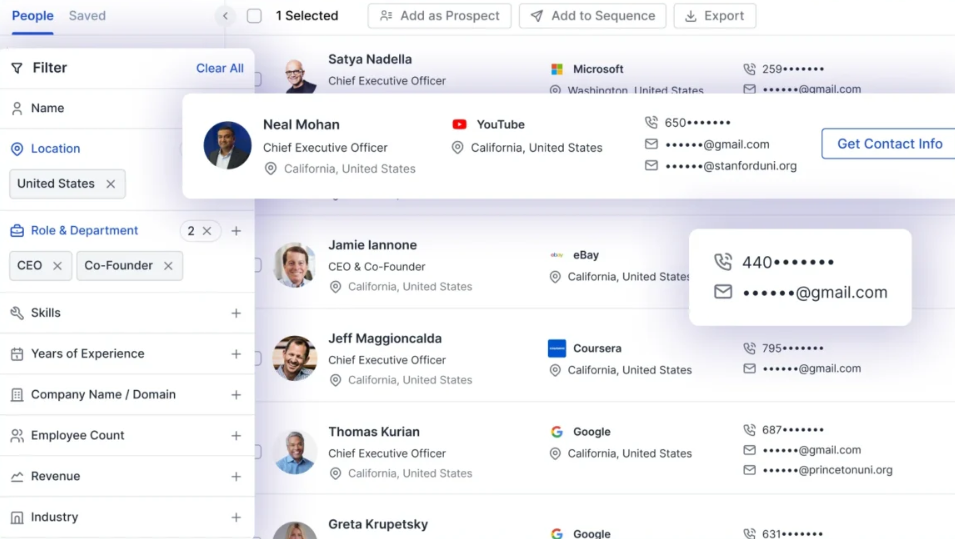
Saleshandy started as an email tracking extension. It has grown into a combined data-plus-outreach platform. Its Lead Finder product is the part that competes directly with Lusha. Our Saleshandy review covers the outreach side too, if that's part of your evaluation.
Key Features
- A database of 700M+ professional contacts and 60M+ company profiles.
- Real-time email verification with a reported 92% accuracy rate.
- Direct integration into Saleshandy's cold email sequencing tool.
- LinkedIn-based email discovery.
What I Like About Saleshandy
- One purchase can replace two subscriptions. That helps teams already paying separately for data and sending.
- A large database (700M+ contacts) at a low entry price point.
- Unused Lead Finder credits reportedly carry over rather than resetting.
- Native integration into the sending tool. No export-and-import step between finding a lead and emailing it.
What Could Be Better
- Lead Finder is a separate purchase from Saleshandy's Outreach sending plans. The low headline price doesn't include data.
- Data quality is reportedly weaker outside the US and EU.
- Outreach is email-only. Teams running LinkedIn-first or multichannel sequences need a second tool.
- No built-in dialer, so phone-based outbound isn't part of the workflow.
Pricing
Lead Finder starts around $24 to $29/month for entry-level credit volumes. It scales up to roughly $199/month for larger teams. This is separate from Saleshandy's Outreach sending plans, which start around $25/month. A full stack (data plus sending) typically runs $50 to $75/month combined at the entry tier.
If the data-plus-outreach bundle isn't quite the right fit, Saleshandy alternatives covers the wider field.
10. Adapt

Adapt.io is a lighter-weight B2B contact platform. It's aimed at teams that want core prospecting features without an enterprise price tag.
Key Features
- CSV and CRM export capabilities.
- Basic lead scoring.
- Dynamic lists with real-time data pushes.
- REST API access for custom enrichment workflows.
What I Like About Adapt.io
- A genuine free plan for testing the platform before paying anything.
- Built-in lead scoring, so smaller teams don't need to build prioritization logic themselves.
- REST API access even at the lower end of the pricing spectrum.
- One of the more affordably positioned tools in this entire category.
What Could Be Better
- Paid tier pricing isn't published. You have to submit a request form to see numbers.
- Database size claims vary a lot across third-party sources. Some say 60M, others say over 200M contacts.
- No built-in intent data layer, unlike a number of competitors on this list.
- Fewer advanced features overall compared to platforms like Apollo or ZoomInfo.
Pricing
Adapt.io publishes a free plan with limited credits. It gates paid tier pricing behind a request form. Budget for a mid-tier SMB price point based on third-party reporting. Confirm current numbers directly, since Adapt.io doesn't list paid pricing publicly.
For a broader look at this exact category, B2B contact database providers has the field.
11. SwordFish

Swordfish AI specializes in something few tools on this list touch well. Personal cell phone numbers and personal email addresses. That makes it a favorite among recruiters and phone-first sellers.
Key Features
- A reverse search tool for matching a partial contact to a full profile.
- Bulk CSV enrichment against a 200+ partner data network.
- Chrome extension covering LinkedIn, GitHub, and social platforms.
- CCPA-aligned data handling.
What I Like About Swordfish AI
- Strong at personal cell numbers specifically, a data type plenty of rivals handle poorly.
- A flat rate that removes the per-credit anxiety common elsewhere in this category.
- Bulk file enrichment against a 200+ partner network, useful for cleaning up an existing list.
- A pay-only-on-match model for file enrichment, so a low hit rate doesn't cost extra.
What Could Be Better
- The "unlimited" Solo plan has fair-use caps. They're undisclosed, and only show up after you hit them.
- No permanent free plan, just a limited trial.
- No company intelligence, technographic data, or intent signals. This is a narrow, single-purpose tool.
- Business-line coverage is thinner than personal-line coverage. Not a general-purpose database replacement.
Pricing
Swordfish runs two tiers. Solo, at $99/month, is single user with "unlimited" lookups subject to undisclosed fair-use limits. Teams, at $599/month on annual billing, adds API access and bulk file enrichment. There's no permanent free plan, though a limited free trial is typically available.
12. Seamless.AI

Seamless.AI leans on real-time AI-driven search rather than a static pre-built database. It scans the web at the moment of a lookup.
Key Features
- Real-time, AI-assisted contact discovery.
- Job change tracking.
- Enterprise-level security features on higher tiers.
- Chrome extension for prospecting.
What I Like About Seamless.AI
- Real-time search can surface fresher data than a static database in some cases.
- Job change tracking baked in without needing a separate signal tool.
- A free tier exists to test data quality before committing to anything paid.
- Chrome extension makes in-browser prospecting fast for reps working LinkedIn directly.
What Could Be Better
- Multiple reviewers report credits being consumed even on failed lookups.
- Pro and Enterprise pricing sits entirely behind a sales call. No numbers are published.
- Paid plans are typically annual-only. Reports mention a 60-day cancellation window before renewal.
- The free tier gives only 50 lifetime credits, not a monthly refresh, so it runs out fast.
Pricing
Seamless.AI's Free plan gives 50 lifetime credits (not monthly). As of 2026, the mid-tier Basic plan has reportedly been phased out. That leaves Free, Pro, and Enterprise, with the latter two requiring a sales conversation. Reported real-world Pro pricing runs $79 to $150+/user/month. Expect a 5-seat minimum and an annual contract too.
If the quote-only pricing is a dealbreaker, Seamless.AI competitors has more transparent options.
13. 6sense

6sense is a different category of tool entirely. It's a predictive ABM and intent orchestration platform. Contact data is just one module inside a much larger system.
Key Features
- Predictive AI scoring for account buying-stage and fit.
- Third-party intent data alongside 6sense's own "Dark Funnel" visitor identification.
- Automated, personalized outreach sequencing tied to account signals.
- A free plan with limited monthly data credits.
What I Like About 6sense
- Predictive scoring that goes well beyond what a plain contact database offers.
- A real fit for account-based marketing motions where coordinated, account-level timing matters.
- "Dark Funnel" visitor identification surfaces anonymous research activity. A typical tool misses that entirely.
- A free plan exists for testing basic functionality before any budget conversation.
What Could Be Better
- Pricing is entirely custom-quoted. Reported median contracts run around $55,000 to $58,000 a year.
- Multi-year contracts are standard, which limits flexibility if the platform isn't delivering.
- It's overkill if your team just needs verified contact data rather than full ABM orchestration.
- Implementation and ramp time run longer than a straightforward database tool, given the platform's scope.
Pricing
6sense's Free plan includes 50 monthly credits. Paid tiers (Team, Growth, Enterprise) are entirely custom-quoted, with enterprise deployments reaching well past $100,000/year. This puts it in a different budget category than the rest of this list. Weighing it against the enterprise database route specifically? 6sense vs ZoomInfo covers that comparison directly.
For teams weighing whether the ABM spend is worth it, 6sense alternatives breaks down lighter options. Nearly all cost a fraction of the price.
How to Choose the Right Lusha Alternative
Run through these before picking a tool, in roughly this order:
- Coverage where you sell. A database strong in North America and thin in EMEA or APAC will quietly underperform. That's true whenever your target accounts sit outside the US.
- Mobile versus email-only. Check what a "verified contact" includes. Some tools charge the same credit for an email as a phone number. Others meter phone data far more aggressively.
- Pricing model fit. Per-seat pricing (Apollo and similar all-in-one platforms) rewards teams that share usage evenly. Credit-based pricing (SMARTe, UpLead, Lusha itself) rewards teams with predictable, moderate volume.
- Compliance requirements. GDPR or CCPA compliance a procurement requirement? Confirm it directly rather than assuming. Coverage varies by vendor and region.
- Integration depth. A tool that syncs cleanly into your CRM saves more time than a marginally bigger database does.
- Whether you need a platform or a database. Apollo, Saleshandy, and 6sense bundle outreach or ABM orchestration on top of data. Already have a sales intelligence stack for that? A pure data tool is the simpler buy.
Take the free trial or free tier seriously before committing to an annual contract. A 15-minute test against 20 real target accounts tells you more than any pricing page.
The Bottom Line
Lusha isn't a bad tool. It's a tool built for a specific shape of team. Plenty of teams have simply outgrown that shape, or never fit it to begin with. The right alternative depends less on which tool has the biggest database. It depends more on where your team sells and how you pay for data today. It also depends on whether you need a database or a full platform wrapped around one.
A free trial against your real target accounts beats reading any article, including this one.