I've watched sales teams make the same mistake three times in a row. They pick a tool based on a G2 badge or a peer recommendation, sign a 12-month contract, and then spend the next six months wondering why their connect rates haven't moved.
The problem isn't that Apollo or ZoomInfo are bad tools. The problem is that most teams pick the wrong one for their actual workflow.
I'll give you a straight breakdown of Apollo vs ZoomInfo — pricing, data quality, mobile coverage, intent data, and integrations — so you can make the right call for your team. And yes, at the end, I'll tell you why SMARTe outperforms both for outbound-first sales teams. But first, let's make sure you understand what you're actually choosing between.
Apollo and ZoomInfo Are Not the Same Kind of Tool
This is the part most comparison articles skip. And it's the part that causes the most confusion.
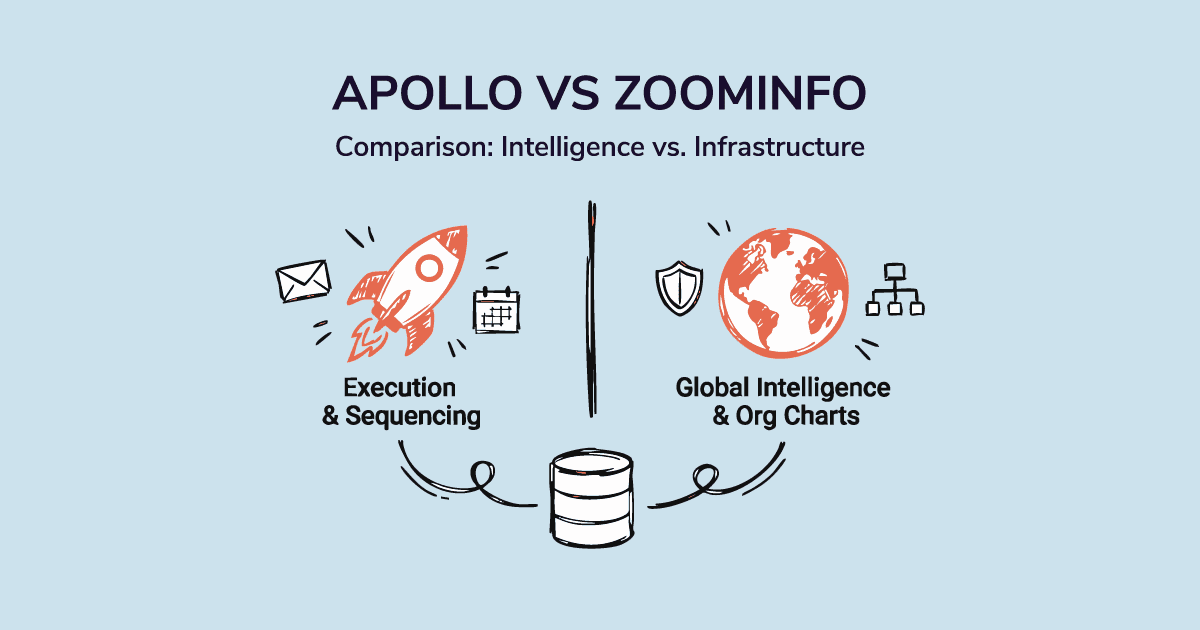
Apollo.io is, at its core, a sales engagement platform with a contact database built in. It was designed for SDRs who want to prospect, build sequences, and send emails all in one place. The database came later. The sequences came first.
ZoomInfo is, at its core, a data intelligence platform with engagement features tacked on. It was built around the depth and quality of its contact and company database. The sales workflow tools are secondary.
Here is the thing though. If you need a sequencing tool with decent data bundled in, Apollo makes sense. If you need the deepest possible database of US contacts and you already have Outreach or Salesloft, ZoomInfo makes more sense.
Most teams conflate the two because they both show up in the same search results. They're not the same. And picking the wrong one based on price alone is how you end up stuck in a contract that doesn't serve your actual motion. For a broader look at this category, the roundup of best sales intelligence tools covers where both fit.
What Apollo Is Actually Built For
Apollo is best for teams that want everything in one tab. Prospecting, sequencing, email writing, basic CRM sync. It's priced for SMBs and growth-stage startups that can't justify a ZoomInfo contract. You can get started for free (more on that shortly) and the UI is genuinely intuitive.
The trade-off: the data layer is thinner than it looks on a slide deck. Apollo's contact database relies heavily on user-contributed data and public web scraping. That's not a knock on them. It's just how they built it. And it means accuracy can vary, especially for mobile numbers and international contacts.
What ZoomInfo Is Actually Built For
ZoomInfo is built for enterprise GTM teams that need data depth, not just data volume. They invest heavily in machine learning, human research, and acquisitions (they've bought multiple companies to expand their database). The result is a platform that's very good at US-based account coverage, firmographic depth, and ABM-style targeting.
The trade-off: the price tag is serious. You can't sign up without talking to a sales rep. Contracts run annually and often exceed $14,995 for a baseline team. And outside of the US, the data gets noticeably thinner.
Apollo vs ZoomInfo: Database Size and Data Quality
Both platforms have large databases. Here are the numbers:
- Apollo: 275M+ contacts across 73M+ companies
- ZoomInfo: 220M+ active contacts, 174M+ verified emails, 94M direct dials
But database size is not the story. The story is how that data gets collected, and how often it gets refreshed. If you want to understand why this matters day-to-day, read more about how B2B data goes stale over time and what it costs your pipeline.
How Apollo Collects Its Data (and Why That Matters)
Apollo pulls data from public web crawling, third-party partnerships, and — here's the part most people miss — a network of data contributors. When you connect your CRM or email to Apollo, you're adding to their database.
Apollo's own Terms of Service confirm this: users grant Apollo a license to use, reproduce, and share any data submitted to the platform, even after they stop using it. So if your competitor is also on Apollo, there's a real chance your contact data is helping build their prospect lists too.
This isn't unique to Apollo. It's common in the industry. But it's worth knowing before you sync your entire CRM on day one.
The accuracy impact: G2 reviewers consistently flag Apollo's mobile number quality as inconsistent. For SDRs doing heavy cold call volume, this matters more than almost anything else.
How ZoomInfo Collects Its Data
ZoomInfo uses machine learning, automated web scraping, human research teams, and company acquisitions to build and maintain their database. They also run a community of business professionals who voluntarily contribute their data in exchange for platform credits.
The result is generally higher accuracy for US-based contacts, especially at the executive level. ZoomInfo assigns confidence scores to records so you know how fresh the data is. The problem is that outside of North America, these confidence scores drop sharply.
G2 reviews regularly mention that ZoomInfo's European and APAC data is significantly weaker than its US coverage. For US-only teams, this is a non-issue. For teams with global mandates, it becomes a real constraint.
This is a fundamental challenge across most B2B contact database providers — strong in one region, thin everywhere else.
The Question No One Asks — How Fresh Is the Data?
Neither Apollo nor ZoomInfo does real-time verification at the contact level. They verify in batches. They refresh on a schedule. That means by the time a record shows up in your search results, it could be weeks or months old.
People change jobs. Phone numbers get reassigned. Email addresses bounce. The industry average for B2B data quality degradation is significant — around 20 to 30 percent of contact data goes stale every year.
What to do:
Before committing to any data vendor, ask specifically: what is your verification methodology, how often do you refresh individual records, and what is your bounce rate guarantee for emails? If they can't give you a clear answer, that's your answer.
Apollo vs ZoomInfo Pricing — What You Actually Pay
Pricing is where these two tools are most different. And where the fine print matters most.
Apollo Pricing Breakdown
Apollo publishes its pricing, which is genuinely refreshing in this space. Here's the current structure:
- Free: $0 forever, 5 mobile credits/month, 10 export credits/month
- Basic: $49/user/month (annual) or $59/month — 5,000 mobile credits/year
- Professional: $79/user/month (annual) — unlimited sequences, enhanced limits
- Organization: $119/user/month (annual, 3-user minimum) — advanced security, call transcriptions
The free plan is one of the most generous in the category. You get real database access, two active sequences, and the Chrome extension. It's enough to test the product seriously before paying anything.
The catch with paid plans: Apollo charges one credit for an email reveal and another credit for a phone number. At scale, your credit budget disappears faster than you expect. Teams doing serious outbound volume find that actual costs run 2 to 3x the advertised rate once overages and add-ons come in. For a full breakdown, the Apollo pricing guide covers every tier and the hidden costs in detail.
ZoomInfo Pricing Breakdown
ZoomInfo does not publish pricing. You need to contact their sales team to get a quote, and that quote is customized based on your team size, use case, and contract length.
Based on widely reported estimates, ZoomInfo typically starts at $14,995/year for a small team. Enterprise contracts can reach $30,000 to $50,000+ depending on the package. The platform uses a credit system similar to Apollo — you get a set number of credits per year, and each contact export consumes them.
For a complete picture of what you're actually committing to, the ZoomInfo pricing breakdown goes through all the contract structures and add-on costs.
The Credit Trap: What Both Tools Do to Your Team's Behavior
Here is the thing that doesn't get talked about enough. Credit-based systems change how your reps behave. When every dial or export burns a credit, reps start rationing. They get selective in a way that kills prospecting volume. They second-guess which contacts to reveal. They avoid testing new segments because it feels expensive.
I call this the scarcity mindset. And it is one of the biggest productivity killers in outbound sales.
Mobile Coverage — The Comparison No One Is Making
Every comparison article leads with database size. Almost none of them lead with mobile coverage. And for SDRs doing high-volume cold outbound, mobile coverage is the only number that actually affects your connect rate.
Why Mobile Numbers Determine Your Connect Rate
Your prospects don't answer their office lines. Most decision-makers screen unknown numbers on their desk phone automatically. A direct mobile number — verified, current, and actually theirs — is the difference between a conversation and a voicemail.
This is why mobile coverage should be your first question when evaluating any sales intelligence tool. It's also why your outbound prospecting workflows break down when the underlying data doesn't hold up.
Apollo's Mobile Coverage Gap
Apollo reports 120M phone numbers in its database. That's a big number. But phone number count and verified mobile number count are very different things.
A significant portion of Apollo's phone data is office lines, HQ numbers, and unverified entries pulled from web scraping. G2 reviewers specifically and repeatedly flag the quality of Apollo mobile numbers as inconsistent. On the Organization plan, you get 5,000 mobile credits per year. For a team of five SDRs doing 50 dials a day, that's gone in under a week.
ZoomInfo's Direct Dial Numbers — and Their Limits
ZoomInfo claims 94M direct dials. That's more than Apollo's verified mobile count by most independent estimates. For US enterprise contacts, ZoomInfo's direct dial coverage is genuinely strong.
But again, this coverage drops outside of North America. And the cost of accessing those direct dials at scale — with ZoomInfo's per-credit pricing on a $15,000+ contract — is hard to justify for teams that aren't landing enterprise accounts every week.
What to do:
When evaluating any credit-based platform, calculate your actual required monthly credits — not the ideal scenario, but a real-volume scenario. Take your reps' average daily prospecting volume, multiply by 30, and see how quickly you burn through the plan's allowance. Then compare that against the overage cost.
Intent Data, Integrations, and Features
Intent Data: Who Does It Better?
Both platforms include intent data, but they source it differently.
Apollo partners with Bombora and LeadSift to surface buying signals. Bombora is the gold standard for B2B intent — it pulls consent-based data from a cooperative of 5,000+ B2B publisher sites. LeadSift adds signals from public web crawling including social media, blogs, and forums. This combination is solid for most teams.
ZoomInfo uses proprietary intent technology built on bidstream data — essentially reading ad auction signals to infer research behavior. Their intent topic library is extensive, but bidstream intent has accuracy limitations that some analysts have flagged.
For teams that want to understand how intent data actually works before baking it into their prospecting motion, it's worth getting clear on the difference between consent-based and bidstream sources before you decide.
CRM and Workflow Integrations
Apollo integrates with Salesforce, HubSpot, Microsoft Dynamics, Pipedrive, Outreach, and Zapier. The integrations work, but G2 reviewers flag occasional sync issues and bugs with bidirectional Salesforce updates.
ZoomInfo has a larger integration marketplace — 40+ CRM and sales tools. At the enterprise level, it's the more plugged-in platform. But enterprise connectivity also means more configuration, more admin overhead, and more potential failure points.
If CRM data enrichment at scale is a core use case for your RevOps team, the integration quality matters as much as the feature list.
Technographics and Firmographics
ZoomInfo has a stronger firmographic filter set — industry codes, revenue bands, headcount, org charts. Apollo has basic firmographic filtering but it's less granular.
On technographics, both platforms offer tech stack data. ZoomInfo has more depth here, especially for enterprise accounts. For teams doing technographic targeting as a core prospecting filter — say, finding companies using Salesforce and Outreach but not a conversation intelligence tool — ZoomInfo's coverage is more reliable.
Apollo vs ZoomInfo — Who Should Use Which Tool?
Here's the honest decision framework. No affiliate links. No hidden agenda.
Use Apollo If...
- You're a startup or growth-stage company with a budget under $500/month
- Your team is US-focused and you need decent data plus built-in sequencing in one tool
- You want transparent pricing you can evaluate without a sales call
- Your reps are doing email-heavy outbound more than high-volume cold calling
- You want a free plan to test before committing
Apollo is a legitimate tool for the right use case. If you're a founder-led sales team, a small SDR team, or an early-stage startup that needs to move fast without a complex procurement process, Apollo is a reasonable starting point.
Use ZoomInfo If...
- You're an enterprise sales organization with a formal data procurement process
- Your team sells exclusively into US enterprise accounts and needs deep firmographic coverage
- You run ABM campaigns that require org chart data, technographic depth, and intent overlays
- You already use Salesforce at scale and need enterprise-grade CRM integration
- Budget is not a constraint and you need the biggest US database available
ZoomInfo earns its price tag for enterprise teams doing complex account-based selling into US markets. If that's your motion, it's worth the conversation with their sales team.
When Neither Tool Fully Works for You
Here's where it gets interesting. Both Apollo and ZoomInfo leave real gaps:
- Apollo's mobile data quality is inconsistent for high-volume cold callers
- ZoomInfo's international coverage drops sharply outside North America
- Both use credit systems that create behavioral friction for high-volume teams
- Neither does real-time contact verification at the point of use
- Both have per-seat pricing that punishes team growth
If you've already evaluated them and hit these walls, the Apollo alternatives and ZoomInfo alternatives roundups are worth reading before you commit to either.
Why SMARTe Is Better Than Both for Outbound Sales Teams
I'll be straight with you. SMARTe is a competitor to both Apollo and ZoomInfo. So take this section with that in mind. But also read it, because the data speaks for itself.
Apollo does sequencing well. ZoomInfo does US firmographic depth well. SMARTe does something neither of them prioritizes: verified mobile coverage at scale, real-time contact verification, and global depth without per-seat pricing penalties.
Here's the specific breakdown.
289M+ Contacts — Verified in Real Time
SMARTe's database has 289M+ verified B2B contacts across 66M+ company profiles. That's bigger than Apollo (275M) and significantly bigger than ZoomInfo's active contact count (220M).
But the number isn't the differentiator. The verification method is.
SMARTe uses real-time verification — not batch processing, not monthly refreshes. When you pull a contact, the data is validated at that moment. That means the email you're about to send isn't bouncing from an address that went stale six months ago. And the number you're about to dial is still assigned to the person you're trying to reach.
This is the data problem Apollo and ZoomInfo both struggle with, just in different ways.
75%+ US Mobile Coverage — The Number That Moves Connect Rates
SMARTe covers 75%+ of US decision-makers with verified direct dial mobile numbers. ZoomInfo claims 94M direct dials total, but that includes desk lines and office numbers in the count. Apollo's mobile accuracy is inconsistent at scale.
When 75%+ of the US contacts you pull have a verified mobile attached, your connect rate changes. Your SDRs spend time talking instead of leaving voicemails. Your cost per meeting drops. Your pipeline math works.
For teams running high-volume cold call outbound, this single number — mobile coverage rate — matters more than almost any other feature on the comparison table.
Global Coverage That Actually Works
SMARTe covers 200+ countries with 50%+ global direct dial coverage. ZoomInfo's international data gets thin fast outside the US. Apollo's European coverage is a known weakness flagged by G2 reviewers consistently.
If your team sells into LATAM, APAC, or EMEA — or if you're planning to — SMARTe's regional depth in those markets is a genuine operational advantage, not a marketing claim.
No Per-Seat Pricing — No Scarcity Mindset
SMARTe prices by credits, not seats. Pricing starts at $15,000 per year and your entire team shares one credit pool. When you hire a new SDR, you don't pay another $79 or $119 per month just to give them access.
Credits start at $0.30 each and the rate falls as volume grows, reaching $0.20 per credit at 1M credits. Larger commitments go lower than that.
SMARTe is enterprise only, so there's no self-serve tier to sign up for. You get a quote built around your credit volume rather than your headcount.
AI Agents and SMARTe MCP — Where Neither Competitor Has Caught Up
SMARTe has AI Agents built natively into the platform. They auto-discover buying groups per account, handle account research, monitor signals, and let reps stay focused on selling instead of data prep.
SMARTe also offers an MCP (Model Context Protocol) server that gives AI tools like Claude and ChatGPT direct, real-time access to verified B2B contact data. If your team is using AI-assisted prospecting workflows, this is the integration that makes them actually useful — pulling live, verified contacts rather than hallucinated ones.
The Comparison Table
| Feature | Apollo.io | ZoomInfo | SMARTe |
|---|---|---|---|
| Primary use | Sales engagement + data | Data intelligence + GTM | Verified B2B data + AI |
| Database size | 275M+ contacts | 220M+ active contacts | 289M+ verified contacts |
| US mobile coverage | ~120M phones (variable accuracy) | 50M direct dials | 75%+ verified direct dials |
| Data verification | User-contributed + scraping | ML + human review | Real-time verification |
| Pricing model | $49–$119/user/month | Custom quote, $14,995+ /yr | From $15,000/yr, pay-per-credit |
| Per-seat pricing | Yes | Yes | No — share credits |
| Intent data | Bombora + LeadSift | Proprietary + bidstream | Bombora built-in |
| Global coverage | US-strong, EU weak | US-strong, EU limited | 200+ countries, LATAM/APAC |
| Self-serve signup | Yes — free plan available | No | No — enterprise only |
| CRM integrations | Salesforce, HubSpot, Outreach | 40+ integrations | Salesforce + Outreach native |
| AI features | Higher tiers only | Copilot at add-on cost | AI Agents built in natively |
| GDPR / CCPA | Yes | Yes | Yes + SOC 2 Type II |
The Bottom Line
Apollo is a good tool for small, budget-conscious teams that want data and sequencing in one place. ZoomInfo is a powerful platform for enterprise teams that live and die by US contact depth and ABM sophistication.
But both have the same underlying problem. They don't verify data in real time. They charge per seat. And their mobile coverage — the one thing that determines whether your SDR has a conversation or leaves a voicemail — doesn't hold up at the level outbound teams actually need.
SMARTe was built for exactly this gap. 289M+ verified contacts. 75%+ US mobile coverage. Real-time verification. No per-seat pricing. And genuine international depth in the markets where Apollo and ZoomInfo are still catching up.
At the end of the day, data isn't the product. Pipeline is. And the teams that win in outbound aren't the ones with the biggest lists. They're the ones reaching the right person, on a number that actually rings, with a message that's been earned by choosing the right data.
Book a demo to see the mobile coverage in your target accounts firsthand, and ask for a live sample against your own list.