TL;DR:
Real-time B2B data verification checks contact records at the moment you use them, not on a past batch schedule. Here is what that timing difference costs revenue teams and what to do about it.
- B2B contact data decays at 22 to 30% per year. Batch-enriched lists go stale between every cycle.
- Real-time verification checks email deliverability, phone status, and job title accuracy at the point of use.
- Batch and real-time enrichment cover different workflow moments. Most mature GTM stacks need both.
- The three workflows where live data matters most: CRM enrichment, job change tracking, and pre-sequence checks.
- SMARTe verifies contacts in real time across 289M+ contacts, with 90%+ CRM match rates and 75%+ US mobile coverage.
Your SDRs are probably dialing against contacts that look right but are not. The email was valid six months ago. The phone number was good when someone ran the last batch job. Real-time B2B data verification is the fix for that. It checks records the moment you use them, not the last time someone refreshed the database.
B2B contact data decays at 22 to 30% per year. Batch enrichment has a freshness gap built into its design. By the time a rep dials, some of that list is already wrong. This page covers how real-time verification works, how it differs from batch enrichment, and where it changes outcomes for your team.
What Real-Time B2B Data Verification Actually Means
Real-time B2B data verification means your platform checks a contact record the instant you access it, against live sources, before the result reaches a rep or workflow.
Pull a contact from a real-time system and you get what is true right now. The platform queries live sources in the moment. Email deliverability. Phone connectivity. Whether that person still works at that company. The result reflects the current state of that contact, not the state of the database the last time it ran a bulk update.
Batch enrichment works differently. It runs on a schedule. You trigger a job, the vendor processes records in bulk, and results come back later. Batch is efficient at scale. But it creates a gap between when data was verified and when you actually use it.
What It Actually Checks
Four things matter most for outbound teams:
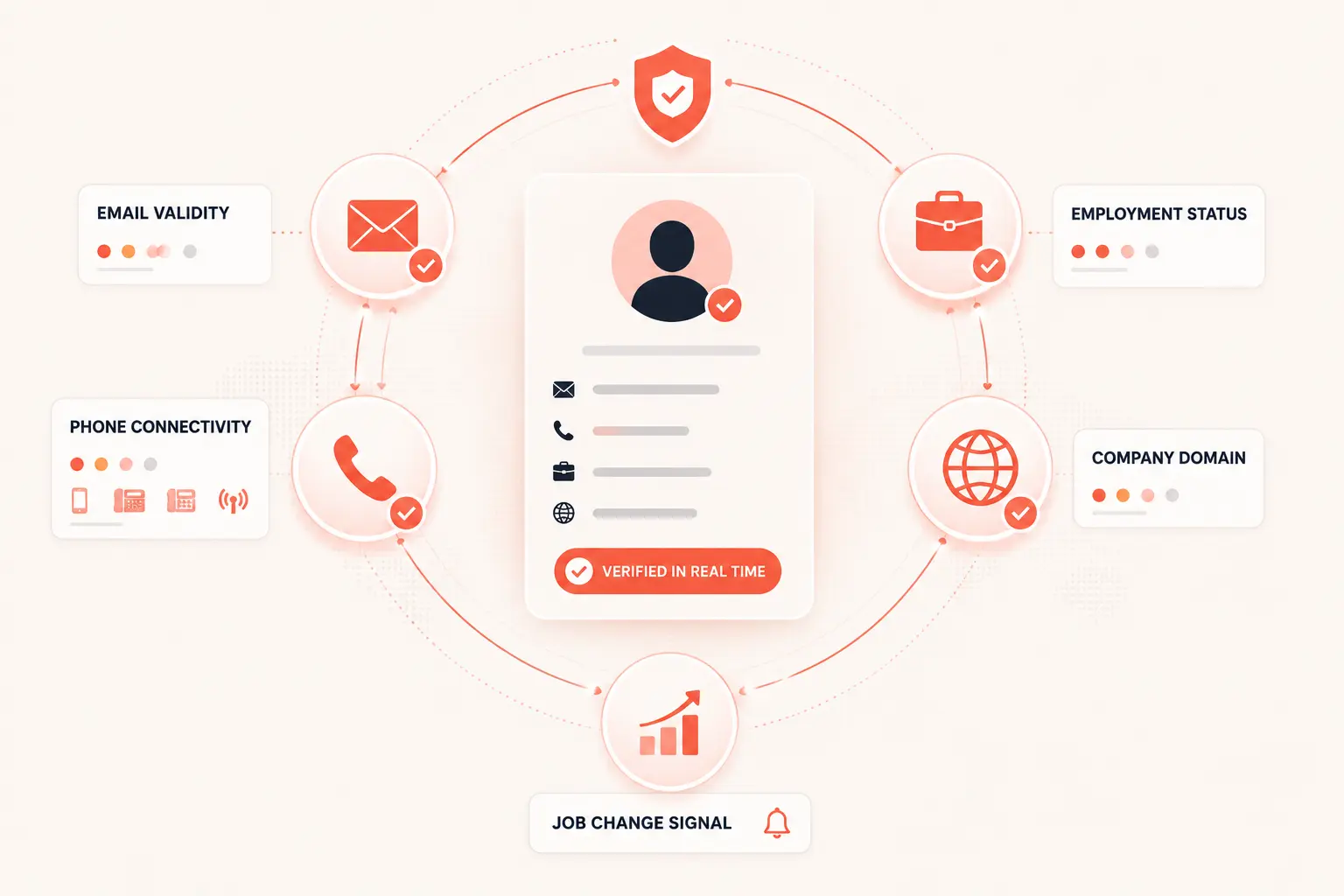
- Email validity. Not just whether the address format looks right, but whether the mailbox actually exists and accepts mail. Catch-all domains are the tricky case (they accept any address at the SMTP check, but many silently reject actual delivery). Good platforms add a risk-score layer on top of format validation to flag these.
- Phone connectivity. Whether the number is active, what type it is (mobile, direct dial, landline, VoIP), and whether it is likely to connect when dialed.
- Employment status. Whether the contact still works at that company with that title. Job changes are the fastest driver of data decay in B2B by a wide margin.
- Company domain. Whether the organization is still operating under that domain. Acquisitions, rebrands, and closures make domains useless fast.
Some platforms also pull job change signals as part of verification. That turns a data quality check into an outreach trigger. That is where it gets genuinely useful.
What It Cannot Fix
You would expect real-time to mean always fresh. That is not actually how it works.
Real-time verification catches stale data at the moment you try to use it. A contact who changed jobs yesterday will not show as stale unless the platform's underlying database has already captured that update.
I have seen this play out badly. Teams switch to a real-time vendor expecting clean data, and the data is still wrong, because the vendor's database only refreshed monthly. They were getting stale data delivered instantly.
Verification speed and data freshness are separate things. A platform can check a record in milliseconds and return information that is two months old. The underlying refresh cadence matters as much as the delivery speed.
Batch vs. Real-Time: Two Different Jobs
Neither model is better. They solve different problems, and most teams that get this right run both.
Batch enrichment is the right tool for bulk work. Cleaning a large database. Prepping a campaign list. Running a quarterly CRM hygiene cycle. Per-record cost is lower. Processing volume is higher. You do not need results in the next five seconds.
Real-time verification is the right tool when timing matters. Before a sequence launches. When a new lead enters the CRM. When a buying signal fires and a rep needs to act today, not after the next scheduled batch job runs.
Batch Enrichment vs. Real-Time B2B Data Verification
| Batch Enrichment | Real-Time Verification | |
|---|---|---|
| When it runs | Scheduled (weekly, monthly, quarterly) | At the point of use |
| Data freshness | Weeks to months old at action time | Current at moment of lookup |
| Cost per record | Lower | Higher |
| Best for | Database refresh, list prep, CRM hygiene | Pre-sequence checks, new CRM records, inbound routing |
| Failure mode | Freshness gap between cycles | Cost overrun on high-volume lookups |
The problem most teams have is not picking the wrong model. It is running only batch and assuming the data is still good by the time the reps start dialing. That assumption is expensive.
Running batch for database maintenance and real-time for the live moments is where most mature teams land. And for teams who want to pull from multiple sources simultaneously to fill coverage gaps, that is where waterfall enrichment comes in.
How Quickly Does B2B Data Go Bad?
Research from Marketing Sherpa puts annual B2B data decay at roughly 22.5%. Gartner estimates the annual cost of poor data quality at $12.9 million per organization. Both figures measure the same problem from different angles.
Broken down by field, the picture looks like this:
B2B Contact Data Decay Rates by Field Type
| Data Field | Annual Decay Rate | What It Breaks |
|---|---|---|
| Job title | 25 to 35% | Wrong persona targeted, message misses the mark |
| Business email | 20 to 25% | Bounces damage your sender domain |
| Direct dial / mobile | 15 to 20% | Dead dials waste rep time |
| Company domain | 10 to 15% | Outreach hits defunct organizations |
Run those numbers against a 10,000-contact database. That is 2,200 to 3,000 stale records within a single year. With quarterly batch refreshes, some contacts stay wrong for up to 90 days before the next cycle catches them.
Job changes drive most of it. One personnel move breaks the email, the phone number, and the job title simultaneously. Three fields. One event. The CRM has no idea it happened.
For a deeper look at what causes these patterns and how to measure them in your own CRM, see the guide on B2B data decay.
Where It Changes the Outcome
Real-time verification does not hit every role the same way. Where it matters most depends on what you are doing with the data.
RevOps: Fixing the Drift Nobody Notices
Most CRM data problems do not happen all at once. There is no single event where things break. Records drift. A title goes wrong here, a phone number there, a domain that changed after an acquisition. Until the CRM is technically full but practically unreliable.
Real-time CRM data enrichment patches this as it happens, not in a cleanup sprint you schedule once a quarter. When a new record enters the system or an existing one gets touched in a workflow, the platform updates relevant fields automatically. No CSV export. No manual project.
Match rate is the metric that tells you how much of your database actually gets covered (and it is usually not the number vendors put in the slide deck). A 60% match rate means four out of ten records do not get touched in a given enrichment cycle. That is not a minor gap.
SMARTe runs at 90%+ CRM match rates. For Salesforce teams, Salesforce data enrichment runs natively inside the workflow, not through a separate export cycle.
Bad CRM data compounds quietly. Wrong titles route reps to the wrong contacts. Stale emails damage sender reputation. By the time any of that shows up in your metrics, the damage is already done.
SDRs: Every Stale Number Costs Dial Time
Most SDR managers I have talked to treat high bounce rates as a deliverability problem. They adjust the subject line. They question the copy. They rarely question the data.
A lot of bounce problems start before the sequence launches. The contact was already wrong when the rep hit send.
Verifying contacts before a sequence goes out catches bad records before they hit the domain. The math is simple: if 20% of a 150-contact sequence has stale mobile numbers, that is 30 dials before a rep talks to anyone real. At 60 dials a day, that is 30 minutes of capacity gone. Every day. On contacts that were never going to answer.
In my experience, mobile coverage rate tells you more about a data provider than any other single number. Total database size is a marketing stat. SMARTe covers 75%+ of US contacts with verified direct dials. That number predicts whether your reps will actually connect with people.
Sales Managers: Job Changes Are Pipeline Triggers
When someone changes jobs, they do not disappear as a buyer. Often they become a better one.
The 30 to 90 days after a new hire is the buying window. Fresh budget. New mandate. No existing vendor relationships to work around. I think this is the most underused pipeline trigger in B2B outreach. Most teams miss it because no one is monitoring job changes at scale.
Automated job change tracking turns a missed window into an alert. When a contact changes roles, the system flags it, updates the record, and routes an alert to the relevant rep. That is the outreach signal, not a guess, an event.
The expansion angle matters too. When a champion at a current account moves to a new company, that is a warm intro window. Automated champion tracking makes sure you know when that happens. Without it, the window closes before most reps even notice.
Five Questions to Ask Any Data Vendor
Before signing anything, get straight answers to these.
What is your CRM match rate against my actual records? Not against internal benchmark data. Pull a sample of your own CRM and ask for a real match test. If a vendor hedges on this, that is your answer.
What is your mobile coverage rate within my ICP? Database size does not predict connect rate. Verified mobile coverage in your specific target segment does. Ask for this number by geography and industry, not the global average.
Is verification actually real-time, or fast batch? Some vendors run batch jobs every few hours and call it real-time. Ask directly: does verification fire at the moment of record access, or on any scheduled cycle? This distinction is the whole thing.
How do you handle compliance? SOC 2 Type II, GDPR alignment, and CCPA compliance are the baseline. Then ask what happens when a data subject requests deletion. How fast? Through what process? The certification is the floor.
What integrations do you support natively? If moving verified data to your CRM requires exporting a CSV, you do not have a real-time workflow. Native Salesforce, HubSpot, or Outreach integrations mean verification fires inside the tools your reps already use.
How SMARTe Does It
SMARTe verifies contacts at the point of use. When you pull a record, the platform checks email deliverability and phone connectivity in real time before the result reaches you. Not on a batch schedule.
The database has 289M+ verified contacts and 66M+ company profiles. It tracks 64,000+ technographic products, so enrichment is not limited to contact fields. You can match by tech stack, firmographic profile, or buying signal data and get a verified contact in the same lookup. Bombora intent data is built in natively, not pulled from a separate source.
The SMARTe MCP (Model Context Protocol) gives AI tools like ChatGPT and Claude direct access to SMARTe's live B2B data. AI agents pulling from a cached or batch-updated dataset work from the past, not the present. For teams building AI-powered outreach workflows, the difference matters. See the full guide on AI data enrichment for more on how this works in practice.
Coverage: 75%+ US mobile with verified direct dials. 50%+ global direct dial coverage. 90%+ CRM enrichment match rates. Native Salesforce and Outreach integrations. SOC 2 Type II certified, GDPR-aligned, CCPA compliant.
Book a demo and we'll run a sample match against your own target accounts. SMARTe is enterprise only, from $15,000 a year, with no per-seat fees, so the whole team shares one credit pool.