TL;DR:
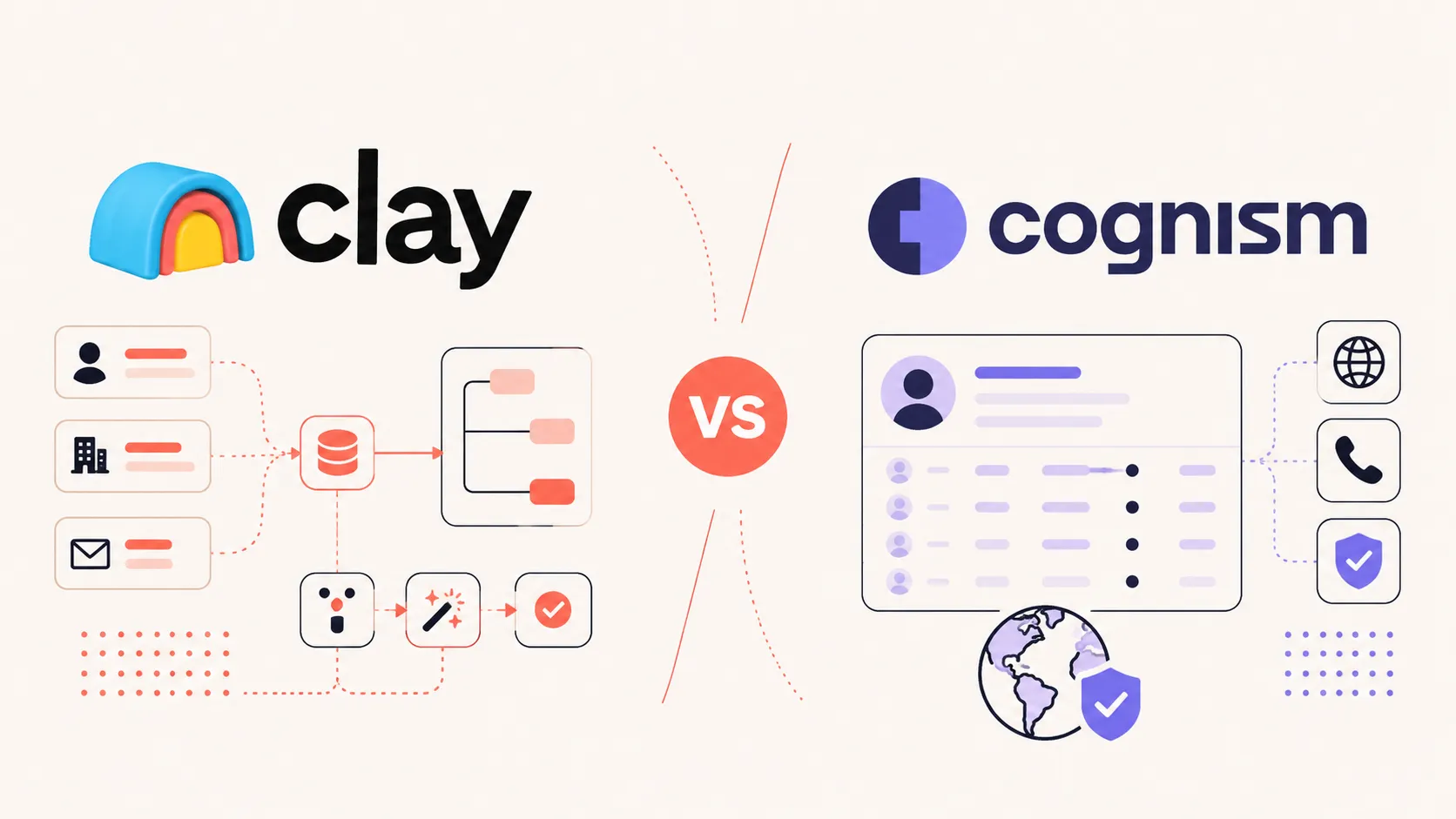
- Cognism sells one database with 10M+ phone-verified contacts and screening against 16 Do Not Call lists. Clay sells a waterfall across 200+ providers that you build and run.
- Cognism publishes no prices. Both of its packages include 5 seats, and Vendr's median Cognism deal is $32,750 a year.
- Clay is free to start, then $167 a month on Launch or $446 a month on Growth, which you need for CRM sync (billed annually).
- G2 users rate Cognism easier to use (9.0 vs 7.8). Clay is far more flexible, with AI research, custom signals and its own email sequencer.
- Cognism isn't a native Clay integration. You can still call Cognism's API from Clay with your own Cognism contract.
Clay vs Cognism at a glance
Cognism gets reps to verified European contacts faster, while Clay covers more ground if someone builds it. I checked every vendor fact in this table on November 6, 2026.
How I compared Clay and Cognism
I used the same checklist SMARTe uses for choosing a B2B data provider: data source, mobile quality, compliance, intent, AI, outreach, integrations, usability and cost.
Facts come from each vendor's pricing pages, Cognism's Diamond Data, security and FAQ pages, and Clay's docs. G2 supplied the review scores. Cognism doesn't publish prices, so cost figures come from Vendr's purchase data.
What is Clay?
Clay is a spreadsheet-style data orchestration tool that GTM teams use to enrich leads and act on them. It has no verified contact database. Clay rents emails, phone numbers and company data from 200+ providers under one contract. You chain those providers together in a table.
A Clay table works like a production line. Each column does one job, and each row is a lead moving through it. The main parts:
- Waterfall enrichment: Clay tries providers in the order you set and stops when one returns a valid result. You pay nothing when a lookup comes back empty.
- Claygent: an AI agent that reads websites and answers custom questions for every row.
- Sculptor: an AI helper that builds workflows from a plain-English request.
- Signals: job changes, funding, tech stack changes, web visits and social mentions.
- Sequencer: native cold email on paid plans since September 2026.
- CRM sync and API: Salesforce and HubSpot sync, webhooks and an HTTP API, all on Growth.
What is Cognism?
Cognism is a London-based B2B data and sales intelligence platform with its own contact database. Cognism describes it as hundreds of millions of company and contact profiles across EMEA, the US and APAC. It says 4,000+ customers use it.
Cognism's main parts in November 2026:
- Diamond Data: contacts whose numbers Cognism's team has called to confirm they reach the named person. Cognism reports 10M+ phone-verified contacts globally.
- Two packages, Standard and Pro: both include 5 seats. Pro adds premium mobile data, on-demand mobile verification and intent data.
- Chrome extension: reveals emails and mobiles while reps browse LinkedIn, and it also works inside Outreach.
- Signals: hiring, funding and M&A, and job changes.
- MCP & API: access to Cognism data from custom workflows and AI assistants.
- CRM Enrichment: an add-on for CRM data enrichment that fills and maintains records.
Clay vs Cognism: 7 head-to-head comparisons
Clay and Cognism differ most in who gathers the data. Cognism collects and checks it before you log in, and Clay collects it on demand from other vendors.
1. Data source: one database vs many providers
Cognism is one curated database, and Clay is a way to query many.
Cognism's records come from first-party sources, third-party providers, public sources, manual research and partnerships. Machine learning processes the data daily. A research team also checks the contacts customers request most.
Clay's data enrichment keeps no master record. It sends each lookup to providers in sequence, so your coverage is the sum of every provider you turn on. If Cognism lacks a contact, you need another tool to find it, while a miss in Clay just passes the row to the next provider.
My take: one strong database beats a waterfall when most of your buyers sit in the regions that database covers best. Cognism's own pages lean hardest on Europe, so that's where it earns its price.
Diagram comparing Cognism's single verified database with Clay's waterfall across many data providers
2. Mobile numbers and connect rates
Cognism leads on verified mobile numbers.
Cognism's Diamond Data team calls numbers to check that the named contact picks up. Cognism cites an independent study of 1,000 mobile numbers. The intended person answered 45% of the time on Cognism-verified numbers, against 18% on standard numbers. Pro customers can also ask for on-demand verification, which Cognism says takes under 48 hours.
Clay unlocks phone enrichment on the Launch plan. Its numbers come from whichever phone providers sit in your waterfall, and Clay doesn't call them to confirm. You can add a validation provider, which adds a step and a cost.
When you compare them for phone prospecting, count how often the intended contact answers per 100 dials. A number that reaches voicemail or a switchboard still shows up as "found" in both tools.
3. European data and GDPR compliance
Cognism does more of the work of keeping your B2B data compliant.
Cognism lists these safeguards on its own pages:
- Contact notices: business contacts are told when they enter the database
- Do Not Call (DNC) screening: numbers are checked against 16 DNC lists. These include the US, the UK's TPS and CTPS, Australia, France and Germany
- Certifications: ISO 27001 and ISO 27701 from a UKAS-accredited body, plus SOC 2 Type II
- Privacy laws: aligned with GDPR and compliant with CCPA, by Cognism's account
Clay lists SOC 2 Type II, GDPR, CCPA, ISO 27001 and ISO 42001 for its own platform. Each provider in your waterfall collected its records under its own terms. So your team checks each provider for lawful basis and DNC screening.
Neither tool takes over your own GDPR duties. The rules on GDPR and cold calling still apply. You need a lawful basis, usually legitimate interest, for every European contact you call or email.
4. Intent data and buying signals
Cognism is stronger on packaged intent data, and Clay is stronger on custom signals.
Cognism Pro includes Bombora intent data, with up to 12 topics chosen from a library of 11,000+. It also tracks buying signals such as hiring, funding, M&A and job changes.
Clay adds job change, news and social signals on Launch and web intent on Growth. Claygent can also build signals no vendor sells. One illustration: flag target accounts that posted a German-speaking sales role and added a CRM in the same quarter.
5. AI and workflow automation
Clay wins on automation by a wide margin.
Clay was built for GTM workflow automation. Claygent researches rows on the web, and Sculptor drafts workflows from a prompt. AI formulas handle lead scoring and routing. You can branch logic, run code and choose between AI models from OpenAI, Anthropic and Google.
Cognism's AI helps reps search faster. Standard includes AI search and AI company research, and Pro adds an AI persona builder. There's no workflow builder, so any multi-step automation happens in another tool.
6. Outreach and integrations
Clay can send cold email on its own, while Cognism passes contacts to the tools you already use.
Clay Sequencer sends cold email through Smartlead, with up to 4 emails per sequence. It has no dialer, so phone-heavy teams still run multi-step sales cadences in Outreach, Salesloft or HubSpot. Clay's CRM sync, webhooks and HTTP API all sit on the Growth plan.
There's no sequencer or dialer in Cognism. It integrates with Salesforce, HubSpot, Pipedrive, Microsoft Dynamics, Outreach and Salesloft. The Cognism Chrome extension works inside Outreach, and the MCP & API product feeds Cognism data into AI assistants.
7. Ease of use and who runs it
Cognism is easier for reps to pick up, and Clay needs someone to own it. G2's comparison page shows the gap (scores as of November 2026):
The reviewer mix shows who buys each tool. 73.5% of Clay's G2 reviewers work at small businesses, while 53.4% of Cognism's are mid-market and 21% are enterprise.
A Clay owner manages API keys, credit budgets, prompts and run conditions. That's the GTM engineer's job. Cognism needs an admin for seats and CRM mapping, but reps can start prospecting without anyone building anything.
Clay vs Cognism pricing in 2026
Clay publishes every self-serve price, and Cognism publishes none. You can sign up for Clay online, but Cognism needs a sales call.
Clay pricing
Clay lists four plans on its pricing page:
Clay's pricing has two meters. Data credits pay for provider data, and actions pay for each step a table runs. A fully enriched record usually costs 6 to 20 data credits, according to Clay University. Seats are unlimited on every plan.
Cognism pricing
Cognism's pricing page shows two packages and no prices:
Cognism pricing counts usage in credits too:
- 1 credit = 1 revealed contact
- Viewing a contact you already revealed is free
- A credit is used again only if that contact changes jobs
- Credits work across the Cognism app, Enrich and the API
Cognism doesn't publish how many credits each seat gets, so ask for the number in writing. Vendr's Cognism data shows a median deal of $32,750 a year across 94 purchases. Deals range from $16,585 to $88,449, and Vendr says buyers save 26% on average.
Year-one cost for a 5-rep SDR team
Here's an illustrative year-one comparison for 5 SDRs, using list prices and Vendr's median.
Bar chart of illustrative year-one cost for a 5-rep SDR team on Cognism and Clay
Clay looks far cheaper on paper, but the table leaves out the person who builds and maintains the waterfall. Price that person's time before you compare the two numbers.
5 things to check before you sign
Most of these checks apply to Cognism's annual contract, and the last one covers Clay:
- Itemized pricing. One Vendr community member said Cognism's order form didn't show unit prices or line-item discounts. Ask for a line-by-line quote.
- Auto-renewal notice. Another Vendr user said Cognism wouldn't bend after a missed notice date. Put the deadline in your calendar on day one.
- Renewal cap. Vendr reports buyers winning caps of 3 to 4% on future increases.
- Credits per seat. Get Cognism's allocation in the contract, along with what happens when you run out.
- Clay overages. Clay top-ups cost 30% more than plan credits, and actions reset each billing cycle.
Can you use Cognism inside Clay?
Not natively. As of November 2026, Clay doesn't list Cognism as a marketplace integration. Cognism's own Clay guide names no direct connection either.
You can still connect them through Cognism's API. Cognism's Standard package lists MCP & API access, and Clay's HTTP API column needs the Growth plan. A setup that keeps costs down looks like this:
- Run cheaper providers first. Let your usual Clay providers try for the mobile or email.
- Preview in Cognism. Cognism's Search and Enrich API calls return preview data and don't use credits.
- Redeem only what you need. Redeem a contact only when the preview shows the field you want. Contact redemptions cost Cognism credits, while company redemptions and repeat redemptions are free.
- Check your contract first. Read Cognism's terms and your data processing agreement before you move Cognism data into another tool.
Each Clay step still uses Clay actions. You pay both vendors on every row that reaches the Cognism step, so keep that step last.
Clay vs Cognism pros and cons
Cognism's strength is ready, compliant data, and its weakness is rigidity. Clay gives you more control and asks for more work to run.
Cognism pros and cons
Cognism pros:
- Phone-verified Diamond Data, with on-demand verification on Pro
- Compliance work done for you, including contact notices and 16 DNC lists
- Easy for reps, with a 9.0 ease-of-use score on G2
- Bombora intent and buying signals inside the same tool
Cognism cons:
- No public pricing and no free trial listed
- One source, so there's no fallback when a contact is missing
- No workflow builder, sequencer or dialer
- Strict renewal terms reported by Vendr users
If Cognism isn't the right fit, compare these Cognism alternatives or read the full Cognism review. Teams also weighing ZoomInfo can check Cognism vs ZoomInfo.
Clay pros and cons
Clay pros:
- 200+ providers in one waterfall, in the order you set
- Claygent and AI formulas for research no database offers
- Free plan, monthly billing and unlimited seats
- Native email Sequencer and ad audience sync
Clay cons:
- Steeper learning curve, with a 7.8 ease-of-use score on G2
- You check compliance for every provider you add
- No dialer and no packaged intent dataset
- CRM sync needs the $446-a-month Growth plan
If Clay isn't the right fit, compare these Clay alternatives or read the full Clay review.
Which should you choose: Clay or Cognism?
Decide by region first, then by who will run Clay or Cognism.
Choose Cognism if
Cognism fits when most of these are true:
- Your reps make cold calls into the UK or Europe every day
- Legal or procurement wants DNC screening and ISO 27701 on paper
- Nobody on the team has time to build or maintain workflows
- You want reps prospecting in the first week
Choose Clay if
Clay fits when most of these are true:
- You have a RevOps lead or GTM engineer with time to own it
- Your target list spans the US and several other regions
- You want custom signals, AI research or automated lead routing
- You prefer monthly billing over an annual contract
Use both if
Use both when a builder runs Clay and your European mobile hit rate stays low. Put Cognism last in the waterfall as a paid fallback for the rows other providers miss.
Quick picks by scenario
For 6 common setups, I'd pick Clay or Cognism like this:
How to run a fair Clay vs Cognism test
Test both tools on your own contacts before you sign. Cognism lists no free trial, so ask its sales team to run your sample. Clay has a free plan and a 14-day trial.
- Build a 200-contact sample. Take 100 contacts from your main European market and 100 from everywhere else.
- Remove the contact fields. Keep only name, company and domain.
- Run both tools. Use the same 200 rows in each.
- Dial 50 mobiles from each list. Log how often you reach the person you asked for.
- Check every email. Run found emails through email verification before you send anything.
- Time the setup. Note how many hours it takes each tool to deliver its first usable list.
- Compare against year-one cost. Divide each tool's annual price by the number of usable contacts it found.
A split result, with Cognism ahead in Europe and Clay ahead elsewhere, is a good reason to run both.
Is there a third option? Where SMARTe fits
SMARTe fits if you want one database like Cognism, with mobile coverage across 200+ countries, that also runs inside Clay. Since we sell a product in this category, weigh this section with that in mind.
Like Cognism, SMARTe is a B2B data and sales intelligence platform. Its data covers 285M+ contacts and 66M+ companies across 200+ countries. SMARTe reports:
- 75% of North American contacts come with mobile numbers
- About half of the international database is mobile-ready
- 95% email accuracy and 98% company data accuracy
Reps reach the data through the SMARTe Chrome extension and native Salesforce, HubSpot, Outreach and Salesloft integrations. SMARTe's intent data also comes from Bombora, the source Cognism uses. SMARTe is SOC 2 Type II certified, GDPR aligned and CCPA compliant.
SMARTe also works natively inside Clay, on Clay's shared API key or your own SMARTe account. That gives a Clay team a mobile and international source without an API workaround. The Enterprise plan starts at $15,000 a year.
SMARTe has two limits. A single data source can't replace a multi-provider waterfall, and there's no self-serve plan or free trial.
If you're comparing Clay and Cognism and want SMARTe in the same test, book a SMARTe demo. It's a no-commitment walkthrough built around your use case.
My verdict on Clay vs Cognism
For a European SDR team without a builder, I'd start with Cognism. Verified mobiles, contact notices and DNC screening are hard to rebuild in Clay. Reps can also use Cognism without a build step.
For a team with a GTM engineer and a mixed or US-heavy list, I'd start with Clay. It reaches more contacts across regions, and its AI and signals let you run plays Cognism can't.
I expect a lot of teams to land on a Clay waterfall with one strong database inside it. Run the 200-contact test first, then check both quotes against SMARTe pricing before you sign.