TL;DR:
Clay Review: Quick Summary
Clay is a prospecting and data enrichment platform that helps sales teams find contacts, enrich records, automate research, and build outbound workflows from a single workspace. Its biggest differentiators are waterfall enrichment, which searches multiple data providers to improve match rates, and Claygent, an AI research agent that can gather and structure data from websites and other public sources.
Pricing: Clay offers a Free plan with 6,000 actions per year and 1,200 data credits. Paid plans start with Launch at $167/month, followed by Growth at $446/month, while Enterprise pricing is custom. Costs can increase depending on credit consumption and workflow usage.
Best for: RevOps teams, GTM engineers, growth agencies, and sales organizations that want to automate prospecting, enrichment, and research workflows.
Pros: Excellent data coverage, powerful waterfall enrichment, flexible workflow automation, AI-powered research, and unlimited seats on all plans.
Cons: Steep learning curve, credit-based pricing can be difficult to predict, and the platform may feel overly complex for small teams or users looking for a simple contact database.
Verdict: Clay is one of the most powerful prospecting platforms available today. It combines data enrichment, research, and workflow automation in a way few competitors can match. However, the platform delivers the most value to teams with a clear outbound process and someone dedicated to managing and optimizing workflows.
Looking for an honest Clay review? Clay helps sales teams find prospects, enrich contact data, and automate outbound workflows from a single platform.
In this review, I'll take a close look at Clay's features, pricing, pros, cons, and user feedback.
Rather than focusing only on marketing claims, I'll examine how the platform fits into real prospecting and RevOps workflows so you can decide if it's the right tool for your team.
What Is Clay?
Clay is a B2B data enrichment and prospecting platform built around one core idea: instead of paying for multiple data providers and stitching everything together by hand, you route all of it through one interface.
You build what Clay calls a "Clay table," which looks and behaves like a smart spreadsheet. You connect it to your data providers, set rules for how enrichment should run, and let it work.
The company started in 2017 in New York, founded by Kareem Amin and Nicolae Rusan. For the first four years, it bounced between different product directions without finding traction. The 2021 pivot to outbound sales and marketing data changed everything. Revenue grew by a factor of ten between 2022 and 2024, then added another 600% in 2024 alone. In June 2025, Clay raised a $100 million Series C at a $3.1 billion valuation, led by CapitalG (Alphabet's investment fund).
Customers now include OpenAI, Anthropic, Canva, Intercom, Rippling, and Vanta. Over 50,000 teams use the platform.
That's the story. Now let's get into what Clay actually does, day to day.
Clay's Core Features
Waterfall Enrichment
This is the feature that put Clay on the map. It sounds technical. The concept is simpler than the name suggests.
Say you need a verified email for a prospect. Your current process might be to check Apollo first. If Apollo doesn't have it, you manually go to Hunter. Still nothing? Maybe Lusha next. You're running three separate subscriptions and doing all of this by hand.
Waterfall enrichment automates that sequence. You define the order of providers inside Clay. It queries the first one. If it fails, it moves to the next. The moment it finds the data, it stops for that record and moves on. You don't pay for redundant lookups (with one exception I'll cover in the pricing section).
Single-source enrichment tools tend to cap out around 40 to 50% email match rates. Clay's waterfall method can push that above 80% for most lists. That's not a marketing claim. Multiple G2 reviews confirm it. OpenAI's sales team reportedly went from 40% enrichment coverage to over 80% after switching from a single-provider setup to Clay's multi-source model.
If you're running outbound prospecting at any serious scale, that gap matters more than most teams realize.
Claygent
Claygent is Clay's AI research agent. It launched in 2023. By mid-2025, it had completed over one billion tasks.
Here's what makes it different from regular data providers. Standard providers pull from structured databases. Claygent reads websites. You give it a plain-language prompt: "Find whether this company has recently posted about hiring SDRs" or "Summarize the key value proposition from this company's homepage." Claygent visits the pages, reads the content, and returns a structured result.
For pre-call research at scale, this is valuable. An SDR prepping for 50 calls can't spend 15 minutes per account researching on Google. Claygent does it in seconds per record and returns the output in a format you can actually use.
The quality of what you get back depends heavily on how well you write the prompts. That's a skill. New users often get inconsistent results because their prompts are too vague. (And before you ask: no, there's no default template that works for every use case. You have to learn to write Claygent prompts well, or the outputs will drift.) Most teams spend a few weeks figuring out prompt structure before results become reliable.
Prospecting and List Building
Clay lets you search for prospects directly inside the platform. You filter by job title, seniority, company size, revenue range, geography, industry, and a few hundred additional attributes. The results include contact details, LinkedIn URLs, and relevant profile data.
You can also import from your CRM, upload CSV files, or pull from LinkedIn Sales Navigator if your team has a subscription. Clay handles B2B data enrichment once records are loaded into the table.
For teams building highly specific lists from scratch, this is where the platform shines. You can target fintech startups with fewer than 50 employees using a specific payments tool, and Clay will pull, enrich, and organize that list in one workflow.
There's also a Google Maps search function, useful mainly for agencies doing location-specific outreach or regional B2B campaigns. Most enterprise teams won't need it.
AI Personalization
After enrichment, Clay can generate personalized outreach copy for each contact in your table. You define a message structure and tone. Clay fills in the prospect-specific details based on what the enrichment found.
The idea is solid. Your research becomes the input for your message, at scale. Think cold email personalization that doesn't require a copywriter to manually write 500 variations.
In practice, quality varies. Teams that invest time building clean enrichment workflows and writing specific prompts get genuinely useful copy. Teams that treat this as a black box and expect it to produce polished emails from the start tend to be disappointed. The output is only as good as the data feeding it.
CRM Integrations
Clay connects natively to Salesforce, HubSpot, Outreach, and Salesloft. You pull records from your CRM into a Clay table, enrich them, and push the results back with updated fields.
One catch: full CRM data enrichment workflows through Clay require the Pro plan. That starts at $800 per month on month-to-month billing. Starter and Explorer users don't get it.
The Salesforce sync generally works reliably. HubSpot integration is solid too, though some teams have hit OAuth scope issues and field mapping problems when syncing large volumes. These are solvable, but they require RevOps attention to set up correctly.
Sculptor and Sequencer
These are Clay's two newest significant additions.
Sculptor is an AI co-pilot for workflow building. You describe what you want in plain language, and Sculptor builds the workflow structure for you. It cuts setup time for new users and makes complex multi-step logic more approachable. Experienced Clay builders mostly ignore it and build manually, since they already know what they're doing.
Sequencer is Clay's built-in email outreach tool, added in late 2025. Before Sequencer existed, Clay was purely an enrichment layer. You had to export enriched data into a separate tool like Smartlead, Instantly, or Outreach to send emails. Sequencer brings email sending into Clay itself.
For teams that wanted more of a complete GTM workflow inside one platform without adding another vendor, Sequencer is a real improvement. Whether it's ready to replace a dedicated outreach tool at high volume is still a fair question.
Clay Pricing
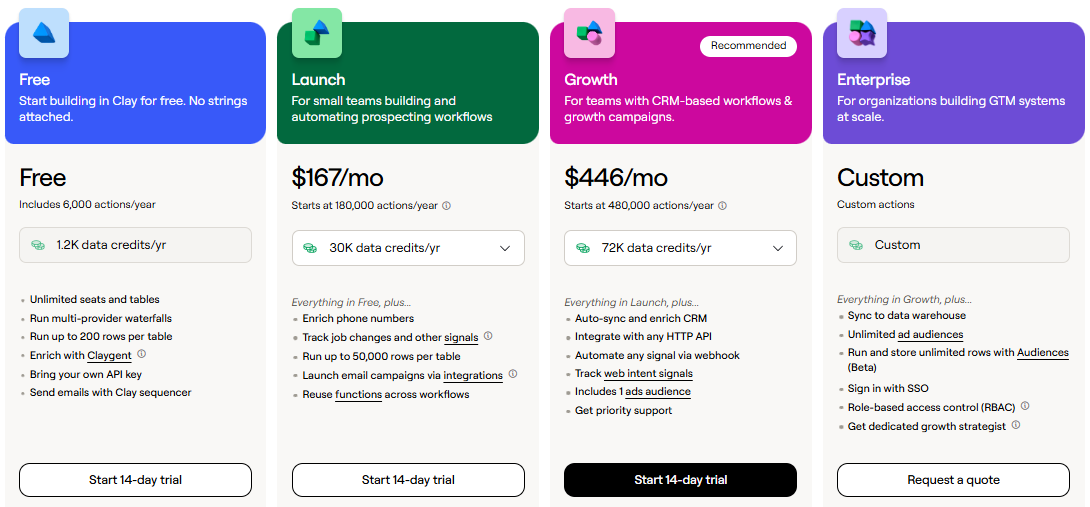
Clay uses a credit-based pricing model with four plans: Free, Launch, Growth, and Enterprise. Instead of charging per user, Clay includes unlimited seats on all plans. Pricing is mainly based on the number of actions and data credits your team needs.
Free Plan
Clay's free plan includes 6,000 actions per year and 1,200 data credits. You can build workflows, run multi-provider waterfalls, enrich records with Claygent, and invite unlimited team members.
The biggest limitation is scale. Tables are capped at 200 rows, making this plan best suited for testing the platform rather than running production prospecting campaigns.
Launch Plan
The Launch plan starts at $167 per month and includes 180,000 actions per year and 30,000 data credits.
This is where Clay starts to become useful for outbound teams. You can enrich phone numbers, track job changes and hiring signals, run tables with up to 50,000 rows, and launch email campaigns through Clay or connected tools.
For most small sales teams, this is likely the entry point worth considering.
Growth Plan
The Growth plan starts at $446 per month and includes 480,000 actions per year and 72,000 data credits.
In addition to prospecting workflows, Growth adds CRM automation, webhook support, HTTP API integrations, web intent signals, ad audience syncing, and priority support.
If your team relies heavily on Salesforce or HubSpot workflows, this is the plan where Clay begins to function as a broader GTM operations platform rather than just a prospecting tool.
Enterprise Plan
Enterprise pricing is custom and designed for larger organizations building complex GTM systems.
Features include data warehouse syncing, unlimited ad audiences, SSO, role-based access controls, advanced governance features, and a dedicated growth strategist from Clay.
Most small and mid-sized teams will not need Enterprise unless they have strict security requirements or manage large-scale data operations.
My Take on Clay Pricing
What I like about Clay's pricing is that unlimited seats are included across all plans. Many sales tools charge separately for each SDR, AE, or RevOps user, which can become expensive as teams grow.
The downside is that the credit system can be difficult to predict at first. Different enrichment providers, workflows, and AI actions consume credits at different rates. As a result, your actual cost depends heavily on how you use the platform.
For teams running high-volume prospecting campaigns, it's worth estimating monthly credit usage before committing to a plan. The subscription price is only part of the total cost of ownership.
What Real Users Say About Clay
Clay holds a 4.7 out of 5 rating on G2, based on 192 verified reviews. Here's what the actual feedback says, without the spin.
What People Like
Waterfall enrichment comes up constantly. G2's "Data Cleaning and Enrichment" category scores a 94% satisfaction rating across 51 reviews for Clay. Users consistently describe going from 40% match rates with their previous single-provider setup to 80%+ coverage after switching.
Claygent is the second most praised feature. RevOps teams use it for account research at scale. SDR managers build it into pre-call prep workflows so their reps walk into every call with context they didn't have to manually compile.
Flexibility is the third consistent theme. Clay doesn't impose a rigid structure on how you work. You build the logic the way your team needs it. One G2 reviewer described it well: "It's not just a lead database. It becomes a full research and enrichment engine for outbound." That flexibility is a genuine strength if you have a builder who knows how to use it.
The Clay University training library and the active user community also get strong mentions. The company has built a real support structure around learning the platform.
Where It Falls Short
The learning curve is the most common complaint, flagged in 16 separate mentions across aggregated G2 feedback. This is not a plug-and-play tool. Most teams need multiple weeks of setup and learning before the platform starts paying off. Some hire Clay-specialist consultants just to build their initial workflows.
Credit burn is the second most cited frustration. Users describe exceeding their monthly allocation faster than expected, especially during initial setup when workflows aren't yet optimized.
Signal cadence is another real limitation. Clay updates CRM integrations and live signals once per day. If you're building event-triggered workflows around job changes, funding announcements, or other buying signals, a 24-hour delay creates tangible problems.
A segment of Reddit and LinkedIn critics describe Clay as an "API wrapper" that resells data providers at a markup. That framing undervalues what Clay adds on top of those providers. But the underlying cost concern it points to is real, especially at scale.
Who Should Use Clay
Clay is a strong fit for RevOps teams and GTM engineers who want full control over enrichment logic and workflow design. Growth teams running high-volume outbound lead generation with at least one technical operator who can own the build and maintain it. Agencies managing prospecting across multiple client ICPs with diverse targeting needs. Enterprise teams with dedicated RevOps staff and a budget that can sustain the Pro plan plus credit costs.
Clay is a harder fit for small sales teams without a dedicated RevOps person. Founders or SDRs who need quick, clean access to contact data without workflow configuration overhead. Teams expecting results in days rather than weeks. Anyone who needs real-time signal enrichment (the once-per-day sync cadence will become a real frustration).
In my opinion, the single biggest predictor of Clay success is whether your team has someone who can own it. Clay's power comes entirely from how you configure it. Without a capable, dedicated builder, you're paying for a complex spreadsheet that nobody fully understands.
Clay vs. SMARTe: Different Tools for Different Jobs
Teams ask this comparison constantly, so let me address it directly.
Clay is a workflow and enrichment orchestration layer. It doesn't own a proprietary contact database. It routes queries through 100+ external providers and gives you tools to structure, clean, and act on the results. You pay per action, and cost scales with usage and with how many lookups fail.
SMARTe is a B2B contact intelligence platform with its own verified database of 289M+ contacts. That's a different architectural choice. You get 75%+ US mobile coverage and 50%+ global direct dial coverage, with real-time verification built in, not dependent on a waterfall of third parties. Geographic coverage runs across 200+ countries, with genuine depth in LATAM and APAC markets where many US-first platforms are thin. The SMARTe and Clay integration is a popular setup for teams that want both.
Some teams run them together. Clay handles the complex workflow logic, custom Claygent research, and multi-provider enrichment sequences. SMARTe provides the verified contact data layer, particularly for mobile and direct dial numbers where accuracy is what determines connect rates.
Neither is a default answer for every team. The right call depends on your stack, your RevOps function's technical depth, and what your outbound volume justifies.
If you're exploring the best data enrichment tools available before committing, it's worth running both side by side on a real list to compare coverage and effective cost per enriched record.
Clay Alternatives
If Clay's pricing or complexity isn't the right fit for your team, there are several paths worth looking at.
Apollo.io combines prospecting data with built-in sequencing in a more accessible package, though its data depth is thinner in non-US markets. ZoomInfo gives you a large proprietary database with enterprise-grade governance, but at a price point that puts it out of reach for smaller teams. Lusha is faster and simpler for individual reps who need quick contact lookups, not teams building data pipelines. SMARTe is built specifically for teams where mobile coverage and international depth are the deciding factors.
For a full breakdown, the Clay alternatives page covers the options in detail.
The Verdict
Clay is one of the most capable data enrichment and workflow platforms on the market. The waterfall enrichment concept is sound, Claygent adds real research depth that structured databases can't match, and the platform has shipped fast over the past two years.
But capable doesn't mean right for everyone.
If your team has the technical depth to configure it properly, and your outbound volume justifies the cost and complexity, Clay deserves serious consideration. If you need fast, clean access to verified contact data without engineering overhead, a dedicated contact intelligence platform will get you there faster with more predictable costs.
The question before you sign up isn't "Is Clay powerful?" It is. The question is whether your team has what it takes to run it.