Most SDRs I talk to believe they have a messaging problem. The sequences aren't landing. The subject lines aren't opening. The replies aren't coming.
But here is the thing. Most of the time, it's not the messaging. It's that the email feels like it could have been sent to anyone.
That is the real problem with cold outreach right now. Generic emails are everywhere. AI has made them cheaper to produce, which means inboxes are flooded with polished, well-structured, utterly irrelevant messages. The ones that get replies are the ones that feel written for one specific person, in one specific situation, at one specific moment.
This guide covers exactly how to do that. You'll learn what real cold email personalization looks like (not just swapping in a first name), how to research a prospect in under five minutes, where to personalize in every email, and how to scale it without losing the human touch that makes it work. If you haven't nailed the fundamentals yet, start with our guide on how to write a cold email first, then come back here.
Let's get into it.
What Cold Email Personalization Actually Means
Most people hear 'personalization' and think: merge tags. First name. Company name. Maybe a location field if they're feeling ambitious.
That's not personalization. That's mail merge.
Real personalization means your email demonstrates that you understand the specific world your prospect lives in. Their role. Their current challenges. What they're probably thinking about this quarter. And why your message is relevant to that, right now.

SMARTe GTM Intelligence
Start Smarter Prospecting Today
Beyond the First-Name Merge Tag
Using someone's first name in a subject line does improve open rates. It has been true for years. But it stopped being a differentiator a long time ago.
Every prospect knows what a merge tag looks like. These used to feel personal. Now they feel automated, because they are.
The personalization that actually moves people is the kind that makes them think: 'Wait, this person actually looked me up.'
Relevance vs. Personalization — What's the Real Difference?
Here is a distinction that matters more than most people realize.
Personalization is about the recipient. Relevance is about the situation.
You can write a highly personalized email that is completely irrelevant. 'I loved your LinkedIn post about distributed teams' is personalized. But if your pitch has nothing to do with distributed teams, it's just flattery with extra steps.
The emails that get replies combine both. They reference something real about the person or company, and they connect that reference directly to a problem your product solves.
The Formula
Specific signal + real problem = a relevant email. Everything else is noise.
Why Personalizing Cold Emails Is Worth the Effort
Before we get into how, let's talk about why. Because it does take effort. And some SDRs would rather send 500 generic emails than 50 personalized ones.
Here is what the data shows.
What the Data Shows
Personalized emails deliver significantly higher results than generic campaigns. HubSpot research on email personalization shows personalized sends deliver 6x higher transaction rates, and personalized subject lines lift open rates by 26%.
But the number that changed my perspective came from a case study published by Outreach and highlighted by Armand Farrokh at 30 Minutes to President's Club. A team using fully personalized emails had about 10% of the email volume of the control group — and nearly double the meetings booked. Less email. Better results.
Trigger-event personalization — referencing something that just happened at a prospect's company — can push open rates significantly above the baseline for generic templates. The math is hard to argue with. You don't need more email. You need better email.
Why Generic Outreach Is Getting Worse, Not Better
Here is what's changed in the last two years. AI writing tools have made it trivially easy to generate cold email copy. Every SDR team now has access to the same prompts, the same templates, the same structures.
The result? Inboxes that look identical.
Perfect grammar. Zero relevance. And reply rates dropping across the board for teams still running spray-and-pray.
The upside: it's easier than ever to stand out. Because most of your competition is still sending the same seven-line 'hope you're well' email to thousands of people who've never heard of them.
The Three Levels of Cold Email Personalization
Not every email needs 30 minutes of research. The right level of personalization depends on your deal size, your list volume, and how well-defined your ICP is.
Here is a framework that holds up in practice.
Level 1 — Role-Based Segmentation (Fast, Scalable)
This is the baseline. You segment your list by role, industry, and company size, then write emails specific to each segment.
A VP of Sales gets a different email than a RevOps Manager. Not because you wrote 1,000 individual emails, but because you wrote five tight variations that speak directly to what each persona cares about.
This works because the pain points are different. The VP cares about team quota and pipeline. The RevOps Manager cares about CRM hygiene and data accuracy. Same product, completely different angle.
Start with your ideal customer profile and build segment variations from there. And make sure your prospecting list is clean and segmented before you write a single word. Targeting the wrong person is a data problem before it's a personalization problem.
Level 2 — Company and Trigger Research (Moderate Effort)
At this level, you're doing light research on each account before writing. You're looking for one signal — one thing that recently happened at this company that makes your outreach timely.
Funding round. New hire at the VP level. A job posting for a role your product would make easier. A press release about expansion into a new market.
You find the signal. You write one opening line around it. The rest of the email stays templated.
This is where most of the ROI lives. Moderate effort, significant lift in reply rates.
Level 3 — Deep Individual Personalization (High Effort, High Return)
This is for your highest-priority accounts. Strategic targets. Enterprise deals where the ACV justifies spending 20 minutes per prospect.
You read their LinkedIn posts. You watch the webinar they spoke at. You find the specific tension in their business that your product addresses.
The email is short. The research is deep. And the result feels like a message from someone who actually understands their situation.
Honest note: this level doesn't scale to 200 prospects a week. It's for the accounts where it's worth your time.
How to Research a Prospect Before Writing
Good personalization starts before you write a word. The research phase is where most SDRs cut corners, and it shows in the emails they send. The deeper your sales prospecting strategies go, the better your personalization will be.
Company-Level Signals to Look For
Company signals tell you why this company is likely to need your product right now. Think of them as situational triggers.
The most valuable ones:
- Job postings. A company hiring for a role that your product supports signals active need. Hiring five SDRs? They're scaling outbound and need the infrastructure to support it.
- Funding rounds. New capital means new growth targets and new problems to solve. Companies that just raised are building. They're buying.
- Leadership changes. A new VP of Sales joining a company almost always means the outbound motion gets rebuilt. That's a window.
- Recent content. A company blog post, press release, or case study tells you what they're doubling down on.
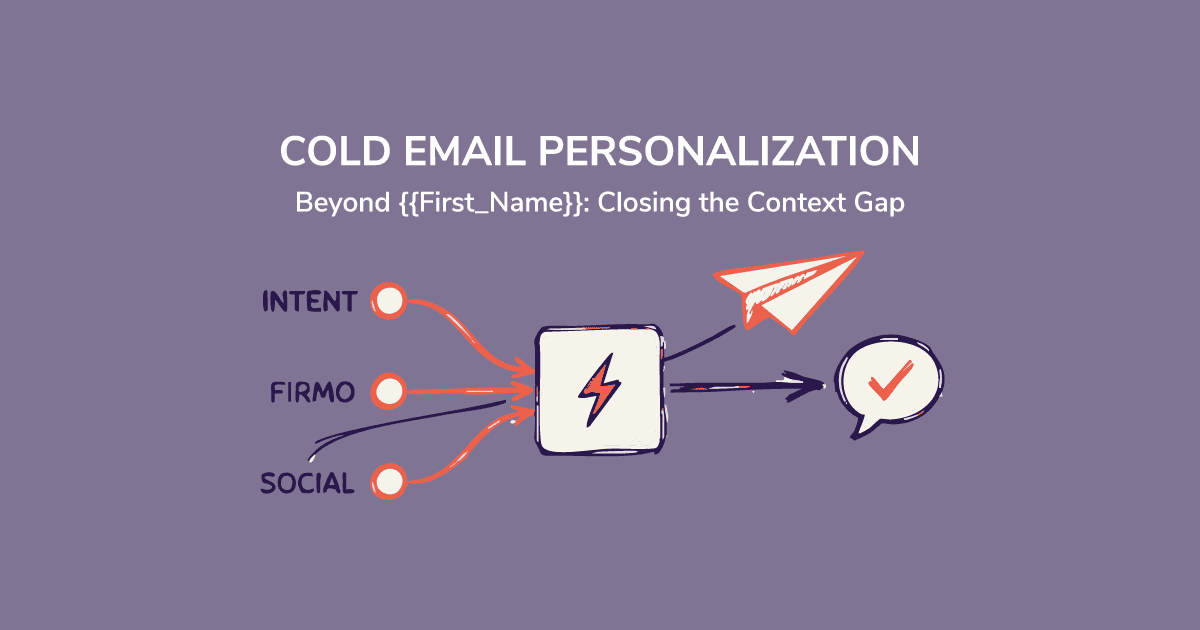
Automatically tracking job changes and leadership transitions at your target accounts gives you a constant stream of timely signals without manual checking. That's also where intent data comes in — it tells you which companies are actively researching solutions like yours right now, before they reach out to anyone.
Person-Level Signals to Look For
Person signals tell you something specific about the individual you're emailing.
- LinkedIn activity. Recent posts, articles, comments. If someone posted about outbound data quality last week and you sell data — that is a gift.
- Shared background. Same university. Worked at a company you've already helped. Small connections create genuine warmth.
- Speaking engagements or podcast appearances. If your prospect was on a podcast last month, you have 45 minutes of insight into exactly what they think about their field.
- Role changes. Someone who just moved from a large company to a smaller one is navigating the absence of resources they used to have. That's a real pain point, not a hypothetical.
LinkedIn prospecting makes this research faster than any other channel because the signals are public and current.
The 'First Is Best' Trigger Stack Approach
Here is the framework I'd steal from Armand Farrokh at 30MPC if I were building an outbound team tomorrow.
Instead of researching every possible signal for every prospect, you build a ranked list of your top five triggers. Then when you're researching a prospect, you run the list top to bottom and use the first one you find.
Here is what that looks like for a B2B sales data tool:
- Company posted a job for an SDR team lead (scale signal)
- Company just raised a Series A or B (growth signal)
- Prospect posted about data quality or outbound challenges (pain signal)
- Prospect recently joined from a large company (resource gap signal)
- Company expanded into a new market (territory signal)
You find the first match. You write the opener around it. The rest of the email stays consistent.
This is how you personalize at volume without losing your mind.
Where to Personalize in Every Cold Email
Every part of a cold email has a job. The subject line earns the open. The opener earns the read. The body earns the reply. The CTA earns the meeting.
Personalization in the right place at the right stage makes the whole thing work.
The Subject Line — Earn the Open
Your subject line has one job: get the email opened. The best personalized subject lines are short (under seven words), specific, and make the prospect feel like this email was written for them. Our guide to cold email subject lines for sales goes deep on what works in the current inbox environment.
What to do:
Build your trigger stack before you start a new outbound sequence. Write five trigger templates — one per signal. Then research each prospect by running the list top to bottom and stopping at the first match you find.
One thing that works well right now: lowercase subject lines. They read like a message from a colleague, not a marketing blast.
The Opening Line — Prove You Did Your Homework
This is the most important sentence in your entire email.
The first line is where personalization lives or dies. If it feels generic, nothing else you write will save the email.
Good first lines reference something real and specific. Not 'I noticed you're in SaaS' (anyone in SaaS can say that). Something like:
That opener is personalized (it references a specific company action), it's relevant (it connects directly to a problem), and it leads naturally into the body of the email.
What to avoid: hollow compliments. 'I love what you're doing at Acme' is flattery, not personalization. Prospects see through it immediately, and it damages your credibility before you've said anything useful.
The Body — Connect Research to a Real Problem
The body of a personalized cold email is short. Three to five sentences. Not a product overview.
The structure that works:
- State the problem your prospect is probably dealing with (based on the signal you found)
- One sentence on what you do to solve it
- A specific proof point: a result you've driven for a similar company
That's it. You're not educating them on your product. You're showing you understand their world and have done something about it for people like them.
Short. Specific. Connected to a real signal.
The CTA — Match the Ask to the Relationship
Your CTA should be the smallest possible ask that moves the conversation forward.
'Book a 30-minute demo' is a big commitment from a stranger. 'Open to a quick 10-minute chat?' is better. 'Worth a 5-minute look?' is better still.
The lower the friction, the higher the conversion. And for follow-up emails specifically, the ask can be even smaller.
Your sales follow-up email templates deserve the same personalization attention as your first touch — because most replies come on touch two or three, not touch one. A solid follow-up email sequence is where deals actually get started.
How to Personalize Cold Emails at Scale
Here is where most people think personalization breaks down. You can't spend 20 minutes on every prospect when you're working a list of 300.
You're right. You can't. But you don't need to.
Build a Trigger-Template Library, Not Just a Template Library
Standard templates are generic. Trigger templates are specific.
A trigger template is a short, swappable opening paragraph built around one type of signal. You write five of them, and they cover the vast majority of situations you'll encounter.
Write these once. Use them repeatedly with slight tweaks for each account. You can find more frameworks and starting points in our collection of B2B cold email templates to build your trigger library from.
Segmentation as Personalization
Before you write a single first line, make sure your list is actually segmented.
Sending the same email to a Director of Marketing and a VP of Sales is a personalization failure before you ever open a prospect's LinkedIn profile. They have different jobs. Different metrics. Different pain points.
Build your outbound prospecting sequences by segment first. Role, industry, company size, growth stage. Each segment gets its own base email and its own trigger-template stack.
This is the layer of personalization most teams skip, and it's the one with the highest return per hour invested.
The Role of AI and Data Enrichment in Scaling Without Losing Humanity
AI can help you personalize faster. It can draft opening lines, identify patterns in prospect data, and flag signals across a list.
But AI writes like AI. The opener still needs a human eye before it goes out. Think of AI as your research assistant, not your writer.
And no AI tool can make up for bad underlying data. This is the part most articles on cold email personalization miss entirely. AI sales prospecting tools can do a lot of the signal detection work for you. But if the contact data underneath is stale — wrong email, old title, moved to a different company — none of it matters. You're personalizing a message for a version of this person that no longer exists.
B2B data decays fast. Studies consistently put the rate at 20 to 30 percent per year. One in four contacts in your CRM is probably out of date right now. Personalization requires current data. Not just a name and a company, but a verified email address, an accurate title, and ideally a mobile number that actually reaches them.
What to do:
Before scaling any personalized outreach sequence, audit your contact data. If you're pulling from a static list, assume at least 20% of it is stale. Verified, real-time data is the foundation. The writing and the research sit on top of it.
How SMARTe MCP Lets ChatGPT and Claude Personalize Cold Emails with Live B2B Data
Here is where it gets interesting.
Most teams using AI to help with personalization run into the same wall. The AI is only as good as the information you give it. You paste in a LinkedIn URL, copy some company details, write a prompt, and wait for a first line. It works. But it's slow. And the data you're feeding it is still whatever you manually pulled moments ago.
SMARTe MCP changes that.
MCP stands for Model Context Protocol. It's the open standard that lets AI tools like ChatGPT and Claude connect directly to live external data sources. When you connect SMARTe to your AI assistant through MCP, the AI can query verified contact data, company details, and real-time buying signals without you copying and pasting anything.
Here is what that looks like in practice.
You open ChatGPT or Claude and ask it to write a personalized cold email for a VP of Sales at a company you're targeting. Instead of working from whatever you've manually fed it, the AI queries SMARTe's database directly. It gets the prospect's verified email, current title, and relevant company signals from 283M+ contacts — then builds the personalization from live, accurate data.
The first line it writes is grounded in real, current information. Not a hallucination. Not a six-month-old LinkedIn bio.
(And yes, this matters more than most people realize. The AI is only as accurate as the data it works from. Real-time verified data is what separates a genuine personalization engine from a very confident guesser.)
This is the closest thing to having a research assistant who never sleeps, never works from stale records, and writes in whatever tone you need.
The teams that will win outbound in the next two years aren't going to be the ones who write better copy. They're going to be the ones who connect better data to smarter AI workflows and let the system do the research while they focus on the conversations.
What to do:
Connect SMARTe MCP to your AI tool of choice — ChatGPT or Claude — and test one trigger template written from real-time data. Compare the output quality and the time it took against your current manual research process. The gap is usually significant.
Cold Email Personalization Mistakes That Kill Reply Rates
Even experienced SDRs make these. Some are obvious. Some are subtle.
Hollow Compliments That No One Believes
'I love what you're building at Acme' is not personalization. It's a compliment you could write for any company about any person.
Prospects know when they're being flattered. And when they feel that, the credibility of everything that follows collapses.
Replace vague praise with a specific observation. Not 'I love your approach to demand gen' but 'Your recent webinar made a specific point about CRM data accuracy that I keep thinking about.'
One real reference beats ten generic compliments every time.
Personalizing the Wrong Part of the Email
Some teams spend all their effort on the subject line and send a generic body. Others nail the opener and blow the CTA with an ask that's too aggressive.
The opener and the body need to connect. The personalization signal you use in the first line needs to flow into the problem you describe. If you reference a company's Series B funding but your email body is about email deliverability with no bridge to growth, the email feels disjointed.
The segue from the trigger to the problem is where most personalization fails. If you state the signal but don't connect it to the problem, it reads robotic. Build the transition into the first paragraph so the whole thing flows naturally.
Sending Personalized Emails to Bad Data
This is the mistake no one talks about.
You can write the most personalized, well-researched, perfectly structured cold email in the world. And if the email address is six months out of date — or the person changed companies — it bounces, or it lands in the wrong inbox, or it reaches someone who moved on in January.
Your personalization efforts are only as good as the data underneath them.
This is why data quality is a core part of sales prospecting, not an afterthought. A high bounce rate tanks your sender reputation, which means even your good emails stop landing in the inbox. And if you're running B2B prospecting at any real volume, stale B2B contact database records will kill your results before your first word gets read.
SMARTe gives B2B sales teams access to 283M+ verified contacts with 75%+ US mobile coverage, verified in real time so you're not personalizing emails to contacts who left their company six months ago. See SMARTe's coverage in action.
The Real Point of Personalization
Personalization isn't about impressing prospects with the depth of your research. It's about respecting their time.
The SDRs and sales teams I see winning with cold outreach aren't sending the most email. They're sending the right email, to the right person, at the right moment. The message feels like it was written for that person because it was — built on a real signal, connected to a real problem, and delivered to a verified contact who is actually reachable.
Stop thinking of personalization as a writing skill. It's a research skill, a data skill, and a systems skill.
Get those three things working together and your reply rates will reflect it.
If you want to see what verified, real-time contact data looks like in practice, book a demo and see SMARTe's coverage in action.