TL;DR:
- The average B2B data provider delivers around 50% accuracy. Half your outreach fails before it reaches anyone.
- Database size is the wrong metric. The 7 criteria that predict real field performance are: verification method, mobile coverage, geographic depth, data freshness, compliance, CRM and AI integrations, and pricing transparency.
- The only honest pre-purchase test is a 100-record bake-off on your actual ICP.
- SMARTe passes all 7: 289M+ verified contacts, 75%+ US mobile coverage, real-time verification, SOC 2 Type II certified, GDPR-aligned, CCPA compliant, native Salesforce and Outreach integrations, plus a live MCP for AI agent access. Enterprise only, from $15,000 a year, with the price published and no free tier.
Choosing a B2B data provider is one of the most important decisions for any sales team. The quality of your data affects everything from email deliverability to lead generation and revenue growth.
The problem is that most B2B data providers make similar claims. They all promise accurate contact data, large databases, and better prospecting results. During a demo, it's easy to believe that every platform offers the same value.
The reality is different. A provider may look great on paper but perform poorly once your team starts building prospect lists and running outreach campaigns. Bad data leads to bounced emails, missed opportunities, and wasted sales effort.
I've reviewed and compared many B2B data providers, and I've found that the best platforms stand out in a few key areas. Database size is only one piece of the puzzle. What matters more is how accurate, reliable, and useful the data is for your sales team.
In this guide, I'll walk through the seven most important factors to consider when choosing a B2B data provider in 2026. These criteria will help you find a platform that supports your prospecting efforts and delivers better results.
What is a B2B data provider?
A B2B data provider aggregates verified business contacts, company intelligence, and buying signals. It delivers that data into your CRM and sales tools. The best ones go beyond contact lists. They add real-time verification, intent signals, and buying-group mapping so your team reaches decision-makers faster.
What's the difference between contact data, technographic data, and intent signals?
Contact data covers emails and direct dials. Technographic data and tech stack intelligence maps what tools a company currently uses, so you know who might be replacing a competitor or buying a complementary product. Intent signal data shows which accounts are actively researching your category right now.
Most platforms do one of these well. A few do all three. Know which one your motion needs before you start a demo.
How do B2B data providers verify records?
Two models exist. Batch processing updates the database on a schedule, monthly or quarterly. Real-time verification checks each record at the moment you pull it.
B2B contact data decays at roughly 2.1% per month. That is about 22.5% gone in a year. A batch-processed record can be three job changes old before you ever dial it. Understanding how B2B data works and when it goes stale is the starting point for any provider evaluation.
What are the 7 criteria for choosing a B2B data provider in 2026?
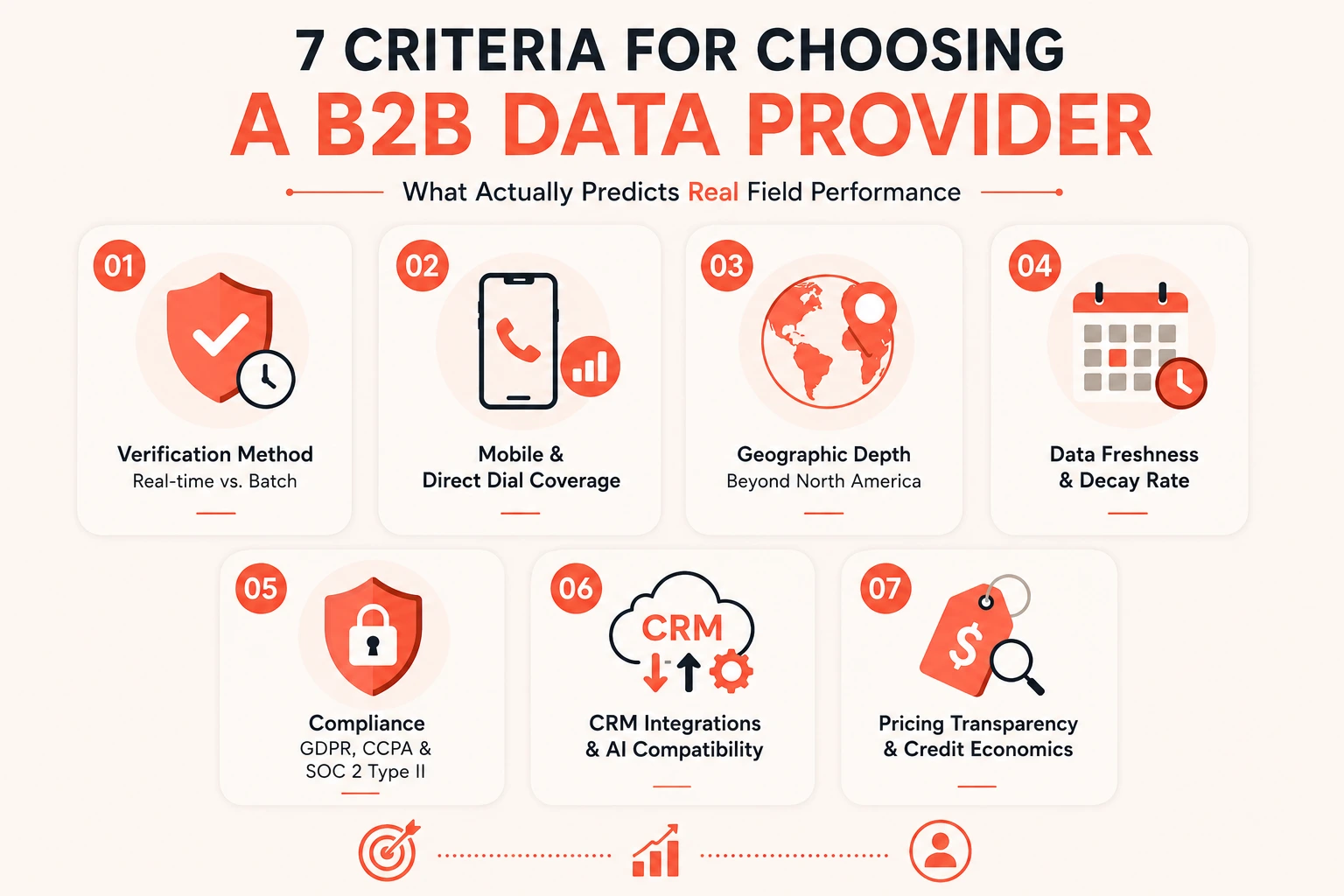
Seven criteria predict real field performance: verification method, mobile coverage rate, geographic depth, data freshness, compliance, CRM integrations, and pricing transparency. Database size is not one of them. Hit rate on your actual target accounts is. Every criterion maps to a specific failure mode in the field.
1. Verification method: real-time vs. batch
A real-time provider validates the record the moment you pull it. A batch provider last checked it whenever their update cycle ran. That might have been last week. Or five months ago.
In my experience, this is the performance predictor most teams skip during vendor evals. They compare database sizes. They rarely ask how the data was verified or when.
Ask: "How often is each record re-verified after initial collection?"
What to do: Request a live demo on 20 accounts from your own ICP. A vendor who redirects you to their curated sample has already told you something.
What good B2B data looks like is a record validated at the moment of use. SMARTe verifies contacts in real time, not from a static snapshot.
2. Mobile and direct dial coverage rate
Most providers return direct dials on 10 to 20 percent of accounts in a given vertical. SMARTe covers 75%+ of US contacts with verified direct dials. That gap is not a minor detail. It is the difference between a working cold calling motion and an expensive voicemail operation.
Verified B2B direct dials skip gatekeepers. Mobiles reach the person wherever they work. (Remote and hybrid work made this more true, not less. Office lines now route to mailboxes that nobody checks until Friday afternoon.)
The question to ask is specific: "What is your direct dial rate in my vertical?" Not their total database number. Their coverage rate in your specific market. Those are two different answers.
3. Geographic depth beyond North America
Most B2B databases default to the US market and thin out fast outside it. That is fine if your ICP is entirely North American. It is a real problem if you sell into B2B data markets in the UK, EMEA, APAC, or LATAM.
I have watched teams buy a "200 million contact" database and get back single-digit useful records for their actual market. One of them was selling into mid-market UK companies. Great coverage overall. Just not in the market they needed.
Ask for contact density per company in your target region. Not total contacts in a country. That number tells you whether you can actually build a buying committee from what they return.
SMARTe covers 200+ countries. The LATAM and APAC depth is genuine, not just a flag on a data coverage map.
4. Data freshness and decay rate
A 2025 Validity survey of 602 CRM users found that 37% had lost revenue directly from poor data quality. 76% said less than half their CRM data was accurate. How B2B data decay affects your pipeline is a revenue problem, not a data hygiene problem.
Job changes drive most of the decay. Someone leaves a role. Their email dies within days. Their direct dial at the old company is gone. A provider that tracks job changes continuously catches this fast. Quarterly batch tracking does not.
Or let me be more direct: by the time a quarterly batch update runs, your rep has already burned the contact and the sequence.
What to do: Ask for field-level SLAs specifically. "Monthly refresh" as a single claim usually hides that email, direct dial, and job title refresh on different schedules, and that non-US records often run even slower.
5. Compliance: GDPR, CCPA, and SOC 2 Type II
One GDPR enforcement action can run into eight figures. One SOC 2 gap can kill an enterprise deal before it gets to legal review.
Honestly, I think compliance is the criterion most teams discount the most. They are comparing feature lists and per-credit pricing when they should be reviewing third-party audit certificates.
Ask for the actual SOC 2 Type II certificate, not a self-attestation. Ask when they last renewed it. Ask for a data processing agreement before you sign, not after. What compliant B2B data actually means in practice is more than a badge on a pricing page.
Non-negotiables in 2026:
- SOC 2 Type II (third-party audited, not self-certified)
- GDPR-aligned data collection and processing
- CCPA compliance for California contacts
- A data processing agreement available before contract signature
SMARTe is SOC 2 Type II certified, GDPR-aligned, and CCPA compliant. All third-party audited.
6. CRM integrations and AI compatibility
"We integrate with Salesforce" is not an integration evaluation. It is the start of one.
Does the integration support bidirectional sync, or does data only flow one way? What is the sync frequency? How does it handle duplicate records when a contact already exists in your CRM?
CRM data enrichment at scale breaks down fast if field mapping is inconsistent or if duplicates slip through on ingest. Most vendors get the basic connection right. Edge cases are where they differ.
The 2026 question most buyer's guides miss: does the provider support MCP (Model Context Protocol) for AI agent access? If your team uses AI tools in the sales workflow (and most do now), you want the data feeding those agents directly. Not via a CSV someone exports once a week.
SMARTe has native Salesforce and Outreach integrations. The SMARTe MCP gives AI tools like ChatGPT and Claude real-time access to verified B2B data. Most providers do not have this yet.
Ask: "Do you support bidirectional CRM sync and MCP for AI agent workflows?"
7. Pricing transparency and credit economics
Per-seat pricing penalises you for growing your team. Most vendors use it. Most teams accept it without pushing back. I think that is a mistake.
The number that actually predicts your ROI is the per-accurate-record cost at your volume. Not per-seat. Not per-credit. Per accurate record. Make the vendor calculate it. If they cannot or will not, that says something about how they think about data quality.
Check what to look for in a B2B data vendor for a full breakdown of pricing model red flags, including renewal escalators that do not show up until month 13.
Ask: "What is my per-accurate-record cost at my volume? What is your policy when a verified record bounces?"
SMARTe's price is public. It is enterprise only, from $15,000 per year, with credits starting at $0.30 and falling to $0.20 at 1M credits. There are no per-seat costs, so the whole team shares one credit pool. There is no free or self-serve tier, so that price will rule it out for a small team. The published number is still more than most vendors in this category will give you before a sales call.
Evaluation Criteria at a Glance
| Criterion | What good looks like | Red flag | Question to ask |
|---|---|---|---|
| Verification method | Real-time re-verification at point of use | "We run quarterly batch updates" | "How often is each record re-verified after collection?" |
| Mobile coverage | 50%+ direct dials on your specific ICP | Total database number given as the ICP answer | "What is your direct dial rate in my vertical?" |
| Geographic depth | Contact density across EMEA, APAC, LATAM | Thin non-US data, no regional compliance | "What is your contact density per company in my region?" |
| Data freshness | Automated job change tracking, field-level SLAs | Single blanket refresh cadence for all fields | "What are your field-level SLAs for email vs. direct dial?" |
| Compliance | SOC 2 Type II, GDPR-aligned, CCPA compliant | Self-certified compliance, no DPA before signing | "Can you share your latest third-party audit certificates?" |
| CRM and AI integrations | Bidirectional sync, real-time frequency, MCP support | Unidirectional export, no duplicate handling | "Do you support bidirectional sync and MCP?" |
| Pricing | Per-credit, no per-seat scaling, public pricing | Hidden pricing, per-seat model, opaque renewal terms | "What is my per-accurate-record cost at my volume?" |
How should you test a B2B data provider before buying?
The only reliable test is a 100-record bake-off. Pull 100 accounts from your actual ICP. Submit them to two or three providers at the same time. Measure hit rate, decision-maker mobile coverage, and email accuracy. Any vendor that refuses this test has already answered your question.
The 100-record bake-off
Pull 100 real accounts from your target vertical. Your actual next-quarter ICP. Not a vendor-curated sample, not a hypothetical list.
Submit the same 100 accounts to two or three shortlisted providers simultaneously. For each one, measure:
- Hit rate: How many of the 100 accounts return any contact data at all?
- Decision-maker mobile coverage: Of the contacts returned, how many include a verified direct mobile for the actual buyer, not a switchboard number?
- Email bounce rate: Run the returned emails through your outreach tool. Under 3% bounce is the benchmark for verified records.
- Dial accuracy: Call a sample of the returned mobiles. Record how many connect to the right person.
It is more work than a G2 comparison. It is also the only test that measures real performance on your market rather than the vendor's benchmark sample.
Consider waterfall enrichment across multiple providers if you want a structured parallel test. Some teams run waterfall enrichment as a permanent hedge against single-provider coverage gaps.
What the numbers should tell you
Benchmarks worth holding every provider to: under 3% email bounce rate on verified records. Direct dial accuracy above 75% on your ICP. Mobile coverage above 50% of the decision-makers you target.
If a provider returns a 40% hit rate and 15% of those numbers connect to the wrong person, the real per-accurate-record cost is far higher than the sticker price. Do that math before you sign anything.
What questions should you ask a B2B data provider before signing?
Seven questions separate vendors worth trialing from vendors worth passing on. Ask about verification methodology, field-level refresh rates, mobile coverage in your vertical, compliance certificates, CRM sync depth, AI agent support, and credit policy on bad records. Vague answers to any one of these is a red flag.
- "What is your verification methodology: SMTP email validation, live dial verification, or directory-listed? Does that apply to your non-US data too?"
- "What are your field-level refresh SLAs for email addresses, direct dials, and job titles, separately and by region?"
- "What percentage of returned contacts in my vertical include a verified direct mobile, not a main line?"
- "Can you share your SOC 2 Type II certificate, GDPR documentation, and CCPA confirmation before we proceed to contract?"
- "Does your CRM integration support bidirectional sync? How does it handle duplicate records on ingest?"
- "Do you support MCP or open API access for AI agent and LLM workflows?"
- "What is your credit or refund policy when a verified record bounces or connects to the wrong person?"
The last question trips up more vendors than you would expect. B2B data enrichment and CRM match rates matter. So does what happens when the data turns out to be wrong.
Conclusion
Most sales teams treat data like a commodity buy. Lowest price, biggest claimed database, done. Then they spend six months wondering why the vendor's case studies do not match their own numbers.
The teams consistently building pipeline in 2026 treat data as infrastructure. They test before they buy. They hold providers to specific benchmarks. They do not trust a demo on a vendor-curated sample.
Run the bake-off. Ask the 7 questions.
If you want to test SMARTe against your actual ICP before committing, book a demo and ask for a sample match on your own 100 accounts. SMARTe has no free tier, so that sample run is how you test it.