B2B direct dial numbers can make or break your outbound strategy.
I’ve seen great sales reps struggle for one simple reason — they couldn’t reach the right person. They had the perfect pitch. The right timing. Even strong intent signals. But without a verified direct phone number, none of it mattered.
Here’s the problem.
Most teams still rely on main office numbers or outdated contact data. They get stuck in phone trees. They deal with gatekeepers. They leave voicemails that never get returned. Over time, this crushes connect rates and slows pipeline growth.
Now here’s the shift.
With accurate B2B direct dials, you reach decision-makers faster. You skip the noise. You start real conversations. And real conversations drive revenue.
In this guide, I’ll walk you through:
- What B2B direct dials really are
- Why they improve sales outreach and pipeline growth
- How to stay compliant with data and privacy laws
- The best direct dial data providers in 2026
- Key trends shaping the future of phone-based B2B prospecting
If you want higher connect rates, better response rates, and more booked meetings, this guide will show you how to get there.
What Are B2B Direct Dials?
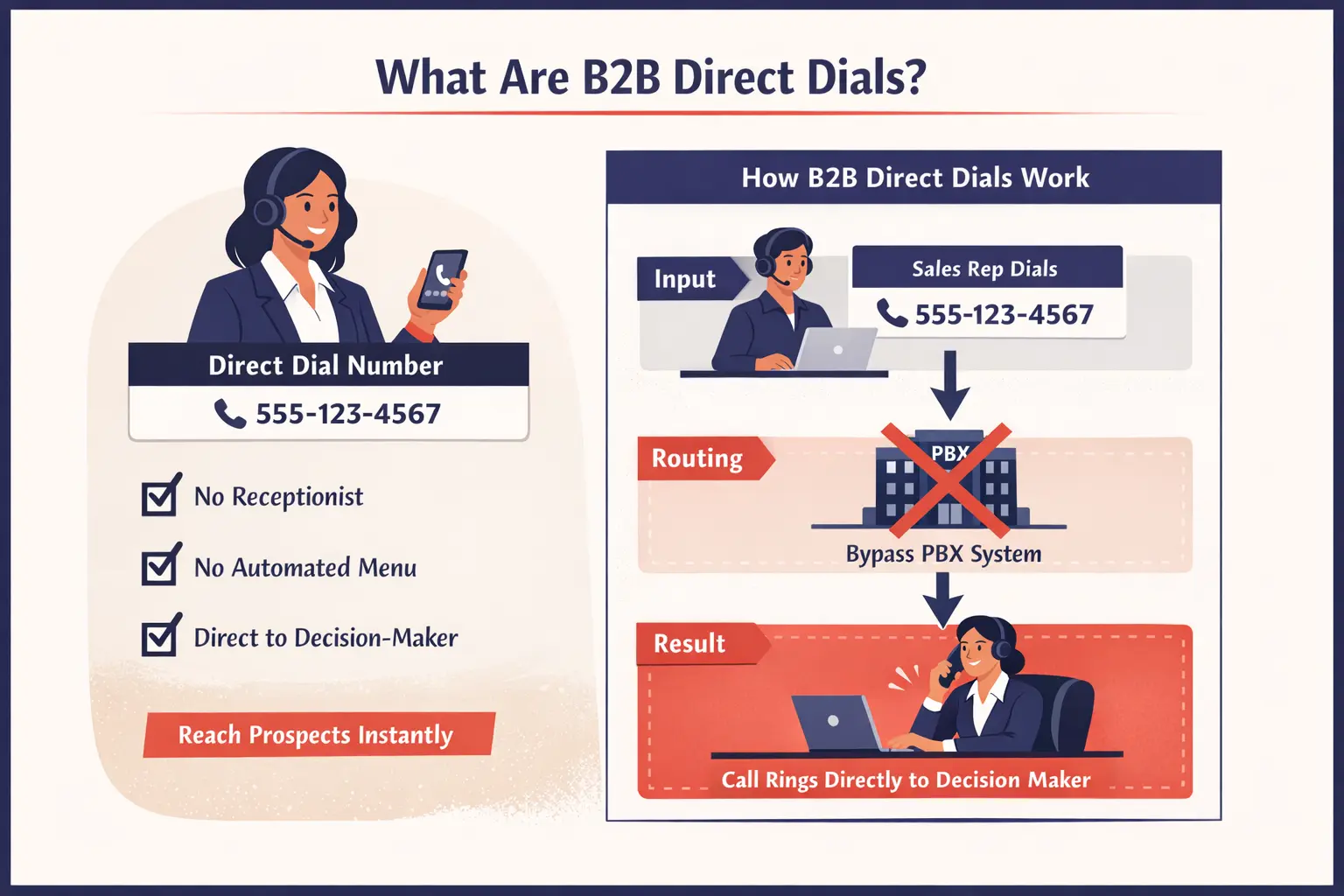
B2B direct dials are unique phone numbers assigned to individual employees within a company. These are also known as direct inward dialing (DID) numbers.
Unlike a main office number, a B2B direct dial connects you straight to a specific decision-maker. There’s no switchboard. No automated menu. No receptionist screening your call.
When you use a verified B2B direct dial number, the call goes directly to the prospect’s desk phone, extension, or business mobile line. It’s fast. It’s direct. And in outbound sales, that speed makes a real difference.
How B2B Direct Dials Work
When a sales representative uses a direct dial, the connection path is streamlined:
- The Input: A sales rep dials a specific 10-digit B2B direct dial number.
- The Routing: The call bypasses the company’s main Private Branch Exchange (PBX) operator console.
- The Result: The phone rings directly at the desk of the target decision-maker (e.g., a CTO, VP of Marketing, or Director of Operations).
A Practical Scenario
Imagine a software sales team targeting C-level executives.
- Without Direct Dials: The rep calls the main HQ number. A receptionist answers. The rep asks for the CTO. The receptionist screens the call ("Is she expecting you?"), or transfers the rep to a general voicemail. Result: Dead end.
- With Direct Dials: The rep dials the CTO’s direct line. The CTO picks up, assuming it is a relevant business call. The pitch begins immediately.
Industry data highlights the stark contrast in efficiency: Representatives typically require 8 to 18 dials to connect with a prospect using main lines. With verified direct dials, this average drops to just 1.55 dials.

SMARTe GTM Intelligence
Start Smarter Prospecting Today
Why B2B Direct Dials Matter: The Math Behind Sales Efficiency
B2B direct dials are not just a nice add-on. They are a revenue lever.
When I look at outbound performance, I focus on one thing: how many real conversations are happening each day. If reps are not speaking to decision-makers, the funnel slows down.
B2B direct dial numbers fix that. They increase reach rates — the percentage of calls that turn into live human conversations. And that one shift changes everything.
More live conversations mean more real opportunities. And the numbers prove it.
1. Higher Connect Rates with Senior Leaders
The higher the title, the harder it is to get through.
Main lines are designed to block access. Receptionists screen calls. Assistants protect calendars.
B2B direct dials remove that barrier.
Sales teams using verified direct numbers report:
- Up to 46% higher connect rates with Directors
- Up to 147% higher connect rates with Vice Presidents
When you can reach senior buyers directly, your outbound strategy becomes far more effective.
2. Small Gains Create Big Pipeline Growth
Sales is a numbers game. Even small improvements compound over time.
If your connect ratio improves from 22:1 to 20:1, it may not sound like much. But for a 20-person team making 60 calls a day, that shift can generate over 1,000 additional sales conversations per year.
More conversations lead to:
- More booked meetings
- More qualified opportunities
- More predictable revenue
That is the real math behind B2B direct dials.
3. Lower Cost Per Lead and Better Rep Focus
Every wrong number costs money.
When reps dial outdated contacts, they waste time. When they fight gatekeepers, they lose momentum. Over weeks and months, that inefficiency raises your cost per lead.
Accurate B2B direct dial data reduces wasted effort. Reps spend more time selling and less time chasing bad information. This improves productivity and lowers overall acquisition costs.
4. Smarter Prospecting Without Manual Research
Before reliable direct dial databases existed, sales reps had to search for contacts manually. Many used basic phone number lookup tools or guessed company extensions just to reach the right person. Some even tried to find a CEO phone number by checking multiple websites and directories. The process was slow and rarely accurate.
A simple cell phone number lookup could take hours and still produce incomplete results. Reps spent more time researching than actually selling.
Modern B2B direct dial providers remove this problem. Instead of searching one contact at a time, teams get verified data at scale.
This speeds up prospecting, improves accuracy, and lets reps focus on strategy instead of detective work. Today, speed and precision make the difference — and direct dial data delivers both.
The Strategic Benefits of B2B Direct Dials
The value of B2B direct dials goes beyond higher connect rates.
When you integrate accurate direct dial data into your CRM, you don’t just improve outreach. You improve how your sales team operates every day. I’ve seen it change team culture, confidence, and consistency.
Here’s how.
1. Bypassing Gatekeepers with Confidence
Gatekeepers are trained to protect executives. That’s their job.
Receptionists screen calls. Executive assistants block unknown numbers. Automated systems filter you out before you even speak.
B2B direct dials remove that barrier.
Instead of spending energy trying to “get past” someone, reps can focus on what truly matters — delivering a strong, clear pitch. This shift improves call quality. It also reduces the stress that comes with constant rejection at the front desk level.
When reps get past the gatekeepers and reach decision-makers directly, conversations feel more professional and more productive.
2. Stronger Team Morale and Less Burnout
Sales burnout is real. I’ve seen talented SDRs lose motivation simply because their effort did not lead to conversations.
Dialing all day and reaching no one drains energy fast.
With reliable B2B direct dials, each call feels purposeful. Reps know there is a real chance someone will answer. That changes mindset.
Higher connection rates create a positive loop:
- More connects
- More meetings
- More wins
- More motivation
When activity leads to results, teams stay engaged. And engaged teams outperform.
3. Faster Conversations in a Noisy Digital World
Email inboxes are crowded. LinkedIn messages go unread. Ads get ignored.
The phone is different. It demands attention.
A B2B direct dial gives you immediate feedback. You can handle cold calling objections in real time. You can adjust your message on the spot. You can build rapport within minutes.
That speed creates a real competitive advantage.
In fast-moving markets, the first vendor to have a live conversation often wins the deal. And direct access makes that possible.
Legal Considerations: Compliance Is Non-Negotiable
In 2026, data privacy is serious business.
B2B direct dials can boost your outreach. But if you ignore compliance rules, the risk is huge. Fines, lawsuits, and brand damage can wipe out years of hard work.
I always tell sales teams this: growth is important, but compliant growth is smarter.
Here’s what you need to know.
GDPR (Europe and UK)
Under the General Data Protection Regulation (GDPR), B2B cold calling can be legal if it follows strict rules.
Legitimate Interest
You do not always need prior consent to call a business number. However, your offer must be relevant to the person’s job role. Your business interest must not override their privacy rights.
If you are selling HR software, calling a Head of HR makes sense. Calling someone unrelated does not.
Opt-Out Requests
If someone asks to be removed from your list, you must act fast. Ignoring opt-outs can lead to serious penalties.
Under GDPR, fines can reach up to 4% of global annual revenue. That is not a small risk.
TCPA (United States)
In the US, the Telephone Consumer Protection Act (TCPA) governs calling practices.
Business Lines
Calling verified business numbers is generally allowed.
Do Not Call (DNC) Lists
You must check your contact lists against the National Do Not Call registry and state-level DNC lists. Skipping this step can be costly.
Record Keeping
Companies are expected to keep records of calls and opt-out requests for up to four years.
Violations can lead to fines of up to $1,500 per call. At scale, that adds up quickly.
Compliance Best Practices for B2B Direct Dials
Not all data is equal.
Always work with B2B direct dial providers that follow strict compliance standards. Trusted vendors screen numbers against multiple DNC lists and follow regulations like GDPR and CCPA.
Avoid cheap, unverified contact lists. Many of them include personal mobile numbers collected without proper consent. That can trigger spam complaints, legal action, and serious financial penalties.
In modern B2B sales, compliance is not optional.
If you want long-term success with B2B direct dials, build your outreach on clean, verified, and legally sourced data. That is how you protect both revenue and reputation.
6 Best B2B Direct Dial Providers for Accurate Phone Numbers
Here are 6 of the best B2B direct dial providers in 2026. I’m listing them based on data accuracy, compliance standards, global coverage, and how well they actually support real sales teams — not just marketing claims.
1. SMARTe

SMARTe is a global B2B sales intelligence tool known for high-quality data at a competitive price. I see many revenue teams choose SMARTe when they want strong direct dial and mobile coverage without paying legacy enterprise pricing.
It is built for GTM teams that need to reach decision-makers across North America, EMEA, APAC, and LATAM.
SMARTe provides access to over 290 million verified contacts, with a strong focus on mobile numbers and global completeness. If your outreach depends on accurate B2B direct dials, this platform is built to support that at scale.
Key Features:
- Extensive Mobile Coverage: Offers strong mobile number availability — up to 75% coverage in North America and around 50% across EMEA and APAC.
- AI-Powered Agents: Uses AI to automate prospecting and surface real-time buying signals such as job changes, funding rounds, and company growth events.
- Technographic and Firmographic Filters: Filter prospects using over 59,000 technology variables and 55+ company attributes. This helps you target accounts with precision.
- Real-Time Verification: Validates contact data at the time of export or enrichment to improve accuracy and reduce bounce rates.
- LinkedIn Chrome Extension: Reveals direct dials and allows reps to push contacts into their CRM directly from LinkedIn or company websites.
- Bi-Directional CRM Sync: Native integrations with Salesforce, HubSpot, Outreach, and Salesloft for seamless workflow management.
Pros:
- Strong Value for the Price: Delivers enterprise-grade contact data at a lower cost than many large competitors.
- Global Data Strength: Performs well in regions that are often underserved, especially Europe and APAC.
- Flexible Pricing Model: Credit-based structure allows teams to scale usage without strict per-seat limits.
Cons:
- Niche Industry Gaps: Some very specific or small industries may have lighter coverage compared to larger legacy databases.
- Feature Depth Can Take Time to Learn: The AI signals and advanced filters may require onboarding to fully leverage.
Pricing:
- Free Plan: Includes 10 monthly credits for testing and exploration.
- Pro Plan: Starts at $25 per month for 50 credits.
- Enterprise Plan: Custom packages starting around $15,000 per year for high-volume usage, with credit costs decreasing at scale.
SMARTe GTM Intelligence
Start Smarter Prospecting Today
2. Cognism

Cognism is known for its phone-verified direct dials and strong compliance focus. It is built for enterprise sales teams operating across North America, EMEA, and APAC.
The platform offers access to hundreds of millions of global contacts, with a strong emphasis on verified mobile and executive direct numbers. Many teams report improved cold call success rates after switching to their verified data.
Key Features:
- Phone-verified direct dials and mobile numbers
- Strong executive-level coverage (Director, VP, C-level)
- Checks against 15+ global DNC lists
- Intent data to prioritize high-fit accounts
- Native CRM integrations (Salesforce, HubSpot)
- Large global database with millions of phone numbers
Pros:
- High compliance standards reduce legal risk
- Strong enterprise coverage
- Accurate data reduces wasted dials
Cons:
- Higher pricing tier
- Best suited for mid-market and enterprise teams
Pricing:
Custom enterprise pricing, typically starting around $10K+ per year.
3. Forager
Forager is gaining attention for direct dial accuracy and AI-powered data enrichment. It focuses on real-time verification, which helps reduce bad numbers and data decay.
It performs well across North America, EMEA, and APAC, making it a strong choice for global outbound teams.
Key Features:
- High direct dial and mobile accuracy
- Strong international coverage
- Waterfall enrichment for improved match rates
- Bulk exports with CRM sync
- Real-time phone validation API
Pros:
- Strong accuracy benchmark
- Good value for high-volume prospecting
- Balanced global coverage
Cons:
- Newer brand compared to legacy players
- Credit-based pricing can scale up quickly
Pricing:
Starts around $675 per month for base credit packages.
4. ContactOut
ContactOut is popular among SDRs who rely on LinkedIn for prospecting. Its Chrome extension allows reps to capture direct dials and emails directly from LinkedIn profiles.
It is often chosen by smaller teams and individual contributors who need affordable access to direct numbers.
Key Features:
- Chrome extension for LinkedIn enrichment
- Global mobile and direct dial coverage
- Bulk number extraction
- Email and phone data bundles
- Basic DNC filtering support
Pros:
- Easy to use
- Affordable entry pricing
- Strong APAC and North America coverage
Cons:
- Accuracy may vary by region
- Compliance processes often managed by the user
Pricing:
Starter plans begin around $49 per month.
5. ZoomInfo

ZoomInfo is a well-known enterprise sales intelligence platform. Its database includes millions of direct dials and verified business phone numbers, especially for VP and C-level contacts.
The platform combines contact data with intent signals and organizational charts, making it powerful for account-based selling.
Key Features:
- Large global B2B contact database
- Verified direct dials for senior decision-makers
- Intent data and org charts
- Deep Salesforce integration
- Regular data refresh cycles
Pros:
- Strong enterprise-grade data
- Advanced integrations and APIs
- Effective for large outbound teams
Cons:
- Expensive for startups
- May be too complex for smaller teams
Pricing:
Enterprise plans typically start around $15K per year.
6. Apollo

Apollo offers an all-in-one sales engagement platform with access to a large B2B contact database that includes direct dial numbers. It combines a mobile phone number database with sequencing and auto-dialing features.
This makes it attractive for teams that want sales prospecting and outreach in a single system.
Key Features:
- Large global contact database
- Built-in dialer and sales sequences
- AI lead scoring
- Chrome extension
- Compliance tools and DNC support
Pros:
- Affordable pricing tiers
- All-in-one outreach platform
- Scalable for growing teams
Cons:
- Phone accuracy may vary by region
- Interface can feel crowded
Pricing:
Plans start around $49 per month, with Pro plans near $99 per user per month.
When selecting a B2B direct dial provider, focus on three things: data accuracy, compliance standards, and how well the platform fits your workflow. The right tool should not just give you numbers — it should give you real conversations.
How to Find B2B Direct Dials Manually (Step-by-Step Guide)
Finding B2B direct dials manually is possible. But it takes patience and careful research.
For small, targeted lists, these methods can work well. For large-scale outbound campaigns, however, manual prospecting quickly becomes time-consuming.
If you are working on a small list — say 10 to 50 prospects — manual research can still work. It takes time. And the success rate may range between 20% to 50%, depending on the industry and privacy rules.
Here’s how to do it the smart way.
1. Check the Company Website Carefully
Many teams skip this step. That’s a mistake.
Start with the company’s:
- Contact Us page
- About Us section
- Leadership or Team page
- Press or Media section
Smaller companies often list direct extensions or department numbers. Sometimes you will find an executive assistant’s number, which can still help you reach the right person.
Use the site’s search bar and type:
- “phone”
- “ext”
- the executive’s name
You can also:
- Press Ctrl + U to view page source
- Check older versions of the site using Google cache or the Wayback Machine
Sometimes companies remove numbers from live pages, but old versions still show them.
2. Use Google Advanced Search
Google is more powerful than most people realize.
Try search queries like:
- “[Company Name]” “direct” phone
- “[Executive Name]” “desk” OR “extension”
- site:company.com “[Executive Name]” phone
- filetype:pdf “contact” “[Company Name]”
PDF files, brochures, and press releases often include direct numbers.
You can also search old interviews, event pages, or conference speaker lists. Many executives share contact details during events.
3. Use LinkedIn for Clues
LinkedIn rarely shows direct numbers publicly. But it gives signals.
Here’s what you can do:
- Check the executive’s profile and review their activity
- Look at event posts, webinar announcements, or comment threads
- Identify executive assistants or operations managers at the same company
Instead of asking for a number directly, send a polite message. For example:
“I’m trying to connect with [Name] regarding [topic]. Could you guide me to the best contact method?”
A respectful approach works better than aggressive cold requests.
4. Review Email Signatures
Your inbox can be a goldmine.
Search your email or CRM for past conversations with that company. Email signatures often include:
- Direct lines
- Extensions
- Mobile numbers
Out-of-office replies are also useful. Many professionals list their direct or backup number when they are away.
You can also ask colleagues if they have previously communicated with the same contact.
5. Call the Main Line the Smart Way
Yes, this still works — if done properly.
Call the company’s main number and be clear and confident.
Instead of saying, “Can I get the CEO’s number?” try:
“I’m following up on a conversation regarding [specific topic]. Could you confirm the best direct line to reach [Name]?”
If blocked, ask to be transferred to the executive assistant. Often, assistants share extensions to reduce repeated calls to reception.
Always stay polite and professional. Tone matters.
6. Use Networking and Referrals
Warm connections increase your chances.
You can:
- Ask mutual LinkedIn connections
- Post in relevant industry groups
- Reach out through alumni networks
- Attend webinars and events
A simple message like, “Do you happen to have the best contact number for [Name]?” can go a long way if you have a shared connection.
7. Check Public and Professional Directories
Some industries publish verified contact details.
Look at:
- Industry association member directories
- Licensing boards (legal, medical, financial sectors)
- Chambers of Commerce
- Government filings and public registries
These sources are especially useful for regulated industries.
8. Try Free Reverse Lookup Tools
If you find a partial number or old contact detail, you can verify it using free tools like:
- Truecaller
- Whitepages
- Public search directories
You can also search forums like Reddit or Quora to see if contact information was shared publicly.
The Wayback Machine is also helpful for viewing archived company contact pages.
Best Practices for Using B2B Direct Dials
Having a direct dial number is only half the equation. How you use it determines whether you book meetings or waste opportunities. Below is a clear, practical framework for high-performance outreach in 2026.
1. Control Volume and Time Blocking
Consistency drives results. Random calling does not.
Set Daily Dial Targets
Aim for 80–150 dials per rep per day, depending on data quality and industry.
Use Power Dialers
Automated dialing tools reduce manual errors, eliminate downtime, and increase talk time. More conversations mean more opportunities.
Call During High-Connect Windows
Schedule call blocks strategically. The best-performing time slots are typically:
- 8:00–9:00 AM (prospect’s local time)
- 4:00–5:00 PM
These hours often improve connect rates because decision-makers are available while gatekeepers may not be screening calls.
2. Apply the 3x3 Research Method
Never rely on completely cold outreach.
Spend 3 minutes finding 3 relevant insights about the prospect or their company before dialing.
Look for:
- Recent funding or expansion
- Hiring trends
- Technology adoption
- A recent LinkedIn post
Example opener:
“I noticed you recently hired three new SDRs. I’m calling to understand how you're managing data onboarding as the team scales.”
Short, relevant, and personalized messages increase engagement.
3. Build a Multi-Touch Cadence
To succeed, you must build a sales cadence that includes multiple touchpoints. One call is rarely enough. Consistent follow-up wins deals.
Plan 6–8 touchpoints over a 2–3 week period.
Use multiple channels:
- Direct dial calls
- Follow-up emails
- LinkedIn engagement
Multi-thread within the account:
Reach out to multiple stakeholders in the same company. When several decision-makers hear your message, internal conversations happen faster.
4. Optimize Openers and Call Scripts
When a decision-maker answers their direct line, you have about five seconds to earn attention.
Use a contextual opener:
“I’m calling regarding your recent expansion into the healthcare segment.”
Avoid generic introductions:
Skip “How are you today?” and move directly to the reason for your call.
Clarity and confidence build credibility instantly.
5. Maintain Data Hygiene and Track KPIs
B2B direct dials are not static. People change roles. Numbers get reassigned.
Clean your data monthly:
Regularly check lists against Do-Not-Call (DNC) registries to stay compliant and reduce risk.
Track performance metrics:
Monitor your Dial-to-Meeting ratio.
- Industry baseline: 2–3%
- High-performing teams using verified direct dials: 5–10%
If performance drops, review your data accuracy, timing strategy, and messaging.
Future Trends in B2B Direct Dials (2026 and Beyond)
Direct dial technology is no longer just about accessing phone numbers. It is shifting toward intelligent, data-driven execution. In 2026 and beyond, success will depend on how well teams combine verified numbers with AI, timing, and personalization.
The future of B2B direct dials is not about more calls. It is about smarter calls—powered by data, timing, and intelligent automation.
AI-Powered Dial Prioritization
AI is moving beyond simple data delivery. Modern platforms now analyze intent signals and behavioral triggers to guide reps on who to call and when to call.
Signals may include:
- Recent funding announcements
- Executive job changes
- New technology adoption
- Hiring spikes
Instead of static call lists, sales teams will work from dynamic priority queues that surface high-intent prospects first. The result: fewer wasted dials and higher connect-to-meeting ratios.
The Rise of Phone-First Outreach
Inbox fatigue is real. With email crowded by automation and AI-generated messaging, phone outreach is regaining importance.
We are seeing a shift toward:
- Shorter outreach sequences
- Higher-quality conversations
- Voice-led engagement strategies
The human voice builds trust faster than text. In competitive markets, direct conversations will become a strategic advantage.
Hybrid Outreach Models
Remote and hybrid work environments have made verified mobile numbers more valuable than ever.
Sales teams are blending:
- Direct dial calls
- Mobile outreach
- Immediate video meeting invitations
A well-timed call can quickly convert into a live Zoom or video demo when interest is high. Speed and flexibility will define top-performing teams.
Real-Time AI Pitch Assistance
AI-powered dialers are evolving into live coaching systems.
During calls, tools will:
- Analyze conversation patterns
- Surface relevant data points
- Suggest objection-handling prompts
- Recommend next steps in real time
This “pitch intelligence” reduces ramp time for new reps and improves consistency across teams.
How to Implement a Winning Direct Dial Strategy
If you want better connect rates and faster pipeline growth, you need more than just access to B2B direct dials. You need a clear execution plan. Here is a simple, step-by-step roadmap to launch and scale your direct dial strategy effectively.
1. Define Your Ideal Customer Profile (ICP)
Start with clarity.
Identify:
- Job titles (e.g., VP Sales, CTO, Head of Marketing)
- Target industries
- Company size
- Geographic regions
The more specific your Ideal Customer Profile (ICP), the higher your connect and conversion rates will be.
2. Choose the Right Direct Dial Provider
Not all providers are built the same.
- Targeting global enterprises? Test enterprise-focused platforms with strong compliance and international coverage.
- Focused on US SMBs? Look for cost-effective tools with strong domestic data accuracy.
Always begin with a trial or sample list. Validate phone number accuracy before committing budget.
3. Integrate With Your Sales Stack
Your direct dial data should flow directly into your workflow.
Connect your provider to:
- CRM (Salesforce, HubSpot, etc.)
- Sales engagement platforms
- Power dialers
Automation reduces manual errors and increases daily call volume.
4. Train for Direct Conversations
Calling a direct dial is different from calling a main line.
Prepare your team with:
- Strong opening lines
- Clear reason-for-the-call (RPC) messaging
- Objection handling frameworks
- Short, confident delivery
When a decision-maker answers directly, there is no gatekeeper buffer. The first 5 seconds matter.
5. Optimize Your Budget
Focus on quality over quantity.
Instead of buying massive, unverified lists:
- Invest in accurate, compliant direct dials
- Reduce wasted dials
- Aim to lower overall data costs by improving conversion efficiency
High-quality data often reduces total spending over time.
6. Track and Measure Performance
Monitor key metrics weekly:
- Connect rate (target 5% or higher with verified direct dials)
- Dial-to-meeting ratio
- Meetings booked per rep
- Pipeline generated
If performance drops, review data quality, call timing, and messaging.
7. Scale With Proof of ROI
Once you see consistent results:
- Expand call volume
- Introduce multi-threading within accounts
- Add more reps or territories
- Refine cadences based on top-performing segments
A strong direct dial strategy can significantly accelerate pipeline growth when executed with discipline.
Direct dials are powerful. But strategy turns access into revenue.
Conclusion
B2B direct dials are more than phone numbers—they are a direct path to revenue.
When backed by accurate data, smart targeting, and consistent follow-up, they boost connect rates, speed up sales cycles, and increase pipeline without increasing team size.
In a world crowded with emails, real conversations stand out. The teams that win will be the ones who reach decision-makers directly and turn calls into opportunities.