B2B sales is brutal right now.
Only 3 in 10 reps hit quota last year. Budgets are tighter. Buying groups are bigger. And the old playbook, the one built on cold volume and gut instinct, is quietly dying.
But here's what's interesting. Deals are still closing. Some teams are growing fast. The gap between them and everyone else didn't happen by accident. It happened because B2B buying changed and the best teams changed with it.
Buyers now complete most of their research before your rep gets on the phone. The average deal involves 13 internal stakeholders. And 94% of buying groups have already ranked their preferred vendor before they ever speak to sales.
If your pipeline feels harder than it used to be, it's not your reps. It's the game.
Let's break down how it actually works in 2026, and how to win it.
What Is B2B Sales?
B2B sales, short for business-to-business sales, is the process of selling products or services from one company to another. You're not selling to a person browsing Instagram at midnight. You're selling to a company that has a budget cycle, a procurement process, and a buying group that may include a dozen people who all need to agree before a contract gets signed.
That last part is the thing that makes B2B sales genuinely hard. It's not the cold calling. It's not the objections. It's navigating a room full of stakeholders who have different priorities and getting all of them to say yes.
The B2B market itself is enormous. Global B2B ecommerce alone is estimated at $32 trillion in 2025. The total market including services, SaaS, and enterprise deals is several times larger. There's no shortage of opportunity. The challenge is in how you pursue it.
B2B Sales vs. B2C Sales: What's Actually Different
People say B2B and B2C are just "different markets." That undersells it. The entire nature of the sale is different.
In B2C, someone sees an ad, gets curious, checks reviews, and buys. The whole thing can happen in an afternoon. In B2B, the average buying cycle now sits at 10 months. Even that figure is misleading because it counts from first contact. Many buyers start their research long before they ever talk to a vendor.
There's another difference that's become more pronounced in 2026: B2B buyers now arrive at sales conversations with their minds mostly made up. Research from 6Sense shows that 94% of buying groups ranked their preferred vendors before making first contact with sales. And they bought from that top-ranked vendor 77% of the time.
This changes everything about how you approach outreach and positioning. Your buyer isn't coming to you to learn. They're coming to validate a decision they've already leaned toward.
Types of B2B Sales
Not every B2B sale works the same way. The model you use depends on your product, your market, and who you're selling to.
Inside Sales
Reps sell remotely via phone, email, and video. It's the dominant model in SaaS and tech. Lower cost per acquisition, easier to scale, and faster to iterate on. Most teams start here.
Outside Sales (Field Sales)
Reps travel to meet prospects in person. It's expensive, but for large enterprise deals it often pays off. Relationships built face-to-face tend to close bigger and stick longer.
Account-Based Sales
Instead of going wide, you go deep. You pick a list of high-value target accounts and coordinate sales and marketing around them. Think personalized outreach, custom content, and multi-threaded engagement at every level of the org. It works best when your ICP is tight and your deal size justifies the investment.
SaaS Sales
Software-as-a-service has its own motion. Free trials, product-led growth, and self-serve often do the early selling. The rep's job shifts toward expansion and enterprise. We've written a full guide on SaaS sales if you want to dig into the specifics.
Channel Sales
Selling through partners, resellers, or distributors instead of direct. Useful for reaching markets you can't cover efficiently on your own. Harder to control the customer experience but much easier to scale geographic reach.
The B2B Sales Process, Step by Step
The B2B sales process isn't a funnel so much as a series of decisions. At each step, you're either earning the right to move forward or you're not.
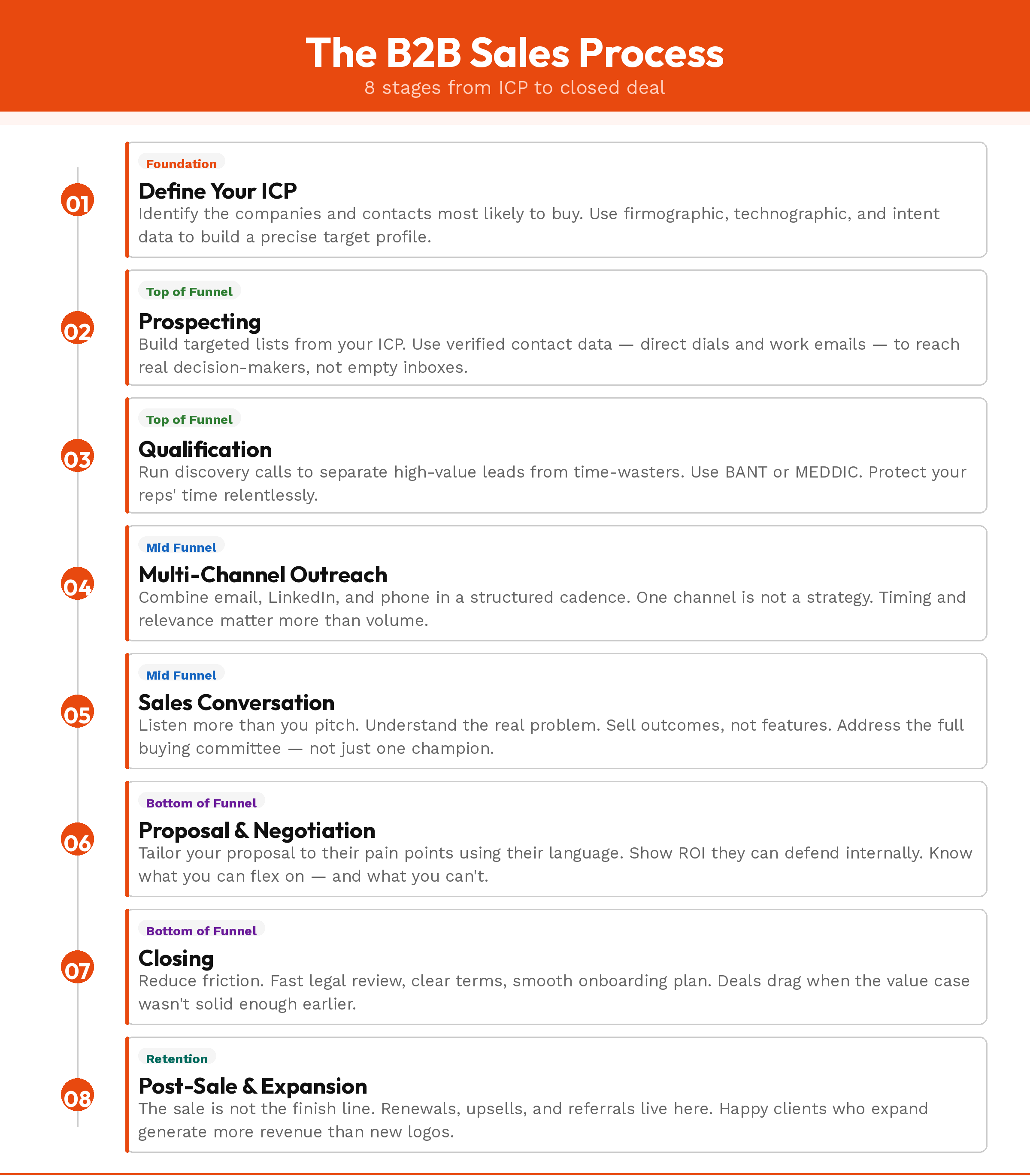
Step 1: Define Your ICP
Before you prospect, before you write a single email, you need to know exactly who you're trying to reach. Your Ideal Customer Profile defines the companies most likely to buy from you and get real value from it.
This means firmographics (industry, size, revenue), technographics (what tools they use), and behavioral signals (what problems they're actively trying to solve). Skip this step and everything downstream is guesswork.
SMARTe helps teams build targeted prospect lists using all three of these filters. You're not just finding the right companies. You're finding the right person inside the right company, with verified contact data to reach them.
Step 2: Prospecting
Once you know who you're after, you find them. This is where most teams struggle not because prospecting is hard in theory, but because bad data makes it brutal in practice.
SMARTe gives teams access to over 100 million verified contacts globally, with direct dials and work emails that are regularly refreshed. Your reps spend time talking to people, not hitting dead ends.
Step 3: Qualification
Not every prospect is worth pursuing. Qualification is how you figure that out before you waste a rep's time. Frameworks like BANT (Budget, Authority, Need, Timing) give you a structure.
The discovery call is where this really happens. Ask better questions. Listen more than you talk. The goal is to separate sales qualified leads from leads that will drain your pipeline without ever closing.
Step 4: Multi-Channel Outreach
The era of single-channel selling is over. B2B buyers interact with up to 10 different channels during their buying journey (McKinsey). One email is not a strategy. One call is not a strategy.
A structured sales cadence that mixes email, LinkedIn, and phone at the right intervals still outperforms anything else in outbound. The sequence matters. The timing matters. The messaging definitely matters.
Step 5: The Sales Conversation
When you get someone on the phone or in a meeting, your job is simple in theory and hard in practice: understand their real problem and show them how you solve it.
Don't pitch features. Pitch outcomes. The CFO doesn't care about your dashboard. They care about what it does for revenue and risk. And they're almost always in the room now. Research shows 79% of B2B purchases require CFO approval.
Common sales objections will come up. Price, timing, the current vendor, internal priorities. Expect them. Prepare for them. And if you're selling specifically to finance leaders, we've written a dedicated guide on selling to CFOs.
Step 6: Proposal and Negotiation
A proposal that isn't tailored to what the specific buyer needs is a waste of both your time and theirs. Map your solution to their stated pain points. Use their language. Show the ROI in terms they can take to a CFO and defend.
Negotiation is normal. Know what you can flex on. Know what you can't. And know that the person you're negotiating with often needs to sell the decision internally. Make that easy for them.
Step 7: Closing
Closing in B2B is rarely a moment. It's the end of a long process. Your job at this stage is to reduce friction. Fast legal review, clear contract terms, a smooth handoff to onboarding.
The deals that drag on at this stage usually do so because the value case wasn't solid enough earlier. When buyers are confident in the decision, the paperwork moves fast.
Step 8: Post-Sale (This Is Where the Real Revenue Is)
The sale doesn't end at contract signature. In B2B, the relationship after the close often matters more than the sale itself. Happy clients renew. They expand. They refer.
91% of B2B sales professionals engage in upselling, and it accounts for 21% of company revenue on average. If you're treating every new customer as a closed file the moment they sign, you're leaving a significant portion of your revenue potential on the table.
B2B Sales Strategies That Actually Work in 2026
There's no shortage of B2B sales advice online. Most of it is recycled from five years ago. Here's what the current data says is actually moving the needle.
Build Your ICP Before You Do Anything Else
Every sales strategy conversation should start here. If you don't know precisely who you're selling to, your outreach won't land, your pipeline will fill with deals that never close, and your reps will burn out chasing the wrong people.
A good ICP in sales combines firmographic, technographic, and intent data. It's not a static document. It should evolve as you learn more about who actually buys from you and why.
Get Signal-Based Selling Right
Generic outreach is getting harder to justify. With 73% of B2B buyers now actively avoiding suppliers that send irrelevant messages (Gartner, 2025), timing and relevance aren't nice-to-haves. They're the price of entry.
Signal-based selling means prioritizing outreach when real triggers happen. A company raises a funding round. A new VP of Sales gets hired. A competitor customer posts a complaint online. These are the moments when outreach actually lands.
SMARTe surfaces these kinds of intent signals so your team can reach the right accounts at the right moment, not just work down a static list.
Sell to the Whole Buying Committee
Selling to one champion and hoping they carry the deal isn't a strategy anymore.
The average B2B purchase now involves 13 internal stakeholders. Each one has a different priority, a different fear, and a different reason to say no. If you're only threading value through one person, you're one reorganization or one bad week away from losing a deal you thought was closed.
The end user cares about ease of use. IT cares about security and integration headaches. Finance wants ROI they can defend upward. The executive sponsor wants strategic fit and minimal risk. One pitch can't satisfy all of that. You need to understand your B2B buying group deeply and map your messaging to each layer of it.
The harder question is knowing who's actually in that group before they show up on a call. Most reps find out too late. There are now platforms built specifically for identifying buying group members early in the process, so you're not walking into a room blind.
Don't Chase Volume. Chase Speed and Relevance
B2B buyers now spend only 17% of their total purchase time with all vendors combined. That's all the time you get, spread across every touchpoint. More outreach doesn't fix this. Better outreach does.
Speed matters too. The average B2B team takes 42 hours to respond to a new inbound lead. That's almost two full days. Meanwhile, 35 to 50% of sales go to the vendor that responds first. This isn't a sales problem. It's an operational one.
Make Your Pipeline Visible
You can't improve what you don't track. Understanding your B2B sales funnel conversion rates at every stage tells you where the real problem is.
Consistent pipeline generation is more important than heroic individual closes. A pipeline that's predictably full beats scrambling every quarter.
Fix Your Follow-Up
This one should be embarrassing for most teams. Half of sales reps never follow up after the first contact. And yet, most B2B deals require 5 to 8 touches before a meaningful response. The math here is not complicated.
Having a set of strong sales follow-up email templates that actually read like they came from a human is one of the easiest improvements you can make. It doesn't require new tools. It just requires discipline.
B2B Sales Trends You Need to Know in 2026
Buyers Are Using AI to Research You Before You Even Know They Exist
94% of B2B buyers are now using AI tools like ChatGPT during their buying process. Nearly a third start their research with AI more often than with a search engine. And more than half ask AI for vendor shortlists before they ever Google anything.
What this means practically: your presence in AI-generated answers matters. The content on your site, the reviews on G2, the case studies you publish, all of that feeds into what AI tools surface when a buyer asks. This is why AI in sales isn't just a tool question anymore. It's a positioning question.
The AI SDR Is Real, and It's Changing the Role
We cover this in depth in our piece on AI SDRs. The short version: AI is now handling prospecting, email sequencing, and early-stage lead research at a scale that individual humans can't match. Human SDRs are moving toward conversations that require actual judgment and relationship-building.
Reps who partner with AI effectively are 3.7 times more likely to hit quota, per Gartner. Reps who get replaced by it, or who resist it, are generating expensive noise.
Self-Service Is Not Optional Anymore
61% of B2B buyers prefer a purchasing experience that doesn't involve a sales rep. Among millennial buyers, that number is even higher. 75% say they'd rather make complex purchases digitally than in person.
This doesn't mean sales is dying. It means the role of the rep is shifting toward later in the process, and toward more complex, higher-stakes conversations. Your digital experience and content have to do the early selling.
Data Quality Is Now a Competitive Advantage
The average B2B sales lead database goes stale fast. People change jobs. Companies get acquired. Emails bounce. The industry average data refresh cycle is six weeks, which means contact data starts degrading before most teams even use it.
Teams with clean, verified, regularly refreshed data outperform those without it, not because they're smarter, but because they're actually reaching real people. SMARTe's platform is built around this. Our data is verified and refreshed continuously so your team isn't wasting calls on numbers that don't work anymore.
In-Person Is Down But Not Dead
In-person interactions now account for 17% of B2B revenue, down from 22% two years ago. But 87% of B2B sellers believe meeting prospects in person before closing large deals is still critical. And 67% of buyers agree.
The shift is that in-person is no longer the primary mode. It's the closing move for complex enterprise deals, not the starting point for most conversations.
The B2B Sales Team: Who Does What
A B2B sales team isn't just a group of reps. There are usually distinct roles and they interact in specific ways.
SDRs (Sales Development Representatives)
SDRs are the front line. They handle outbound prospecting, cold outreach, and early qualification before handing off to account executives. It's a demanding role that requires resilience and a genuine curiosity about buyers' problems.
If you want the full picture on what the role looks like and what makes a strong SDR, we wrote a complete guide on Sales Development Representatives.
Account Executives (AEs)
AEs take qualified leads and work them through to close. They run demos, manage negotiations, and coordinate with legal and finance to get contracts signed. The AE relationship with an account often defines whether that customer renews or churns.
Account Managers
Post-sale. They manage the ongoing relationship, look for expansion opportunities, and reduce churn. In many B2B companies, account managers drive more revenue than new business reps through cross-selling and upselling.
Sales Leaders
Build the process, set the strategy, and create the conditions for the team to succeed. The best ones are fanatical about data and deeply protective of their reps' time.
B2B Sales Tools Your Team Actually Needs
The average sales tech stack has ballooned in recent years, and 45% of sales pros say they're overwhelmed by the number of tools they use. Here's the short list of what actually matters.
Sales Intelligence and Prospecting Data
Everything starts with good B2B data. If your B2B contact database is stale, your whole outbound motion breaks down. A sales intelligence tool like SMARTe gives your team access to verified direct dials and work emails across 100+ million contacts worldwide. Filter by industry, title, company size, tech stack, and intent signals to build lists that are actually worth working.
Our Chrome extension surfaces contact data directly inside LinkedIn so reps don't have to tab-switch and manually copy information. The best Chrome extensions for SDRs can cut research time significantly, and SMARTe's is built for this exact workflow.
CRM
Your CRM is the system of record. Salesforce, HubSpot, and Pipedrive are the most common in B2B. The best CRM is the one your team actually uses consistently.
Sales Engagement
Tools like Outreach and Salesloft let you build and execute multi-channel sequences at scale. They handle the sequencing logic so reps don't have to manually track 40 follow-ups at once.
Sales Forecasting
If you're managing a team, you need to know what's actually going to close this quarter. Sales forecasting software gives you a data-backed view instead of gut feel.
Sales Enablement
Reps need content, training, and playbooks. Sales enablement tools centralize this so the right asset gets to the right rep at the right moment in the deal.
For a fuller breakdown of what's worth investing in, check out our guide to B2B sales tools.
Common B2B Sales Mistakes (And Why They Keep Happening)
- Skipping qualification. Chasing every lead looks like activity. It isn't. Time spent on unqualified leads is time not spent on deals that could actually close.
- Generic outreach. If your email could go to any of 500 companies without changing a word, delete it and start over. Buyers can tell instantly.
- Selling to one person. Find the full buying committee early. Getting ambushed by a gatekeeper or a skeptical finance team at the end of a deal is preventable.
- No follow-up discipline. Deals don't die because buyers say no. They die in the silence between touches. A structured cadence fixes this.
- Misaligned sales and marketing. When marketing calls something a lead that sales can't close, you have an ICP definition problem. Fix it together.
- Treating close as the finish line. Post-sale is where retention and expansion revenue live. It deserves the same attention as new business.
How SMARTe Helps B2B Sales Teams
SMARTe is a B2B sales intelligence platform. We're built for teams that need accurate, current contact data and the ability to find the right buyers fast.
Here's what we do:
- Verified direct dials and work emails so reps reach real people, not voicemail loops and bounce notices
- Prospect list building by industry, job title, company size, revenue, and tech stack
- Intent signals that surface which accounts are actively researching solutions like yours
- A Chrome extension that puts contact data inside LinkedIn, so the workflow is fast
- Integrations with Salesforce, HubSpot, and most major CRMs and sales engagement platforms
- Coverage across North America, EMEA, and APAC for teams selling into multiple markets
The goal is simple: more time in conversations, less time hunting for information that may or may not be accurate.
The Bottom Line
B2B sales in 2026 is harder than it was five years ago. Buying groups are bigger. Buyers are more informed. And most of them have already ranked their preferred vendor before your rep gets on the phone.
That sounds discouraging. It isn't.
It means the teams that win aren't the ones who call the most or email the most. They're the ones with the clearest ICP, the cleanest data, the most relevant outreach, and the discipline to follow up when most reps have already given up.
That's a repeatable system. And systems beat individual heroics every time.
SMARTe is built to help you run that system. Start with the data layer, and the rest of the process gets a lot easier.