TL;DR:
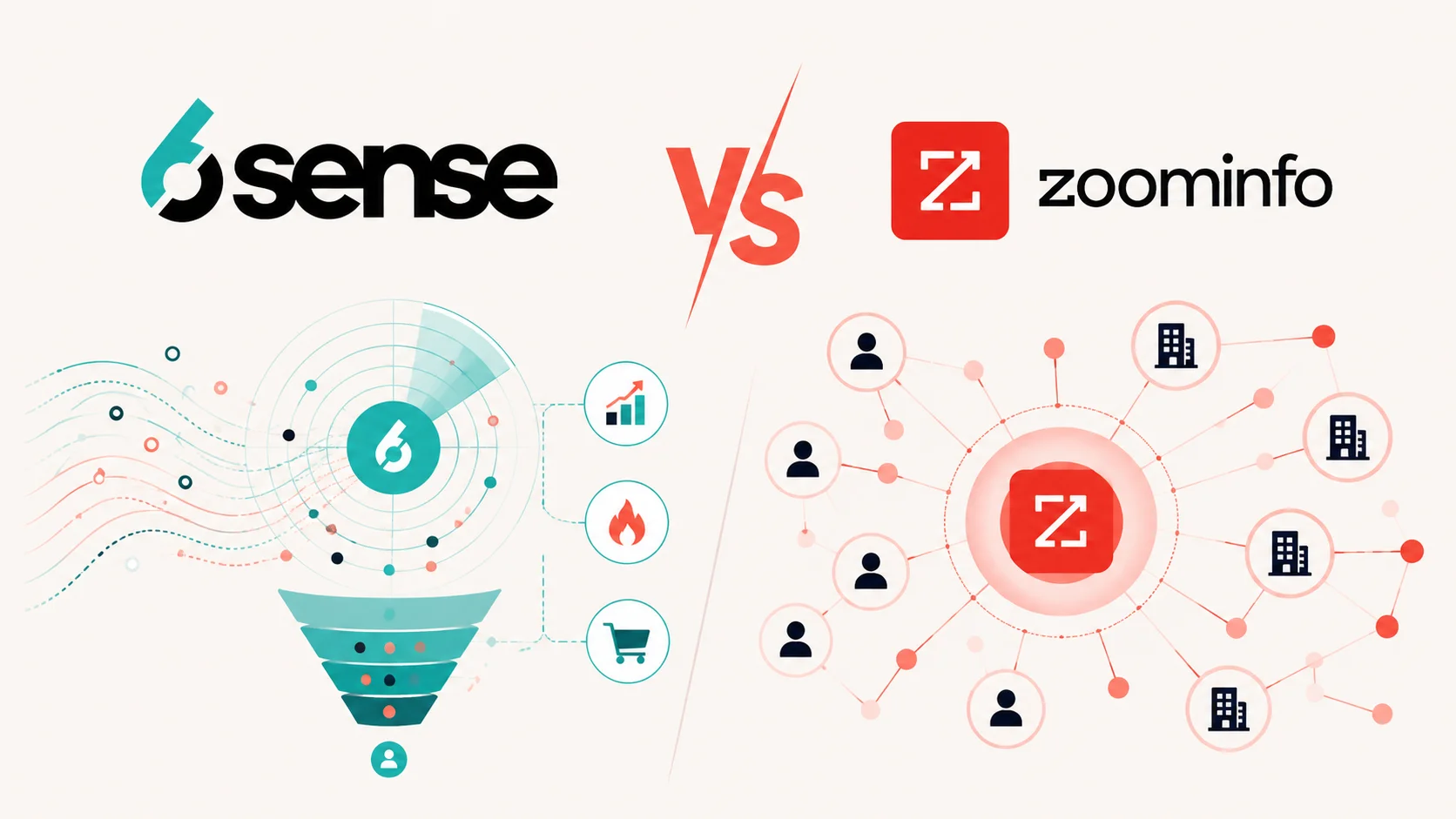
6sense vs ZoomInfo is a choice between two jobs, not two versions of the same tool. 6sense predicts which accounts are in-market. ZoomInfo tells you who to contact once you know.
6sense is an account intelligence and ABM platform. It scores accounts 0 to 100, assigns a buying stage, and fires a 6QA alert when an account reaches Decision or Purchase. Median contract: $62,440/year.
ZoomInfo is a B2B contact database and GTM data platform. It publishes 321M contacts, 94M mobiles, and 70M direct dials, and goes live in under three weeks. Median contract: $33,500/year.
Choose 6sense if account selection is your bottleneck. Choose ZoomInfo if contact reach is.
Key insights:
- 6sense shut down its free plan on August 12, 2026. Every evaluation now starts with a demo.
- ZoomInfo Lite stays free at 10 credits a month, no card, no expiry.
- 6sense bills on account universe size. ZoomInfo bills on seats plus export credits.
- ZoomInfo's net revenue retention slipped to 89% in Q2 2026. Use that at renewal.
- 6sense takes 60+ days and four admin roles to deploy. ZoomInfo takes under three weeks.
- Both launched MCP servers in 2026, so Claude and ChatGPT can query either dataset.
Teams compare 6sense vs ZoomInfo as if they're rival products competing for the same budget. They're not competitors. One scores accounts. The other supplies the people at those accounts.
Buy the wrong one and you spend six figures on software that never touches your real bottleneck.
I've watched that happen twice in eighteen months.
The first team had a marketing ops lead, a locked target account list, and $90K average deal sizes. They bought 6sense. They renewed.
The second had four SDRs, no ABM program, and a VP who loved the demo. Same software. That contract died at month fourteen.
Every ZoomInfo vs 6sense evaluation I've sat through has the same blind spot. Both vendors pitch "know which accounts are ready." Then one hands you a scored account list. The other hands you a mobile number. Whichever gap you really had stays wide open.
This comparison uses Vendr contract data, SEC filings, 2026 product releases, and verified G2 review patterns. No affiliate deals with either vendor.
6sense vs ZoomInfo: Side-by-Side Comparison
What Is 6sense?
6sense is an account intelligence and ABM platform that predicts which companies are researching your category before they fill out a form.
The company dropped the ABM label in 2026. It now calls itself the intelligence engine for agentic go-to-market, which is more than a tagline refresh.
The engine behind it is Signalverse. It ingests roughly one trillion signals a day from:
- Your website and product data
- Your CRM and marketing automation platform
- Bombora's third-party intent feed
- G2, TrustRadius, and TechTarget research activity
A predictive model turns that firehose into a buying stage and an intent score. The model trains on your own closed-won and closed-lost deals, not an industry average.
1. How 6sense Scores Accounts
The score bands are what make 6sense concrete, and almost nobody publishes them.
When an account crosses from Consideration into Decision or Purchase, it becomes a 6QA, short for 6sense Qualified Account. That's the flag your reps work.
You can move the threshold. Too many 6QAs, tighten it. Too few, loosen it.
2. What 6sense Shipped in 2026
Chris Ball took over as CEO in September 2025, after Jason Zintak scaled revenue from $5M to over $250M. The roadmap moved fast after that.
- RevvyAI reached general availability in May 2026. Conversational answers about accounts, inside the Chrome extension, Gong, and the web app.
- AI-Recommended Leads shipped in August 2026. Ad engagement now converts into CRM-ready contacts instead of stopping at the account.
- 6sense MCP Server also landed in August 2026, pushing buying stages, 6QA status, and keyword intent into Claude, ChatGPT, Writer, and Agentforce.
3. Analyst Recognition
Forrester named 6sense a Leader in The Forrester Wave for Revenue Marketing Platforms for B2B, Q1 2026.
Gartner placed it as a Leader in the 2025 Magic Quadrant for account-based marketing platforms, its fifth year running.
One correction, because blogs keep recycling it. The Forrester intent data recognition people quote is from Q1 2025, not 2026.
What Is ZoomInfo?
ZoomInfo is a B2B contact database and GTM data platform that supplies verified emails, mobile numbers, and direct dials for outbound teams.
It changed its Nasdaq ticker from ZI to GTM and now brands itself a GTM Intelligence Platform. CEO Henry Schuck calls it the data backbone modern GTM runs on.
Strip the branding and it's the same asset it always was: the largest commercial B2B contact database on the market.
1. What ZoomInfo's Database Covers
For an SDR who needs a number that rings a human today, that depth is the whole argument.
2. What ZoomInfo Shipped in 2026
- GTM Studio gives RevOps and marketers one workspace to build audiences and push them straight to LinkedIn or Meta ad accounts.
- GTM Workspace is the seller view, renamed from Copilot Workspace. The ZoomInfo Copilot layer now runs across multiple package levels instead of sitting only at the top tier.
- GTM.AI went generally available on June 2, 2026. A headless layer exposing ZoomInfo data through API, MCP, and a CLI.
ZoomInfo also took the Leader spot in The Forrester Wave for Marketing and Sales Data Providers for B2B, Q1 2026. It scored the highest current offering among evaluated vendors and topped 20 of 27 criteria. It ranked No. 1 in 142 G2 Spring 2026 reports.
3. The Retention Number Buyers Should Ask About
Now the part that never makes the deck.
- Q2 2026 revenue grew 1.2% year over year
- Net revenue retention dropped to 89%, down from 90% across the prior three quarters
- Down-market annual contract value fell 12%
Translation: existing customers are cutting spend, not expanding. If you're signing a multi-year deal, bring that to the table. Fuller context sits in this ZoomInfo review.
6sense vs ZoomInfo: Contact Data Accuracy
ZoomInfo wins here, and not closely.
6sense doesn't publish a headline contact count the way ZoomInfo does. That tells you where the company spends its energy. Its people data came largely from the Slintel acquisition.
The Summer 2026 release added verified decision-maker profiles, executive role classification, and better CRM matching. The layer is improving.
Review patterns haven't caught up:
- 6sense: inaccurate data tops its G2 complaint tags, with over 130 mentions. Reviewers put email and phone accuracy in the 80 to 90% band.
- ZoomInfo: Inaccurate Data and Outdated Data each sit around 219 G2 mentions, even while Contact Information is its top-rated strength.
That pattern is physics, not negligence. B2B data decay runs 25 to 30% a year. A quarter of 321 million records is a lot of dead rows.
My read: ZoomInfo is the stronger B2B contact database for North America. Outside the US, both thin out fast. Reviewers in EMEA, APAC, and LATAM still hit wrong titles and disconnected numbers at higher rates than US searches produce.
What to do: Run a 200-record sample on your own ICP before signing either one. Not their sample list. Yours. Score title accuracy and phone connect rate separately, because they fail for different reasons.
6sense vs ZoomInfo: Intent Data
6sense wins here, and it's the reason the platform exists.
Signal volume isn't the difference. Both process enormous feeds. What happens after the signal lands is the difference.
6sense predicts. ZoomInfo filters.
- 6sense runs thirteen years of Signalverse history through models trained on your deals, then fires a 6QA when an account crosses the line your own data says matters.
- ZoomInfo maps IP-to-organization pairings across its bidstream network and flags topic surges. Guided Intent narrows that to topics correlated with your closed deals.
A filter is cheaper and honest about what it is. The specifics are worth reading in this ZoomInfo intent data review.
The split between first-party and third-party intent data explains the accuracy gap. 6sense blends both, which is why analyst evaluations score it higher on noise filtering.
Now the caveat against my own point. A predictive score needs training data. Under 50 closed deals a year, the model fits noise instead of a pattern. At that size, ZoomInfo's topic surge is the more trustworthy signal. Study how an intent data scoring model works before you pay for one.
Either way, benchmark both against pure-play intent data providers. Teams running ABM intent data programs often find they pay platform rates for a feed they could license directly.
6sense vs ZoomInfo: CRM Enrichment
Split decision. ZoomInfo wins on breadth, 6sense wins on workflow design.
6sense Data Workflows runs real-time, on-demand, and scheduled enrichment through a drag-and-drop builder. You can trigger it the second a record lands. The builder is a pleasure to use.
The limit is coverage: Salesforce and HubSpot, and that's the list.
ZoomInfo's Operations line supports a wider set of CRM and marketing automation systems and handles more edge cases out of the box. It also grew 20% year over year in Q2 2026, faster than any other part of the business. Buyers are voting for the data layer, not the applications.
Neither includes enrichment in a base seat. Both quote it separately.
If this is the real reason you're shopping, compare what ZoomInfo enrichment costs on contract against how CRM data enrichment workflows differ across vendors. Press on match rate, not record count. A 40% match against 300 million rows loses to a 90% match against 80 million.
6sense vs ZoomInfo: Technographics
Short section, short answer. ZoomInfo wins.
ZoomInfo maps installed technology across its full company database and lets you filter on it. For competitive displacement plays, that filter does real work.
6sense carries technographics from Slintel. Coverage exists, reviewers flag gaps, and it isn't a reason to buy the platform.
If tech stack targeting drives your motion, compare dedicated technographic data providers before assuming either suite covers it. The difference between firmographic and technographic data matters more than vendors admit when you build filters.
6sense vs ZoomInfo Pricing in 2026
Neither publishes a rate card. Both route you to a rep. Below is what buyers report paying.
1. 6sense Pricing
6sense retired its legacy Team, Growth, Enterprise, and Enterprise Lite tiers in May 2025. Today it sells one Sales Intelligence license with Data Credits and Predictive AI as configurable add-ons.
Vendr's marketplace data puts the median at $62,440 across 385 purchases, ranging from $11,376 to $176,809. Buyers negotiate around 17% off on average.
Three things inflate the real number:
- Credits don't roll over. Unused capacity expires.
- Expanding your tracked account universe mid-contract triggers fees.
- Implementation runs 60 days or more, which usually means a RevOps salary sitting behind the license.
And the free plan is gone. 6sense shut down the free Sales Intelligence tier on August 12, 2026, and those accounts no longer log in.
2. ZoomInfo Pricing
ZoomInfo sells three sales tiers: Professional, Copilot Advanced, and Copilot Enterprise.
What lands on top of that:
- Extra seats at $1,500 to $2,500 each
- Streaming Intent, Engage, and the Global Data Passport, all quoted separately
- The prospecting API, near $50,000 a year on its own
ZoomInfo told investors it's moving to a hybrid consumption model: lower platform fee, pre-purchased credits, rolling out to new business late in Q3 2026. If you renew in 2027, ask which model you land on. Tier detail and credit mechanics sit in the ZoomInfo pricing breakdown.
3. Seats vs Accounts: The Math That Decides Your Quote
6sense prices on how many accounts it scores. ZoomInfo prices on seats plus exports. That single difference flips the answer depending on your shape.
- A 40-rep team working 500 accounts pays ZoomInfo for 40 seats. The same team costs 6sense almost nothing extra, because headcount isn't the meter.
- A 4-person team chasing a 50,000-account TAM is the reverse. ZoomInfo stays cheap. 6sense quotes on that whole universe.
Run that ratio before the first call. Reps divided by tracked accounts tells you which vendor's meter favors you. It's the strongest negotiating lever you'll get.
Integrations and AI Agent Access
Both vendors spent 2026 racing to put data inside AI agents. This is the shift I'd watch closest.
- ZoomInfo GTM.AI is headless, with API, MCP, and CLI access. It completed integrations with OpenAI, Claude Code, Amazon Quick Suite, and Zapier.
- 6sense MCP Server does the equivalent for account intelligence. Buying stages, 6QA status, and keyword intent flow into any MCP-compatible agent.
On raw breadth, ZoomInfo carries 300+ integrations in GTM Studio against 6sense's 100+. But breadth stopped being the interesting metric.
What matters now is whether a rep can ask a plain-language question and get grounded data back. Both cleared that bar in 2026. Scan the field of MCP servers for sales before you wire either one in.
One detail almost nobody reports. ZoomInfo's GTM Studio now ships a 6sense Lead Scoring connector. Add it with a 6sense API key and buying-stage scores flow into ZoomInfo's Enrich panel. The two vendors compete in marketing and interoperate in product.
Implementation, Ease of Use, and Support
ZoomInfo goes live in under three weeks and reps figure it out without training.
6sense takes 60 days and up, and its own documentation describes four separate admin roles for a full deployment. That's not a product flaw. It's a staffing requirement, and teams who skip it end up paying for a model nobody tunes.
Support flips the picture. 6sense reviewers praise their CSMs consistently, often by name. ZoomInfo scores higher on raw support ratings.
One recurring 6sense complaint: CSM turnover. I've read multiple reviews describing three or four handovers inside eighteen months. Continuity suffers when the person who understands your model leaves.
6sense Pros and Cons
Where 6sense delivers:
- Predictive scoring trained on your own deals, not a benchmark
- Five defined buying stages with published score bands, so alerts are tunable
- Signalverse blends first-party, Bombora, G2, TrustRadius, and TechTarget signals
- Native ABM advertising across display, CTV, and LinkedIn
- RevvyAI and the MCP Server put account context inside tools reps already open
- Strong CSM relationships, when the CSM stays
Where it falls short:
- Contact accuracy is the top G2 complaint
- 60+ day implementation and four admin roles
- Enrichment limited to Salesforce and HubSpot
- No free plan since August 2026, so you can't test before a quote
- Credits expire, and TAM expansion costs extra mid-contract
- No conversation intelligence
ZoomInfo Pros and Cons
Where ZoomInfo delivers:
- 321M contacts, 94M mobiles, 70M direct dials
- Fastest time to first dial in the enterprise tier
- Best org chart and buying group mapping for multi-threaded deals
- Forrester Wave Leader with the highest current offering score, Q1 2026
- GTM.AI opens the data to agents without a separate developer contract
- ZoomInfo Lite stays free, so you can inspect data quality before talking to sales
Where it falls short:
- Data quality drops sharply outside North America
- Auto-renewal clauses with 60 to 90 day cancellation windows
- Add-ons turn a $15,000 quote into a $40,000 invoice
- 89% net revenue retention says existing customers are trimming
- Intent is a filter, not a prediction model
Who Should Choose 6sense?
Buy 6sense if all three are already true:
- You run a real ABM program with named target accounts.
- Someone's job description includes tuning the model.
- Deal values clear $50,000 with sales cycles past 60 days.
Below 200 employees, I'd skip it. Not because the product is weak, but because the parts that justify $60,000 a year go unused when nobody owns them. That's the pattern in every churned contract I've seen.
If fit is fine and price is the blocker, cheaper platforms do about 70% of the job. Compare 6sense competitors first, and check what account based marketing software costs across the category before you accept a quote. Teams running enterprise account based marketing at scale are the ones who reliably get their money back.
Who Should Choose ZoomInfo?
Buy ZoomInfo if your motion is outbound-heavy into North America and your reps need dials today.
An SDR can pull a list at 9am and dial it by noon. For high-volume outbound prospecting, nothing at the enterprise tier matches that. Org chart depth alone earns its place on multi-stakeholder deals.
Budget year two before you sign year one. Model the add-ons, the seat growth, and a renewal increase.
If that total makes you flinch, work through ZoomInfo alternatives properly. Head-to-heads like Cognism vs ZoomInfo and Apollo vs ZoomInfo tell you whether the premium buys anything in your territory. For EMEA-led teams, it frequently doesn't.
The Gap Neither Platform Closes
Neither vendor fixed this in 2026.
6sense tells you an account hit the Decision stage. It doesn't reliably hand your rep a mobile number that rings.
ZoomInfo hands you the number, then leaves you guessing which of the 47 contacts at that account is the person doing the research.
Teams that solve it by running both spend past $150,000 a year. I've watched that budget get approved. I've also watched it get cut twelve months later. The combined stack still couldn't answer the only question a rep asks: who do I call right now, and on what number?
Account-level buying signals without contact-level reach is half a workflow. Contact-level reach without timing is the other half. Person-level intent data is where the two meet, and both vendors price that middle at enterprise rates.
Where SMARTe Fits
I work at SMARTe, so weigh this section with that in mind.
SMARTe is a sales intelligence platform built for outbound teams that need the contact layer to hold up under volume.
The number I'd point at first is 75%+ US mobile coverage. Those are direct dials, not switchboards. In APAC and LATAM, where ZoomInfo thins out, that depth decides whether a list is workable or a rebuild.
On signals, SMARTe includes Bombora intent data natively, plus funding events, leadership changes, and headcount growth. It watches job changes so records don't rot quietly. B2B data enrichment runs at 90%+ CRM match rates. There's an MCP server too, so Claude and ChatGPT can query verified data in real time.
On compliance: SOC 2 Type II certified, GDPR-aligned, CCPA compliant. Dell, Salesforce, Accenture, Finastra, Informatica, and Uber use it.
Pricing is Enterprise only, starting at $15,000 a year.
Straight with you: 6sense's predictive modeling goes deeper than what SMARTe does. If full orchestration across paid ads, email, and web is the requirement, 6sense is the better buy and I'd say that on a call.
But for outbound-first teams that need clean contacts, working mobile numbers, and intent in one place, SMARTe covers it without a $60,000 floor.
See how SMARTe finds verified mobile numbers in your target accounts.
How to Decide in One Afternoon
Skip the feature matrix. Answer two questions with your own numbers.
1. Test Your Connect Rate
Pull 50 accounts your team agrees are ICP. Count how many a rep reached a decision-maker at last quarter.
Under 20% means you have a contact data problem. 6sense won't fix it. You'll get better-scored accounts you still can't reach.
2. Test Your Account Selection
Work out what share of closed-won deals came from accounts your team picked on purpose, versus accounts that fell in your lap.
Reps connecting but deals dying is a targeting problem. ZoomInfo won't fix that one.
Then price the fix. A signal-based GTM motion needs both halves eventually, but the question today is which half is bleeding. Run a lead scoring check against your existing CRM first and see whether your data even supports the model you're about to buy.
Conclusion
Teams that get real returns from either platform picked the one that matched how they already sell. They didn't buy the one that demoed best.
Software doesn't create a motion. It makes an existing one faster, or more wasteful, depending on fit.
A predictive model pointed at a list your reps can't reach produces expensive reports. A database of dials pointed at accounts that were never in-market produces expensive voicemails.
Figure out which half is broken. Then buy the fix, not the logo wall.