TL;DR:
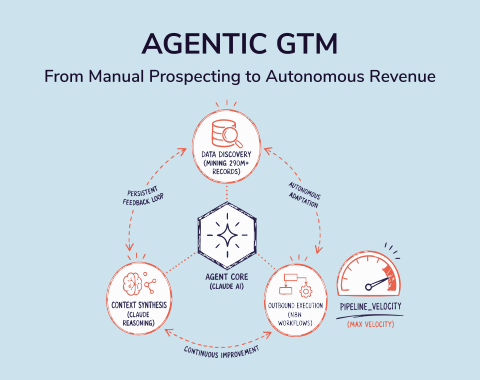
An AI sales agent is software that holds a goal and chooses its own steps to reach it. It sources accounts, researches contacts, writes and sends outreach, handles replies, books meetings, and updates your CRM.
Key Takeaways
- AI sales agents are AI-powered tools that perform or support sales tasks. They run on natural language processing, machine learning, and live company data.
- Agentic AI for sales uses autonomous agents to plan, decide, act, and adapt to new information with minimal human involvement.
- Common AI sales agent use cases include outreach at scale, lead qualification, and buying signal monitoring. Others cover meeting booking, pre-call research, CRM data entry, buying group mapping, and inbound website qualification.
- AI sales agents deliver gains in efficiency, round-the-clock engagement, and scalability without new headcount. They also lower cost per meeting, sharpen lead prioritization, and shorten sales cycles.
- Agents split into four categories: autonomous AI SDRs, copilot and orchestration agents, CRM-native agents, and voice or dialer agents. Each solves a different problem.
- Top AI sales agents include SMARTe, Artisan (Ava), AiSDR, 11x (Alice), Salesforge (Agent Frank), Regie.ai, Clay, Qualified (Piper), HubSpot Breeze, Nooks, and Relevance AI.
- 54% of sellers have already used AI agents, and close to nine in ten plan to by 2027.
- Agent performance depends on the contact data underneath it. Stale records make an agent confidently wrong at scale.
AI sales agents moved from demo to deployment fast. 54% of sellers have already used one, and close to nine in ten plan to by 2027.
That adoption number hides how messy the category still is. Four different product types share the label. Pricing runs from $250 a month to over $100,000 a year. Three of the eleven vendors below publish no figure at all.
I pulled every price below from the vendor's own pricing page in October 2026. One of them states its starting price two different ways on the same page.
What is an AI sales agent?
An AI sales agent is software that holds a goal and selects its own actions. It runs multi-step sales work without a person starting each step.
Give it an ICP and it sources accounts, enriches contacts, drafts messages, sends them, reads the replies, and books the meeting. The broader question of what AI agents are applies here too, just pointed at pipeline.
Plenty of products get the "agent" label stapled on without earning it. Worth separating.
AI sales agent vs AI assistant vs sales automation
Sales automation runs rules you wrote. Form fill triggers email two. No judgment involved.
An AI assistant waits for you. Ask it to draft an email, it drafts the email. Reactive by design, which is how ChatGPT for sales workflows mostly operate.
An AI sales agent starts things. It decides which 40 of your 4,000 accounts matter this week, writes to them, and handles what comes back.
The dividing line is autonomy, not intelligence. A chatbot on your pricing page is not a sales agent. Neither is a browser automation tool, and neither is a GTM workflow automation builder.
What is agentic AI for sales?
Agentic AI for sales describes systems that plan a sequence of actions, execute them, observe the result, and adjust without being re-prompted.
A generative tool writes what you ask for. An agentic system decides what needs writing in the first place. That shift is why agentic GTM became its own budget line rather than a feature request.
The practical test: if it can surprise you with a reasonable decision you did not specify, it is agentic. If it only fills in blanks, it is not.
The four types of AI sales agents
Lumping these together is how teams buy the wrong thing.
1. Autonomous AI SDR agents
These own the full outbound loop. Sourcing, writing, sending, replying, booking. Artisan, AiSDR, 11x, and Salesforge live here.
You hand over the motion and supervise it. That is the pitch and the risk. Buyers comparing this group against the wider AI BDR tools market will see heavy overlap. Anyone evaluating a single AI SDR will recognize the same shape.
2. Copilot and orchestration agents
These research, enrich, and prioritize, then hand execution to a human or another tool. Clay and Regie.ai sit here.
Less autonomy, more control. Teams with strong reps often get more from this shape, especially those already running automated prospecting workflows.
3. CRM-native agents
These run inside the system of record. HubSpot Breeze and Salesforce Agentforce qualify.
Zero integration overhead. Narrow reach outside their own platform.
4. Voice and dialer agents
These handle the phone. Nooks runs parallel dialing with AI answer detection and coaching.
Different problem, different buyer. Teams whose pipeline depends on cold calling need this category, and email agents will not cover it. Inbound voice overlaps with AI in customer service more than people expect.
How AI sales agents work
Agents differ in autonomy. The loop underneath runs the same five steps.
- Define the target. You give it an ideal customer profile, or it infers one from closed-won accounts.
- Source and enrich. It pulls matching accounts and contacts, then fills in emails, titles, and phone numbers.
- Research and write. It gathers context per contact and drafts cold email copy against that context.
- Execute. It sends across email, LinkedIn, or phone, then handles replies and objections.
- Book and log. It schedules the meeting and writes activity back to your CRM.
Step two is where deployments quietly fail. Thin lead enrichment produces confident messages aimed at the wrong inbox.
Hold that thought while you read the pricing.
The 11 best AI sales agents in 2026
I scored these on autonomy, data coverage, channel breadth, and whether the vendor publishes real numbers. I checked every price below against the vendor's own pricing page or documentation in October 2026.
1. SMARTe
Let me be upfront. SMARTe is not an AI SDR. It is the data layer the agents below query, and I work here, so weigh that as you read.
What SMARTe does
It supplies verified contact and company data to AI agents in real time through MCP, API, or native CRM sync.
Where SMARTe wins
- 289M+ verified B2B contacts and 66M+ company profiles
- 75%+ US mobile and direct dial coverage, plus 50%+ global direct dial across 200+ countries
- Real-time verification at the point of query, not a quarterly batch refresh
- Native Model Context Protocol support, so Claude prospecting workflows pull live records mid-conversation
- Listed among the MCP servers for sales that agents query directly
- Bombora intent data built in for buying signals
- 64K+ technologies tracked for technographics targeting
- SOC 2 Type II certified, GDPR aligned, CCPA compliant
Where SMARTe falls short
- No sending engine, no sequencer, no dialer
- Enterprise-only, so small teams will find the entry point too high
- Pairs with an agent rather than replacing one
SMARTe pricing
Enterprise plans start at $15,000 per year on a credit-based model with unlimited seats. The whole revenue team draws from one pool instead of paying per license.
Verdict
If your agent already runs and the bounce rate is the problem, this fixes the input rather than the output. If you have no agent yet, buy a platform below first and treat the data layer as step two. How SMARTe powers Outreach AI walks through the mechanics. Dell, Salesforce, Accenture, and Uber run on it.
2. Artisan (Ava)
Ava is the agent people picture when they hear "AI BDR." Full autonomy by default, with a dial you can turn down.
What Artisan does
Ava sources leads, researches them, writes email and LinkedIn outreach, sends from your reps' domains, handles replies, and books meetings.
Where Artisan wins
- Autonomy dial runs from approve-every-message to fully hands-off
- 250M+ verified B2B contacts bundled in, so no separate B2B contact database subscription
- Ava sends in your reps' names from your own sending domains
- Bi-directional Salesforce and HubSpot sync
- SOC 2 Type II, SSO and SAML, audit logs
- Enterprise plans include a forward-deployed strategist who builds the rollout
- AI dialer available as a per-seat add-on
Where Artisan falls short
- Pricing sits behind a demo again after a brief self-serve experiment earlier in 2026
- Parallel dialing runs up to 3 lines, where dedicated dialers do 5 to 10
- Reported G2 rating lands near 3.9 to 4.2 on a thin review base
- Artisan's own CEO told TechCrunch the response-rate sweet spot for its AI SDR email is about 1%
Artisan pricing
Three quote-only tiers on artisan.co/pricing. Team covers roughly 2,500 leads contacted per month, Scale around 6,000, and Enterprise is custom. Every plan bundles the full platform, CSM support, and onboarding. Reported deals land near $1,500 to $3,000 per month on annual commitments.
Verdict
The strongest full-autonomy option for mid-market teams that want one system instead of six. I rate the autonomy controls highest here. The public honesty about a 1% response rate is rare here. Budget against that number, not the case studies.
3. AiSDR
The transparency play. AiSDR publishes every tier, which almost nobody else in autonomous outbound does.
What AiSDR does
Ami, its GTM agent, builds the strategy, finds leads, writes email and LinkedIn messages, replies in 5 to 10 minutes, and books.
Where AiSDR wins
- Fully published pricing across all three tiers
- 300M+ lead database included, no separate data subscription
- Native two-way HubSpot sync, with Salesforce on the top tier
- Email infrastructure handled for you: domains, mailboxes, warmup, inbox rotation
- Three bounce checks before every send
- Unlimited users on Explore and Scale
- Job change tracking, LinkedIn post engagement, and profile visit signals
Where AiSDR falls short
- Explore and Scale require quarterly contracts paid in advance
- Contact data arrives through third-party APIs, so data vendor quality varies
- Playbooks ship pre-built with limited customization
- Solo tier caps at one user and 200 contacts
AiSDR pricing
Solo at $250 per month (200 AI-researched contacts, one user, month-to-month). Explore at $900 per month (800 contacts, unlimited users, 2 domains, 6 mailboxes). Scale at $2,500 per month (2,500 contacts, 6 domains, 18 mailboxes). Annual billing takes 20% off. A fully managed service adds $2,500 per month on Scale.
Verdict
The best entry point in autonomous outbound, and the pricing page alone earns trust. AiSDR publishes its own benchmark: 1% to 3% conversion from cold contact to booked meeting. Few vendors commit to a number like that in writing. Start on Solo and prove the motion before the quarterly commitment.
4. 11x (Alice)
The enterprise end of the category, and the one with the messiest recent history.
What 11x does
Alice runs autonomous outbound prospecting across email and LinkedIn. Julian, the sibling agent, handles inbound voice and chat.
Where 11x wins
- Published starting price, which is rare at the enterprise tier
- Billing runs per prospect contacted, so a 3-touch and a 30-touch sequence cost the same
- Multi-channel coverage across email, LinkedIn prospecting, voice, and chat
- Managed Gmail mailboxes with domain setup, warmup, inbox rotation, and monitoring bundled
- No setup or implementation fees at any tier
- Integrates with Pipedrive, Salesforce, HubSpot, and Google Calendar
Where 11x falls short
- Entry cost near $45,000 a year before any customization
- The pricing page contradicts itself. The plan card reads $3,750 per month billed annually, while the FAQ on the same page says 11x starts at $36,000 per year
- SSO, a custom DPA, or API access pushes you to Enterprise regardless of volume
- Reported G2 rating around 3.8, the lowest of the autonomous group
- TechCrunch reported in March 2025 that companies whose logos appeared on the 11x site, including Airtable, said they were not customers
- The same reporting found ARR figures counted trial periods as full-year contracts
11x pricing
Alice Growth from $3,750 per month, billed annually, covering up to 5 end users and 2,000 new prospects a month. Pro raises that to 5,000 prospects. Julian runs $5,333 per month for voice (2,000 calls) and $2,417 per month for chat (3,000 chats). Pro and Enterprise are custom.
Verdict
The math works above roughly $50,000 in average deal size, where one closed deal covers the year. Get the starting number in writing before you sign, because the vendor's own page states it two different ways. The per-prospect billing model is well designed, and I wish more vendors copied it.
5. Salesforge (Agent Frank)
The budget autonomous agent. Email-first, and honest about it.
What Salesforge does
Agent Frank sources contacts, writes personalized email, sends, follows up, and handles replies in auto-pilot or co-pilot mode.
Where Salesforge wins
- $499 per month flat for a working autonomous agent
- Large built-in contact database, which Salesforge puts at 500M+ records
- Supports 20+ languages, which suits teams selling outside English markets
- Co-pilot mode lets you approve before sending
- Billing runs per active contact, not per seat
Where Salesforge falls short
- Email only. No LinkedIn, no phone, no multi-channel
- No buying signals, so a signal based GTM motion needs a second tool
- Email infrastructure costs extra through Infraforge, from $33 per month
- No free trial, and the agent sits behind a demo
- The pricing interface shows $499 while the FAQ references $599
Salesforge pricing
$499 per month billed annually, or $599 billed quarterly, covering 1,000 active contacts and roughly 6,000 to 7,500 personalized emails. Email infrastructure is separate, so the effective quarterly minimum sits near $1,797.
Verdict
The right pick for a small B2B team that wants to outsource cold email mechanics and already has its own targeting logic. The missing signal layer is the real limitation, not the channel count. Pair it with an intent source, or you are just sending faster at a static list. Signal stacking is the fix, and Frank will not do it for you.
6. Regie.ai
The augmentation play. Regie built agents that feed reps rather than replace them.
What Regie.ai does
Auto-Pilot agents handle research, prioritization, and contact readiness inside the rep's daily workflow. Humans still send and book.
Where Regie.ai wins
- Approval gates on every agent send
- Large bundled contact pool, which Regie puts at 220M+ records
- Built-in parallel dialer, so email and phone run in one system
- Strong fit for teams on the best sales engagement platforms
- Reported G2 rating of 4.4
- Reviewers consistently call out easy implementation
Where Regie.ai falls short
- Seat minimums create a hard floor: 10 seats on the entry tier
- The dialer is a paid add-on rather than included
- Per-user pricing in a category that moved to volume pricing
- Annual contracts standard
Regie.ai pricing
AI SEP at $180 per user per month with a 10-seat minimum, putting the floor near $21,600 a year. Force Multiplier Rep at $499 per user per month with a 5-seat minimum, roughly $29,940 a year. The AI parallel dialer adds $150 per user per month.
Verdict
Buy this if you have reps you intend to keep. The human-in-the-loop design is the whole point, and it suits regulated industries and complex deals where multi-threaded selling beats raw volume. The seat minimums make it a poor fit under 10 reps.
7. Clay
Not an SDR. The research and enrichment engine that feeds everything else.
What Clay does
Claygent runs AI research across the web, and Clay orchestrates waterfall enrichment across 150+ data providers into one table.
Where Clay wins
- Deepest enrichment orchestration available, by a wide margin
- Unlimited seats on every plan, including free
- The March 2026 overhaul cut marketplace data costs by 50% to 90%
- Failed lookups no longer consume credits
- Free tier is usable for real testing, not just a demo
- Clay data enrichment workflows feed almost any downstream agent
- The SMARTe Clay integration adds verified mobile coverage to those tables
Where Clay falls short
- The built-in sequencer caps at 4 steps, so it is not a real sending tool
- Dual-currency billing (Data Credits plus Actions) makes forecasting hard
- Steep learning curve, and teams often hire a GTM engineer to run it
- Real annual cost for a larger team lands far above the headline price
Clay pricing
Free (100 Data Credits, 500 Actions per month, 200 rows per table). Launch at $185 per month, or $167 billed annually. Growth at $495 per month, or $446 annually. Enterprise is custom. Data Credits roll over up to 2x your monthly allowance. Actions never roll over.
Verdict
Clay is the best research layer in the category and a poor standalone agent. Teams that pair it with a sender get excellent results. Teams expecting it to book meetings get an expensive spreadsheet. Know which one you are buying before the invoice arrives.
8. Qualified (Piper)
The inbound specialist, and the entry with the biggest news attached.
What Qualified does
Piper works your website traffic in real time, qualifying visitors through chat, voice, and video, then routing or booking.
Where Qualified wins
- Purpose-built for inbound rather than retrofitted from an outbound tool
- Works visitors while intent is live rather than hours later
- Deep Salesforce integration, now deeper still
- Qualifies and scores visitors without a separate lead scoring tool
- Strong fit for traffic-rich B2B sites
Where Qualified falls short
- Salesforce acquired it, closing April 1, 2026, and Piper is folding into Agentforce
- Packaging and terms may shift as that integration lands
- No published pricing at any tier
- Little use if your pipeline runs outbound-led
- Premium cost puts it out of reach for smaller teams
Qualified pricing
Gated across Premier, Enterprise, and Ultimate tiers, all quoted through a demo. Third-party procurement data places contracts near $42,000 to over $100,000 per year, with negotiated deals around $40,000 to $50,000. Treat that range as directional, since the vendor publishes nothing.
Verdict
Still the strongest inbound AI SDR, with a real asterisk. The acquisition means you are buying into Salesforce's roadmap rather than Qualified's. If you run Salesforce already, that may be upside. If you do not, I would wait a quarter and watch how the Agentforce merge lands.
9. HubSpot Breeze
The lowest-friction agent here, with the narrowest reach.
What HubSpot Breeze does
Breeze runs signal-based prospecting and autonomous outreach inside HubSpot, using the CRM data already sitting there.
Where HubSpot Breeze wins
- Zero integration overhead for teams already on HubSpot
- Outcome-based pricing at roughly $1 per qualified lead
- No separate license on paid Hubs
- Agents share context with existing CRM data enrichment workflows
- Signal-based prospecting covers basic B2B prospecting inside the CRM
- Reported G2 rating of 4.4
Where HubSpot Breeze falls short
- Locked to HubSpot and much weaker outside it
- Requires Sales Hub Professional or Enterprise, creating a floor near $12,000 to $18,000 a year for a 10-person team
- Breeze features share one credit pool, so heavy use of one can starve the others
- Shallower autonomy than dedicated AI SDR platforms
HubSpot Breeze pricing
Included on paid Hubs with usage billed around $1 per qualified lead, charged as 100 credits per recommended lead. The real cost is the underlying Sales Hub subscription, not the agent.
Verdict
If you already run Sales Hub Professional, turn it on this week. The marginal cost is close to nothing and setup is a toggle. If you are not on HubSpot, this is not a reason to migrate.
10. Nooks
The phone agent. Different category, different buyer.
What Nooks does
Nooks runs multi-line parallel dialing with AI answer detection, a virtual salesfloor, call recording, and coaching.
Where Nooks wins
- Strongest connect-rate lift in the dialer category
- AI answer detection skips voicemails and gatekeepers automatically
- Virtual salesfloor makes remote coaching workable
- Reported G2 rating of 4.8, the highest of the eleven tools reviewed
- Call recording and analytics built in
Where Nooks falls short
- No published pricing at all
- Roughly a five-seat minimum on annual contracts
- Setup runs heavy for small teams
- Premium per-seat cost in a category moving to volume pricing
- Connect rates still depend entirely on dial accuracy
Nooks pricing
Quote-only, with nothing published. Third-party reports put it near $4,000 to $5,000 per user per year, around $333 to $417 a month. A five-seat minimum on annual billing is standard.
Verdict
The best tool here for teams whose pipeline runs through the phone. One warning worth stating plainly: a parallel dialer multiplies dial volume, so bad numbers waste five lines instead of one. Verified B2B direct dials matter more for a dialer than for any email-first agent.
11. Relevance AI
The build-your-own option, for teams that want agents shaped to their process.
What Relevance AI does
It lets you assemble a team of custom agents for research, list building, outreach drafting, and qualification without writing code.
Where Relevance AI wins
- No-code agent builder with a marketplace of 400+ prebuilt agents
- Free tier available for real testing
- Connects to Gmail, Notion, HubSpot, LinkedIn, and Slack
- Published pricing with a transparent upgrade path
- Flexible enough for workflows no packaged agent handles, closer to AI workflow automation tools
Where Relevance AI falls short
- No contact database, so you supply the data
- No email infrastructure or deliverability tooling
- Output quality depends heavily on configuration
- Slower time to value than a packaged AI SDR
Relevance AI pricing
Free tier with daily credits. Team at roughly $199 per month and Business at roughly $599 per month, with custom Enterprise. Confirm current tiers directly, since this vendor adjusts packaging often.
Verdict
Right for technical GTM teams with an unusual process and the patience to build. Wrong for anyone who wants meetings booked next month. Treat it as a framework, not a product. Similar logic applies to Claude RevOps automation builds.
How to choose an AI sales agent
Four questions, answered in order, narrow this list to two options.
Is your pipeline outbound or inbound?
Outbound points to Artisan, AiSDR, 11x, or Salesforge, pairing with your existing outbound prospecting motion. Inbound points to Qualified or Breeze.
Running both means buying both, and plenty of teams underestimate that.
How clean is your contact data?
Pull 200 records and verify them. If more than a fifth fail, fix that before you buy an agent.
An agent amplifies whatever you feed it, and B2B data decay runs at 20% to 30% a year whether you measure it or not.
Do you want autonomy or control?
Full autonomy suits teams without SDRs. Human-in-the-loop suits teams with reps worth keeping.
Regie.ai and Clay sit on the control side. Artisan and 11x sit on the autonomy side. Anyone surveying the wider best AI GTM tools market will see the same split repeat.
What is your average deal size?
Below $10,000, the per-meeting economics on premium agents stop working. AiSDR Solo or Agent Frank make more sense.
Above $50,000, 11x and Qualified start to pencil out. Honest pipeline generation math matters more than the feature list.
Why AI sales agent deployments fail
I have watched enough of these stall to see three causes repeat.
The data underneath is stale
An agent querying an outdated database books calls with people who left. In one published analysis of 1.28 million AI-written cold emails, 11.8% of automated replies were notices saying the recipient had moved on.
That is an input problem, not an agent problem, and AI data quality decides it. Bad CRM data breaks agents faster than it breaks humans, because humans notice. Reaching AI-ready B2B data is dull work that happens to determine everything downstream.
Expectations get set by the demo
Demos show the best campaign. Artisan's CEO put the realistic AI SDR email response rate near 1%. AiSDR publishes 1% to 3% cold-to-meeting conversion.
Build your forecast on those numbers. Why AI SDR deployments fail usually traces back to a board deck built on demo math.
Nobody owns the output
An autonomous agent with no human reviewing performance drifts. Reply quality slips, the domain degrades, and three months later somebody notices the meetings stopped.
Assign an owner. Review a sample of sends weekly. Track meetings held rather than emails delivered, which is where honest SDR metrics earn their keep.
What I would do in your position
Starting from zero with a small team, I would verify my data first. Then run AiSDR Solo for a quarter at $250 a month. Prove the motion before signing anything longer.
With reps and a working process, I would look at Regie.ai and keep humans in the loop.
And if I had already bought an agent and the numbers looked flat, I would check the bounce rate before blaming the software. That is almost always where the answer hides.
The agents are good enough now. What they run on usually is not. Real-time B2B data verification is the least exciting fix in AI sales prospecting, and the one that moves the number. The same holds across AI in sales generally.