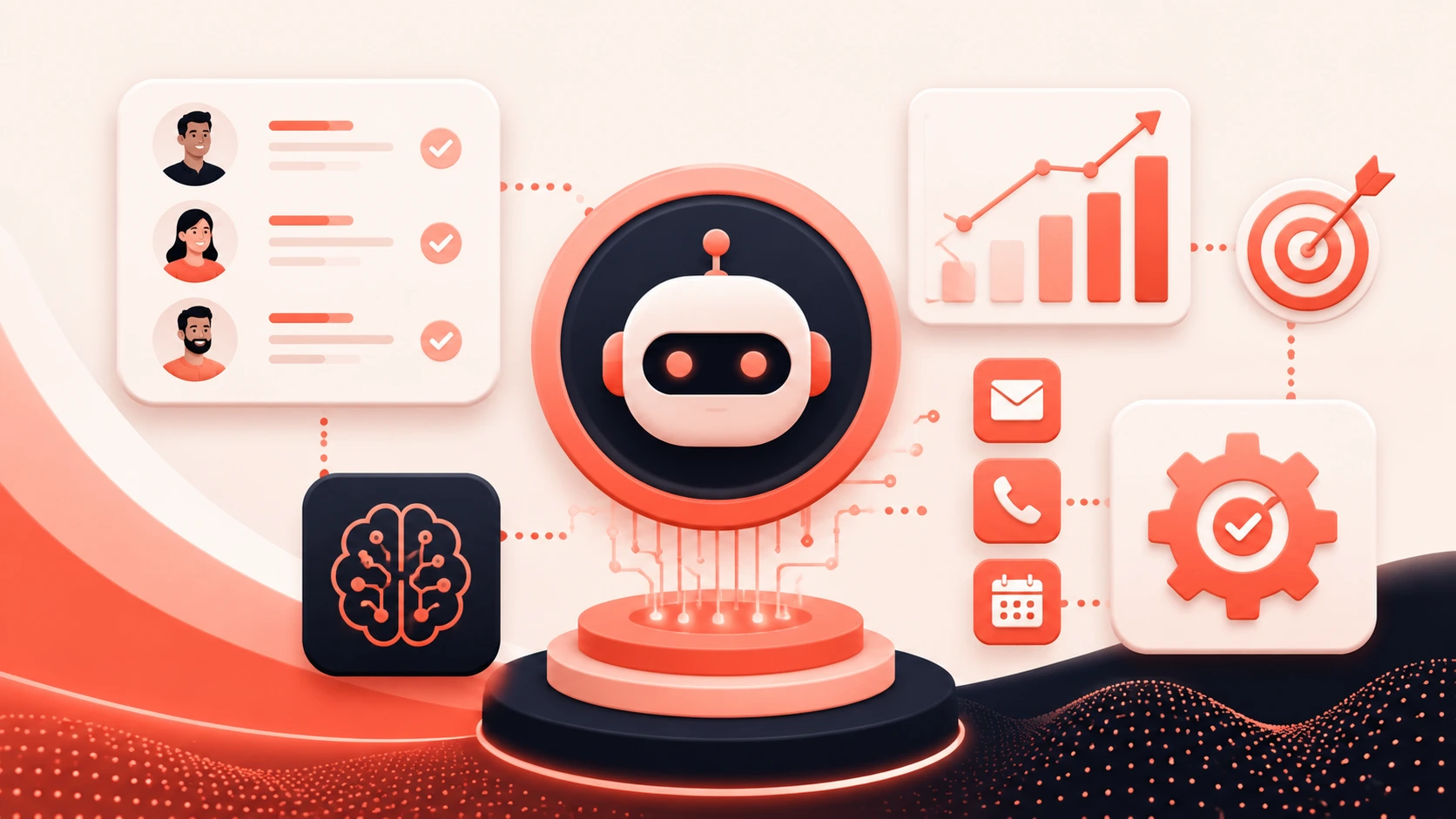
AI agents are not chatbots. They are systems that can interpret a goal, understand their environment, make decisions, and take action without being told every step. This shift from passive response to autonomous execution is one of the most important changes in modern software engineering.
I remember the first time I deployed an autonomous agent that actually worked. I gave it a loose instruction. It realized it lacked data, searched for the information on its own, wrote a Python script to analyze the results, and delivered a complete output without further input. That was the moment it stopped feeling like AI and started behaving like a system operator.
If you are reading this, you are likely past the hype cycle. You are not looking for prompt tricks or chatbot demos. You want to understand how AI agents really work and how to build them in a way that holds up in production.
This guide is written for engineers, architects, and product leaders who want practical clarity. It explains what AI agents are, how they differ from traditional automation, and how to design them as reliable systems. You will learn the core building blocks, the architectural patterns, and a proven framework for creating autonomous agents that can reason, act, and adapt in real-world environments.
What Is an AI Agent?
An AI agent is an intelligent software system designed to achieve a goal, not just respond to inputs. It operates with a level of autonomy. Humans define the objective. The agent decides how to reach it.
Unlike traditional software or rule based bots, an AI agent can observe its environment, interpret data, and make decisions in context. It uses reasoning, memory, and domain knowledge to choose actions that move it closer to its goal. It is not limited to a fixed script. It adapts.
An AI agent can also learn over time. It improves decisions based on feedback and past outcomes. This ability to think across steps and adjust behavior is what makes an AI agent fundamentally different from automation tools or chatbots.
In short, an AI agent is software that can think, decide, and act with purpose.
What Does an AI Agent Do?
An AI agent takes ownership of tasks that usually require human judgment. It breaks down complex goals into manageable steps and executes them independently.
It can collect and analyze data from multiple sources. It can reason over that data to identify patterns, risks, or opportunities. Based on this understanding, it decides what action to take next.
In real world use, an AI agent may research accounts, qualify leads, draft emails, update CRM records, or monitor buyer intent signals. In customer support, it may search documentation, ask clarifying questions, resolve issues, or escalate cases when needed.
AI agents can also collaborate. They can work alongside humans as copilots or coordinate with other agents to complete larger workflows. This makes them useful for multi step processes like sales funnels, marketing campaigns, and operational analysis.
The value comes from consistency, speed, and scale. The agent works without fatigue and improves with use.

SMARTe GTM Intelligence
Start Smarter Prospecting Today
How AI Agents Work?
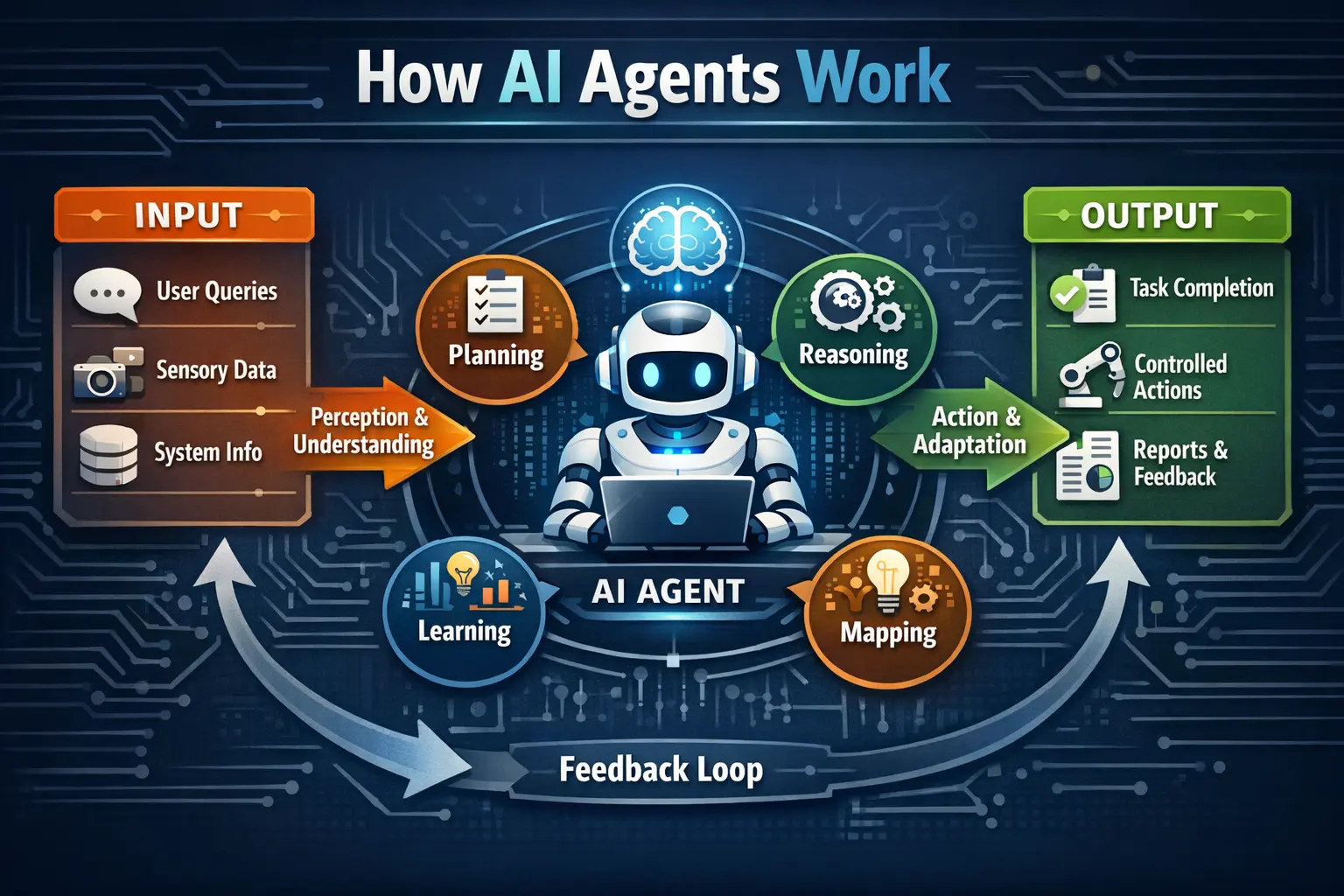
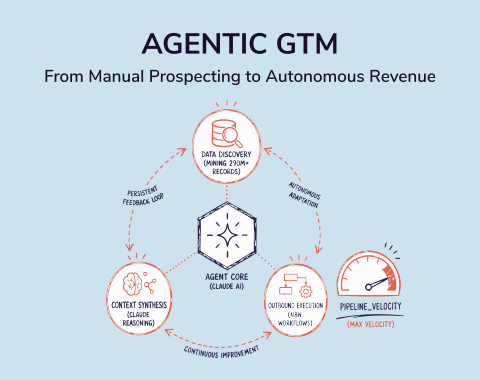
AI agents operate in a continuous decision loop. The agentic loop is circular, not linear. It iterates until the job is done.
First, the agent receives a goal. This goal may be explicit, like generating qualified leads, or implicit, like resolving a support ticket.
Next, the agent breaks the goal into smaller tasks. It plans how to complete them based on context, available tools, and constraints. This planning step is critical. It allows the agent to choose actions instead of following a fixed path.
The agent then executes actions. This may involve querying databases, calling APIs, analyzing documents, or generating content. Each action produces new information.
After acting, the agent evaluates the result. If the outcome moves it closer to the goal, it continues. If not, it adjusts its plan. This feedback loop enables learning and adaptation.
Most AI agents are powered by large language models combined with memory systems and external integrations. Memory helps the agent retain context across steps. Integrations allow it to interact with real business systems like CRMs, analytics platforms, and internal tools.
This combination enables autonomy. The agent does not just answer questions. It plans, acts, reflects, and improves.
Types of AI Agents
AI agents are classified based on how they perceive their environment, make decisions, and act to achieve outcomes. Some operate on fixed rules. Others reason, plan, and learn over time. Together, these agent types form the foundation of modern agentic AI systems.
Below are the five main types of AI agents, explained clearly and practically.
1. Simple Reflex Agents
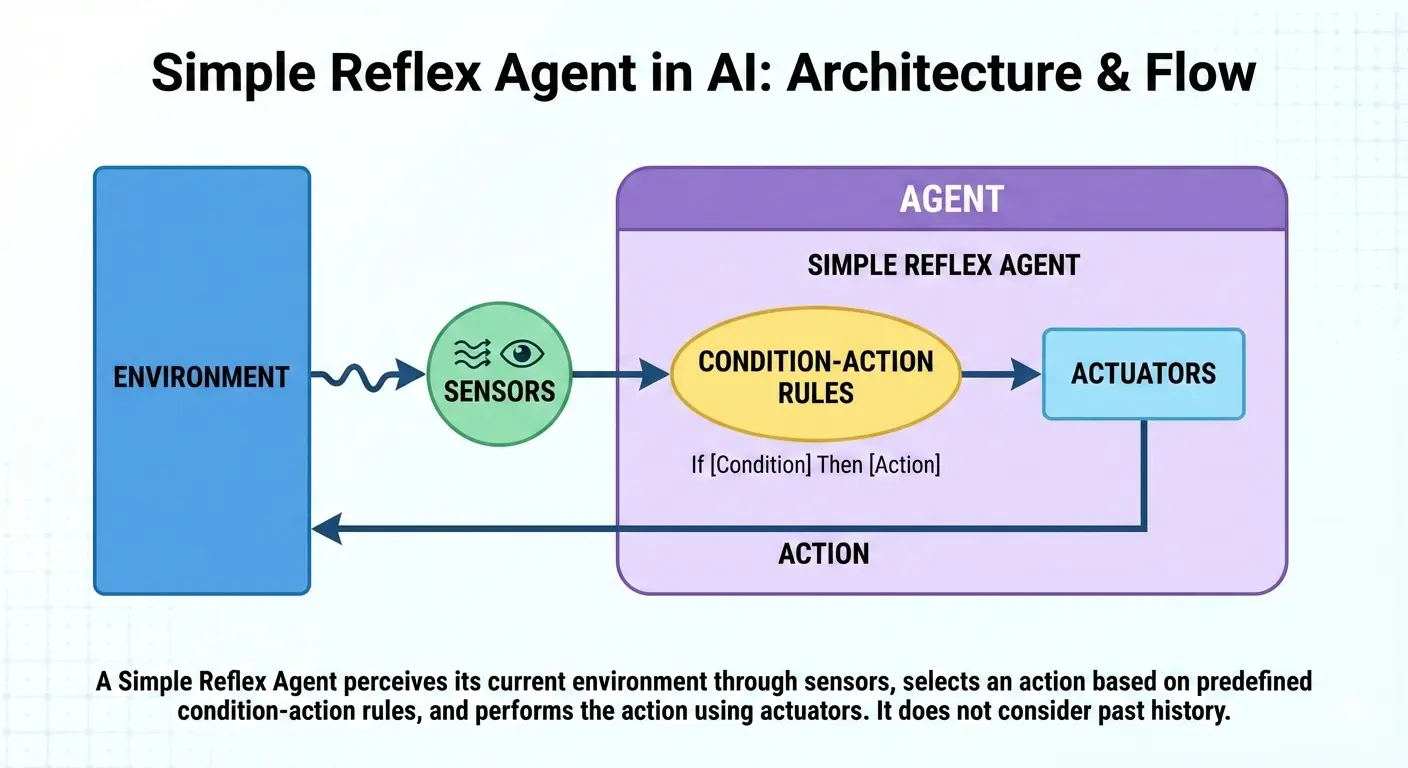
Simple reflex agents are the most basic form of AI agents. They act only on the current state of the environment using predefined condition action rules. There is no memory. There is no learning.
The agent observes an input and immediately triggers an action. A thermostat turning heating on or off based on temperature is a classic example.
These agents work well in stable and predictable environments. They fail in complex or changing conditions because they cannot adapt or learn from past mistakes.
2. Model Based Reflex Agents

Model based reflex agents improve on simple reflex agents by maintaining an internal model of the environment. This model helps the agent track what has happened before and understand how the environment changes over time.
Instead of reacting only to current input, the agent reasons about context. For example, a robot navigating a room can remember obstacles it has already encountered and adjust its path.
These agents perform better in partially observable environments. However, they still rely on predefined rules and lack deeper planning or learning capabilities.
3. Goal Based Agents
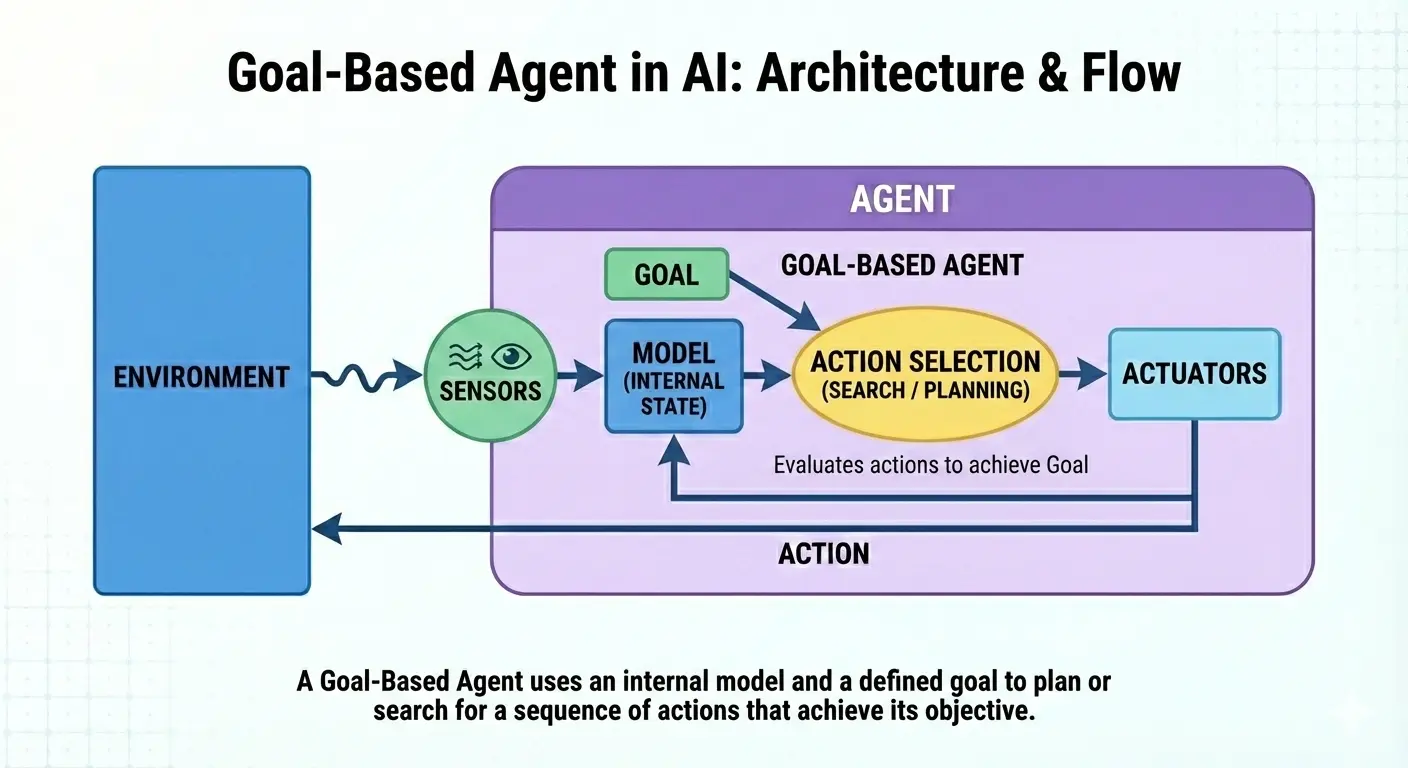
Goal based agents act with a specific objective in mind. Instead of reacting blindly, they evaluate different actions and choose the one that moves them closer to their goal.
These agents plan ahead. They consider future states and outcomes before acting. A navigation system choosing the best route to a destination is a common example.
Goal based agents are useful in scenarios where reaching a defined outcome matters. However, they are limited by the quality of their planning logic and do not inherently optimize between competing outcomes.
4. Utility Based Agents
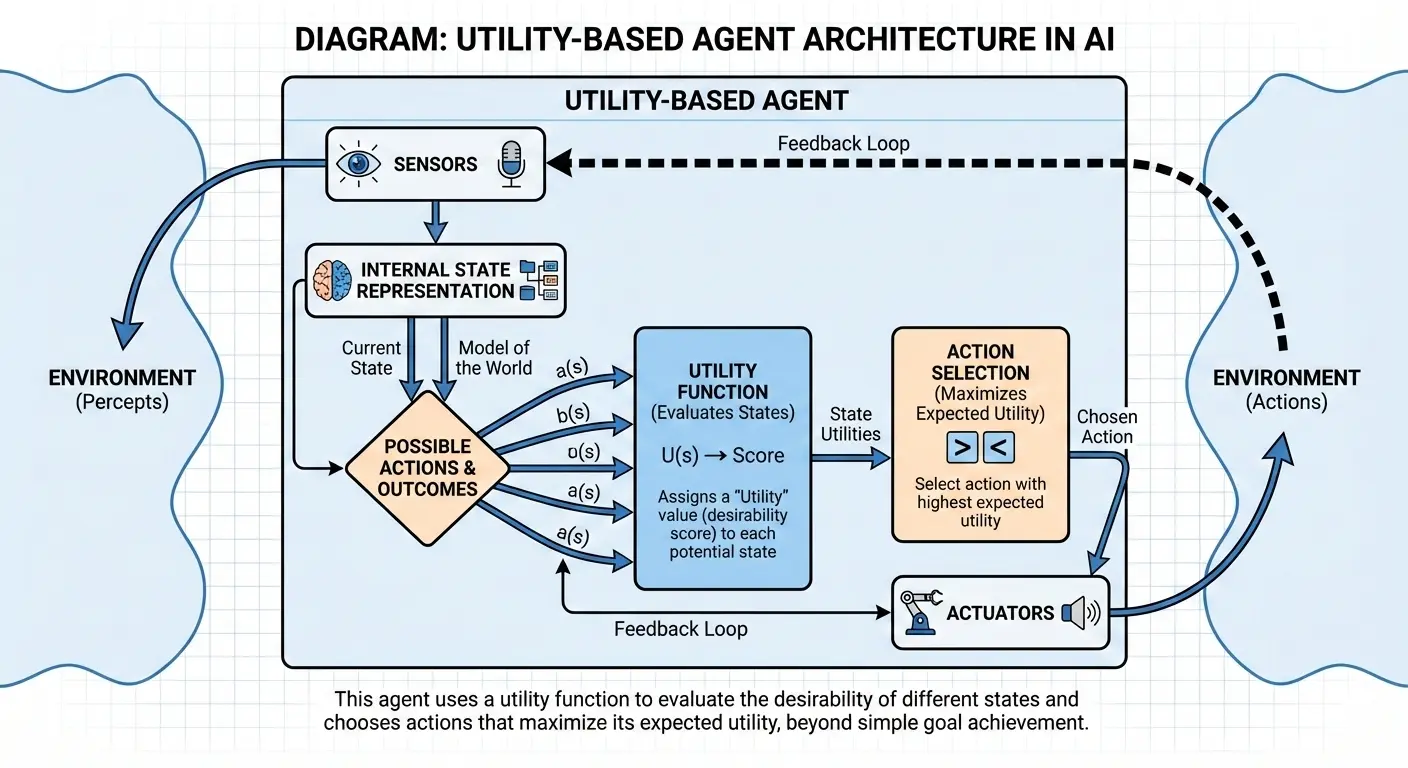
Utility based agents go one step further by optimizing decisions using a utility function. Rather than simply achieving a goal, they choose actions that maximize overall value.
They weigh tradeoffs. Speed versus cost. Risk versus reward. Efficiency versus quality.
A self driving car balancing safety, travel time, and fuel efficiency is a strong example. In business systems, utility based agents are often used for pricing, recommendations, and resource allocation.
Their main challenge lies in defining accurate utility functions. Poorly designed utility models can lead to suboptimal decisions.
5. Learning Agents
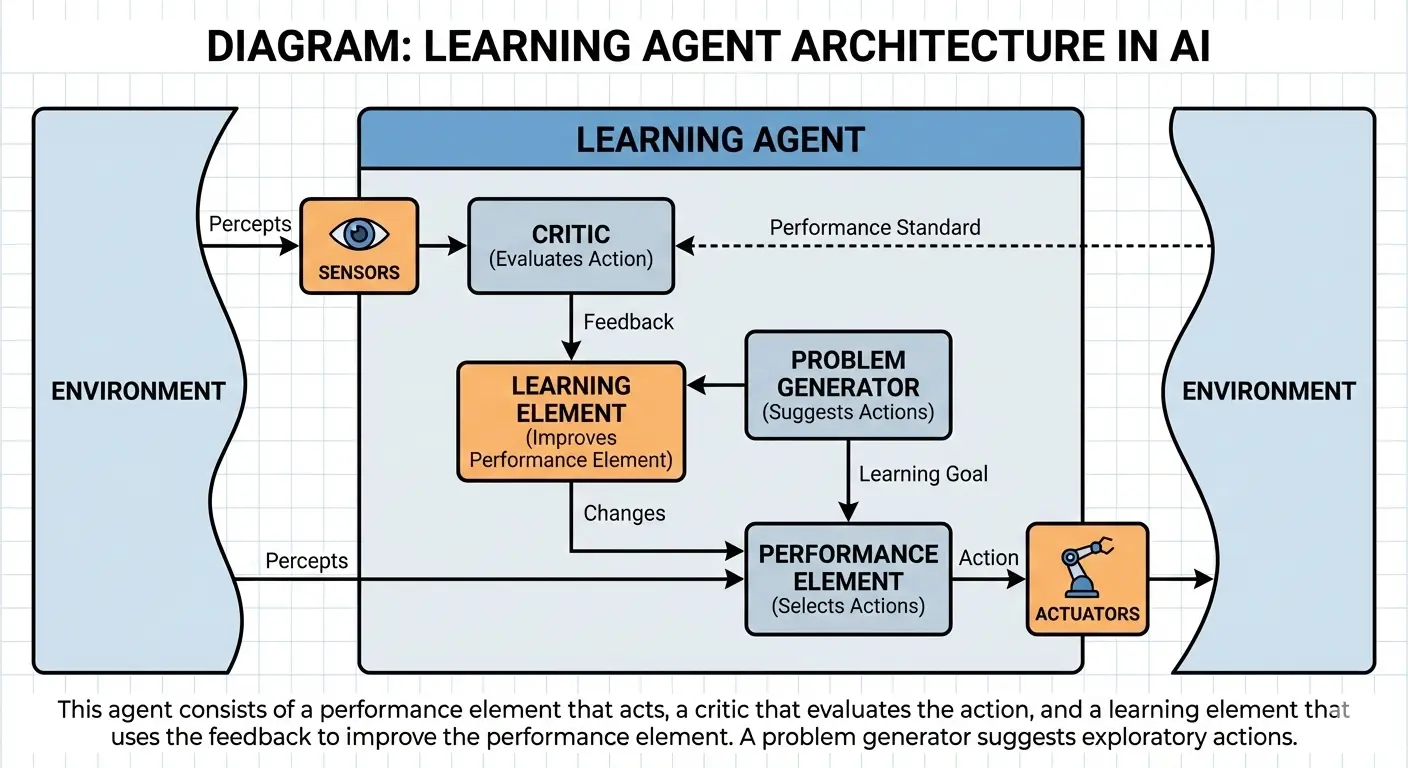
Learning agents are the most advanced type. They improve over time through experience and feedback.
Instead of relying only on predefined rules, learning agents adapt their behavior. They test actions, receive feedback, and refine future decisions. Reinforcement learning is a common approach used here.
A learning agent typically includes four parts:
- A performance element that takes actions
- A learning element that improves behavior
- A critic that evaluates outcomes
- A problem generator that encourages exploration
These agents are ideal for complex, dynamic environments such as autonomous systems, recommendation engines, and conversational AI.
Note: In real world applications, AI systems rarely rely on a single agent. Multiple agents work together, each handling a specific responsibility, to manage complex workflows. This coordination improves scalability, adaptability, and autonomous decision making.
AI Agents in B2B Sales Execution
AI agents in B2B sales execution are autonomous systems designed to run critical sales workflows from start to finish. They do not just assist sales teams. They execute. This shift is at the core of how AI in sales is changing execution across modern revenue teams.
These agents operate across the full sales funnel. They identify target accounts using ICP in sales, firmographic data, and buying intent signals. They qualify leads by analyzing behavior, engagement, and historical outcomes. In many organizations, they function as an AI SDR, handling early stage execution before human reps step in.
AI agents manage outreach at scale without losing relevance. They tailor messaging to roles, industries, and stages in the B2B buyer journey. Follow ups happen automatically and on time. Conversations are tracked. Context is preserved. Every action feeds back into the system.
To execute this seamlessly, they often rely on specialized content models and tools such as Conversion to ensure the generated messaging remains highly relevant.
Execution does not stop at engagement. AI agents update CRMs, manage pipeline stages, and surface deal risks or opportunities in real time. They monitor signals that indicate readiness to buy or likelihood to drop off. When human judgment is required, they hand off with full context.
The result is faster execution and cleaner pipeline generation. Sales teams spend less time on manual work and more time closing deals. AI agents handle volume, consistency, and timing. Humans focus on strategy, relationships, and negotiation.
In B2B sales, execution is everything. AI agents make it continuous, intelligent, and scalable.
AI Agents in B2B Marketing Execution
AI agents in B2B marketing execution are autonomous systems built to run and optimize marketing workflows at scale. They do not replace strategy. They execute it continuously.
These agents operate across the full demand generation cycle. They support ABM campaign execution by identifying high value accounts, mapping stakeholders, and tailoring messaging based on firmographics and intent signals. Audience segmentation evolves in real time as buyer behavior changes.
AI agents manage multi channel execution without manual oversight. They run and refine email marketing campaigns, personalize cold email sequences, and coordinate messaging across ads and content distribution. Performance signals guide every decision. What works is scaled. What does not is adjusted or stopped.
They also connect marketing activity with downstream outcomes. By analyzing engagement, content consumption, and response patterns, AI agents surface intent that informs both outreach and handoffs. This intelligence feeds sales workflows, including cold calling prioritization, so reps engage when timing is right.
AI agents integrate with modern AI marketing tools and analytics platforms to handle testing, optimization, and attribution. Budgets are allocated dynamically. Messaging adapts to audience response. Insights compound over time.
While agents handle execution, marketing teams focus on positioning, narrative, and growth strategy. In B2B marketing, relevance and timing drive results. AI agents make both continuous and measurable.
How to Build Agentic AI: A Practical 7-Step Framework
Building an AI agent is not about simply plugging a language model into a workflow and hoping it works. True agentic AI is about designing a system that can observe, reason, decide, and act toward a clearly defined goal with minimal human intervention.
I’ve built agents that automate parts of business processes, optimize workflows, and even make complex decisions based on real-world data. From my experience, the difference between an agent that thrives and one that fails is not the model you choose—it’s the system design, the data foundation, and the clarity of the outcome.
This framework will guide you in building AI agents that work—whether for B2B sales, marketing, operations, or any other domain.
Step 1: Define the Outcome, Not the Task
Every successful agent begins with a well-defined business outcome, not just a task or feature.
Ask yourself:
- What measurable result should this agent own?
- Where in the process does it operate?
- When should it act autonomously, and when should it hand off to a human?
For example, if you are building an agent to automate part of a B2B sales process, the outcome is not “send emails.” The outcome might be: “Move high-intent accounts from cold to engaged efficiently.”
This single definition changes everything. The agent now has a clear purpose: decide which accounts to prioritize, when to engage, and how to escalate to human sales reps. Ambiguity here creates agents that guess, hesitate, or act randomly. Clear ownership is non-negotiable.
Step 2: Choose the Agent’s Behavior and Decision Model
Once the outcome is defined, you need to determine how the agent thinks. This decision shapes its entire design.
Agents can operate in several modes:
- Reactive: Responds immediately to signals.
- Goal-oriented: Plans steps to achieve a defined outcome.
- Optimization-focused: Continuously learns and refines decisions based on results.
- Adaptive learner: Improves behavior over time with feedback.
For instance, a sales automation agent must do more than react to a single signal. It must weigh account fit, timing, intent signals, and past engagement history before acting. This requires a mix of planning, optimization, and learning—not simple rules.
Defining the thinking model upfront ensures the agent behaves predictably and can handle complex, multi-step processes.
Step 3: Build a Robust Data Foundation
The most critical—and often overlooked—step is providing the agent with a deep, accurate, and connected data layer. Without it, even the most sophisticated model cannot make intelligent decisions.
A general agent needs to understand its environment, including:
- Entities it interacts with (customers, products, processes).
- Current state and historical behavior.
- Relevant external signals.
- Constraints and dependencies.
For example, a sales-focused agent benefits from:
- Firmographics: Company size, industry, revenue, location.
- Technographics: Software and tools the company uses.
- Intent and behavioral signals: Hiring, funding, research activity.
- Buying group data: The stakeholders, influencers, and champions who are part of the decision process.
This is where SMARTe comes in. SMARTe provides enriched firmographic, technographic, intent, and buying group data—exactly the context your AI agent needs to reason effectively and act confidently. With AI sales tool like SMARTe, your agent can:
- Accurately prioritize accounts.
- Personalize outreach to the right stakeholders.
- Time actions precisely to match buying intent.
Without reliable data like this, even the smartest AI agent is just guessing.
Start building smarter agents today with SMARTe and give your AI the data it needs to execute confidently. Book a demo now!
Step 4: Design the Agent Workflow and Control Logic
Now comes the critical step where the agent becomes a functioning system.
You need to define its workflow:
- What triggers the agent?
- How does it evaluate context?
- What decisions can it make independently?
- What actions can it execute?
- When should it escalate to a human?
For instance, a B2B sales agent could:
- Detect a spike in intent from a target account.
- Validate account fit using firmographic data.
- Identify key decision-makers.
- Trigger outreach sequences.
- Notify a sales rep if engagement crosses a threshold.
This is where planning, reasoning, and execution converge. A clear workflow ensures your agent is not just automated—it is autonomous with accountability.
Step 5: Select the Right Models and Integrations
At this stage, you choose the technology stack to support the agent. But remember: models are tools, not the agent itself.
A typical agent may include:
- Large language models for reasoning, messaging, and planning.
- Machine learning models for scoring, prioritization, and predictions.
- Integrations with CRMs, marketing platforms, analytics tools, or internal systems.
Simplicity beats complexity. The agent must be transparent and observable. You need to know why it acted, not just what it did.
Step 6: Train, Test, and Refine in Real Scenarios
Never trust artificial demos. Agents behave differently when confronted with real-world complexity.
I test agents by simulating real scenarios:
- Past accounts, campaigns, or tickets.
- Known edge cases.
- Timing-sensitive sequences.
Check for:
- Accuracy of prioritization.
- Relevance of actions.
- Timing and escalation quality.
- Unexpected failures or conflicts.
Human feedback is essential here. A small, controlled loop of supervision prevents large-scale mistakes later.
Step 7: Monitor, Learn, and Optimize Continuously
Deployment is not the end—it is the beginning.
Once live, your agent must be monitored like a revenue-driving system:
- Track influence on metrics or outcomes.
- Measure decision accuracy and engagement quality.
- Detect drift in behavior or signal interpretation.
The environment changes constantly. Buyers evolve. Processes adapt. Data decay. Continuous monitoring, fresh data, and feedback loops are non-negotiable.
A robust data layer, like SMARTe for AI sales agents, is indispensable for continuous learning. For other domains, equivalent context-rich data is critical.
Conclusion
So far, we have covered what AI agents are, how they work, and how they differ from simple automation. We explored how agentic systems observe context, make decisions, and take action toward clear outcomes. We also looked at how AI agents are applied in real B2B sales and marketing execution, from account prioritization to personalized engagement.
Most importantly, we walked through how to build an AI agent step by step, from defining outcomes and data foundations to designing workflows, selecting models, and monitoring performance in production.
The key lesson is simple. AI agents succeed when they are engineered as systems, not experiments. With clear ownership, strong data, and thoughtful control logic, autonomous agents become reliable operators, not just intelligent tools.
.png)