TL;DR:
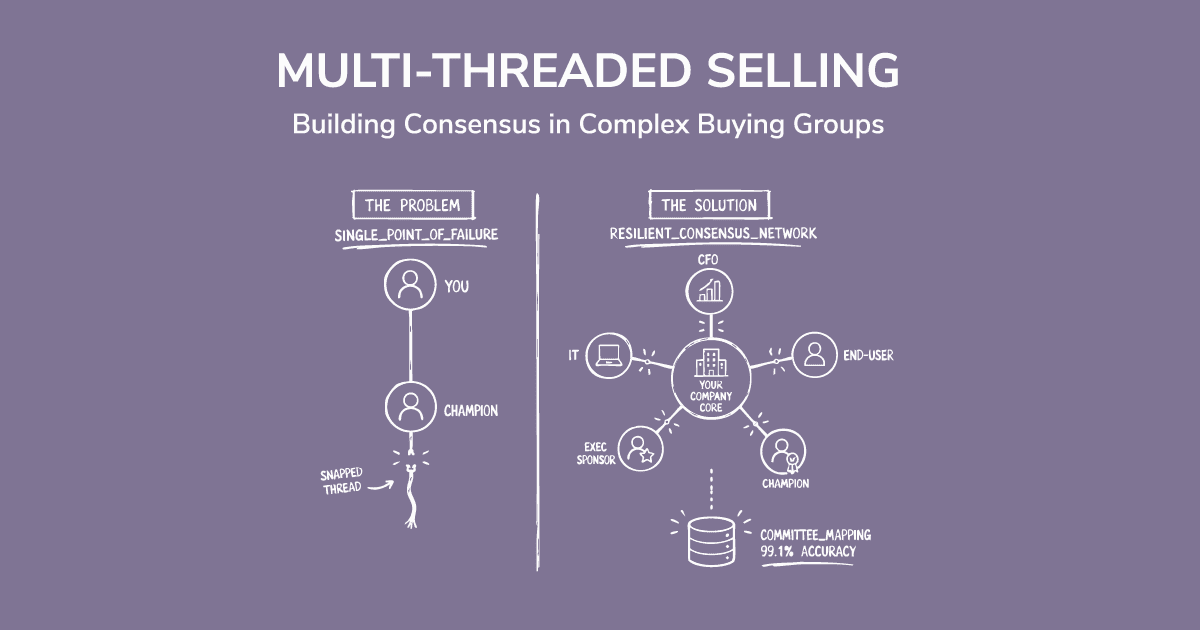
Multi-threaded selling is a B2B sales strategy where you build direct relationships with multiple stakeholders across a buying committee at the same time instead of routing everything through a single champion. Most enterprise deals don't collapse because of pricing or product. They collapse because one person left the company and you had no other relationships there.
- 78% of sales reps still take a single-threaded approach. Only 7% engage six or more contacts per account
- Single-threaded deals close at half the rate of multi-threaded deals (Gong, 1.8M opportunities)
- The average B2B buying committee now has 8.2 stakeholders across three or more departments
- 74% of buying teams experience internal conflict during the purchase process. Your champion can't handle that alone
- The six roles you need to map: champion, economic buyer, technical evaluator, end user, blocker, executive sponsor
- Always warn your champion before reaching out to others. Going around them quietly destroys the relationship that's actually selling for you
- The biggest barrier is not the strategy itself. Finding verified contact details for a full nine-person committee when your CRM data is six months out of date is where most motions break down
You had one contact. They loved the product. They said the deal was on track. Then they went quiet for three weeks. You followed up twice. Nothing. You found out later they moved to a different company and nobody told you.
That is a single-threaded deal dying exactly the way single-threaded deals always die.
Multi-threaded selling is a B2B sales strategy where you build direct relationships with multiple stakeholders across the buying committee simultaneously rather than relying on one person to navigate the deal internally. Closed-won deals have twice as many buyer contacts as closed-lost deals. 78% of sales professionals still take a single-threaded approach. Only 7% connect with six or more people at the accounts they are trying to close.
Those two stats explain a lot of missed quotas.
What Is Multi-Threaded Sales?
Multi-threaded sales means building and maintaining direct relationships with multiple decision-makers and influencers inside a single target account at the same time. Instead of relying on one champion to sell internally on your behalf, you develop parallel relationships with the people who can advance, stall, or kill the deal.
The average B2B buying decision now involves 8.2 stakeholders, and 89% of buying decisions cross multiple departments. Your champion cannot speak credibly for finance, IT, legal, and the end user team simultaneously. They are one person trying to win over five or eight others without you in the room. Multi-threading puts you in more of those rooms directly, rather than hoping your champion handles them all.
Single-threaded selling means one rep, one contact, one fragile thread. When that thread breaks, the deal resets to zero. And when that thread breaks, the deal resets to zero.

SMARTe GTM Intelligence
Start Smarter Prospecting Today
Why Single-Threaded Selling Loses Deals
Single-threading feels efficient. You build a strong relationship with one person, they become your internal champion, and you trust them to drive the deal forward. The problem is that you are handing the most important conversations in the sales cycle to someone who has their own boss, their own politics, and their own constraints.
The Champion Risk Most Reps Underestimate
The average tenure in a B2B tech role is 2.5 to 3 years, per LinkedIn Workforce data. In a six-month enterprise sales cycle, there is a real probability your champion changes roles before the deal closes. When that happens and you have no other relationships at the account, you do not inherit the deal. You start over.
I have seen reps lose deals worth over $200,000 six weeks from close because their champion took a role at a competitor. Every thread ran through that one person. Nobody else at the account had heard of the vendor.
The Internal Politics Your Champion Can't Win Alone
Your champion loves the product. That does not mean they can sell it internally. 74% of B2B buying teams experience unhealthy internal conflict during the purchase process, according to Gartner research. Teams that reach consensus are 2.5 times more likely to rate the outcome as high quality.
A champion who likes your product but lacks credibility with finance, or who has a strained relationship with the technical evaluator, cannot build the internal consensus needed to close. They bring you a positive signal. You read it as a strong deal. The deal dies in the evaluation stage because people you never spoke to raised objections your champion could not address.
The Invisible Blocker
Single-threaded deals close at half the rate of multi-threaded ones. A big reason is the invisible blocker: a stakeholder who had strong opinions about your product, your pricing, or your competitor, and who expressed those opinions only to your champion, never to you.
Multi-threading surfaces blockers before they can derail the deal quietly. A direct relationship with the technical evaluator means you hear their concerns before they become a late-stage objection. A conversation with the budget holder before you submit the proposal means you know the financial constraints before procurement kills a number you could have restructured.
The B2B Buying Committee: 6 Roles You Need to Map
According to Gartner, complex B2B sales can involve up to 10 people on the buyer's side. In strategic enterprise deals, that number climbs further. Each person has different priorities, different evaluation criteria, and different relationships with the outcome. Your job is to understand and reach all of them, not just the one who replies to your emails fastest.
These six roles appear in almost every enterprise buying committee:
- Champion: Your internal advocate. Believes in your product and will sell it internally. They matter enormously but cannot do it alone, especially in organisations where they lack budget authority.
- Economic buyer: Controls or significantly influences the budget. Often a VP, CFO, or CRO. Cares about ROI, total cost, and strategic fit. Not about features or demos.
- Technical evaluator: Assesses product fit, security, integration requirements, and implementation complexity. A blocker if they have unresolved concerns. An accelerator if they trust the solution.
- End users: The people who will use the product daily. Their enthusiasm (or lack of it) carries real weight. A skeptical user base makes even confident champions hesitate.
- Blocker: A stakeholder who may resist change, favour a competitor, or find the timing inconvenient. Not always visible early. Almost always present.
- Executive sponsor: Senior leadership whose approval is required for final sign-off. Getting their buy-in before the end of the cycle is different from asking them to close the deal for you.
Map these roles at the start of every enterprise sales process. Not three months in when you realise you have never spoken to the economic buyer.
How to Build a Multi-Threaded Sales Strategy
Most teams know they should multi-thread. Where it breaks down is execution. Reps are stretched thin, accounts are complex, and adding five more relationships to manage per deal feels like more work than it is worth. These steps give you a practical framework for doing it without burning bridges or creating chaos inside your CRM.
Step 1: Build the Stakeholder Map at the First Discovery Call
Start mapping the committee at the discovery call, not when the deal goes quiet. Every conversation surfaces a new name. When your champion says "I will need to loop in our CTO for the technical review," that is a name to find, research, and reach before the technical review starts, not during it.
A practical map tracks six things per contact: role, name, title, relationship to champion, known concerns, and current engagement level. Update it after every interaction. Honestly, the stakeholder map is the most underused tool in enterprise sales. Most reps build it once and never touch it again.
Step 2: Match Your Message to Each Role
A message that resonates with a technical evaluator will bore a CFO. The same pitch that excites a budget holder will confuse an end user who cares about day-to-day usability. Multi-threading is not about having multiple conversations. It is about having multiple different conversations tailored to what each person actually cares about.
Finance cares about payback period and what happens to the business if they do nothing. Technical evaluators care about how it works, what breaks when it fails, and what implementation actually requires from their team. End users care about whether the product makes their job easier or just adds another system to learn. Match the message to the person. Not to the product.
Step 3: Involve Executive Leadership Earlier Than Feels Comfortable
In my experience, the executive alignment conversation happens six weeks too late in most deals. For anything above $50K ACV, you need threads running to the economic buyer, the technical evaluator, and ideally someone who controls the signature, not just the champion who introduced you. Getting your VP or CRO engaged early is not about creating closing pressure. A budget holder who has spoken directly with your CRO has a different level of trust than one who has only heard about your company through a rep.
Step 4: Always Warn Your Champion Before Reaching Out to Others
Going around your champion without telling them is political suicide. If they find out you emailed their VP without warning, you have broken the one relationship genuinely advocating for you internally. And you will not easily rebuild it.
The fix is a single sentence: "I'd love to connect with your CFO directly to walk through the ROI case. Would you mind making a quick introduction?" That keeps the trust intact and almost always produces a warmer connection than cold outreach would have anyway.
Step 5: Track Engagement at the Contact Level, Not the Account Level
Your CRM probably shows account-level activity. That is not enough. You need to know which specific contacts are engaged, which have gone quiet, and which threads are at risk of going dark before the deal stalls.
If the technical evaluator has not responded in two weeks and your champion says they are "still reviewing it," that is a warning sign worth addressing now. If the economic buyer has never opened a single touchpoint, that thread does not exist yet. Track recency of engagement per contact so you can see which relationships need attention before you find out by losing the deal.
5 Multi-Threading Mistakes That Kill Enterprise Deals
Even experienced reps make these errors consistently. They tend to show up in the late stages, when there is no time left to fix them.
- Confusing access with influence. Ten people on a Zoom call is not a multi-threaded deal. If none of them can move budget or sign a contract, you have a webinar, not a sales process. Count engaged stakeholders who have actual authority, not just attendees.
- Starting too late. Most reps start multi-threading when their primary contact goes dark. By then, you are rebuilding from scratch with people who have no context about the deal. Multi-threading starts at the first call, not as a recovery tactic.
- Using the same message for every contact. Sending the same email to a CFO, a CTO, and a VP of Sales is multi-blasting, not multi-threading. It signals you do not understand their individual priorities and makes every recipient trust you a little less.
- Ignoring end users. End users rarely have final sign-off, so reps skip them. But a vocal user group that does not want the product can derail a deal the economic buyer was ready to approve. Winning users early gives your champion a coalition to point to.
- Multi-threading without the data to execute it. Every guide tells you to identify all the stakeholders. None of them explain that finding verified emails and working direct dials for eight people at an enterprise account is where the strategy actually collapses. Generic info@ addresses and phone numbers from two years ago are not threads. They are dead ends that look like threads until you try to use them.
Why Multi-Threaded Selling Fails: The Data Problem Nobody Mentions
You have mapped the buying committee. You have the names. You have the titles. Now you need to reach them. And the verified contact details for a nine-person enterprise buying committee are often the hardest thing to find in the entire B2B prospecting process.
Bad CRM data is a multi-threading blocker disguised as an admin problem. An economic buyer with a four-year-old phone number in your CRM is not a thread. The technical evaluator who left the company eight months ago and still appears in your contact database is not a thread. A stale record is a ghost you will not discover until you have already wasted the touchpoints.
B2B contact data decays at roughly 22.5% per year. Over a six-month enterprise sales cycle, a meaningful percentage of the contacts you mapped at the start will have changed roles, changed numbers, or left the organisation. Finding out at final review is the most expensive way to learn this.
Real-time champion tracking catches role changes before they become deal resets. When your primary contact moves companies mid-cycle, you need to know before they stop responding. You also need a replacement relationship already started. When the technical evaluator gets promoted and their replacement has different concerns, finding the replacement in the first week matters far more than most reps think.
The strategy works when you have verified, current contact data for the full B2B buying group. It fails when the stakeholder map is full of names attached to records nobody has verified since last year.
SMARTe's 289M+ contacts run through real-time verification so that when you map a nine-person buying committee, you can actually reach them. 75%+ US direct dial coverage means the economic buyer your champion mentioned has a working mobile number attached to their record, not a main switchboard. And SMARTe's platform for identifying buying group members surfaces the full committee automatically, so you are not starting from an org chart and a LinkedIn search for every account you work.
How to Measure Multi-Threaded Selling Performance
Most teams measure multi-threading effort. They count outreach touches and call volume. What actually predicts win rate is outcome: how many real, engaged relationships exist at the deal level at each stage.
Track these four numbers per opportunity, not per account:
- Contacts per opportunity: A healthy enterprise deal at final stage should have three to five actively engaged contacts. Below two means you are single-threaded regardless of what the account record shows.
- Engagement per role: Are you tracking separate conversations with the economic buyer, technical evaluator, and champion? If all the activity runs through one role, the other threads are not real. They are names in a CRM field.
- Thread recency: How recently has each contact engaged? A contact who has not responded in three weeks on a live deal is a thread going dark. Catching it early is easier than restarting it after the deal stalls.
- Win rate by contact coverage: Compare your close rate on deals with three or more engaged contacts versus one or two. I would bet the gap is wider than you expected. That data makes the business case for multi-threading to your leadership more effectively than any benchmark report.
Multi-Threaded Selling in 2026 Is Not a Tactic. It Is How Enterprise Deals Get Done.
For complex B2B sales above $30K ACV, single-threading is not a calculated risk. It is a failure mode you are accepting in advance, at the moment you decide not to reach the budget holder, the technical evaluator, or the person in procurement who will quietly kill the deal in week eleven.
The B2B buying group in 2026 is larger, more distributed, and more empowered to slow deals than at any point in the last decade. The reps winning the most consistently are not the ones with better pitches. They are the ones with more threads, built earlier, maintained by better data.
Map the committee at the first call. Reach each role with a message that speaks to what they specifically care about. Keep your champion informed before you expand. And make sure the contact data underneath every thread is actually current when you need to use it.
Try SMARTe free and see how quickly you can map and reach the full buying committee at your top accounts.