There was a time when one “good lead” could carry an entire deal.
Someone downloads an eBook. Sales gets excited. Pipeline celebrations begin. That time is over.
If your team still treats a single contact as a buying signal, you’re playing a nostalgia game while competitors map the entire decision-making group before sending the first email.
Here’s the uncomfortable truth: deals don’t close because of leads anymore. They close because buying groups align.
I’ve watched GTM teams spend weeks chasing champions who seemed promising but lacked real buying power, only for procurement, finance, or legal to step in late and quietly derail the deal.
Not because the product failed, but because the real buyers were never identified.
In 2026, B2B purchasing is a committee sport — multiple stakeholders, different incentives, and shared risk.
Sound familiar?
I’ve cut through the marketing fluff to highlight the best platforms for identifying buying group members.
Let’s get into it.
9 Tools I Use to Identify Buying Group Members in 2026
Here are the 9 best platforms for identify buying group members in 2026:
1. SMARTe

Let me address the obvious question first.
Yes, SMARTe is our product. And no, it is not listed first out of bias.
It sits here because most sales intelligence platforms still struggle with one critical problem. Global buying group visibility.
Many tools perform well in North America but fall apart once you move into international markets. Data coverage becomes inconsistent, contact accuracy drops, and mapping buying committees turns into manual research again.
SMARTe approaches this differently.
Instead of asking reps to build org charts themselves, SMARTe’s AI agents automatically assemble buying committees by analyzing more than 290 million contacts across 200 plus countries. The platform identifies decision makers, champions, influencers, and potential blockers so teams understand account dynamics before outreach even begins.
The biggest shift is psychological. Reps stop selling to a lead and start selling to an organization.

SMARTe GTM Intelligence
Start Smarter Prospecting Today
What I Like
- Strong direct dial and mobile accuracy across global markets
- Around 75 percent accuracy in North America and close to 50 percent globally
- Buying committees are mapped automatically instead of manually researched Job Change Tracker helps teams protect deals and follow champions to new companies
- Designed for teams that sell into complex enterprise accounts
What Could Be Better
- Focuses primarily on intelligence and data rather than campaign execution
- Requires structured sales or RevOps workflows to maximize value
- Teams expecting an all in one marketing platform may need additional tools
Pricing
SMARTe charges only for credits, never seats or user licenses:
- Free Plan: 10 monthly credits free. No credit card required.
- Pro Plan: $25/month for 50 credits ($0.50 each).
- Enterprise Plan: From $15,000. Per-credit price capped at $0.30, down to $0.20 at 1M credits. Custom pricing available for larger packages.
2. Demandbase
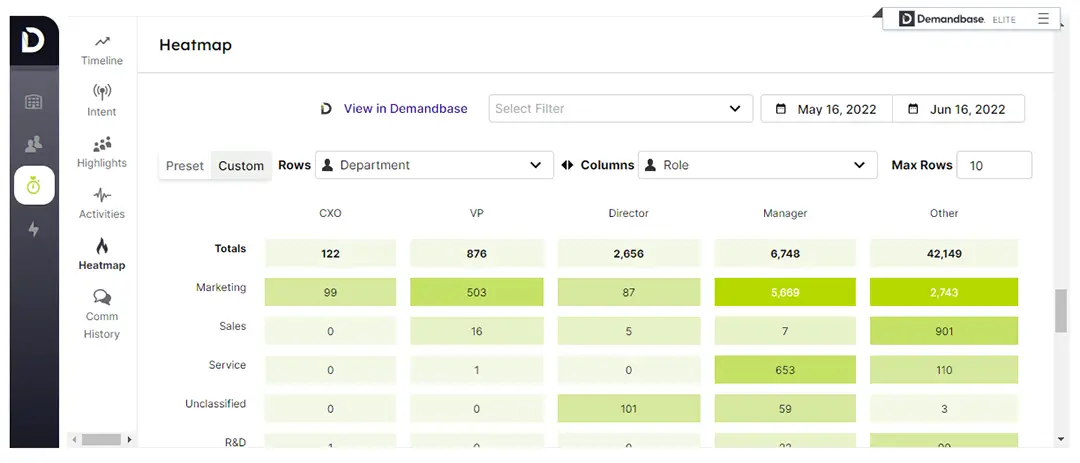
Demandbase has been a major name in account-based marketing for years. Most enterprise marketers already know the platform.
What feels different now is their Buying Group AI.
Instead of relying on reps to manually identify stakeholders, Demandbase analyzes intent signals, engagement behavior, and account activity to assemble buying committees automatically. The platform evaluates more than 150 million contacts and predicts who is likely acting as a champion, influencer, or decision maker within an account.
This changes how pipeline conversations happen internally. Sales and marketing stop debating lead quality and start discussing account readiness.
What I Like
- Excellent identification of anonymous website visitors
- Strong intent data that helps prioritize accounts already researching solutions
- Deep Salesforce integration that reduces operational friction
- Aligns sales and marketing around shared account intelligence
What Could Be Better
- Implementation requires planning and onboarding time
- Platform complexity can slow adoption for smaller teams
- Best suited for organizations with established ABM processes
Pricing
Demandbase typically starts around $10,000 per year, with pricing scaling based on customization, integrations, and company size. It is clearly positioned for mid-market and enterprise organizations investing heavily in account-based strategies.
3. 6sense
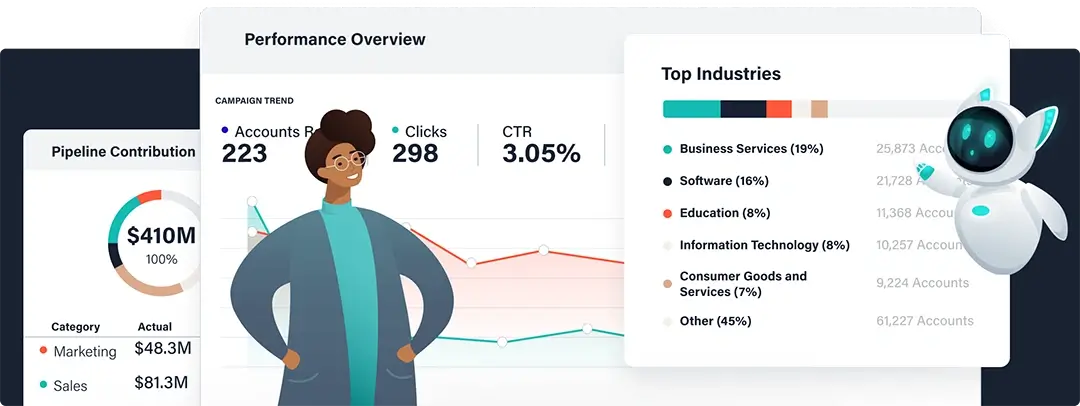
If Demandbase helps orchestrate account strategy, 6sense helps you see what buyers are doing before they ever talk to you.
Most buying activity happens anonymously. Buyers research B2B data vendors, compare solutions, and build internal consensus long before a demo request appears. This invisible phase is where many opportunities are missed.
6sense focuses on illuminating that hidden journey.
The platform processes billions of behavioral signals to identify accounts actively researching your category. It then maps likely buying group members and predicts purchase timing so revenue teams know where to focus attention.
Instead of reacting to inbound interest, teams begin engaging accounts already moving toward a decision.
What I Like
- Exceptional visibility into mid funnel buying activity
- Identifies accounts researching your category before form submissions
- Helps prioritize outreach based on likelihood to purchase
- Often improves win rates when paired with strong ICP targeting
What Could Be Better
- Large volume of data can overwhelm new users
- Requires a clearly defined Ideal Customer Profile to avoid noise
- Setup and operational alignment take time
Pricing
6sense sits firmly in enterprise territory. Pricing commonly starts around $50,000 annually and scales based on usage, data volume, and organizational requirements, making it best suited for mature revenue teams.
4. Anteriad
Not every company has a $50K budget sitting around for intent data platforms.
And honestly, not every team needs one.
This is where Anteriad finds its place. It focuses on helping mid-market organizations identify buying groups without forcing them into enterprise level complexity or pricing.
Anteriad’s Audience Identification uses AI to build ICP matched buying committees by combining historical conversion data with real time behavioral signals. What stands out is how quickly teams can activate these audiences. Instead of exporting data across multiple tools, marketers can immediately launch personalized campaigns through ads or email workflows.
The experience feels less like analysis and more like execution.
What I Like
- Affordable entry point compared to enterprise intent platforms
- Fast deployment with minimal operational friction
- Strong privacy focused data handling
- Easy activation of identified audiences for campaigns
- Well suited for mid-market revenue teams
What Could Be Better
- Predictive modeling is not as deep as enterprise platforms
- Limited native integrations compared to larger ecosystems
- Less visibility into long term buying timelines
Pricing
Pricing typically starts around $5,000 per month and scales based on data volume and activation needs. It positions itself as a practical middle ground between lightweight tools and enterprise intent platforms.
5. ZoomInfo

You cannot talk about B2B sales intelligence without mentioning ZoomInfo.
At this point, they are less a tool and more infrastructure for many revenue teams.
ZoomInfo’s GTM Intelligence Platform goes far beyond contact enrichment. With ZoomInfo AI Copilot, the platform analyzes intent signals, organizational hierarchies, and its massive data ecosystem to dynamically generate buying groups inside target accounts. These insights flow directly into CRM systems, allowing teams to trigger coordinated multi threaded outreach automatically.
For many organizations, ZoomInfo becomes the engine that feeds pipeline creation.
What I Like
- Extremely deep contact and company data coverage
- Reliable access to direct dials and verified emails
- Automated buying group generation inside existing workflows
- Strong CRM integrations that accelerate execution
- Excellent for scaling outbound pipeline
What Could Be Better
- Pricing can quickly become expensive for smaller teams
- Usage based credits require disciplined management
- Data volume can encourage quantity over strategy if not managed well
Pricing
The ZoomInfo pricing model is a bit confusing. ZoomInfo doesn't publicly list fixed prices. Based on our research, Professional tiers typically range between $15,000 and $18,000 per year.
Elite packages often fall between $35,000 and $45,000 or higher depending on seats and data usage.
Additional licenses and credits can increase total cost significantly.
6. Adobe Audience Agent (Journey Optimizer B2B)
If your organization already runs on Adobe, looking elsewhere rarely makes sense.
Adobe Audience Agent, part of Journey Optimizer B2B, approaches buying group identification from a different angle. Instead of relying heavily on third party data, it uses your own first party signals. CRM history, website engagement, and customer interactions all feed into AI models that recommend missing stakeholders and evaluate buying group health.
The result is a system that continuously monitors deal momentum and alerts teams when engagement weakens or key roles are missing.
This is less about sales prospecting and more about maximizing accounts already in motion.
What I Like
- Deep utilization of first party data for higher contextual accuracy
- Strong synergy with Adobe Experience Cloud workflows
- Reduces manual buying group assembly dramatically
- Helps monitor deal health over time
What Could Be Better
- Requires significant investment in the Adobe ecosystem
- Not designed as a standalone solution
- Complexity makes it unsuitable for smaller teams
Pricing
Adobe offers custom enterprise pricing only. Costs vary depending on existing Adobe stack adoption and organizational scale, making it primarily viable for large enterprises already invested in Adobe Experience Cloud.
7. UserGems
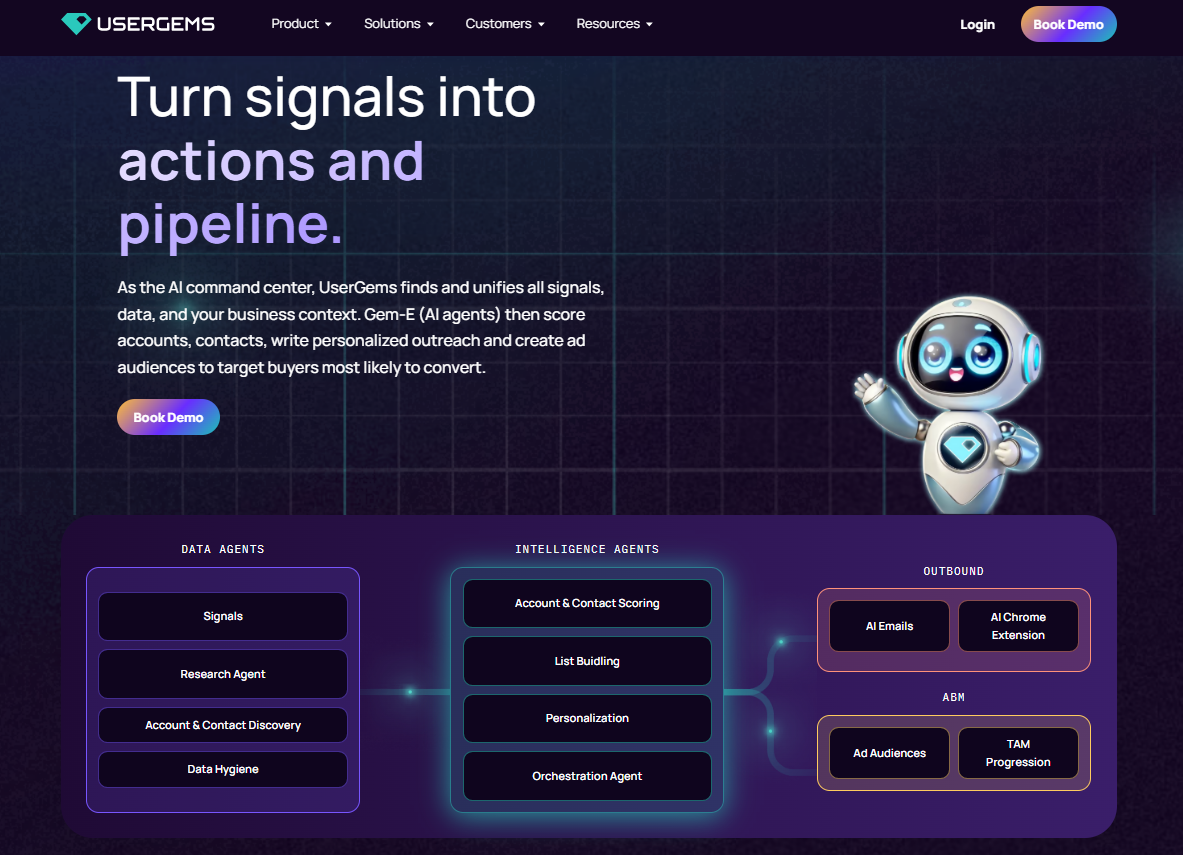
UserGems is an AI command center for outbound and ABM that helps revenue teams identify the people behind active buying activity. It captures contact-level intent, tech-stack shifts, funding events, role changes, and other signals, then scores accounts and contacts with a transparent AI model trained on the team’s own sales history. Gem-E agents can turn those insights into signal-driven lists, personalized outreach, ad audiences, and coordinated workflows across the existing stack.
What I Like
- Contact-level signals help teams look beyond account-level intent.
- Custom, editable scoring avoids a black-box approach.
- Modular agents support prospecting and ABM without requiring a separate all-in-one platform.
8. Influ2
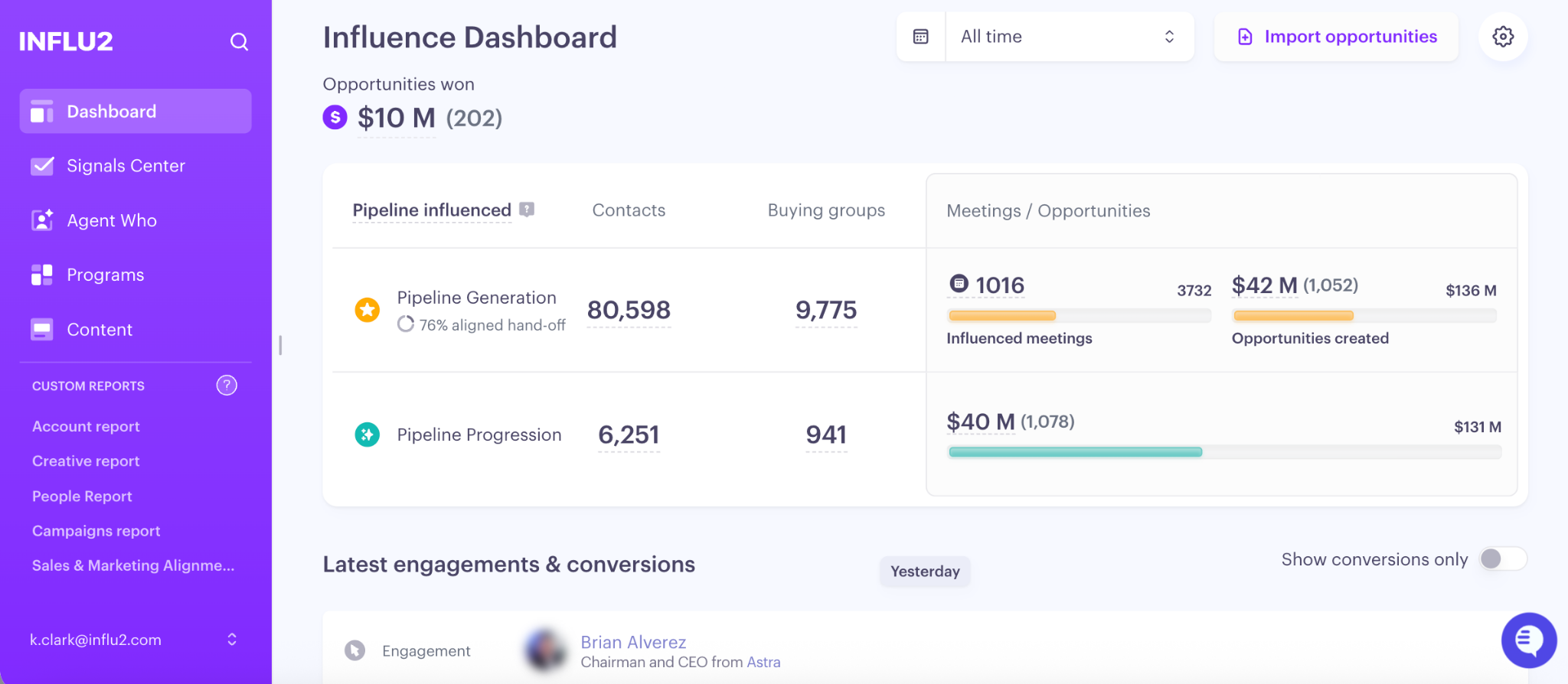
While many platforms focus on account-level signals, Influ2 shifts the perspective to the individual buyers within those accounts. Their person-based advertising platform allows GTM teams to identify and target specific members of a buying group by name, tracking engagement at the contact level.
The platform provides real-time intent alerts when a specific buyer interacts with an ad, identifying the "who is who" of interest. This allows for highly relevant sales outreach without the friction of gated content or web forms.
What I Like
- Precision targeting that reaches individual decision-makers rather than broad companies
- Instant notifications that tell sales reps exactly which contact clicked an ad
- Bridges the gap between marketing impressions and direct sales action
- Form-free identification reduces friction in the buyer's journey
What Could Be Better
- Performance is heavily dependent on the quality of your initial target contact list
- Requires close marketing and sales alignment for timely follow-up
- Higher management overhead compared to account-wide display campaigns
Pricing
Influ2 uses custom pricing models based on the volume of target contacts and campaign reach. Enterprise deployments are quoted individually to match specific GTM goals. You can visit Influ2 for a custom quote.
9. Folloze
While many tools identify who is in a buying group, Folloze focuses on the engagement that converts them. It allows marketing teams to build personalized microsites and campaigns in minutes, bypassing the typical web-team bottleneck. By capturing signals from the entire committee—like specific features or use cases explored—Folloze gives sales a clear roadmap for their next move. It’s an execution-first platform designed to turn account intelligence into an active pipeline.
What I Like
- Scalable personalization that eliminates the need for technical web support.
- High-fidelity intent signals that reveal what individual committee members care about.
- Accelerates sales cycles with ready-to-use, brand-governed engagement boards.
- Deep native integrations with CRM and intent-data leaders like 6sense and Demandbase.
What Could Be Better
- Maximizing the platform requires a pre-existing library of diverse content assets.
- Best suited for organizations with established ABM strategies rather than early-stage startups.
Pricing
Folloze offers custom enterprise pricing based on account volume and engagement scale. It is positioned for mid-market and enterprise teams that need to scale personalized experiences without adding headcount.
The Big Takeaway for 2026
There is growing fatigue around “AI-driven” tools promising to do the work for us.
Yes, the platforms above are powerful. They make identifying buying group members faster, clearer, and far more scalable than ever before. But tools alone do not create pipeline.
If your outreach is generic, if you cannot speak differently to a CFO than a VP of Engineering, or if you treat buying groups like a list of contacts instead of a group of real decision makers, better data will only help you miss faster.
The teams winning in 2026 use these platforms to understand who actually influences the deal, then tailor conversations around each stakeholder’s priorities and pressures.
Data finds the people. Human insight wins the deal.
Because in the end, buying groups do not buy from software. They buy from teams that understand them.