TL;DR:
Phone number lookup works in two directions. Reverse lookup means you have a number and want the name. You type in a phone number and find out who it is, using a free tool like NumLookup or Truecaller. Forward lookup means you have a name and need the number, which is a B2B sales problem that platforms like SMARTe solve.
Key takeaways:
- Got an unknown call? Start with NumLookup or Truecaller, both free.
- Need one prospect's direct dial? A browser extension (SMARTe, Lusha) pulls it straight from LinkedIn.
- Building a call list at scale? Consumer tools won't do it. You need a B2B contact database.
- Enriching a CRM full of stale numbers? Look at a real-time enrichment API, not a one-time list purchase.
How to Lookup a Cell Phone Number
The method depends on what you already have: a number or a name.
If You Have a Number and Want the Owner:
- Google it first. Put the number in quotes: "555-867-5309". If it belongs to a business or shows up in spam-report threads, Google surfaces it in seconds. No tool needed.
- Run it through NumLookup. Free, no sign-up, returns a name and carrier for the majority of US cell numbers in under ten seconds.
- Try Truecaller. With 400M+ registered users contributing numbers globally, Truecaller identifies the majority of callers. Also shows whether other users have reported the number as spam.
- Check social media. Search the number directly in Facebook's search bar. If the owner linked their mobile to their profile, it surfaces. LinkedIn works too, though less reliably for personal numbers.
- Go deeper with Spokeo or BeenVerified. If free tools return nothing, both pull from 100+ public record sources. You'll pay for the full report, but the data is thorough.
If You Have a Name and Want the Number:
- Search Google and LinkedIn first. Name plus company, or check their LinkedIn bio. Some decision-makers list their direct line publicly.
- Use a browser extension for one-off lookups. The SMARTe extension and Lusha both pull verified numbers straight from a LinkedIn profile. Visit the profile, click lookup, done.
- Use a B2B contact database for lists. Consumer tools don't scale. If you need verified direct dials across a list of prospects, you need a platform with ICP (Ideal Customer Profile) filters and real-time verification.
Two Types of Phone Number Lookup (And Why the Difference Matters)
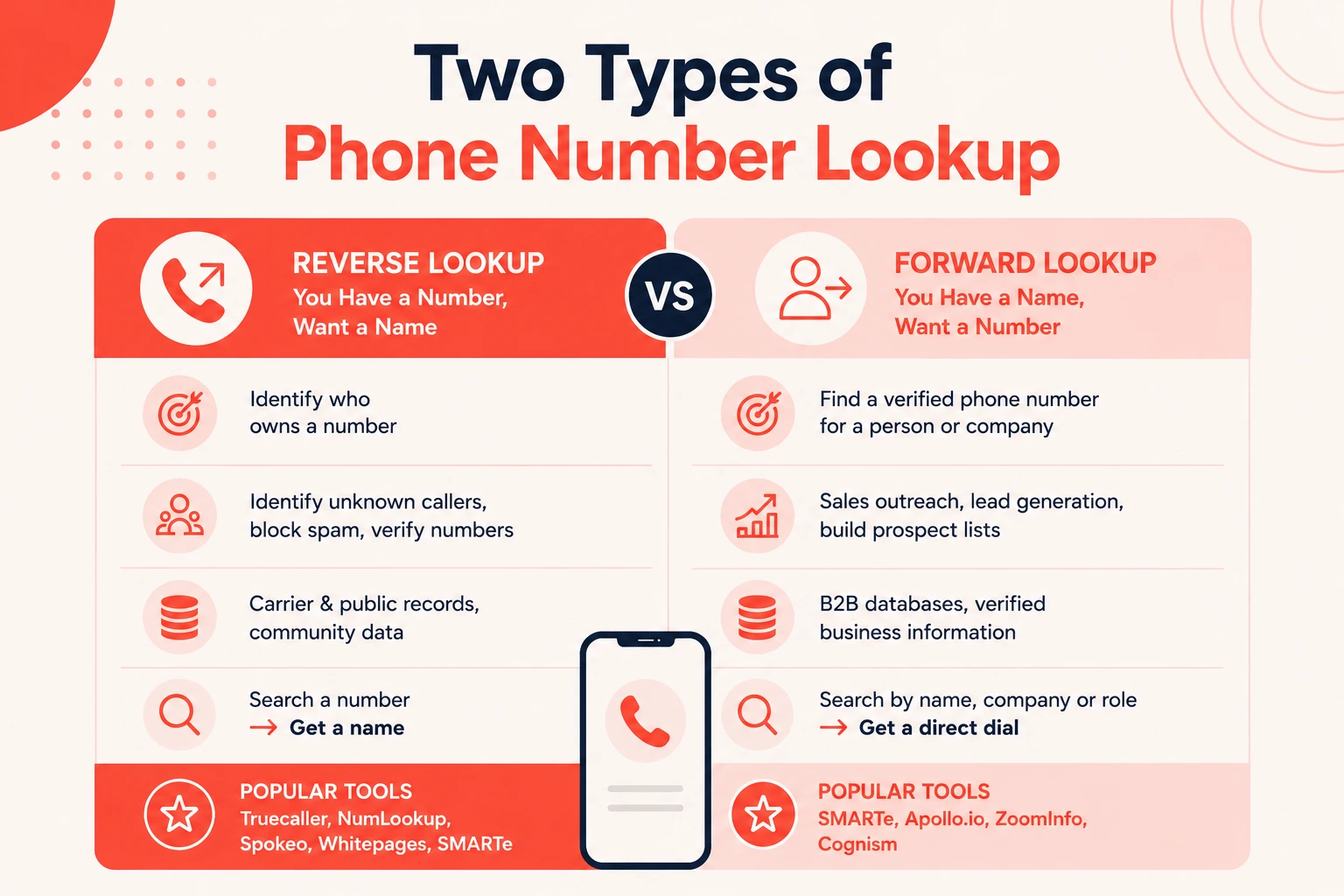
Phone number lookup works in two directions. Which direction you're searching changes everything about which tool helps you.
Reverse Lookup: You Have a Number, Want a Name
You start with a phone number. You type it in and find out who it belongs to.
Reverse lookup tools cross-reference numbers against carrier records, public databases, and community-reported data. They're built for consumers: identifying unknown callers, detecting spam, or checking whether a number is legitimate before you respond.
Truecaller, NumLookup, Spokeo, and Whitepages all work this way. They're good at this job. They won't help you find a prospect.
Forward Lookup: You Have a Name, Want a Number
You start with a person. A name, a company, a job title. You need their verified phone number.
Forward lookup tools pull from B2B contact databases built for sales teams. You search by name, company, or role and get a direct dial back. (Some also run as browser extensions, so your reps can pull numbers straight from LinkedIn without breaking their workflow.)
SMARTe, Apollo.io, ZoomInfo, and Cognism all work this way.
Part 1: Best Free Reverse Phone Number Lookup Tools
These tools have one job: you have a number and want to know who owns it. A free phone number lookup is usually enough for this. They're consumer tools, not sales tools. If you're a sales rep trying to find a prospect's direct dial, skip to Part 2 below.
1. Truecaller
Truecaller is the best-known free cell phone number lookup app in the world. Over 400 million registered users have contributed numbers to its database. The standout feature is live caller ID: it shows the caller's name before you even pick up, not after you've already missed the call. If you're checking whether a number has a history of spoofing or robocall complaints, Truecaller's spam-reporting layer is built on the same kind of community data the FCC tracks at a national level.
Key Features:
- Real-time caller identification on incoming calls
- Reverse phone number lookup by entering any number manually
- Spam detection and call blocking
- Community-reported database with 400M+ registered users
- Works on Android and iOS
- Web lookup available without the app
Pros:
- Identifies callers before you answer, not after
- Strong coverage in India, Southeast Asia, and Europe
- Spam blocking saves time for high call-volume users
- Free for core features
Cons:
- US coverage is inconsistent for newer or ported numbers
- Signing up shares your own contact list with their database (worth knowing before you install)
- Premium features require a paid plan
- Ads in the free version
Pricing: Free for core features. Premium starts around $3/month.
2. NumLookup

NumLookup is a completely free cell phone number lookup tool with no sign-up, no account, and no credit card required. Enter any US number and get a name, carrier, and approximate location back in seconds. For a quick check on whether a number belongs to a real person or a spam operation, this is about as fast as a free phone number lookup gets.
Key Features:
- Reverse phone lookup for any US number
- Returns owner name, carrier, and location
- No registration or account required
- Works for mobile and landline numbers
- Clean, no-ad interface
Pros:
- Completely free, no hidden costs
- Fastest option for basic lookups
- No personal data required to use it
- Simple enough for anyone
Cons:
- Returns basic information only
- No background history, linked accounts, or social profiles
- Limited to US numbers
- Won't help with unlisted or very new numbers
Pricing: Free. Always.
3. Google Search
Plenty of people skip this step. They shouldn't. A Google phone number lookup is free, and a quoted search ("555-867-5309") surfaces business listings, spam complaint threads, and any public record that has indexed the number. For business numbers and suspected spam callers, Google often gets you there faster than any dedicated tool.
Key Features:
- Surfaces public business listings tied to the number
- Returns spam complaint threads and forum reports
- Finds social media profiles where the number appears publicly
- No tool or account needed
Pros:
- Free and instant
- Works well for business numbers and registered entities
- Often faster than dedicated lookup tools for flagged spam numbers
- No sign-up or data sharing
Cons:
- Won't work for personal mobile numbers with no public footprint
- Results are unstructured and require manual review
- No carrier or line-type information
Pricing: Free.
4. Spokeo
Spokeo aggregates public records from over 100 sources including address history, relatives, linked social media accounts, and more. For a full report on an unknown caller, it goes further than any free tool on this list.
Key Features:
- Reverse phone lookup with owner name and address
- Pulls from 100+ public record sources
- Social media profile linking
- Address and location history
- Email address discovery
- Criminal record checks available
Pros:
- One of the more thorough consumer reverse lookup tools in the US
- Clean, easy-to-read reports
- Fast results
- Also searches by name, email, or address
Cons:
- Full reports require a paid subscription
- Free preview is limited, and the paywall prompt shows up fast
- US-focused, limited outside North America
- Subscription model may auto-renew
Pricing: From $14.95 to $19.95/month depending on the plan.
5. BeenVerified
BeenVerified covers similar ground to Spokeo but adds criminal records, court filings, employment history, and relationship data. If you need more than a name and location, this is the more thorough option in the consumer category.
Key Features:
- Reverse phone lookup with full owner details
- Criminal records and court filing access
- Employment and education history
- Address and relative information
- Email and social media cross-referencing
- Mobile app available
Pros:
- Deepest background data of any tool in this list
- Well-structured, readable reports
- Useful for vetting unknown callers beyond basic identification
- Also searches by name, email, or address
Cons:
- More expensive than Spokeo for comparable basic lookups
- Subscription auto-renews, which catches people off guard
- Limited free preview before paywall
- Primarily US data
Pricing: From $17.94 to $23.99/month depending on the plan.
6. Whitepages
Whitepages is one of the oldest phone directory services still running. It focuses on US landlines and mobile numbers with carrier identification, line-type verification, and spam flagging.
Key Features:
- Reverse phone lookup for US numbers
- Carrier and line-type identification (mobile vs. landline)
- Spam flag alerts
- Address and location data
- Background report access
Pros:
- Long-established, widely recognised service
- Good for carrier and line-type confirmation
- Spam flagging is reliable
- Basic lookup is free
Cons:
- Free version returns far less data than it used to
- The bulk of the useful information sits behind a paywall
- Not worth it for detailed owner reports compared to Spokeo or BeenVerified
- US-only coverage
Pricing: Basic free. Detailed reports require a paid plan starting around $1.99 per report or a subscription.
Free Reverse Lookup Tools at a Glance
Part 2: Best B2B Phone Number Lookup Tools (For Sales Teams)
These tools solve a different problem entirely. You're not identifying an incoming caller. You're finding a verified B2B direct dial for a specific person on your prospect list so your rep can reach them.
Here are the tools:
1. SMARTe

Overview: SMARTe is built specifically for outbound B2B sales teams, with real-time verification at the point of lookup rather than a static, aging database.
Key metrics: 289M+ verified contacts across 200+ countries, 66M+ company profiles, and technographic data (the technologies a company runs) on 64,000+ products. The number that affects daily connect rates more than any other: 75%+ of US contacts include a verified mobile or direct dial, not a company main line or switchboard. Global phone number database depth is strong too, with 50%+ direct dial coverage internationally, ahead of many US-heavy platforms for teams prospecting across EMEA, APAC, or LATAM. (I've seen SDR teams run the same US playbook in Germany or Singapore and wonder why connect rates drop by half. The data is usually the reason.)
SMARTe also helps teams build targeted prospect lists, enrich existing records, and create verified contact databases across industries, including healthcare, technology, finance, manufacturing, and more. Whether you're building a healthcare email list or prospecting in another market, verification at the point of lookup helps keep your data current.
Integrations and compliance: Native Salesforce and Outreach integrations, a browser extension for LinkedIn prospecting, Bombora intent signals, and AI agents for buying group mapping. The platform is SOC 2 Type II certified (an independent third-party audit of data security controls), aligned with GDPR (the EU's General Data Protection Regulation), and compliant with CCPA (California's Consumer Privacy Act).
Key Features:
- 289M+ verified B2B contacts across 200+ countries
- 75%+ verified US mobile and direct dial coverage
- 50%+ global direct dial coverage
- 66M+ company profiles with firmographic filters
- Technographic data across 64,000+ products
- Browser extension for LinkedIn prospecting
- Native Salesforce and Outreach integrations
- Real-time verification at the point of lookup, not batch processing
- CRM data enrichment API with 90%+ match rates
- Bombora intent signals built in
- AI agents for buying group mapping and account research
- SOC 2 Type II certified, GDPR aligned, CCPA compliant
Pros:
- Highest verified US mobile coverage in its category
- Verification at the point of lookup means data is current when you use it
- No per-seat pricing on Pro, which keeps costs flat as the team grows
- Strong international depth for EMEA, APAC, and LATAM prospecting
- Free plan with no credit card required
- Enrichment match rates hold up at scale
Cons:
- Pro credits go fast for high-volume teams
- Enterprise pricing requires a conversation
- Better suited for outbound-first teams than inbound-heavy ones
Pricing:
- Free: $0/month, 10 credits, no credit card required
- Pro: $25/month, $0.50 per credit, no per-seat costs
- Enterprise: From $15,000/year
2. Apollo.io
Apollo combines a B2B contact database with a built-in sequencer, making it one of the few platforms where you can find a number and run outreach without switching tools. The database covers 200M+ contacts with solid US coverage for email-first prospecting teams.
Phone number accuracy is a different story at scale. Apollo doesn't publish a direct-dial verification percentage, and direct dial rates are inconsistent in practice. A lot of SDR managers I've spoken to end up running Apollo for email sequences while layering a dedicated phone data platform on top specifically because the mobile numbers don't hold up for dialing campaigns. Our Apollo.io alternatives comparison breaks down where other platforms pull ahead by use case.
Key Features:
- 200M+ B2B contacts
- Built-in outreach sequencer (email, phone, LinkedIn)
- Chrome extension for LinkedIn
- CRM integrations including Salesforce and HubSpot
- Advanced filters by job title, company size, industry, and technology used
- Email verification included
- Free tier with monthly credits
Pros:
- All-in-one: data and outreach in a single platform
- Generous free tier for early-stage teams
- Large database with solid US email coverage
- Strong filters for list building
- Well-documented API
Cons:
- Direct dial and mobile number accuracy is inconsistent at high volume, and the vendor doesn't publish a verified-percentage figure to check it against
- Per-seat pricing gets expensive as the team scales
- Data quality varies by geography outside the US
- Support response times lag on lower-tier plans
Pricing:
- Free plan with limited monthly credits
- Basic: $49/month per user
- Professional and Organisation tiers at higher pricing
3. ZoomInfo
ZoomInfo is the best-known name in B2B data. Large enterprise teams default to it because it's familiar, procurement is established, and switching costs are high once you're embedded. Data quality for US enterprise contacts is strong, particularly for large companies and well-known industries.
The two problems are cost and international coverage. ZoomInfo pricing runs to large annual commitments, and the per-seat model means costs scale fast with headcount. Outside North America, coverage thins considerably, and like Apollo, ZoomInfo doesn't publish a direct-dial verification rate for public comparison. If you're evaluating from a blank slate, our ZoomInfo alternatives comparison covers the main options worth considering.
Key Features:
- Large US B2B contact database
- Firmographic and technographic filters
- Intent data via Bombora partnership
- Native Salesforce CRM integration and Salesforce data enrichment
- Org chart data
- Chorus conversation intelligence on select tiers
Pros:
- Strong data quality for US enterprise accounts
- Name recognition makes internal buy-in easier
- Org chart data is useful for account-based selling
- Large support team
Cons:
- Expensive with large annual contracts and limited flexibility
- Per-seat pricing penalises growing teams
- International coverage outside North America is thin
- Contract auto-renewal terms have drawn consistent criticism
- Onboarding complexity is real
Pricing:
- Custom. Typically a large annual contract with no public per-seat pricing.
4. Cognism
Cognism is the strongest option for EMEA and UK prospecting. Their Diamond Data product focuses specifically on phone-verified numbers rather than scraped data, with numbers re-verified on a 90-day cycle. For teams running GDPR-compliant cold calling into Germany, France, the UK, or other regulated EU markets, the combination of data accuracy and compliance infrastructure is hard to match.
For US-heavy teams it's not the natural first choice. Coverage outside Europe doesn't match their European depth, and the pricing reflects a platform designed for enterprise-scale compliance requirements. If you're already on Cognism and questioning the fit, our Cognism alternatives breakdown covers the main options by geography.
Key Features:
- Phone-verified Diamond Data with 90-day re-verification cycle
- Strong EMEA and UK direct dial coverage
- GDPR, CCPA, and global compliance built into data sourcing
- Intent signals for buying trigger identification
- Chrome extension for LinkedIn
- CRM integrations including Salesforce and HubSpot
- Do-Not-Call list scrubbing across multiple geographies
Pros:
- Best phone-verified data for European outbound
- Compliance is built into the product, not bolted on
- High accuracy for UK and EMEA direct dials
- Reliable for teams that need to document lawful basis for outreach
Cons:
- Coverage outside Europe is weaker
- No transparent self-serve pricing
- Designed for enterprise, not small or mid-size teams
- Setup and onboarding takes time
Pricing:
- Custom. Mid-to-upper range. Requires a sales conversation.
5. Lusha
Lusha is one of the best phone number extractor tools for B2B outreach. The Chrome extension pulls verified contact data directly from LinkedIn profiles, and for individual SDRs doing targeted research on a small number of prospects, it gets the job done without much friction.
The credit model limits it at scale. You burn through the free tier quickly, and costs add up for teams prospecting more than a few hundred contacts per month. International coverage is thin, and the platform isn't designed for bulk phone prospecting at volume. Our Lusha alternatives comparison covers where other tools handle volume and international markets better.
Key Features:
- Chrome extension for LinkedIn contact lookup
- Verified direct dials and email addresses
- CRM integrations including Salesforce and HubSpot
- Bulk enrichment for CSV files
- API access on higher plans
- Intent data signals available
Pros:
- Very fast for individual LinkedIn lookups
- Clean, minimal interface with a low learning curve
- Good for SDRs who prospect one contact at a time
- Free plan available
Cons:
- Credit model gets expensive at volume
- International coverage is limited
- Not built for high-volume list building
- Free plan (5 credits/month) runs out fast
Pricing:
- Free: 5 credits/month
- Pro: $29/month with 170 credits
- Premium and Scale tiers at higher volume
6. LeadIQ
LeadIQ focuses on signal-based prospecting. The platform tracks job changes and buying triggers, funding events, and leadership hires so you can time outreach to a meaningful moment rather than blasting a static list. For teams that have defined their ICP tightly and want to reach accounts when intent is highest, the signal layer earns its place.
Data quality is good for mid-market US prospects. Direct dial coverage is reasonable. The platform suits targeted, lower-volume outreach better than bulk list building at scale. If it's not the right fit, our LeadIQ alternatives comparison covers the main options.
Key Features:
- Job change and buying signal tracking
- Verified direct dials and email addresses
- Salesforce and HubSpot CRM integrations
- Chrome extension for LinkedIn
- Sequence integration with outreach tools
- Team prospecting and shared lists
Pros:
- Signal-based triggers add useful context to outreach timing
- Clean UI with low friction for individual SDRs
- Good for Salesforce-heavy workflows
- Free plan available
Cons:
- Not built for high-volume bulk prospecting
- International coverage is limited
- Smaller database than Apollo or ZoomInfo
- Pricing scales by seat
Pricing:
- Free plan available
- Essential: $39/month per user
- Pro: $79/month per user
- Enterprise: Custom
B2B Phone Number Lookup Tools at a Glance
How to Pick the Right Tool for Your Situation
You Got an Unknown Call, and You Want to Know Who Called
Start with NumLookup. Free, no sign-up, thirty seconds. If you need more detail beyond a name and carrier, Spokeo or BeenVerified go deeper for a monthly fee. If you want real-time identification on all future incoming calls, install Truecaller.
You Need One Prospect's Phone Number
The SMARTe browser extension and Lusha Chrome extension both pull verified numbers directly from LinkedIn profiles. For finding a specific executive's line, our guide on how to find someone's phone number covers a handful of approaches, including free options.
You're Building a List at Scale
Consumer tools won't touch this. You need a B2B contact database with advanced filters: job title, company size, industry, geography, tech stack.
SMARTe's prospecting search pulls from 289M+ verified contacts with those filters. The data comes with verified direct dials, not generic company numbers. Our guide on building a cold calling database walks through how to structure this properly.
For outbound prospecting at volume, the quality of your contact list determines everything downstream. Connect rates. Reply rates. Pipeline. Low-quality data increases dial waste and cost per meeting booked.
You're Enriching Your CRM
You already have records. Some have phone numbers. Plenty don't, or the numbers are outdated.
CRM data enrichment tools append missing contact data and flag stale records automatically. SMARTe's enrichment API runs at 90%+ match rates with real-time validation. For many B2B teams, a conservative estimate is that 25 to 40 percent of CRM contacts are missing direct dials. Enriching those records pays back quickly.
What This Comes Down To
Reverse lookup and B2B prospecting are different problems. They need different tools. Consumer lookup platforms and B2B sales intelligence databases are not interchangeable, and treating them as such is how teams end up frustrated with connect rates they can't explain.
If you got an unknown call: start with NumLookup. Free, thirty seconds, no account.
If you're in sales and you need verified direct dials at scale: ask your vendor what percentage of their numbers are actual direct dials, and get the answer in writing. Many vendors do not publish that figure at all, which is worth noticing on its own.
SMARTe discloses that number directly: 75%+ verified US mobile coverage, verification at the point of lookup, 289M+ contacts, no per-seat pricing on the Pro plan. Start free, no credit card needed.