TL;DR:
The best phone number extractor tools for B2B outreach prioritize verified mobile data and direct dials over bloated, outdated databases.
Here are the top tools categorized by specific sales team needs:
- SMARTe: Best overall for scaling, phone-first teams requiring high US mobile coverage (75%+) and deep global data.
- Apollo.io: Best for early-stage teams needing an affordable, all-in-one prospecting and email sequencing platform.
- Lusha: Best for individual SDRs executing rapid, single-contact lookups on LinkedIn within North America.
- Cognism: Best for enterprise sales targeting the UK and Europe with human-verified (Diamond) mobile data.
- LeadIQ: Best for cutting workflow friction with one-click data capture from LinkedIn Sales Navigator to your CRM.
- Kaspr: Best budget-friendly option for small teams or solo reps prospecting in European markets.
The Bottom Line: Never buy a tool based on total database size. Evaluate platforms strictly on their verified mobile connection rates within your specific target market, and ensure they maintain SOC 2 and GDPR compliance to protect your outreach.
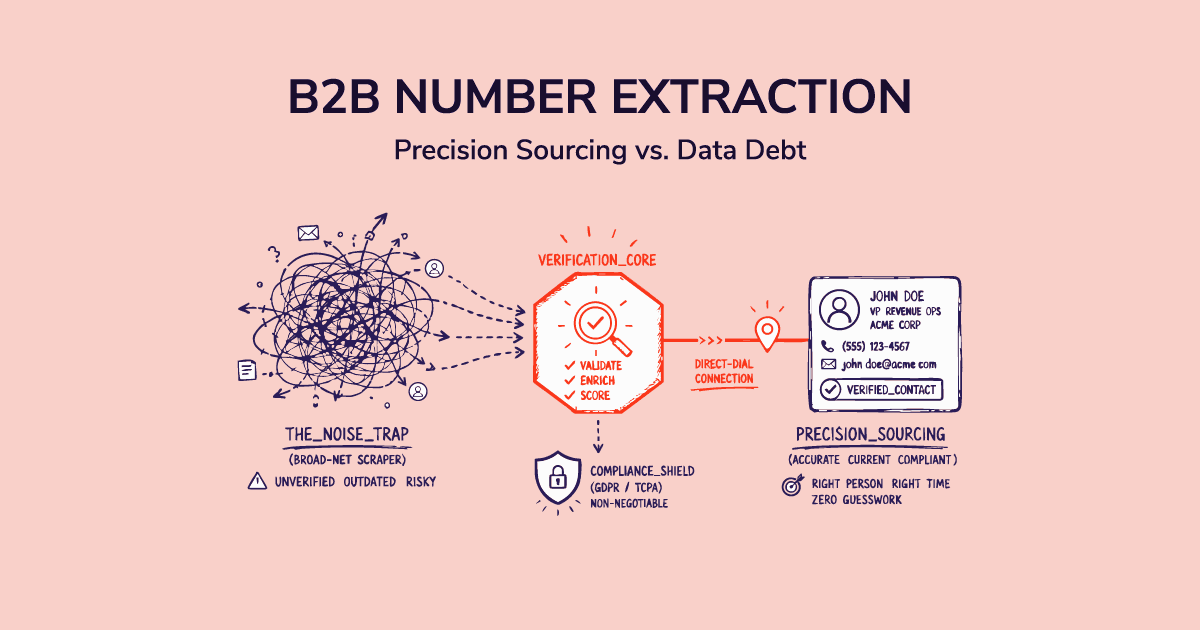
A phone number extractor for B2B is only useful if it gives you numbers that actually connect.
Most don't. You get a switchboard, a desk extension no one picks up, or a mobile number that stopped belonging to your prospect six months ago. Your reps are dialing. They're just not reaching anyone.
I've tested a lot of these tools. Here's the best phone number extractor tools. 👇
Best Phone Number Extractor Tools for B2B Outreach
1. SMARTe

Let me start here because mobile coverage is the one metric most comparison articles gloss over, and SMARTe is the tool where it matters most.
Most platforms in this category give you a contact database and call it a phone number extractor. The real question is: how many of those contacts have a verified mobile number, not a desk extension from 2022? For most tools, that number sits between 30% and 50%. For SMARTe, it's 75%+ across US contacts.
That gap is what decides your connect rate. When I look at outbound teams stuck at 4% to 6% connect rates, the fix almost always starts with the data, not the script.
The browser extension pulls verified emails and mobile numbers directly from LinkedIn profiles and company websites. (It also works inside LinkedIn Sales Navigator, which matters because most SDRs don't want to leave their prospecting workflow to go hunt for a number in a separate tab.) For reps who need to find CEO phone numbers or reach senior decision-makers fast, this is the fastest path to a dial that actually connects.
The prospecting interface lets you filter by role, company size, industry, tech stack, and more across 289M+ verified contacts. Build a list of SaaS CFOs at companies with 200 to 1,000 employees in the US, and you'll see exactly how many have verified mobile numbers before you export a single contact.
For RevOps teams, the enrichment API runs at 90%+ match rates with real-time verification. Not a batch update that refreshes quarterly. B2B data decay is the quiet pipeline killer, and SMARTe's job change tracking runs automatically so CRM records don't silently expire between cycles.
International coverage spans 200+ countries with 50%+ global direct dial coverage. If your ICP includes LATAM, APAC, or UK accounts, this is real depth in markets where most US-first platforms are weak. B2B contact database coverage at this scale takes years to build and is hard to fake.
Standout Features
- 289M+ verified contacts globally with 75%+ US mobile coverage
- Browser extension for LinkedIn, Sales Navigator, and company websites
- Real-time data verification at point of use (not batch)
- ICP-matched prospecting with firmographic, technographic, and role filters
- Buying group mapping per account (auto-discovers stakeholders)
- Bombora intent signals built in natively
- CRM enrichment API at 90%+ match rates
- Automatic job change tracking
- 50%+ global direct dial coverage across 200+ countries
- Native Salesforce and Outreach integrations
- SMARTe MCP for giving AI tools like ChatGPT and Claude real-time access to verified contact data
Pros
- Highest verified US mobile coverage in this category at 75%+
- Real-time verification means the number you pull is the number as of right now
- Free plan with no credit card required (you can test the database before spending anything)
- Shared credits on Pro, so the whole team works from one pool without per-seat fees
- Global direct dial depth in markets most competitors skip
- SOC 2 Type II certified, GDPR-aligned, and CCPA compliant
- Intent data, technographics, and enrichment in one platform instead of four
Cons
- Free plan gives you 10 credits/month, which is enough to test but not enough to run a full prospecting cycle
- The platform depth means there's a learning curve if you just need a simple LinkedIn lookup tool
Pricing
- Free: $0, 10 credits/month, no credit card required, full team access
- Pro: $25/month, pay-per-credit at $0.50/credit, no per-seat cost
- Enterprise: starts at $15,000/year, $0.30/credit max, volume pricing, 2-year subscription
Verdict
If your outbound motion is phone-first and your ICP extends beyond the top 500 US tech companies, this is the tool I'd pick. The mobile coverage depth is real. The free plan is a real way to pressure-test the data before spending anything. And the fact that the whole team shares credits on Pro, rather than paying per seat, makes the math work for scaling teams in a way most other platforms don't.

SMARTe GTM Intelligence
Start Smarter Prospecting Today
2. Apollo.io

Apollo is where most outbound teams start. And honestly, for a lot of early-stage teams, starting here makes sense.
The platform bundles prospecting, sequencing, and basic CRM features into one place for a price point that doesn't require budget approval. If you're a two-person sales team trying to get your first outbound motion running, Apollo gives you enough to start.
Where I see teams hit a wall is around month three or four. Connect rates plateau. They assume it's a messaging problem. In my experience, it's usually the phone data. Mobile number accuracy on lower-tier plans varies a lot, and data freshness isn't as tight as platforms built specifically around contact verification. Best sales intelligence tools that prioritize phone data tend to outperform Apollo for teams where calling is the primary channel.
That's not a knock on Apollo. It's just a different tool for a different use case.
Standout Features
- 275M+ contacts with email, phone, and company data
- Built-in email and multi-step sequencing
- Chrome extension for LinkedIn and Gmail
- Intent data layer
- CRM sync with Salesforce and HubSpot
- Role, industry, company size, and technology filters
- Free tier that actually works for basic prospecting
Pros
- All-in-one: prospecting, sequencing, and basic CRM in one platform
- Generous free tier for getting started without a credit card
- Large contact database with broad coverage
- Sequence builder is solid for email-heavy outbound
- Easy onboarding. Most reps are prospecting on day one
Cons
- Mobile number accuracy and freshness varies, especially on free and basic plans
- Phone credits are separate from email credits, which adds friction
- Not built for phone-first outbound teams that need high mobile coverage rates
- Data verification isn't real-time. Gaps show up when you're dialing at scale
- Contact data outside the US and Western Europe can be unreliable
Pricing
- Free: limited monthly credits, includes basic prospecting and sequences
- Basic: $49/month
- Professional: $79/month
- Organization: $119/month per user
- (Pricing subject to change. Check Apollo's site for current rates)
Verdict
I'd recommend Apollo to early-stage teams that need one tool to handle email prospecting, sequencing, and basic contact lookup. If calling is your primary channel and you're dialing more than 40 to 50 contacts a day, you'll want better mobile coverage than Apollo typically provides on standard plans.
3. Lusha

Lusha is the fastest single-contact lookup tool I've come across. Click a LinkedIn profile, get a direct dial in under two seconds. For an individual SDR doing focused LinkedIn outreach, that speed is real.
Where it falls apart is when you try to scale it. Per-seat pricing stacks up fast once you have a full team. And if your ICP sits outside North America, coverage drops noticeably. I've talked to RevOps teams who tried to use Lusha for bulk CRM enrichment and hit fill rate issues pretty quickly. Lusha isn't built for that. See Lusha alternatives if you're in that situation.
Standout Features
- Chrome extension for fast direct dial lookup on LinkedIn
- Works on LinkedIn, Sales Navigator, Salesforce, and company websites
- CRM push to HubSpot and Salesforce
- Team plan with shared usage visibility
- Intent signals and job change alerts on higher plans
Pros
- Fastest individual contact lookup in this category
- Clean, simple interface with no learning curve
- Reliable North American direct dial coverage
- Works across multiple surfaces without switching tools
- Good for high-volume LinkedIn prospecting in North America
Cons
- Per-seat pricing gets expensive quickly for larger teams
- International coverage drops off significantly outside North America
- Not built for bulk CRM enrichment at scale
- Credits don't roll over on most plans
- Standalone tool with no built-in sequencing or outreach features
Pricing
- Free: 5 credits/month
- Pro: approximately $49/month per user
- Premium: approximately $79/month per user
- Scale: custom pricing
- (Check Lusha's site for current rates, as plans change frequently)
Verdict
Lusha is the right tool for a single SDR or a small team doing targeted LinkedIn outreach in North American markets. It's not the right tool for a RevOps team trying to enrich 50,000 CRM contacts or a sales team prospecting into European or APAC accounts.
4. Cognism

Cognism built its reputation on European mobile coverage, and it's earned that reputation. Their Diamond Data process physically phone-verifies numbers before adding them to the database. That's a meaningful difference from tools that verify via algorithmic checks. For UK and European outbound, connect rates with Cognism data tend to be consistently stronger than the rest of this list.
The trade-off is price and US coverage. If your ICP is North America-first, Cognism is probably not the right fit. The US data is there, but it's not the depth you'd get from a platform purpose-built for North American outbound. And at $15,000+/year with no self-serve option, the entry point is high.
Standout Features
- Diamond Data: phone-verified mobile numbers for European contacts
- GDPR-compliant data across EU markets
- Sales Companion for AI-powered lead recommendations
- Chrome extension for LinkedIn and CRM tools
- Native integrations with Salesforce, HubSpot, Outreach, and SalesLoft
- Intent data
- Real-time company event triggers (funding, hiring signals)
Pros
- Best European mobile coverage in this category
- Phone-verified numbers, not just algorithmically verified. Real connect rates reflect that
- Strong compliance infrastructure for GDPR-heavy outbound
- Deep integrations with major enterprise tech stacks
- Reliable for enterprise sales workflows with complex buying committees
Cons
- Pricing starts at $15,000+/year with no self-serve plan. No way to test before committing to a contract
- US coverage is weaker compared to North America-first platforms
- Overkill for small teams or companies with a US-only ICP
- Long-term contract structure reduces flexibility
- No free plan or trial without going through sales
Pricing
- Custom pricing only, typically starts at $15,000+/year
- No self-serve tier
- (Contact Cognism directly for pricing. They don't publish it publicly)
Verdict
If your team is running serious outbound into the UK, DACH, or broader European enterprise accounts and connect rate is a priority, Cognism is worth the conversation. For a US-first team or a company that needs to test before committing, there are better starting points.
5. LeadIQ

LeadIQ doesn't try to be a full contact intelligence platform. It's a capture tool. Click a contact in LinkedIn Sales Navigator, push it directly to Salesforce or Outreach. That's the job, and it does that job well.
Where I'd point people toward LeadIQ is early-stage SDR teams that spend most of their time in Sales Navigator and need to eliminate the manual copy-paste step between finding a contact and starting a sequence. That friction adds up. Outbound prospecting teams that run 100+ contacts a week feel it immediately when it goes away.
Standout Features
- One-click capture from LinkedIn Sales Navigator to CRM or sequencer
- CRM deduplication at point of capture (avoids creating duplicate records)
- Direct push to Salesforce, Outreach, HubSpot, and SalesLoft
- Pipeline tracking across the team
- Prospecting insights on companies
Pros
- Fastest capture-to-CRM workflow for LinkedIn-based prospecting
- Removes manual data entry from the SDR workflow entirely
- CRM deduplication on capture saves RevOps cleanup time later
- Clean integration with Sales Navigator
- Reasonable pricing for early-stage teams
Cons
- Doesn't serve global ICPs well. Coverage outside North America is thin
- Phone data depth is modest compared to dedicated data platforms
- Smaller database than SMARTe or Apollo
- Largely dependent on LinkedIn as the prospecting surface, with limited reach outside of it
- Not a full prospecting or enrichment platform
Pricing
- Free: 20 credits/month
- Starter: approximately $45/month
- Pro: approximately $89/month per user
- Enterprise: custom pricing
- (Check LeadIQ's site for current rates)
Verdict
For US-focused SDR teams that live in Sales Navigator and want to cut the time between finding a contact and starting a sequence, LeadIQ is a good fit. It's not a contact intelligence platform and doesn't try to be. See LeadIQ alternatives if you need more global coverage or full enrichment capabilities.
6. Kaspr

Kaspr is part of the Cognism group, which tells you something about where its strengths are. European LinkedIn prospecting with clean data. The free plan is actually functional for a solo rep testing the tool, not just a stripped-down tease.
For a small team doing outreach into European accounts via LinkedIn, Kaspr works. For a team that's scaling or covering global accounts, you'll hit the edges of what it can do fairly quickly.
Standout Features
- LinkedIn Chrome extension with European phone and email data
- CRM push to Salesforce, HubSpot, and Pipedrive
- Team credit sharing across accounts
- Zapier and API integration for workflow automation
- Contact exports to CSV or directly into sequences
Pros
- Strong European phone data, backed by Cognism's data infrastructure
- Free plan is actually usable, not just a token gesture
- Shared team credits (whole team works from one pool)
- Clean interface with minimal setup time
- Good compliance coverage for EU outbound
Cons
- Coverage outside Europe and North America drops off quickly
- US mobile coverage isn't as strong as platforms focused on the North American market
- Not built for bulk enrichment or RevOps-scale workflows
- Limited prospecting filters compared to full sales intelligence platforms
- Scales poorly for teams larger than five to ten SDRs
Pricing
- Free: 5 credits/month
- Starter: approximately €30/month
- Business: approximately €60/month per user
- Organization: custom pricing
- (Pricing in euros. Check Kaspr's site for current rates)
Verdict
If you're an individual rep or a small team doing LinkedIn outreach into European markets, Kaspr is a solid, low-cost starting point. Once your ICP expands globally or you're managing more than a handful of reps, you'll need a platform with broader coverage.
How to Pick the Right Phone Number Extractor for Your Team
I've seen teams overbuy on database size when mobile coverage was the only metric that actually mattered for their motion. I've also watched teams cut costs on data and then spend two quarters staring at a 4% connect rate and rewriting scripts that were never the problem.
Here's how I'd think about this by role.
1. SDRs and BDRs: You need mobile coverage and speed. The tool that gets a verified direct dial to your dialer with the least friction wins. If your call list is US tech companies, most platforms in this list cover you adequately. Where it breaks down is when you're calling from a cold calling database that covers financial services, manufacturing, or accounts outside North America. Direct mobile numbers are how you get past the gatekeeper and reach the actual decision-maker. A cold calling list full of switchboard numbers is a dial activity log. Not a pipeline builder.
2. Sales Managers and VPs: Think in cost per meeting, not cost per seat. A tool that lifts your team's connect rate from 8% to 14% on the same dial volume pays for itself faster than almost any other investment you'll make this year. Before signing any contract, ask every vendor for their verified mobile coverage rate specifically in your ICP. Not total database size. Mobile coverage rate in your target segment. That number predicts your connect rate math more accurately than anything else.
3. RevOps and Marketing Ops: You need real-time enrichment, not batch. CRM match rates above 85%. Automatic job change tracking. And a clean way to fill gaps when the primary source doesn't match, which is where waterfall enrichment comes in. For teams running outbound prospecting at scale, the enrichment infrastructure matters as much as the prospecting layer.
One thing I keep seeing: teams underestimate how much workflow friction costs them. A tool that requires a CSV export and a manual CRM import adds 15 to 20 minutes per rep per day. Across a team of 10 SDRs, that's two full work weeks per month spent on data admin. The best tools for finding someone's phone number at scale remove that step entirely.
Compliance: Check This Before the First Dial
Phone outreach has rules. Most teams treat compliance as an afterthought and then scramble when someone flags an issue six months later.
Short version: GDPR applies if you're calling into Europe. CCPA covers California contacts. TCPA governs mobile outreach across the US. Any phone number extractor worth using should be SOC 2 Type II certified and GDPR-aligned at minimum. SMARTe covers all three. If you're setting up a new outbound motion and haven't read through the compliance requirements for your target regions, do that before your first dial. GDPR and cold calling is a good place to start if you're running any European outbound.
Honestly, this is the step most teams skip and then regret. Don't be that team.
The Tool Only Matters If the Data Behind It Is Right
Bad data costs more than any subscription. It drives down connect rates. It burns out SDR teams who are working hard and reaching almost nobody. It makes pipeline forecasting unreliable and gives managers a false read on what's actually wrong.
The right phone number extractor gives your reps verified direct dials at the point of use. Numbers that reflect where your prospects are right now, not six months ago. That's the version that changes the math on everything downstream.
Try SMARTe free. No credit card required.