TL;DR:
Composable data architecture is a way of building your GTM tech stack so each layer does one specific job, shares clean data with the next, and can be swapped out without breaking everything else. When it works, every team operates from the same trusted data. When it breaks, revenue teams fight over attribution, forecasts miss, and outbound teams burn effort on stale contacts.
- Composable data architecture has three layers: system of record, system of truth, and system of engagement
- Most GTM stacks fail because the system of truth layer runs on outdated contact data
- B2B contact data decays at 20 to 30% per year, meaning up to a third of your CRM goes stale within 12 months
- A working composable stack needs continuous, automated enrichment, not quarterly clean-up projects
- SMARTe provides the verified B2B contact data layer that makes composable architecture functional for revenue teams
You're on a forecast call. Marketing says pipeline is $4.2 million. Sales says $3.8 million. Customer success has a third number. Nobody is using a different tool. Everyone is pulling from the same CRM.
This is what a broken composable data architecture looks like from the inside.
The stack seems connected. The integrations are live. But data isn't flowing cleanly between layers, so every team arrives with a different version of reality. Deals get counted twice. Attribution goes unresolved. And RevOps spends the first twenty minutes of every forecast call reconciling numbers before anyone talks about the actual business.
I see this at mid-market B2B companies constantly. The tools are fine. The problem is the architecture underneath them.
What Is Composable Data Architecture?
Clear definition first, because the term gets used loosely and that creates real confusion.
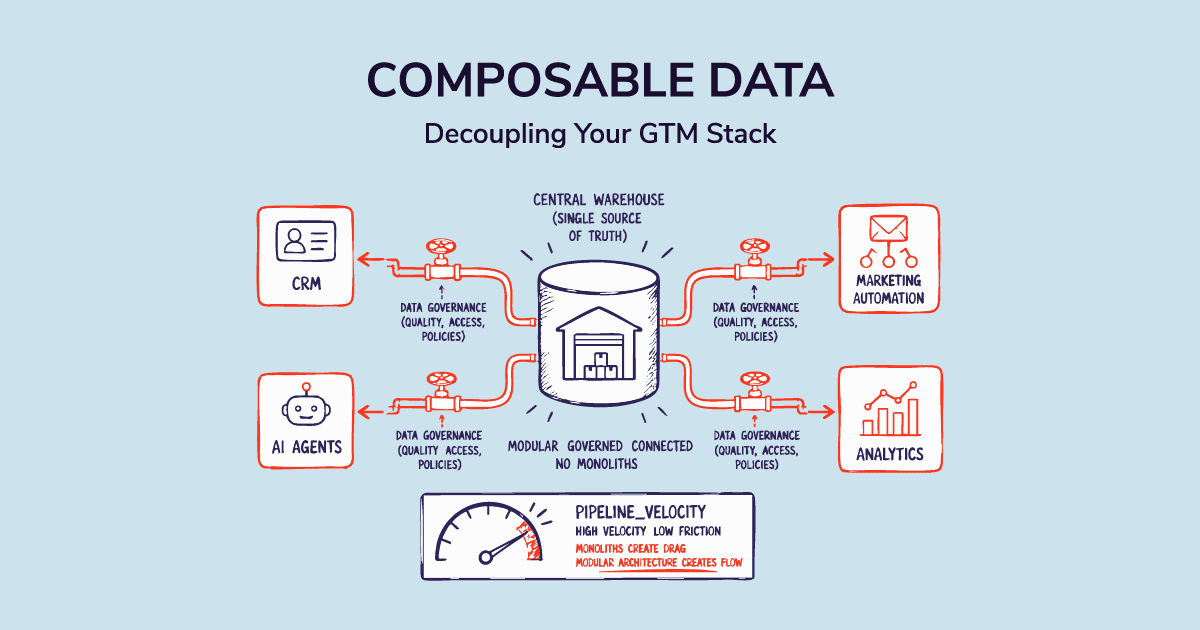
Composable data architecture is an approach to building your tech stack where each component does one specific job, shares data cleanly with the others, and you can swap it out without breaking the whole system. Think of it as modular by design. Every tool is a building block, not a load-bearing wall.
The alternative is what most teams have built without meaning to: a patchwork of tools added one by one to solve specific problems, with no shared data layer connecting them. Each decision made sense at the time. The accumulated result doesn't.

SMARTe GTM Intelligence
Start Smarter Prospecting Today
Integration vs. Composability: They Are Not the Same Thing
This is the misconception that costs revenue teams the most time.
You can connect every component of your GTM tech stack with native integrations and still have a fragmented architecture. Integration means tools can pass data to each other. Composability means they're all operating from the same trusted source, with consistent definitions, in real time.
If your CRM, your marketing automation tool, and your sales engagement platform each have a slightly different version of the same account record, you have integration. You don't have composability. And that difference shows up every single quarter in attribution fights and forecast gaps.
(Worth noting here: most vendors talk about composability in terms of technical flexibility. For GTM teams, what actually matters is whether the data means the same thing across every tool in the stack. That's the practical definition.)
The Three Layers Every GTM Stack Needs
Every working composable GTM stack runs on three layers.
System of record. Where data lives. For most B2B teams, that's Salesforce or HubSpot. Contacts, accounts, opportunities, activity history. All stored here.
System of truth. Where data gets validated, enriched, and trusted. Most teams underinvest here badly. Understanding what data enrichment does in practice is really understanding how this middle layer functions.
System of engagement. Where teams act. Sales engagement tools, ad platforms, email sequences, outbound dialers. Actually, I'd go further and say this is the layer that gets all the credit when things work and all the blame when they don't. Revenue gets created here, or it doesn't. But the outcome depends entirely on what flowed in from the layers above.
The architecture works when data flows cleanly from layer one through layer two to layer three. It breaks when the middle layer is weak, inconsistent, or out of date.
Why Composable Data Architecture Breaks Revenue Operations
Most conversations about composable architecture focus on technical problems. APIs, middleware, integration layers. I think that's the wrong place to look for most B2B revenue teams. The breakdown that costs money happens at the business layer, not the infrastructure layer.
Attribution Fights That Never Get Resolved
Attribution should be a calculation. For most teams, it's a negotiation.
Marketing claims the deal because of the webinar three weeks ago. Sales claims it because of the sequence the AE ran for two weeks straight. CS flags it as expansion driven by the onboarding call. Nobody is making things up. Everyone has timestamps and touchpoints to back their position.
The problem is that their engagement tools don't share a consistent customer record. RevOps ends up refereeing instead of reporting. That's an architecture problem dressed up as an organizational one.
Sales Forecasts Nobody Fully Trusts
Every VP of Sales I've talked to has added a mental qualifier to their own forecast. "This is what Salesforce shows, but..." And then they list the reasons the number might be off.
That qualifier exists because bad CRM data accumulates slowly and hits all at once. Stale contacts. Deals stuck in stages nobody updated. Accounts where the primary contact left the company six months ago and nobody flagged it.
The data is technically present. But it's unreliable. And pipeline generation built on top of unreliable data produces forecasts that leaders adjust by gut feel before they share them.
Contact Data Decay Breaks the Whole Stack
This one gets discussed least. It matters most.
B2B contact records go out of date fast. People change roles, change companies, get promoted. Industry estimates put annual B2B contact data churn at somewhere between 20 and 30 percent. If you built your CRM database a year ago, potentially a third of it is already wrong.
In a composable stack, that decay doesn't stay contained. Wrong contacts in the system of record feed wrong segments into marketing automation. Wrong segments generate wasted spend and sequences landing in inboxes that no longer exist. Broken engagement data produces broken attribution. Broken attribution produces bad forecasts. One bad layer contaminates every layer downstream.
DATAVERSITY's 2024 Trends in Data Management survey found that 68% of organizations named data silos as their top concern, up 7 percentage points from the previous year. Most of them responded by buying more tools. More tools don't fix a data quality problem.
The Most Neglected Layer in Your Data Architecture
Back to the three-layer model. The pattern becomes obvious once you've seen enough GTM stacks: teams invest seriously in the system of record (a strong CRM) and the system of engagement (solid sales tools and ad platforms). The system of truth layer gets treated as an afterthought.
And the system of truth layer is exactly where everything breaks.
Why Your System of Truth Is the Weakest Link
Here's what I actually think the real problem is.
Most RevOps teams treat data enrichment as a project, not a process. They run a big CRM clean-up. They match records against a provider. They fill the gaps. Then they move on and let the decay restart.
What B2B data means for revenue teams goes beyond having a large contact database. Accurate data at the moment of use is fundamentally different from data that was accurate on the day you pulled it. That gap between a cleaned CRM and a functioning system of truth is where most outbound programs quietly fall apart.
Why first-party data matters as the foundation of any composable stack is well understood. What gets less attention is that even first-party data decays. You need continuous, automated verification running on top of it. Not a quarterly clean-up project blocked out on someone's calendar.
What 20 to 30 Percent Data Decay Costs Your Sales Team
Let me make this concrete.
Your SDR team is working 5,000 accounts. If 25% of the contact data is stale, 1,250 accounts have wrong phone numbers, wrong emails, or the wrong person listed entirely. A quarter of the target list is already wrong before anyone picks up the phone.
The messaging is fine. The sequence is fine. The contacts are wrong.
What B2B data decay looks like in practice is something every revenue leader should understand before approving another tool budget. You can build the most well-connected architecture in your category and still waste 25% of your team's outbound effort if the contact layer isn't clean.
What Good Composable Data Architecture Looks Like
When the architecture is working, it feels unremarkable. Reps don't open five tabs before a call. RevOps doesn't spend mornings reconciling numbers. Forecasts reflect reality closely enough that people actually act on them.
That's not an accident. It's the result of each layer doing exactly one job.
One Layer, One Job
Your CRM stores records. Validating and enriching them belongs in the truth layer. Your engagement tools send sequences and log activity. Deciding who goes into a sequence flows from the data layer. Your ad platform runs campaigns against a segment. That segment was built from verified, enriched data that flowed in automatically.
When layers try to own functions they weren't designed for, you get overlap and conflict. The attribution argument starts again. RevOps goes back to playing referee.
The Quickest Test for Composability
Ask yourself: how hard is it to swap out one tool in your stack?
If the answer is "extremely difficult" or "it would break too many things," the architecture isn't actually composable. Tools should connect to a shared data layer, do their job, and be replaceable when something better comes along. (This test also tells you which vendors have deliberately built switching costs into their product, which is worth knowing regardless of whether you're actively evaluating alternatives.)
How SMARTe Powers Your System of Truth Layer
The system of truth layer needs a data foundation. For B2B revenue teams, that foundation is verified contact data that stays current between enrichment cycles, not just at the moment of import. That's what SMARTe provides.
Real-Time Verified B2B Contact Data
SMARTe's database covers 289M+ verified B2B contacts across 200+ countries. The verification isn't a batch process running on a schedule. It's real-time: data validated at the moment you pull it, not six months ago when someone last ran the list.
75%+ US mobile coverage means SDRs reach real decision-makers on direct lines. 86% of US decision-makers are reachable with verified email. Those numbers flow into the CRM, which feeds the engagement tools, which generates activity data that attribution models can actually use.
For teams working global markets, 50%+ global direct dial coverage holds the same standard outside North America. That's a meaningful gap when most competitor data skews heavily toward the US.
Automated CRM Enrichment That Runs Itself
A system of truth that requires manual maintenance isn't really a system. It's a quarterly project with a person attached to it.
SMARTe handles CRM data enrichment automatically, at scale, with 90%+ match rates. Job changes get tracked. Missing fields get filled without a RevOps analyst scheduling time for it.
Waterfall enrichment takes this further, pulling from multiple data sources in sequence so that when one source doesn't have a record, the next one does. The gaps close in the background.
SMARTe also produces AI-ready B2B data: contact records that are clean, verified, and structured for AI agents and LLM-driven workflows without manual reformatting. As AI gets embedded deeper into revenue workflows, the quality of the data layer stops being a RevOps consideration and becomes a revenue one.
Buying Signals and Intent Data Built Into Your Pipeline
Composable architecture at its best gives teams more than clean contact data. It gives them timing.
Sales intelligence at its most useful tells you not just who to target but when they're ready to buy. SMARTe's buying signal tracking covers Bombora intent data, funding events, leadership changes, and headcount growth. All of it flows directly into the same data layer feeding your sequences and CRM. The signals show up where the work happens. Not in a separate tab. Not in a report nobody reads.
That's what composable architecture is supposed to deliver: the right data, in the right layer, at the right time, flowing to the teams who need it without anyone having to ask.
The Bottom Line
Most revenue teams don't have a tools problem. They have a data architecture problem that got disguised as a tools problem over several years of adding integrations that never quite fixed the underlying issue.
Composable architecture works when each layer does one job and passes clean, trusted data to the next. The system of record stores. The system of truth validates and enriches. The system of engagement acts. When any one of those three fails, the whole thing fails. Quietly. Through forecast gaps and attribution fights and SDRs working lists where a quarter of the contacts are wrong.
I believe the revenue teams that pull ahead over the next few years won't have the most tools. They'll have the cleanest data flowing through the fewest, most connected layers.
Try SMARTe free and see how verified contact data and real-time CRM enrichment fit into your architecture. No credit card required.