TL;DR:
A healthcare email list is a verified database of professional contact data. It covers physicians, nurses, hospital executives, and administrators. Built for B2B outbound and account-based marketing.
The defining challenge: healthcare contact data decays faster than any other B2B vertical. Medical professionals change jobs. Practices merge. Hospitals consolidate constantly.
- Specialty and role segmentation matters more than raw contact volume
- Real-time verification beats quarterly batch updates for this vertical
- Direct dial coverage is as important as email for reaching physicians
- HIPAA governs patient data, not professional B2B outreach
- SMARTe covers 289M+ verified B2B contacts across 200+ countries
- 75%+ US direct dial coverage with native Bombora intent data included
A healthcare email list is only valuable if the contact data is accurate. Doctors change practices, hospitals acquire independent clinics, and nursing leaders move between facilities every year. When those changes happen, email addresses, phone numbers, and reporting structures change with them. An outdated list leads to bounced emails, missed opportunities, and wasted sales effort.
That is why buying the biggest healthcare database is rarely the right answer. What matters is how often the data is verified, how detailed each contact record is, and whether you can reach the right healthcare professionals when your campaign goes live.
In this guide, you'll learn what a healthcare email list should include, why healthcare contact data becomes outdated faster than most B2B industries, how to evaluate data providers, and the best ways to reach verified doctor, nurse, and healthcare executive contacts.
What Is a Healthcare Email List?
A healthcare email list is a database of professional contact data for medical professionals. It's built for B2B sales and marketing outreach. You're not reaching patients. You're reaching the physicians, nurses, executives, and administrators who buy equipment, software, supplies, and services.
Good healthcare contact data contains much more than an email address. A properly built record includes all of the following:
- Job title and seniority (cardiologist vs. Chief Medical Officer)
- Medical specialty and subspecialty (cardiology vs. interventional cardiology)
- NPI number (National Provider Identifier, a federally assigned unique ID for licensed US healthcare providers)
- Practice type (independent, group practice, or hospital-employed)
- Organizational affiliation (which hospital, health system, or medical group)
- Verified direct phone number and email address
NPI numbers matter more than most people realize. They let you distinguish a cardiologist in private practice from a hospital-employed one at the same address. Those two people have completely different purchasing workflows and budget authority.
Without that context, every message you send lands at the same generic level.
I think the "email list" framing undersells what you actually need. Think of it as a contact intelligence database. Physicians' institutional email addresses get filtered by hospital IT systems. Gatekeepers screen inbound calls at the front desk. Email alone doesn't reach this audience reliably. That's why SMARTe's 75%+ US direct dial coverage and 50%+ global direct dial coverage exist.
Types of Healthcare Email Lists
Pick the segment based on your product's purchasing path. Who signs the check determines who you target first.
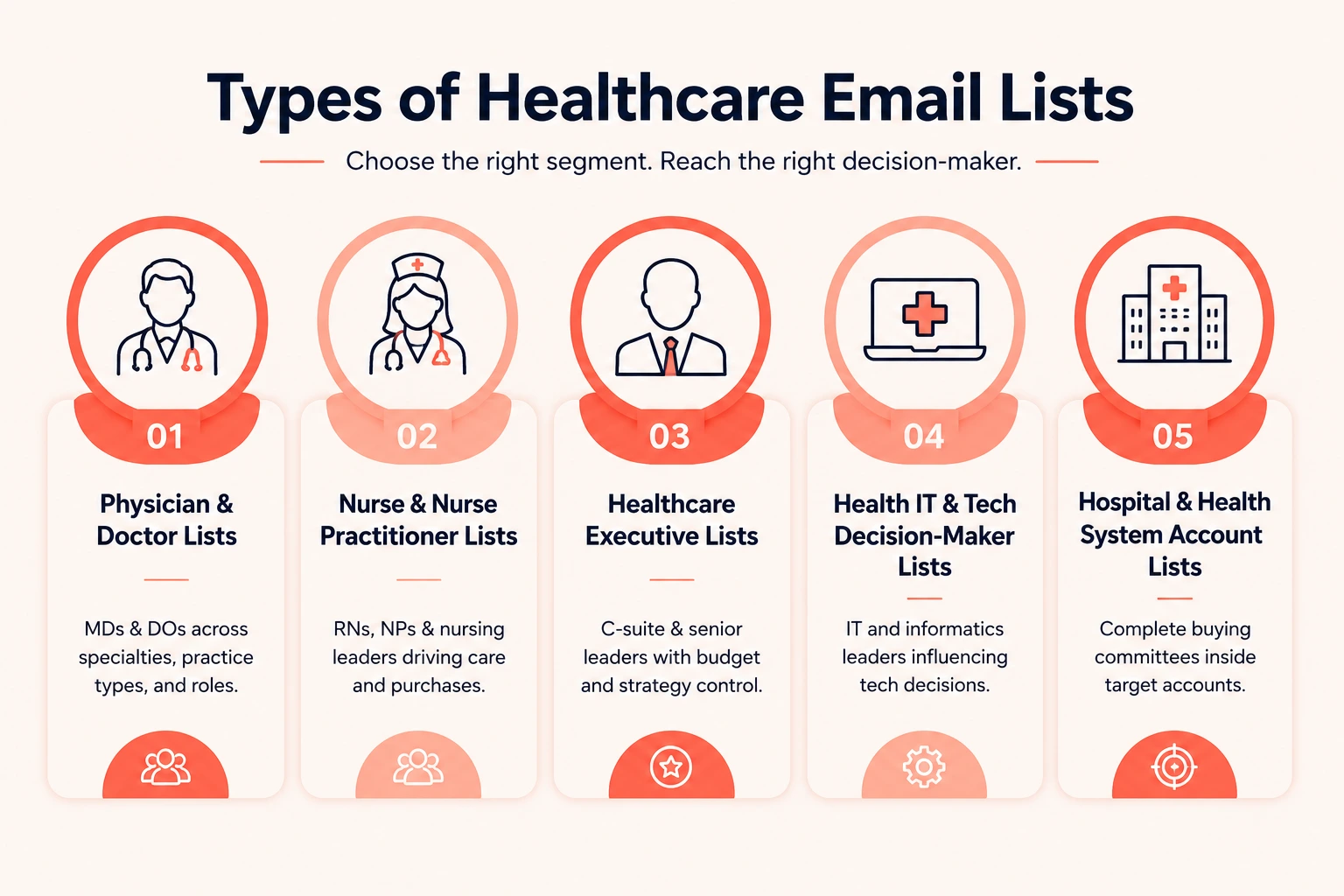
Physician and Doctor Email Lists
Physician lists cover MDs and DOs across every specialty and practice setting. Filter by specialty, practice type, geography, and employment model.
The specialty filter is where these lists earn their value. A company selling cardiac monitors doesn't need all physicians. It needs cardiologists, electrophysiologists, and cardiac surgeons. A pharma company launching a diabetes drug needs endocrinologists, primary care physicians, and obesity medicine specialists. Total physician count means nothing if you can't reach your specific clinical audience.
Three dimensions to segment physician contacts:
- By specialty: Cardiologists, oncologists, orthopedic surgeons, neurologists, and any subspecialty your product serves clinically
- By practice type: Independent private practice vs. large group vs. hospital-employed. An independent physician makes purchasing decisions in days. A health system committee takes months.
- By role: Practicing clinicians who influence purchases vs. physician executives who hold budget authority. Medical Directors, CMOs, and Department Chiefs sign off on spend. These two groups need completely different messages even when you're selling the same product.
Nurse and Nurse Practitioner Email Lists
Three nursing segments exist. Each one is a different buyer profile.
Registered Nurses (RNs) are the largest group. They influence purchases for medical supplies, patient care equipment, and clinical software across hospitals, outpatient clinics, and long-term care facilities.
Nurse Practitioners (NPs) have prescribing authority and make independent clinical decisions. I've watched pharma and medical device teams skip NPs entirely. Then they wonder why physician-only campaigns hit gatekeepers. (Usually, someone built the list with "physician" as the only filter. That single word cuts out a massive segment of clinical decision-makers.) NPs are often more accessible than attending physicians. They're more open to evaluating new solutions too.
Nursing Leadership (Directors of Nursing, Chief Nursing Officers, Nurse Managers) controls departmental budgets. If you sell wound care products or clinical workflow software, nursing directors are your actual buyers. Not frontline nurses.
Healthcare Executive Email Lists
Executive contacts cover C-suite and senior leadership at hospitals, health systems, and large medical groups. You need these for large deal sizes where the board needs to approve the purchase.
Hospital CIOs control technology purchasing. CFOs control financial approvals. CMOs control clinical strategy. Each executive holds different criteria for the same product. The team that sends identical outreach to all three loses.
I'd argue the most underused segment in healthcare executive outreach is the VP-level operational layer. Think VP of Clinical Operations, VP of Nursing, VP of Revenue Cycle. These people own implementation decisions. They push enterprise purchases through faster than the C-suite does. You can build out your C-level executive email list strategy from there.
Health IT and Technology Decision-Maker Lists
Beyond clinical roles, healthcare organizations run large IT departments with their own buying authority. Health Informaticists, Directors of Clinical Applications, Pharmacy Informatics Directors, and IT Security Directors all influence major software and infrastructure purchases.
These contacts respond to technical specs and ROI arguments. Not clinical evidence. They're a distinct segment with distinct messaging needs. A dedicated breakdown of reaching IT decision-makers in complex organizations covers how to structure outreach for this group.
Hospital and Health System Account Lists
For enterprise deals, you need every relevant contact inside a target hospital or health system. Not just one person.
A clinical data platform touching every department at a regional hospital doesn't get approved by one person. You need the clinical champion, the CIO, the CFO, and the department heads working in parallel. You can't discover them mid-cycle. Map the full buying committee before you start.
Why Healthcare Contact Data Decays Faster Than Other B2B Verticals
B2B data decay is a problem everywhere. In healthcare, the rate is genuinely worse.
A 2024 CHG Healthcare survey found 62% of physicians made at least one career change between 2022 and 2024. Only 44% planned to stay in their current role past 2025. Three out of five people you're targeting have moved or changed titles within any two-year window.
The individual-level churn is just part of it. Four organizational forces compound the problem:
- Hospital consolidation: Large health systems keep acquiring independent practices. Every acquisition can change every email address at the absorbed organization overnight.
- Private equity acquisitions: PE firms have been buying independent physician groups at scale. They restructure hierarchies and shift budget authority when they do.
- Practice mergers: Smaller clinics and specialty groups merge constantly. Practice-level domains and contact details change with them.
- Administrative turnover: Practice managers and operations staff turn over at rates most B2B industries don't see.
Most list providers batch-update their databases every 60 to 90 days. By the time that update runs, a large portion of changes have already happened. Your outreach hits the last known address. It now belongs to someone else, a dead inbox, or a forwarding route that goes nowhere.
Real-time verification solves this. It validates contacts at the moment you pull them, not on a fixed schedule.
The cost of ignoring it isn't just wasted outreach. A bounce rate above 2% starts damaging email deliverability. Above 5%, you're hurting your sender domain reputation. In healthcare, a single bad purchased list can push bounce rates above 20%. Automatically tracking job changes is how you catch this before a campaign launches, not after.
What to Look for in a Healthcare Email List Provider
I ran this test directly: the same healthcare ICP campaign sent to five different contact lists simultaneously. Bounce rates ranged from 4% to 28%. Data quality and verification recency explained every point of that gap.
Ask these questions before you spend money.
How and when do you verify contact data?
Batch updates every 60 to 90 days are industry standard. Real-time verification at point of use is the bar worth demanding. If a provider can't explain their verification process clearly, that evasion is the answer.
What's your exact record count in my specific segment?
Don't accept "millions of healthcare contacts" as an answer. Ask for the count for pediatric oncologists in the Northeast or CMOs at hospitals with 200+ beds in the Southeast. Total database size is a marketing number. Your segment count is the operational one.
What's your direct dial coverage rate?
Email alone doesn't reach physicians reliably. Institutional addresses at large hospital systems get filtered. You need verified mobile numbers and direct office lines for multi-channel sequences that connect. SMARTe delivers 75%+ US direct dial coverage and 50%+ global coverage.
Can you show compliance documentation, not just claims?
Ask how they source data. Ask about opt-out processes. Ask what audits they hold. SMARTe is SOC 2 Type II certified, meaning third-party auditors verified the controls. A vendor who just says "we're GDPR compliant" without documentation is giving you a marketing claim, not a compliance posture.
Does this connect directly to my CRM?
Data in a CSV starts decaying the moment you download it. Native Salesforce and Outreach integrations push contacts straight into your workflow. Job changes update automatically. CRM data enrichment at 90%+ match rates is how enterprise outbound programs stay accurate.
How to Run Healthcare Email Outreach That Actually Works
Bad data generates zero pipeline on its own. Neither does a good list without a strategy. Four things separate the campaigns that book meetings from the ones that torch a sender domain.
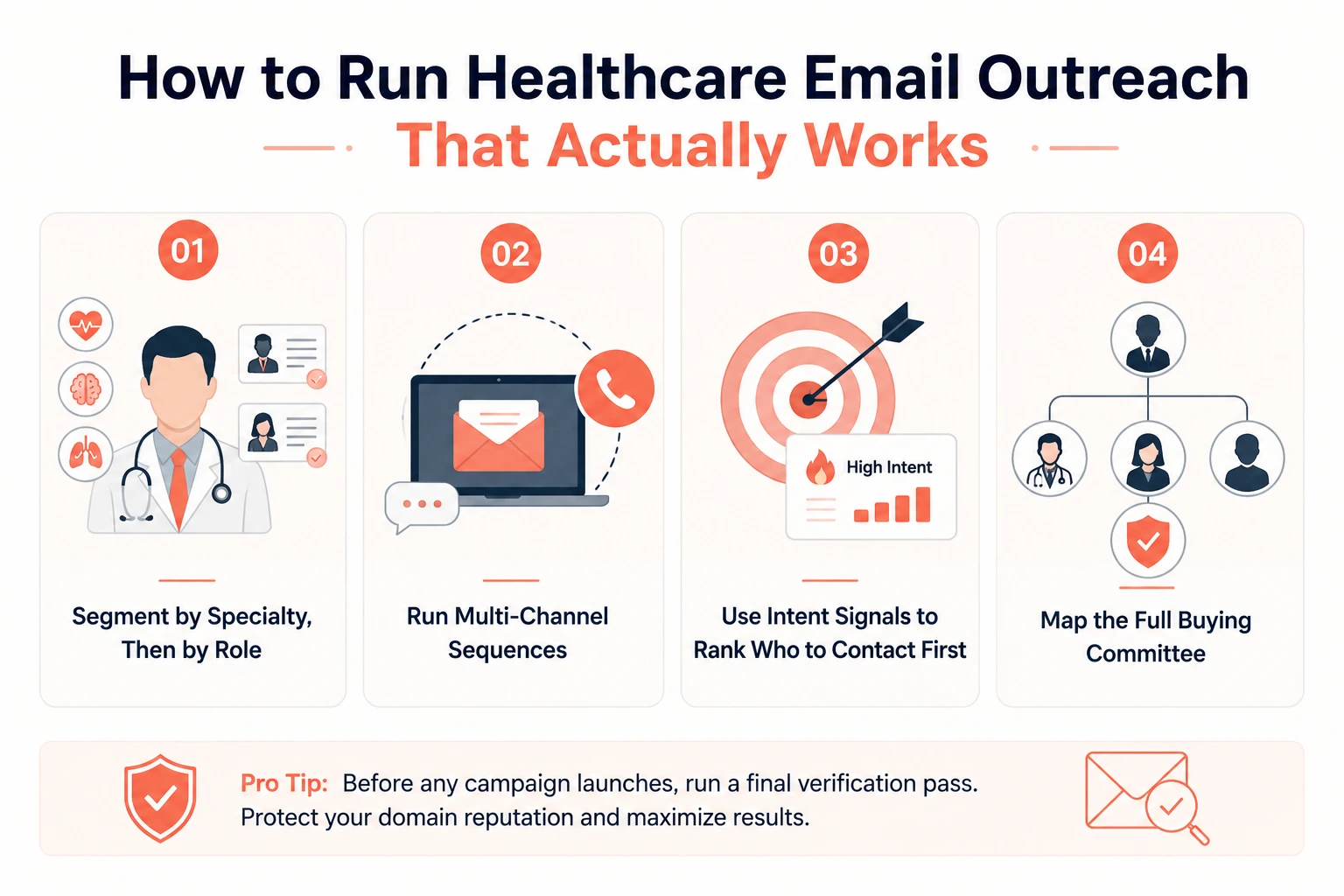
1) Segment by specialty, then by role. Every physician specialty is a different buyer with a different clinical frame. Every executive role has different approval authority. Running one sequence to all healthcare contacts generates unsubscribes, hostile replies, and a damaged sender reputation. A cardiologist and a hospital CFO need completely different messages for the same product. Cold email personalization at the specialty level is the minimum standard, not a differentiator.
2) Run multi-channel sequences, not email-only campaigns. Healthcare professionals are hard to reach by email alone. At large hospitals, institutional email addresses get deprioritized fast. Pairing cold email with verified direct dial calls gets much higher connect rates in this vertical. Both channels require verified data. A wrong mobile number wastes time the same way a bounced email does.
3) Use intent signals to rank who to contact first. Not every account on your list is actively shopping. Bombora intent data shows which hospital systems are researching your product category right now. SMARTe has Bombora built in natively. No separate contract. Sort your list by buying readiness. Your SDRs work the active accounts first, not the ones cold to the category. The full intent data framework covers how to structure this.
4) Map the full buying committee before outreach starts. Enterprise healthcare deals require consensus. You need the clinical champion, the IT decision-maker, the CFO, and department heads moving together. Discovering committee members mid-cycle is the most common reason enterprise healthcare deals stall.
What to do: Before any campaign launches, run a final verification pass through email verification tools. Even fresh data from a reputable provider benefits from one last check. Your domain reputation is worth protecting.
Compliance for Healthcare Email Outreach
HIPAA does not govern professional B2B outreach. Full stop.
HIPAA protects patient health information (PHI). A physician's work email, a CMO's direct line, a nurse practitioner's contact: none of that is Protected Health Information. You can legally send cold outreach to all of them.
The CAN-SPAM Act governs B2B healthcare email in the US. Under the FTC's CAN-SPAM compliance guide, every commercial email must meet these requirements:
- Accurate sender identification in the "From" and "Reply-To" fields
- Honest subject lines that don't deceive the recipient
- A physical business address in the body of the email
- A working opt-out mechanism that processes unsubscribes within 10 business days
- No re-emailing anyone who has already opted out
Violations carry fines up to $53,088 per email. It applies to B2B email the same as consumer email.
GDPR applies for contacts in EU countries. B2B outreach to professional emails falls under legitimate interest in many EU member states. But the rules vary by country. Germany and Austria have stricter opt-in requirements than France or Spain. (One correction worth making: the UK runs its own UK GDPR since Brexit. It mirrors the EU standard closely. The real differences exist within EU countries themselves, not in a UK vs. EU comparison.) Work with a provider who documents their GDPR approach per country.
SMARTe is SOC 2 Type II certified, GDPR-compliant, and CCPA-compliant. That documentation holds up when legal runs procurement reviews. What compliant B2B data looks like in practice covers the full specifics.
How SMARTe Handles Healthcare Outreach
SMARTe is a B2B sales intelligence platform with 289M+ verified contacts across 200+ countries. For healthcare teams, the platform covers physicians, nurse practitioners, nursing directors, hospital executives, and health IT decision-makers. All contacts include verified emails and direct dials.
Key capabilities for healthcare outbound:
- 75%+ US direct dial coverage so SDRs reach real people, not switchboards
- 50%+ global direct dial coverage for pharma and medtech companies running international campaigns
- Native Bombora intent data built in, no separate contract or add-on module
- Real-time contact verification at point of use, not on a batch cycle
- Native Salesforce and Outreach integrations with 90%+ CRM match rates
- 66M+ company profiles covering hospitals, health systems, and medical groups
- SOC 2 Type II certified, GDPR-compliant, and CCPA-compliant
In a vertical where 62% of physicians reported a career change in a two-year window, real-time verification isn't optional. Batch updates let your list rot between refreshes. SMARTe validates at point of use.
Pricing is straightforward:
- Free plan: $0, 10 credits per month, no credit card required
- Pro plan: $25/month, pay-per-credit, no per-seat fees, full team access
- Enterprise: From $15,000/year with volume pricing
Try SMARTe free and run your first healthcare contact search to see the coverage depth for your specific target specialties.