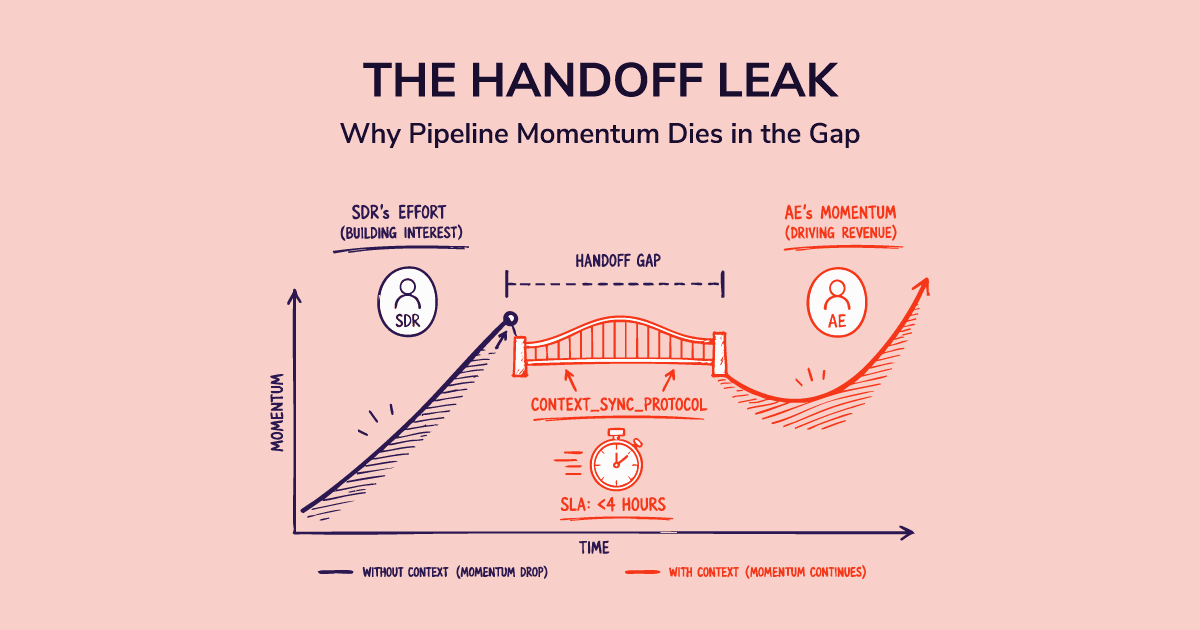
TL;DR:
The SDR to AE handoff is the process of transferring a qualified lead or booked meeting from a Sales Development Representative to an Account Executive so the AE can run discovery, progress the deal, and close. It is the highest-friction conversion point in outbound sales and the place where more pipeline leaks than anywhere else in the funnel.
- 25 to 40% of qualified leads receive no AE follow-up within 48 hours. Most of those deals go cold or go to a competitor
- Each hour of delay after a handoff reduces conversion probability by 10%
- Conversion rates drop 20 to 40% when the handoff package is incomplete (Forrester)
- Implementing a 4-hour AE response SLA improved qualified-to-opportunity conversion by 34% in one team's case study
- The biggest handoff failure is not speed. It is context. The AE asks questions the SDR already answered and the prospect feels ignored before the deal starts
- The root cause is usually upstream: if the SDR's original contact data was stale or incomplete, the handoff package is broken before the SDR even writes the first note
The prospect spent 20 minutes on a call with your SDR. They explained their problem, described their current workflow, named the software they're running, and agreed to a next step. Three days later, they join a Zoom call with the AE. The AE's first question is: "So, tell me a bit about what you're looking for."
That moment kills deals. Not because the AE is incompetent. Because the context from the SDR call never transferred.
This is the SDR to AE handoff problem. It is not a communication problem. It is a process and data problem. And it is the highest-use conversion point in outbound prospecting because when it breaks, the pipeline your SDR team spent weeks building leaks in a single 30-minute call.
What Is the SDR to AE Handoff?
The SDR to AE handoff is the structured transfer of a qualified lead from a Sales Development Representative to an Account Executive at the moment the lead is ready for a deeper sales conversation. The SDR's job ends when the meeting is booked and the context is transferred. The AE's job starts with using that context to run a discovery call that builds on what the SDR already learned, not one that repeats it.
A strong handoff means the AE walks into the first call knowing the prospect's stated problem, their current solution, the signal that triggered the outreach, how many contacts have been identified at the account, what objections came up during the SDR's calls, and what the agreed next step is. Everything the SDR learned transfers directly into the CRM before the meeting happens.
A weak handoff means the AE sees a company name, a contact name, and a title. Nothing else. The first call becomes a second qualification call, the prospect feels like they are starting from scratch, and the deal momentum the SDR built disappears inside a single bad experience.

SMARTe GTM Intelligence
Start Smarter Prospecting Today
Why the SDR to AE Handoff Is Where Pipeline Leaks
This handoff fails more often than sales teams admit. Research from Optifai's analysis of 939 companies shows 25 to 40% of qualified leads receive no AE follow-up within 48 hours. Each hour of delay reduces conversion probability by 10%. A lead that sat uncontacted for two days is already significantly less likely to convert than one the AE called within four hours.
The failures tend to cluster around three specific gaps.
The Qualification Gap
SDRs optimise for meetings booked. AEs need sales-qualified leads that match actual opportunity criteria. When these two definitions are not the same, the handoff produces meetings the AE cannot advance. The SDR hits their number. The AE's first-call-to-opportunity rate falls. Both teams blame each other.
The fix is one shared qualification standard, agreed between SDR and AE leadership, written into the CRM as required fields. If the SDR cannot confirm budget authority, a stated timeline, and a specific pain, the lead should not transfer. Period. Using a framework like BANT, MEDDIC, or your own internal criteria and applying it consistently prevents the pipeline noise that burns AE time on unqualifiable meetings.
The Context Gap
This is the one that actually kills deals. If the AE spends the first ten minutes of a standard thirty-minute discovery call re-qualifying the lead, they have 30% less time to actually sell. And the prospect, who already gave that information once, decides your company does not communicate internally and loses confidence before the AE makes a single point.
The context gap is almost always a CRM documentation problem. No required fields. No handoff template. SDRs logging "demo booked" with three words of notes. AEs inheriting a record that tells them nothing useful about what triggered the meeting or what the prospect actually said. This is fixable with process, not with talent.
The Speed Gap
78% of customers buy from the company that responds first, according to LeadAngel research. A booked meeting that sits unconfirmed for 24 hours, with an AE who has not reviewed the context and has not sent a personalised prep email to the prospect, is already a damaged deal. Show rates drop. Prospect confidence drops. The first impression your AE makes is one of disorganisation.
High-performing B2B sales teams treat the handoff as a time-sensitive event with consequences, not an administrative task that happens when someone gets around to it.
What a Complete SDR to AE Handoff Package Includes
Every handoff should transfer the same minimum set of context, captured in CRM fields before the meeting is formally handed off. Not in a Slack message. Not in an email chain. In the CRM, attached to the opportunity record, where the AE can see it before the call starts.
A complete handoff package includes:
- Company and contact details: Account name, primary contact name, title, direct dial, and email, all verified and not copied from LinkedIn on the day of booking
- ICP qualification confirmation: How the account matches your ICP: company size, industry, tech stack, growth signals, and why this account was targeted
- Qualification framework completion: Budget confirmed or estimated, decision authority of the contact, stated timeline for a decision, and the specific problem they want to solve
- The trigger: What buying signal prompted outreach: a funding event, a leadership hire, an intent spike, or a job posting. This shapes how the AE opens the call
- Call notes and exact prospect language: What the prospect said, in their own words. Not a summary. The actual phrases they used to describe their problem are the ones the AE should echo back
- Objections raised: Any hesitation, concern, or competitive mention that came up during the SDR's calls
- Buying committee contacts identified: Who else at the account was mentioned, even in passing. The AE needs this to start multi-threading from day one
- Agreed next step: The exact next step the prospect confirmed on the call, not a generic "demo scheduled"
HubSpot research shows salespeople using standardised handoff templates achieve 23% higher conversion rates than those logging unstructured notes. The template is not bureaucracy. It is the difference between an AE who opens the first call with "I saw in your conversation with our team that you're evaluating alternatives to Salesforce. I've built today specifically around that" and one who says "So tell me about your situation."
How to Build a Repeatable SDR to AE Handoff Process
Most teams have a handoff "process" that is really just a shared assumption that SDRs will write notes and AEs will read them. That assumption fails at scale. As volume grows, informal handoffs degrade. Context gets lost, leads sit unaccepted, and conversion drops. Here is a structured process that holds up as the team grows.
Step 1: Align on One Shared Qualification Standard
SDRs and AEs need to agree, in writing, on what "qualified" means before a single meeting transfers. If SDRs qualify based on "they showed interest" and AEs qualify based on "they have budget authority and a stated timeline," the pipeline will be full of noise.
Use one framework. BANT, MEDDIC, SPICED, or your own internal model. Define it specifically for your B2B sales process. Budget confirmed means what exactly? Timeline means what response? Write these down. Add them as required CRM fields the SDR must complete before a handoff is accepted. No completed fields, no handoff.
Step 2: Build the Handoff Package in the CRM Before Closing the Meeting
The handoff document should be the last thing the SDR completes before the meeting is confirmed, not the first thing an AE finds missing when they prep the night before. Many teams do this backwards: SDR books meeting, sends calendar invite, writes notes "when they get a chance." By the time the AE looks at the record, the SDR has moved on and half the context is gone.
Reverse the sequence. SDR completes the required CRM fields. Meeting is only marked as confirmed when the handoff package is complete. This sounds like extra friction. In practice, it takes five minutes and prevents thirty minutes of wasted AE discovery.
Step 3: Use a 3-Way Introduction, Not a Cold Calendar Invite
The worst handoff in B2B sales is the blind calendar invite: a meeting appears on the prospect's calendar with a new AE name they have never heard of, and no explanation of why the conversation is changing hands.
A 3-way introduction email changes this completely. The SDR sends a short email that thanks the prospect, summarises what was discussed, introduces the AE by name and explains what they will cover, and confirms the meeting time. The prospect arrives feeling informed rather than handed off. The AE looks prepared rather than starting from scratch. Conversion from booked meeting to held first call improves. Show rates improve. Honestly, the 3-way email is the single highest-ROI change most teams can make to their handoff process in under a week.
Step 4: Set a Response SLA and Treat It Like a Hard Constraint
AE response time after a handoff needs a number attached to it. "Quickly" is not a number. A 25-person SaaS team with no formal SLA had an average time-to-first-AE-contact of 38 hours, per Optifai's case study data. 28% of their qualified leads received no AE contact within 72 hours. After implementing a 4-hour contact SLA with a Slack alert and escalation path, average contact time dropped to 3.2 hours and conversion improved 34%.
Set tiered SLAs based on lead temperature:
- Inbound demo request: AE must contact within 1 to 4 hours
- Outbound qualified interest: AE contacts within 4 to 8 hours
- SDR-sourced meeting booked: AE sends prep email and confirms meeting within 4 hours of handoff
Treat a missed SLA as a process failure, not a rep failure. Auto-alert the manager. Assign a backup if the primary AE is unavailable. Qualified pipeline waiting in a queue is pipeline being handed to a competitor.
Step 5: Require 15 Minutes of AE Preparation Before the Call
AEs who contact a prospect immediately after receiving a hot lead, without reviewing the handoff package, consistently underperform on first meetings. They skip over context the SDR captured. They ask questions the prospect already answered. They miss the signal that caused the prospect to engage in the first place.
Build a mandatory fifteen-minute prep period into the handoff SLA. AEs review the package, research the mentioned competitors, pull a relevant case study, and identify two or three likely objections based on the prospect's role and the signals that triggered outreach. In practice, this fifteen minutes pays for itself in the first call every time.
The SDR to AE Handoff SLA: What High-Performing Teams Use
Response time targets vary based on lead source and intent level. The consensus from RevOps benchmarks across multiple research sources points to:
- Demo requests and inbound form fills: 1 to 4 hours. These are the highest-intent leads in your pipeline. A demo request that sits overnight is unacceptable in 2026.
- SDR-booked outbound meetings: 4 to 8 hours for initial AE preparation and confirmation email to the prospect
- Marketing qualified leads transitioning to sales: Up to 24 hours, but with an automated confirmation sent to the prospect within two hours of handoff accepting
Build the escalation into the system. If an AE misses the SLA, an automatic alert goes to the sales manager. If the AE is unreachable, the lead routes to the backup AE for that territory. Manual escalation processes fail under volume. Automate the escalation or the SLA is just a suggestion.
High-performing sales teams are 1.5 times more likely to rate their lead handoff process as excellent, according to Salesforce State of Sales research. That 1.5x advantage shows up as more first calls converting to qualified opportunities, fewer show-rate no-shows, and shorter time from meeting to closed deal.
The Data Problem That Breaks Handoffs Before They Start
Most handoff guides focus on process. Notes templates, SLA frameworks, 3-way email scripts. Those help. But there is a more foundational problem that sits upstream of all of them, and fixing it is worth more than any process change.
If the SDR worked from a contact list with stale or incomplete data, the handoff is broken before the SDR writes a single note. An economic buyer with a four-year-old phone number is not a real contact. A prospect whose title changed three months ago is not the right stakeholder to transfer. A CRM record missing the company's technology stack, recent funding events, and known buying committee contacts is not a handoff package. It is an empty form with a name on it.
Bad CRM data makes this inevitable for most teams. B2B contact data decays at roughly 22.5% per year. The SDR who worked from a list built six months ago is routinely calling wrong numbers and emailing addresses that bounced last quarter. The meetings they book often involve the wrong contact at the right account, or the right contact at an account whose situation has changed significantly since the SDR targeted them.
The fix is CRM data enrichment at the point of account entry, not at the point of handoff. When the SDR's account list contains verified firmographic data, technographic data, and identified buying group members with current roles, all of that data transfers automatically when the opportunity is created. The AE inherits a complete record because the data existed before the first dial.
SMARTe's 289M+ verified contacts run through real-time verification. When an SDR creates a handoff, the account record contains verified decision-maker contacts across the buying committee, current direct dials, and enriched firmographic and technographic data. Not stale information from a list that was built when the intent signal fired six months ago. SMARTe's champion tracking also flags when a contact changes roles mid-cycle, so the AE inheriting a deal does not find out the prospect left the company on the first call.
How to Measure SDR to AE Handoff Performance
Most teams measure the handoff by meeting volume. SDRs booked 40 meetings this month. That says nothing about whether those meetings converted. Here are the metrics that actually tell you how the handoff is performing.
- Meeting-to-opportunity conversion rate: What percentage of booked meetings become qualified opportunities after the AE's first call? Below 40% suggests a qualification problem upstream. Below 60% for a well-defined ICP motion is worth investigating.
- Time-to-first-AE-contact: How long between handoff accepted and first AE outreach to the prospect? Benchmark against your SLA. Gaps here directly correlate with show rate and pipeline conversion.
- Show rate: What percentage of booked meetings result in held calls? Below 70% usually signals either a weak 3-way introduction process or a misaligned prospect who was qualified on interest rather than intent.
- First-call-to-opportunity rate: Of the meetings that happen, what percentage generate an opportunity in the CRM? This is the clearest signal of handoff quality.
- Handoff rejection rate: What percentage of leads does the AE reject as not sales-ready? Above 15% suggests the SDR qualification standard and the AE acceptance standard are misaligned.
Review these in a joint SDR and AE meeting monthly, not in separate team reviews. The handoff is a shared process. The metrics should be reviewed by both sides simultaneously.
A Strong Handoff Is a Shared Responsibility
Most SDR-AE handoff problems get diagnosed as an SDR training issue. SDRs need to write better notes. SDRs need to qualify more carefully. SDRs need to do a better 3-way email.
Some of that is true. But in my experience, the most common failure is equal on both sides. SDRs write incomplete notes because no required fields exist in the CRM. AEs do not review context because the culture rewards speed over preparation. Both teams feel the friction. Neither team owns fixing the process.
Building a sales cadence and a pipeline generation motion that actually converts requires treating the handoff as a shared team standard, with clear definitions, required documentation, enforced SLAs, and regular joint review of the metrics that reveal where it is breaking. The SDR-to-AE transfer is not an admin task that happens between two jobs. It is the most critical conversion point in your entire outbound funnel.
Fix it there and everything downstream performs better.
Try SMARTe free and see how verified contact data and real-time enrichment transform the quality of the handoff package your SDRs deliver.