TL;DR:
Sales productivity means getting more revenue and more closed deals out of the same time and the same team, not just working longer hours. Reps spend somewhere between a quarter and less than half of their day on activities that move a deal forward, depending on whose research you trust. The rest goes to admin work, bad data, tool switching, and chasing leads that were never a fit. Fixing it comes down to five things. Clean data, less manual admin, tighter sales and marketing alignment, a smaller tech stack, and clear rules for when a deal moves to the next stage.
Key takeaways:
- Sales productivity is output per unit of input. Sales efficiency is revenue per hour of activity. People treat the two as synonyms constantly, and they shouldn't.
- Estimates of selling time range from under 30% to around 40% of the workweek, depending on the study. No credible source puts it above half.
- Reps carry 8 to 10 tools on average, and sellers who feel overwhelmed by their stack are meaningfully less likely to hit quota.
- Five things kill productivity more than anything else: bad contact data, manual admin work, sales and marketing misalignment, tool sprawl, and pipeline stages with no clear exit criteria.
- Fixing the data and the process moves the number faster than adding headcount does.
A rep opens the CRM Monday morning to 40 tabs of context they lost over the weekend, a lead list nobody scrubbed since March, and a stand-up in ten minutes. None of that is selling. All of it eats the same eight-hour day a demo would.
That's the entire sales productivity problem in one scene. Not laziness, not a lack of hustle. A day structured so the actual selling has to compete with everything else for time, and mostly loses.
This guide covers what sales productivity means, how to measure it without fooling yourself, the five things that quietly kill it, and seven fixes that hold up against the research instead of just sounding good in a deck.
What Is Sales Productivity
Sales productivity is the ratio of output, meaning revenue, closed deals, or qualified pipeline, to the input of time and resources a team spends generating it. A team gets more productive by producing more from the same effort, not by working more hours or hiring more reps.
That sounds simple until you watch it play out. Two reps can work the same number of hours and land in completely different places. One spends the morning updating CRM fields by hand and chasing a lead list full of bad numbers. The other has clean data queued up and automation handling the busywork, so the same three hours go straight into calls and demos. Same input. Very different output.
Sales Productivity vs. Sales Efficiency
These two terms sound interchangeable, and they aren't.
Sales efficiency measures revenue generated per hour of activity or per dollar spent. It's a speed and cost question: how much did this activity return for what it cost. Sales productivity is broader. It measures whether the output itself is worth more, not just whether it arrived faster.
Here's a way to tell them apart in practice. A rep who makes 100 calls a day is efficient. A rep who closes half of their qualified opportunities is effective. Sales productivity needs both. A team can be extremely efficient at doing the wrong activity and still miss quota by a mile.
Why Sales Productivity Matters
How much of the day goes to selling depends on who you ask, and that alone should tell you something. Salesforce's 2026 State of Sales report puts active selling time at around 40%. Other benchmarks land lower, some under 30%. Nobody credible puts it above half. Take the average of any of these studies and you land on a rough truth: reps lose more of their week to everything around the sale than to the sale itself.
The tool stack makes this worse before it makes it better. The average rep now works across 8 to 10 different platforms to close a single deal, and a large share of sellers report feeling overwhelmed by that stack. Overwhelmed sellers miss quota at a meaningfully higher rate than sellers who aren't. More software promised a fix here. Instead it became one more thing competing for the same hours.
None of this is about pushing reps harder. A rep already working a 45 hour week doesn't have four more hours to find. The lever that moves the number is what happens inside the hours they already have.
How to Measure Sales Productivity
You cannot fix what you refuse to measure, and vague productivity goals produce vague results. A handful of metrics tell you almost everything you need to know.
Time Spent Selling
This is the percentage of a rep's week spent on revenue generating activity: calls, demos, live deal work, versus admin, data entry, and internal meetings. Track it with a simple time audit for two weeks before you assume you know the number. Teams tend to overestimate it.
Conversion Rate
The share of leads or opportunities that turn into closed deals. Low conversion paired with high activity is not an effort problem. It usually means reps are busy working the wrong accounts, which is a targeting and qualification issue, not a hustle issue.
Sales Cycle Length
The average time from first contact to closed deal. Compare this within your own team and your own segments over time. Comparing your cycle length against a competitor's published benchmark tells you very little. Deal size, industry, and buyer count all shift the number in ways that have nothing to do with your team's output.
Quota Attainment
The share of reps hitting or exceeding target in a given period. This is the metric leadership watches closest, and it's also the slowest to move, since by the time it drops the underlying problem has usually been building for a quarter or more.
Revenue per Rep
Total revenue divided by headcount. It's the bluntest metric on this list and also one of the more useful ones, because it exposes whether adding reps is adding real output or just adding cost.
What's Killing Sales Productivity
A small set of causes explain the bulk of these problems, and they repeat across nearly every sales org regardless of size or industry.
Bad and Outdated Contact Data
Contact and company data decays fast. A widely cited estimate puts annual CRM data decay at around 30%. That means roughly a third of your records go stale in a year through job changes, company moves, and plain old typos. A rep working a list built on that kind of decay spends real time chasing numbers that don't connect and emails that bounce. Every one of those attempts feels like selling without producing any of the output.
Manual, Repetitive Admin Work
Data entry, activity logging, meeting prep, and pulling account context before a call all eat hours that never show up on a pipeline report. None of it is optional. The bulk of it can run without a human doing it by hand.
Sales and Marketing Misalignment
When the two teams disagree on what a qualified account looks like, sales spends real time re-qualifying leads marketing already touched, or chasing accounts that were never going to close. A clean SDR to AE handoff depends on both sides agreeing on the definition before a lead ever moves.
Tool Sprawl
Every additional platform adds a login, a data export, and one more place information can get stuck. Consolidating a stack sounds like an IT project, but the return shows up directly in sales tools getting used instead of half-adopted and ignored by week three.
Undefined Pipeline Stages
If nobody has written down what has to be true before a deal moves from one stage to the next, reps guess. Guesses create the kind of muddy sales funnel data that makes forecasting close to useless. Fuzzy stages don't just distort reporting. They cost reps time deciding what to do next on every single deal, all week, every week.
7 Sales Productivity Tips That Work
Each of these maps directly to one of the causes above. Fix the cause, and the tip does the rest.
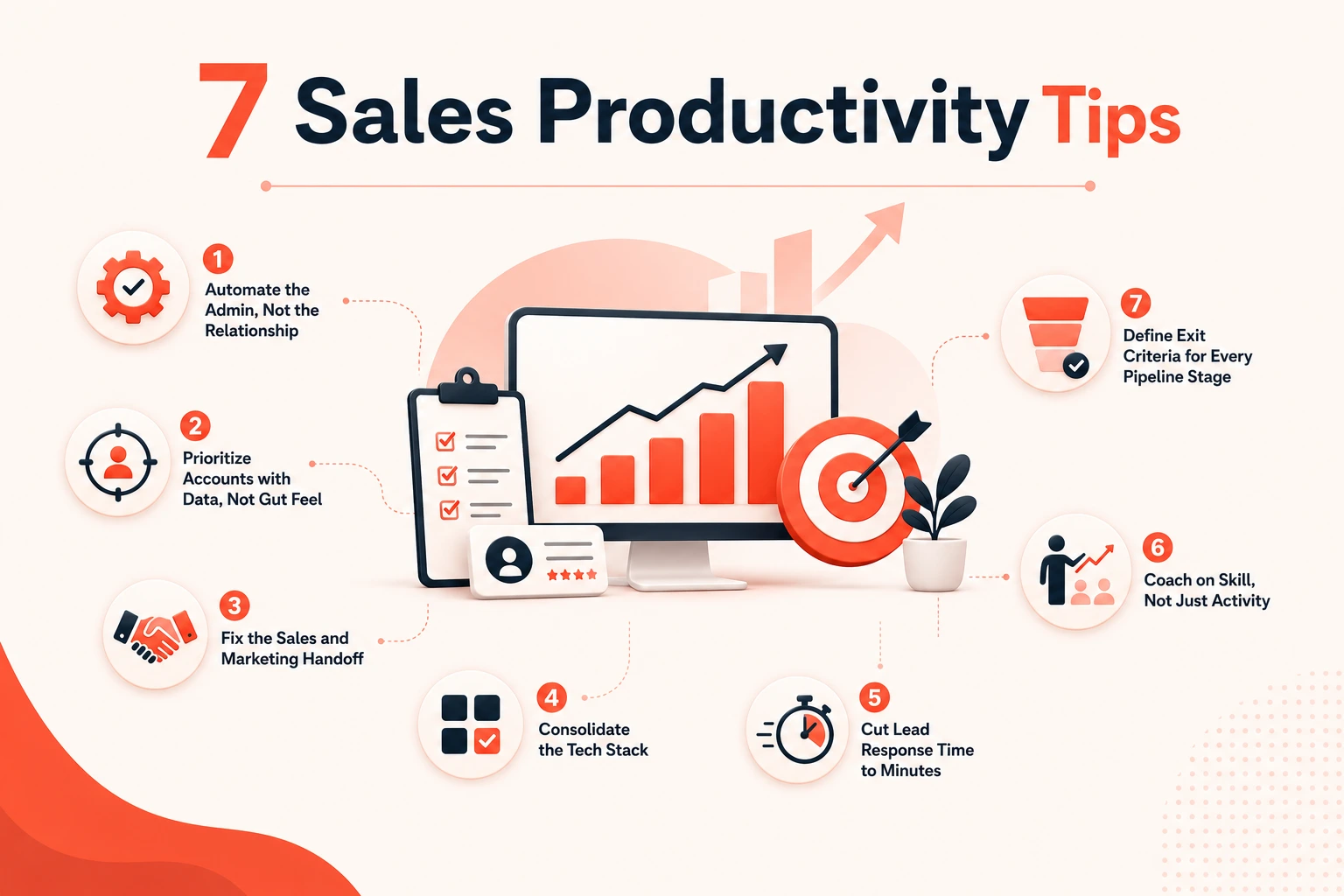
1. Automate the Admin, Not the Relationship
Data entry, follow-up reminders, meeting scheduling, and activity logging are strong automation candidates. A live sales conversation is not. The line to hold is simple: automate the parts of the job a customer never sees, and leave the parts they do see to a human. Teams that blur this line end up with generic, obviously automated outreach that costs more in trust than it saves in time. AI sales tools earn their keep on the first category and struggle badly on the second.
2. Prioritize Accounts with Data, Not Gut Feel
Firmographic fit, technographic signals, and engagement history tell you more about which accounts are worth a rep's morning than instinct does, especially for reps still building pattern recognition. A working lead scoring model turns "this feels like a good account" into a number the whole team can act on the same way.
3. Fix the Sales and Marketing Handoff
Write down what counts as a qualified lead, in a document both teams look at, not a slide from a kickoff meeting eleven months ago. When both sides work from the same definition, sales stops spending Tuesday mornings re-qualifying leads marketing already vetted.
4. Consolidate the Tech Stack
Audit what your team opens every day versus what got bought and quietly abandoned. Cutting from ten tools to five rarely loses functionality. It mostly removes the tax of switching between them, and that tax is bigger than a lot of audits expect it to be.
5. Cut Lead Response Time to Minutes
Response speed is one of the more well documented levers in sales, and the data is not subtle. Studies on lead response consistently find reply rates fall off a cliff once follow-up stretches past the first few minutes. If your process depends on a rep remembering to check a queue, the queue is your bottleneck, not the rep.
6. Coach on Skill, Not Just Activity
Call volume is easy to track and easy to game. Objection handling, discovery quality, and how a rep leads a conversation are harder to measure and matter more. Sales enablement built around real skill gaps, not generic training modules everyone sits through once, moves the number that activity dashboards miss entirely.
7. Define Exit Criteria for Every Pipeline Stage
Every stage in your pipeline needs a plain answer to one question: what has to be true before a deal moves to the next stage. Vague stages produce vague forecasts, and a forecast nobody trusts gets rebuilt in a spreadsheet anyway, which defeats the purpose of having a CRM at all.
Sales Productivity Tools by Category
Tools support productivity. They don't replace fixing the process underneath them, and buying software to paper over a broken process just gives you a faster way to run the wrong play.
A RevOps function, where one exists, usually ends up owning the decision of which tools in each category stay.
Conclusion
None of this comes down to working harder. A rep chasing bad data and re-entering the same information three times is not underperforming. The system around them is producing that outcome by design, even if nobody designed it on purpose.
The fix is rarely a bigger team. It's a shorter list of tools, cleaner data feeding the ones that stay, and pipeline stages specific enough that nobody has to guess what happens next. Teams that get this right don't look busier. They just close more with the same number of people, and that's the entire point of the exercise.