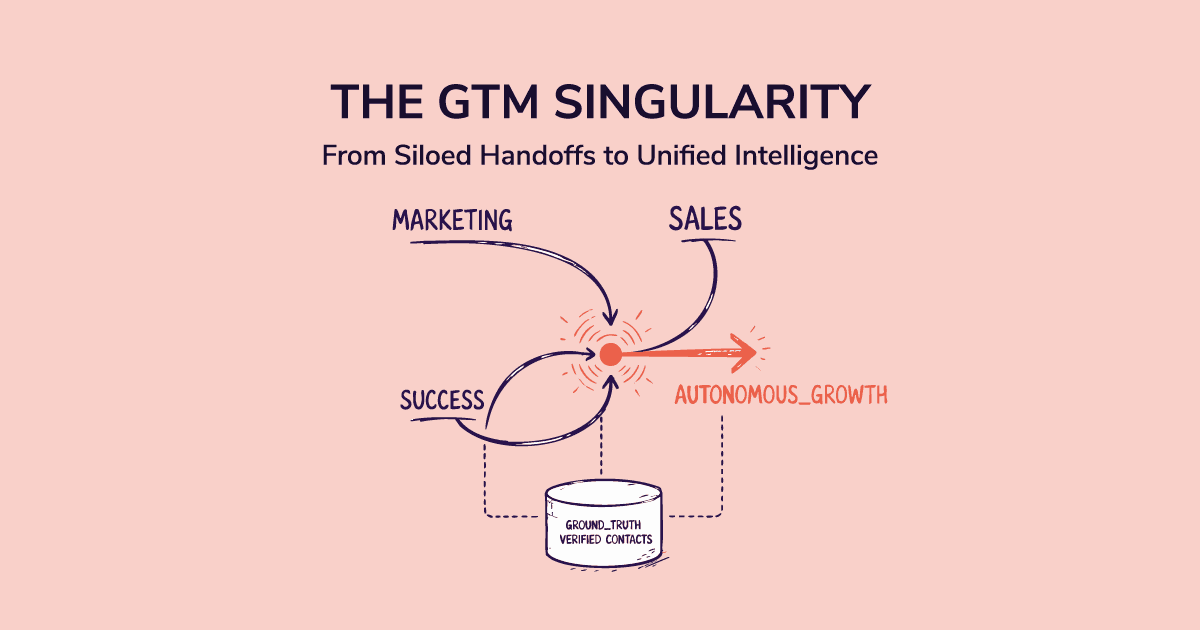
Most B2B sales teams have felt it for two years. The sequences that used to book meetings stopped working. MQL targets got hit but pipeline didn't move. Cold email volumes went up and reply rates went down. Nobody could name exactly why.
Forrester just did.
On April 27, 2026, at B2B Summit North America in Phoenix, Forrester released “The GTM Singularity Is Here.” The core argument: the traditional B2B go-to-market playbook hasn't just declined. It has collapsed. Buyers now rely on AI-powered search, deploy their own AI agents, consult expanded buying networks, and make decisions long before a seller ever enters the conversation. The old model wasn't built for any of that.
What frustrates me about most coverage of this report is that it stops at the framework summary. This article goes a step further. What does the GTM singularity actually demand from outbound teams, RevOps managers, and marketing leaders who need to know what to change on Monday morning, not just what to think about?
What Is the GTM Singularity?
The GTM singularity is Forrester's term for the moment when decades-old B2B go-to-market models break down completely under the combined pressure of AI and shifting buyer behaviour.
Forrester researcher Dave Frankland described it as “a convergence of unpredictability and transformation where traditional rules no longer apply, signalling urgent, inevitable, and profound change.” That's not marketing language. It's a structural diagnosis.
Three forces are converging at the same time. Buyers using AI to research and build shortlists anonymously before any seller enters the conversation. B2B purchase decisions involving more complex buying networks than ever before. And legacy GTM practices (mass emailing, MQL-obsessed marketing, gated content, siloed teams) all becoming ineffective simultaneously rather than one after another.
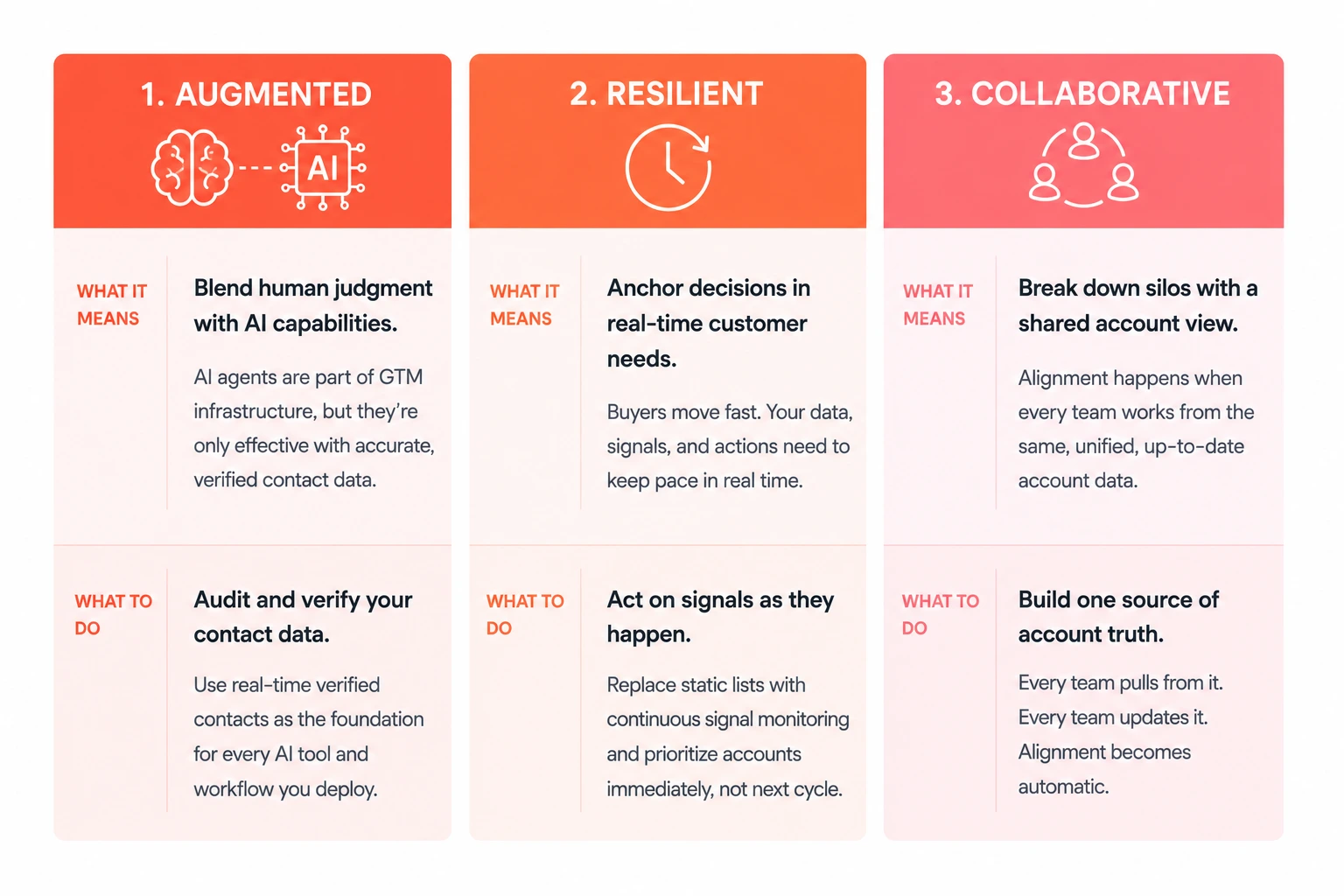
To navigate it, Forrester introduced the ARC framework: three principles for a new GTM approach that works in an AI-enabled market.

SMARTe GTM Intelligence
Start Smarter Prospecting Today
Why the Old B2B GTM Playbook Fell Apart
The unusual thing about the GTM singularity isn't that tactics stopped working. Tactics always stop working eventually. What makes this moment different is that three foundational practices failed at the same time.
1. Mass Email Stopped Working Before Anyone Admitted It
Spam filters got smarter first. Privacy regulations tightened. AI-powered inbox assistants began triaging messages before buyers ever read them. And then the bigger shift: buyers started using AI tools to do their own research, build their own vendor shortlists, and form their own conclusions before your SDR ever sent the first touch.
Forrester's research is direct on this: buyers now make decisions long before sellers enter the conversation. Your mass email sequence isn't arriving early in the process. For many buyers, it's arriving after they've already made up their mind.
2. Marketing Qualified Leads Became a Vanity Metric
I've thought this for a while, and Forrester has now made it explicit in their GTM singularity research. The marketing qualified lead was always a measure of engagement, not purchase intent. Someone downloading a whitepaper doesn't tell you whether they're evaluating vendors this quarter.
Sales teams worked the MQL queue because leadership required it, not because it reliably produced pipeline. And Forrester is unambiguous: clinging to MQL obsession is one of the ineffective practices the GTM singularity is making untenable. Buyers who are genuinely in-market are defining their own requirements, evaluating vendors on their terms, and engaging sellers only when they want to.
3. Gated Content Lost Buyers to Answer Engines
Buyers now turn to answer engines to get confident, specific information before contacting a vendor. Forrester's research describes this as the “visibility vacuum”: a gap where your content should be discoverable but isn't, because buyers are asking AI tools the questions you've hidden behind forms.
When buyers turn to answer engines, they need information that's open, specific, and structured for AI to surface. Gated PDFs don't get indexed. Content behind forms doesn't get cited. If your best thinking lives inside a lead capture wall, it doesn't exist in the buyer's research process.
The ARC Framework: What Each Principle Actually Demands
Forrester's ARC framework is worth understanding as a set of operational requirements, not just a strategic philosophy. Each principle has a specific implication for what outbound teams and RevOps functions need to change.
1. Augmented: Your AI Agents Are Only as Good as Your Contact Data
The Augmented principle says teams must actively blend human judgment with AI capabilities. AI agents connect to GTM initiatives. Buyer-side AI agents get treated as real participants in the buying network.
In practice, this means AI sales agents and AI-assisted workflows are now baseline GTM infrastructure, not experiments. And here's what most teams are getting wrong: they're deploying AI tools on top of contact data that hasn't been verified in months. An AI agent reasoning from stale job titles, disconnected mobile numbers, or churned email addresses doesn't produce a bad sequence. It produces a confident, well-written, completely wasted one.
What to do: Before adding more AI to your GTM stack, audit the contact records those systems will operate on. SMARTe's 283M+ verified contacts run through real-time verification, not a static batch refresh. The AI tools you deploy are only as accurate as the data they work from.
2. Resilient: Real-Time Data Is the Only Kind That Survives This Market
The Resilient principle calls for abandoning static annual plans and anchoring decisions in real-time customer needs. Forrester is explicit: most firms update their GTM plans annually at most, and that cadence can no longer keep pace with how fast buyers move through their journey.
Resilient doesn't mean having a flexible strategy document. It means your data infrastructure refreshes continuously. Your buying signals monitoring runs in real time. When an account shows intent, your team acts on it within days, not at the next campaign cycle.
The B2B buyer journey has compressed. Buyers are moving faster, researching more independently, and forming shortlists earlier than any previous period in B2B sales. A contact database built from a batch refresh six months ago is a map of a territory that no longer exists.
What to do: Replace static list pulls with continuous signal monitoring. When funding events, leadership changes, or intent spikes appear on a priority account, that account moves to the top of the queue immediately. Not in the next campaign cycle.
3. Collaborative: A Shared Account View Is What GTM Alignment Actually Means
The Collaborative principle says that silos between sales, marketing, customer success, and product must come down. Forrester is direct: collaboration requires a shared, unified view of every prospect and customer, with transparency across all teams.
This is harder than it sounds because most organisations run siloed datasets. Sales pulls from the CRM. Marketing pulls from the automation platform. Customer success has account health data in a third tool. None of them match, and the result is outreach that contradicts itself, hand-offs that drop context, and account views that tell a different story to every team.
A RevOps structure built around a single source of account truth fixes this. Not just organisationally. Architecturally. When CRM data enrichment keeps records current across all functions, and every team pulls from the same verified dataset, alignment stops being a meeting agenda item and starts happening automatically.
What to do: Define one source of truth for account data. Assign a RevOps function to own it. Every team pulls from it. Every team updates it. When a customer success rep logs an expansion signal, the account executive sees it. When marketing picks up an intent spike, the SDR queue reflects it.
The GTM Singularity Has a Data Problem Nobody Is Naming

Forrester's blog on the GTM singularity frames it as a crisis and an opportunity simultaneously. I think it's both, but which one your team experiences depends almost entirely on your data infrastructure.
Here's what the coverage of this research keeps skipping.
All three ARC principles require accurate, current contact data to function. You can't be Augmented if your AI agents are reasoning from records that are months out of date. You can't be Resilient if the contact data underneath your signal monitoring is stale. You can't be Collaborative if your shared account view is full of duplicates, wrong titles, and churned contacts. The framework is sound. But it runs on data. And the data at most B2B companies isn't ready.
Bad CRM data doesn't just waste outreach budget. It breaks every downstream GTM system that depends on it. Your AI agents produce confident, well-written sequences aimed at the wrong people. Your signal monitoring routes alerts to contacts who left the account before the buying signal fired. Your collaborative account view is a unified dashboard of incorrect information.
B2B contact data decays constantly. People change roles. Phone numbers get disconnected. Email addresses churn. A database that isn't verified in real time reflects the world as it was, not as it is. And the GTM singularity demands that you respond to the world as it is, right now.
This is exactly where AI-ready B2B data becomes the deciding factor. Contact records verified at the point of use, not refreshed on a quarterly schedule, are what make the ARC framework executable in practice.
SMARTe surfaces Bombora intent signals, job changes, funding events, and technographic data across 64,000+ tracked products in a single view. The contact records run through real-time verification, not a static snapshot. When an account triggers your GTM workflow, the data feeding your AI agents, your sequences, and your shared dashboards reflects who is actually there today. SMARTe's 90%+ CRM match rate and 60%+ reduction in RevOps manual work are direct outcomes of running on verified data rather than decayed records.
Four Things Outbound and RevOps Teams Can Do This Quarter
The GTM singularity isn't a problem you solve in a planning session. It's a problem you solve by changing how your GTM infrastructure actually works. These four steps give you somewhere to start.
1) Audit Your Contact Data Before You Build the AI Layer
Most teams add AI before fixing their data. That's the wrong sequence. The AI tools you deploy will reason from whatever contact records they have access to. If those records are stale, the AI outputs stale results at scale, with higher confidence and lower visibility into the error.
Pull a sample of your active outbound list. Check job title accuracy, email deliverability, and mobile connectivity. If the error rate is significant, your AI layer is already compromised. Run CRM data enrichment against a real-time verified source before building anything else on top of it.
2) Transition High-Value Content to Open, AI-Searchable Formats
Forrester's GTM singularity research is explicit: buyers turn to answer engines and need personalised, ungated information to make confident decisions. If your best content sits behind a gating form, it's invisible to those answer engines.
Move your highest-quality content (your research, your benchmark comparisons, your practical guides) to open-access web pages. Structure each piece with clear headings, specific claims, and direct answers to the questions your buyers actually ask. AI models cite content that is specific, sourced, and structured for easy extraction. Content behind forms doesn't get surfaced.
3) Replace Static List Pulls with Real-Time Signal Monitoring
The Resilient principle made operational. Stop building target lists quarterly and working them until they're exhausted. Start monitoring priority accounts continuously, and act when signals converge.
Set up alerts for funding events, leadership changes, and intent spikes. When two or three signals appear on the same account in the same window, that account moves to the top of the outreach queue immediately, not in the next batch. Buyers in an active buying window don't wait for your campaign calendar. Your team shouldn't either.
4) Build Your RevOps Foundation on One Shared Account Record
The Collaborative principle requires structural change, not just a new meeting cadence. Sales, marketing, and customer success need to pull from the same account record, and someone has to own that record.
Assign ownership to a RevOps function. That function owns the tech stack, the data standards, and the shared dashboard. A record updated by customer success this morning shows up in the SDR's queue this afternoon. Expansion signals logged by an account executive flow to marketing in real time. From there, your go-to-market strategy aligns around shared metrics that mean the same thing to every team, because they're reading from the same data.
The Foundation Comes Before the Framework
The GTM singularity isn't primarily a strategy problem. It's a data infrastructure problem wearing a strategy hat.
Teams that fix the foundation first (real-time contact verification, unified account intelligence, open content that answer engines can surface) will find the ARC framework far more executable than it looks on paper. Teams that adopt the framework without fixing the infrastructure will build elegant models on a foundation that can't support them.
Fix the foundation. The framework follows.
Try SMARTe free and see what the ARC framework looks like when the data underneath it actually works.