The best time to cold call B2B prospects is 10 to 11 AM or 4 to 6 PM, on a Wednesday or Thursday. Those two windows consistently produce the highest connect rates across industries. For executives specifically, 7:30 to 8:45 AM works better than most SDRs expect.
That's the short answer.
The longer one is that timing alone won't move your numbers if you're calling the wrong number at the right time. A verified direct dial at 10 AM on a Thursday converts differently than a main office line at the same hour. The job title you're targeting, the industry you're calling into, the day of the month, how many attempts you're making before giving up: all of it compounds on top of the timing layer.
This guide covers all of it. The best hours and days, broken down by role and industry. What changed when remote work became permanent. How many call attempts actually make sense before moving on. And the one variable that tanks connect rates before timing becomes a factor.
Best Days to Cold Call

Wednesday and Thursday Consistently Come Out Ahead
The data on this goes back over a decade. XANT (formerly InsideSales.com) analyzed more than 100 million B2B sales calls across industries and found Wednesday and Thursday produce connect rates roughly 20% higher than Monday and around 25% higher than Friday.
The reason is straightforward. Monday is recovery and planning mode. Buyers are clearing their weekend backlog, setting up the week, and mentally unavailable for unplanned conversations. By Wednesday they're in full execution mode. The week's priorities are set. They're not yet in end-of-week wind-down. That window of availability is real, and the numbers show it.
Thursday holds up nearly as well. Buyers still have a full day's buffer before the weekend. They're not in wrap-up mode.
This doesn't mean Tuesday is a write-off. It means your highest-value accounts, the ones where getting through actually moves your pipeline, belong in a Wednesday or Thursday dial block.
What the Data Says About Monday and Friday
Monday before 10 AM is the worst single window of the week. Not marginally worse. Most executives are reviewing their week ahead. Managers are in standups. Decision-makers are mid-coordination with their own teams. Monday afternoon recovers somewhat. If you're dialing on Monday, wait until at least 11 AM.
Friday is more nuanced than people admit. Friday morning can still produce connects, particularly early in a sequence where the prospect hasn't heard from you before. Friday afternoon is where it falls apart. After 2 PM, most buyers have mentally started their weekend. You're leaving voicemails for people who won't listen to them until Monday, if ever.
Best Time of Day to Cold Call

10 to 11 AM: The First Real Window
By 10 AM, most buyers have processed their first wave of email, cleared their morning standup, and landed briefly between tasks. That transitional state is when an unexpected call has a real chance.
This window closes faster than most teams realize. By 11:30 AM, buyers are either locked into a pre-lunch meeting or checking out mentally. Calling between 11 AM and 1 PM produces results close to the worst windows of the day.
4 to 6 PM: The Window Most Teams Waste
This is the most underrated cold calling window in B2B outbound, and most SDR teams ignore it entirely.
XANT's research found that calling between 4 and 6 PM produces 71% more connections than calling between 11 AM and 12 PM. Not a small improvement. A genuinely different performance level.
The mechanics make sense. By 4 PM, most internal meetings are done. The pressure of the day is releasing. Buyers have slightly more psychological bandwidth for an unexpected call than they did at 10 AM when they had everything ahead of them. The combination of decision-maker availability and lower call competition from other reps (who mostly dial before noon) makes this window unusually productive.
Most SDR teams do 80% of their dialing before noon and treat the afternoon as overflow. That's the wrong structure. If you protect one serious call block and commit to it, make it 4 to 5:30 PM on Wednesday or Thursday in your prospect's local time zone.
What to do: Build your daily schedule around two hard blocks. 10 to 11 AM and 4 to 5:30 PM, both in prospect local time. Everything else is email, LinkedIn, and admin.
Windows That Consistently Underperform
- 8 to 9 AM: Feels productive. Most buyers are in their first internal meeting or still getting oriented. You're competing with their highest-priority internal time.
- 12 to 1 PM: The lunch transition. People are away from their desk or mentally checked out. One of the lowest-performing windows in XANT's dataset.
- 2 to 3 PM: The post-lunch productivity dip is real. Most buyers are in their deepest focused work block of the afternoon. A cold call rarely lands well here.
- After 6 PM: Unless you have a specific established context with a prospect you know works late, this typically backfires. It feels invasive and usually goes unanswered.
Best Time to Cold Call by Job Title
Most timing guides treat every prospect as the same person on the same schedule. They're not. A VP of Sales and a Director of RevOps have genuinely different calendars. Calling them at the same time, with the same timing assumptions, costs you connects you could be booking.
C-Suite and VPs: Earlier Than Most Reps Think
The 7:30 to 8:45 AM window is more productive for executive-level accounts than almost any SDR team leverages. Executives process email and review their schedule before their first internal meeting fires up. The day hasn't fully loaded. They're not yet in back-to-back mode. An unexpected call at 7:50 AM feels genuinely different from one at 10:30 AM when they're already five meetings deep and their assistant is screening everything.
I've watched reps book VP-level meetings at 7:45 AM that they never would have gotten at any point during standard calling hours. The window is narrow, but it's real.
For C-suite prospects, Wednesday morning before 9 AM and Tuesday late afternoon (4 to 5 PM) tend to outperform the standard windows.
Directors and Senior Managers: Midweek Afternoon
This group responds well to midweek afternoon calling. They're out of their morning standups, not yet consumed by end-of-day wrap-up, and tend to have more flexibility than VPs to take an unplanned call.
Directors also tend to answer their mobile more readily than C-suite contacts. If your contact data includes a verified direct dial for a Director-level prospect, a Wednesday afternoon call will outperform almost any other timing combination for that persona.
RevOps, Marketing Ops, and Technical Buyers
These buyers often do their deepest focused work in the morning. Calling before 9 AM almost never works for this group. The 11 to 11:30 AM slot, right before they break for lunch after a focused morning, actually outperforms the 10 to 11 AM window for many RevOps and technical buyers.
If you're calling a RevOps leader and not getting through in the 10 AM block, try 11 to 11:30 AM specifically before writing off the morning entirely.
Best Time to Cold Call by Industry
The generic timing research averages across all industries. Inside that average, there are differences worth knowing.
1. Financial Services
Avoid the first hour of the day without exception. Anyone in banking, investment, or financial services is in market-open prep between 8 and 9:30 AM. Calling into that window reliably produces no connects.
Late morning (10:30 to 11:30 AM) and mid-afternoon (3 to 4:30 PM) perform best for this vertical. Thursdays tend to be strongest because Tuesdays and Wednesdays often carry internal reporting obligations earlier in the week.
2. SaaS and Technology
The most flexible vertical for cold calling timing. SaaS buyers work varied schedules, most are remote or hybrid, and they're more comfortable with unplanned communication than buyers in traditional industries.
The standard windows hold here. Wednesday and Thursday, 10 to 11 AM and 4 to 5:30 PM. The difference is that the gaps between those windows are less dead than in other industries. Direct dial mobile coverage is especially critical in this vertical because SaaS buyers are rarely at a desk phone.
3. Healthcare
Avoid 8 to 9 AM across the board. Clinical staff have morning rounds. Administrative buyers are handling early operational issues. The windows that work: 10 AM to noon and 2:30 to 4 PM.
For healthcare administrators and procurement, Tuesdays and Wednesdays tend to outperform Thursdays, which often carry more internal clinical meetings at larger health systems.
4. Manufacturing and Industrial
The one vertical where calling earlier actually works. Many plant managers and operations leaders are at their desks by 7 AM and prefer external calls before their floor operations get into full swing. A 7:30 to 8:30 AM call to a manufacturing VP often gets answered when a 10:30 AM call does not.
Avoid end-of-week for manufacturing. Fridays often carry month-end production reporting, and buyers in this vertical are at their least available going into weekends.
How Remote Work Changed Cold Calling Timing
Here's the angle almost every cold calling timing guide skips, and I think it matters more than any specific window.
Almost all the landmark timing research, including the XANT studies cited across the industry, was built on office landline patterns. The model assumed gatekeepers at switchboards, consistent desk phone presence, and predictable 9-to-5 building schedules.
That world is mostly gone.
The average B2B buyer now works from home two to three days a week. Their office number may route to a system that forwards inconsistently or not at all. Their desk phone might sit unplugged. You can call at a perfect Wednesday 4:30 PM window and reach nobody, not because the timing was wrong but because you dialed a number that no longer reliably connects to the person.
This is exactly why B2B direct dials matter more now than when the original timing research was conducted. When you have a verified mobile number, the timing research actually applies to a call that reaches a real person. When you're calling a corporate switchboard, timing is almost irrelevant because the variable determining whether you reach anyone isn't the hour. It's whether the number still works.
The shift away from gatekept office lines also changed the mechanics of getting past the gatekeeper. In a lot of cases, the gatekeeper problem isn't a script problem anymore. It's a contact data problem. You either have the direct line or you don't.
Time Zone Mistakes That Kill Multi-Geography Teams
An SDR team in Austin starts dialing at 9 AM local time. Their list has prospects in New York, Denver, and Seattle. The New York prospects are at 10 AM (solid). The Denver prospects are at 8 AM (too early for most buyers). The Seattle prospects are at 7 AM.
This isn't an edge case. It's one of the most consistent connect rate problems in outbound teams covering more than one region. Reps cycle through geographies at the wrong local hour without understanding why the data looks inconsistent.
For US-based teams covering multiple time zones: East Coast accounts first in your morning, Central and Mountain mid-morning, West Coast in your afternoon. Never run a geographically mixed list sequentially from your local 9 AM.
For teams calling internationally, the compounding effect is worse. A London prospect called at 9 AM UK time is fine. That same prospect called at 9 AM US Eastern time is being reached at 2 PM (not terrible but not ideal). A Singapore prospect called during US business hours is being called in the middle of their night.
What to do: Segment your prospecting list by prospect time zone before you build your dial blocks. Geography should be part of your list architecture, not something you figure out mid-session.
How Many Times Should You Call Before Moving On
Most SDRs quit too early. The data on this is consistent and most reps won't like it.
XANT's research found that 50% of sales reps make only one call attempt before giving up. Another 25% stop after two. But reaching a B2B prospect typically requires six to eight attempts across a full sequence. If you're stopping at two or three calls, you're quitting at exactly the point where most of your competition quits. You're leaving connects on the table by default.
After eight to ten attempts across calls, email, and LinkedIn with no response, the realistic probability of a connection from that sequence drops sharply. Move them to a long-term nurture track and reapproach in 60 days with a fresh angle.
How to Space Your Attempts
Don't call the same prospect on consecutive days. A two to three day gap between call attempts gives the prospect time to encounter your other touches (email, LinkedIn) and prevents your number from feeling familiar in a bad way.
A structure that works: call on day one, email on day two, LinkedIn touch on day three, call again on day five, email on day seven, call on day ten. This mixes channels, keeps your calling attempts from feeling like a siege, and gives the sequence enough surface area to land somewhere.
For a full breakdown of how to structure this, the guide on how to build a sales cadence covers the spacing logic in detail.
When Timing Rules Don't Apply
All of the above optimizes for cold, unprompted outreach. The moment a prospect shows any signal of active engagement, the rules change.
Intent Signals Override the Calendar
If someone visits your pricing page, downloads a report, attends a webinar, or opens your email multiple times in one day, the best time to call is right now. Not Wednesday at 4:30 PM. Now.
Research on sales response time consistently shows that reaching a prospect within five minutes of their first high-intent action dramatically increases the probability of a meaningful conversation. The window closes fast. A call 30 minutes after an intent signal performs meaningfully worse than a call within five minutes of it.
Most teams miss this because they batch follow-up calls into scheduled dial blocks rather than treating buying signals as immediate triggers. If your workflow has a 24-hour delay between a signal firing and a call attempt, you're consistently missing the highest-probability window in your entire outbound motion.
Month and Quarter Timing Matter More Than People Admit
End of month is rough for outbound. Budget-owning buyers are closing their own deals, reconciling spend, and running against their own deadlines. They're not taking cold calls. If you dial at the same volume through the last ten days of every month, you're burning your best lists at the least receptive time.
Early in the month is better. Early in the quarter is often the best single window in any given period. Q1 is the strongest: annual budgets have just refreshed, buyers are actively planning which tools and vendors to bring in for the year, and the conversations that would get deferred in October happen naturally in January.
Q4 has its own logic. October and November can be strong if you're targeting buyers with unspent budget to commit before year-end. December slows significantly. January starts carefully but picks up sharply by mid-month once people have cleared the holiday backlog.
Plan your highest-volume calling sequences around the first two weeks of Q1 and the second month of any quarter. Ease off in the final ten days of any month for your most important accounts.
The Real Reason Your Connect Rate Is Low
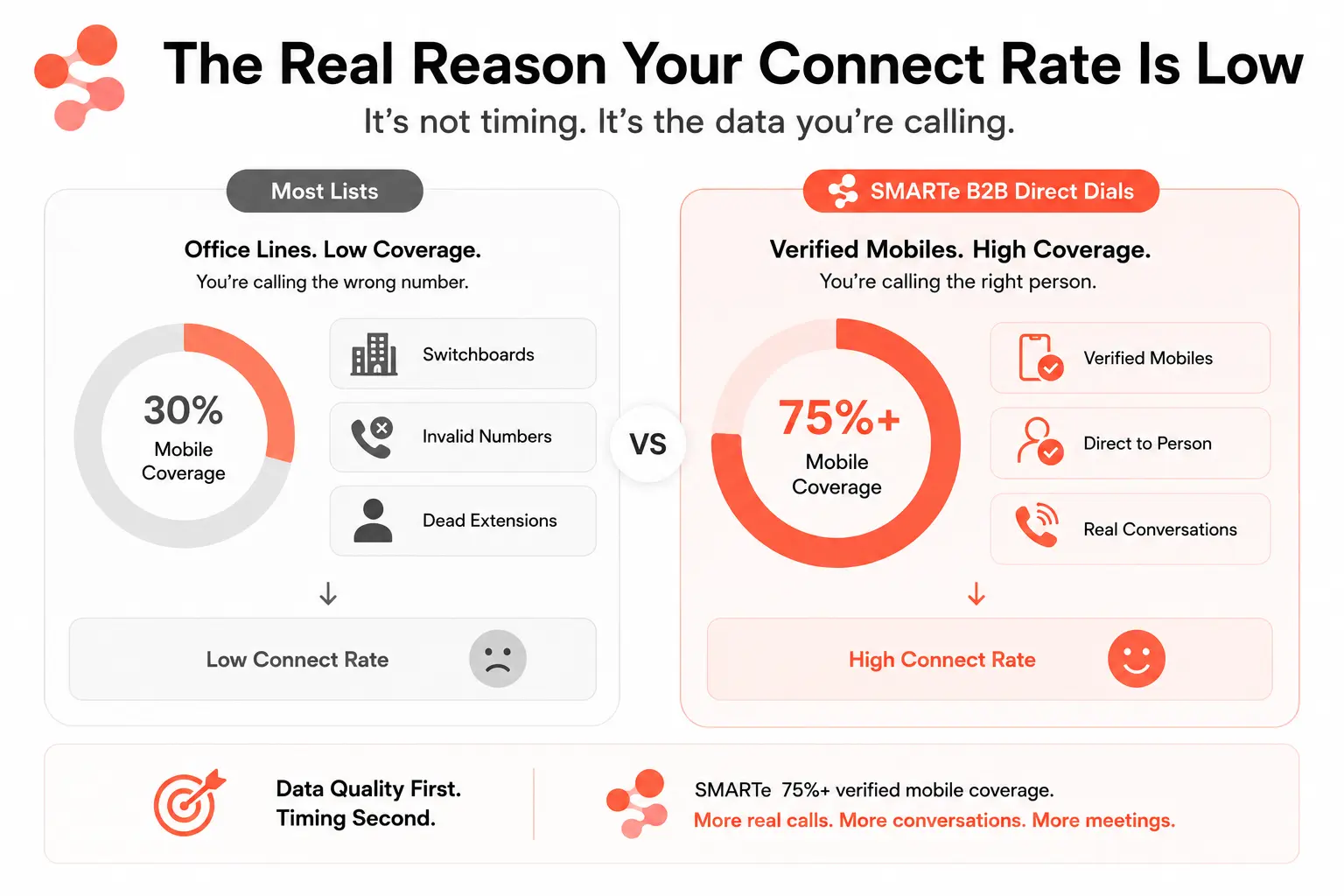
Adjusting your call windows is the last lever you should pull, not the first.
Most SDR teams debug their connect rates by moving their dial blocks around. The real problem is usually what they're calling. Specifically, whether they have verified mobile numbers or office lines that rarely connect to anyone anymore.
Run the math on your own list. If your US contact data carries 30% mobile coverage, you're calling switchboards or invalid lines for 70% of your dials. No timing adjustment fixes that foundation. And most data providers sit at exactly that kind of coverage or lower.
SMARTe covers 75%+ of US contacts with verified direct dials. That changes the connect rate equation entirely. You're not timing calls to a main office number that may route through a dead extension. You're timing calls to the number that actually rings the person.
I've seen teams improve their connect rate more by switching to a data source with real mobile coverage than they ever managed by rearranging their dial blocks. Both matter. Data quality is the prerequisite. Timing is the tuning on top of it.
A well-built cold calling database and clean contact records separate teams that consistently book meetings from teams that optimize their call windows endlessly and still wonder why the numbers don't move. The B2B prospecting statistics on average connect rates make this clear enough on their own.
A Practical Cold Calling Timing Framework
For a team running standard outbound, here's what the timing structure should actually look like:
- Primary call block: Wednesday and Thursday, 10 to 11 AM (prospect's local time)
- Secondary call block: Wednesday and Thursday, 4 to 5:30 PM (prospect's local time)
- VP and C-suite accounts: Tuesday and Wednesday, 7:30 to 8:45 AM as a dedicated early block
- Intent-triggered calls: Immediately on signal, regardless of day or time
- Geographic segmentation: Separate dial lists by time zone; East Coast first, West Coast in your afternoon, international in a dedicated block aligned to their local afternoon
- Call cadence: Six to eight attempts per prospect over three to four weeks, spaced two to three days apart, mixed with email and LinkedIn between call days
Before any of this matters: confirm your contact data includes direct dials. The cold calling scripts can be sharp, the cold calling opening line can be well-crafted, but none of that lands if the number routes to a switchboard that no longer connects to the person you built the list around. Review the most common sales call mistakes and you'll find bad contact data near the top of almost every list.
The teams consistently booking meetings from cold outbound aren't the ones who found the perfect calling hour. They're combining reasonable timing with verified contact data, enough attempts to let the probability math work, and sequences where every touchpoint builds on the last.
Good timing on a wrong number is still a wasted dial. Good timing on a verified direct dial, to the right person, at a point in the quarter when they're open to a conversation, is a different equation entirely. That's where the real connect rate math lives.
Try SMARTe free and see what 75%+ US direct dial coverage does to your outbound numbers. No credit card required.