TL;DR:
Revenue Operations (RevOps) helps B2B companies align sales, marketing, and customer success through shared systems, processes, and data. It removes operational friction, improves forecasting, and creates more predictable revenue growth.
- RevOps aligns sales, marketing, and CS around shared revenue goals.
- It reduces revenue loss caused by siloed teams and disconnected data.
- CRM and data governance are core responsibilities of RevOps teams.
- RevOps manages GTM workflows, handoffs, and process standardization.
- Clean CRM data improves forecasting, reporting, and pipeline accuracy.
- RevOps oversees the revenue tech stack and system integrations.
- Sales Ops and Marketing Ops often operate under RevOps leadership.
- Key RevOps metrics include pipeline velocity, win rate, churn, and CRM data health.
- Successful RevOps functions rely on shared definitions and operating rhythms.
- AI-driven GTM strategies only work when the underlying data is accurate and verified.
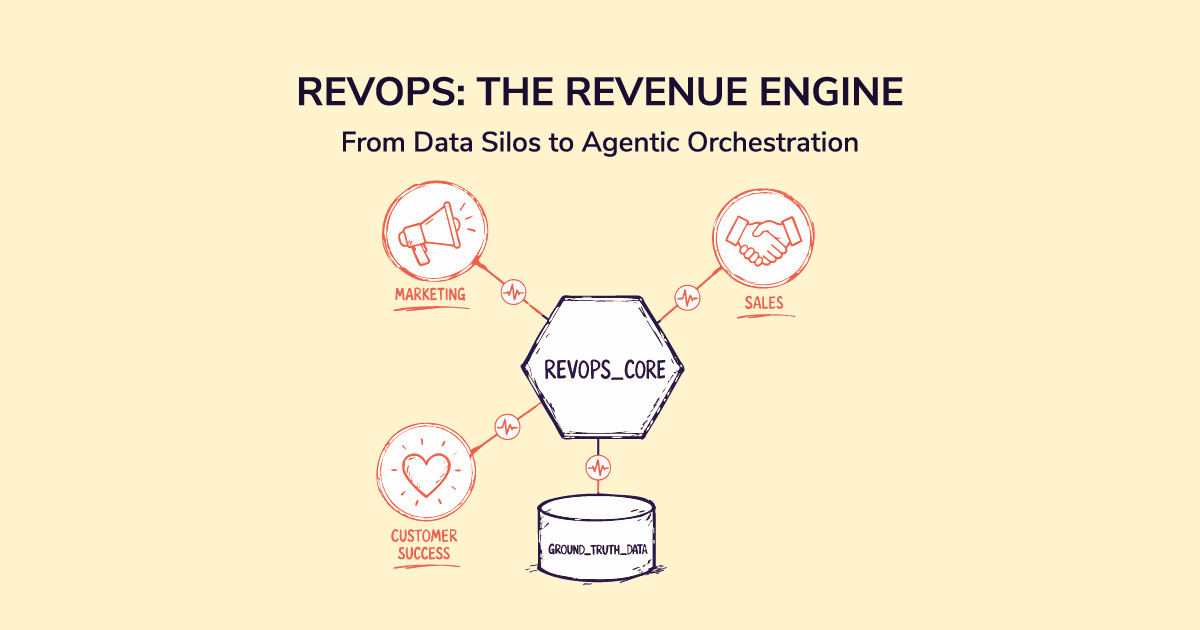
Revenue operations (RevOps) is the business function that aligns sales, marketing, and customer success around shared data, shared processes, and one set of revenue metrics. It removes the friction between these three teams so that revenue growth becomes measurable, repeatable, and predictable.
Most B2B companies lose 10 to 15% of annual revenue to misalignment between these teams. Not to bad strategy. To friction. Leads marketing qualifies that sales ignores. Deals that close with CS finding out too late. Forecasts built from data three different teams dispute every quarter.
RevOps fixes this structurally, not culturally.
What Revenue Operations Actually Means
Marketing handles demand generation. Sales converts pipeline. Customer success retains and expands accounts. For years, each function ran as a separate unit with separate tools, separate targets, and separate versions of the truth.
RevOps is the function that sits across all three. It owns the data, the systems, and the workflows that connect them.
When it works, a lead that marketing qualifies moves cleanly to sales with full context. A deal that closes triggers an immediate, informed CS handoff. A renewal at risk surfaces to the account team before the customer has already decided to leave. That's not magic. It's process design, data governance, and shared accountability working together.
It is not a rebranded Sales Ops team. It is not marketing ops with a broader remit. RevOps is a distinct function that owns the system all three teams operate inside.

SMARTe GTM Intelligence
Start Smarter Prospecting Today
Why B2B Companies Keep Building RevOps Functions
The Real Cost of Siloed Teams
For years, the silo problem was treated as a culture problem. Leadership ran company days, created cross-functional Slack channels, and set up joint planning sessions. Nothing changed, because the problem was never culture. It was architecture.
Marketing measured MQLs. Sales measured closed deals. Customer success measured churn. Each team hit its own number and the business still missed revenue targets. The reason: every handoff between teams was ad hoc, every data source was different, and every QBR became a debate about whose numbers were right.
Lusha's research on B2B GTM alignment puts the cost of that misalignment at up to 10% of annual revenue. For a $30 million company, that's $3 million a year disappearing between teams. That's the number that convinced most finance leaders RevOps was worth building.
What Actually Changes With Alignment
Alignment built on shared data and shared process works differently from alignment built on meetings. When every team pulls from the same B2B sales process, the same contact records, and the same pipeline metrics, the arguments stop. Not because people suddenly get along better. Because there's nothing to argue about.
Salesforce's State of Sales research consistently shows high-performing sales organisations are significantly more likely to have strong cross-functional alignment than average performers. RevOps is how that alignment gets built and maintained.
What a RevOps Team Does Every Day
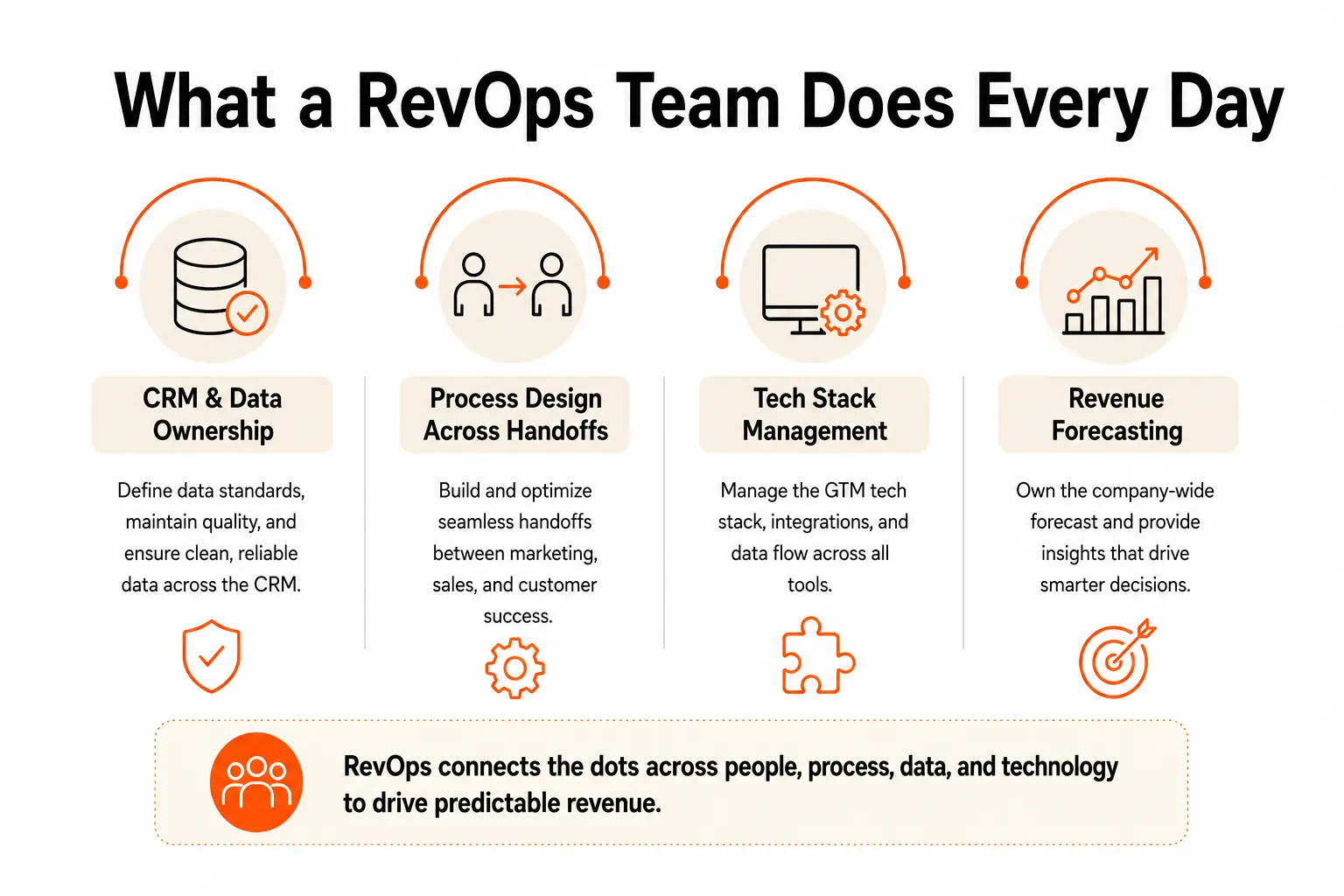
Most RevOps articles describe the function at a high level and stop there. Here is what it actually looks like in practice.
CRM and Data Ownership
RevOps owns the CRM operationally. Not technically (that usually sits with IT), but in terms of standards. They define what fields exist, what counts as a qualified lead, what each deal stage means, and what data every rep logs at each step.
This matters more than most people realise. Bad CRM data is one of the most common and most invisible reasons GTM performance breaks down. Reps call the wrong contacts. Forecasts model stale opportunities. Marketing scores accounts based on data nobody has updated in six months. RevOps builds the standards that prevent this and the processes that maintain it.
Part of that is actively managing data decay. B2B contact data decays at roughly 22.5% per year. Without a live process for catching it, roughly one in five records in your CRM is wrong right now. RevOps owns the fix.
Process Design Across Handoffs
Leads moving from marketing to sales. Deals moving from sales to customer success. Renewal signals moving back to account teams. Every one of these is a handoff. Every handoff is a place where revenue can leak.
RevOps designs the exact steps in each handoff: what triggers it, what data moves with it, who takes ownership, and what the response-time SLA is. Then it monitors whether those steps are actually followed and fixes them when they break.
Without this, every handoff is ad hoc. And ad hoc handoffs fail at the worst possible moments.
Tech Stack Management
The average B2B revenue team in 2026 runs 16 to 20 tools. CRM. Sales engagement platform. Marketing automation. Intent data. Revenue intelligence. BI and reporting. Most of these don't connect cleanly without someone maintaining the integrations. That someone is RevOps.
RevOps owns the GTM tech stack, decides which tools get bought and which get cut, and makes sure data flows correctly between all of them. When a new tool gets added, RevOps owns the integration. When a tool stops working, RevOps owns the fix.
Revenue Forecasting
RevOps owns the company-wide forecast that finance and leadership rely on. Not each manager's individual pipeline review, but the single number the board asks about. That means pulling from CRM, sales engagement, marketing attribution, and CS platforms into one coherent view of pipeline health, deal velocity, and expansion potential.
When the forecast is wrong, RevOps diagnoses where the breakdown happened. Was it an accuracy problem in the pipeline data? A sudden drop in win rate? Deals slowing down at a particular stage? Each cause requires a different fix, and good sales forecasting software fed by clean underlying data is what makes that diagnosis possible in real time.
GTM Rollout and Coordination
New ICP. New pricing. New product launch. New sales play. Every one of these changes requires updates to the tools, sequences, playbooks, and CRM workflows every rep uses daily. Without RevOps owning that rollout, the change takes three months to reach the full team and half of it gets implemented incorrectly.
With RevOps running the rollout, the same change can be live, documented, and reflected in the CRM within a week.
RevOps vs Sales Ops vs Marketing Ops: How They're Different
This causes confusion in almost every organisation that starts building a RevOps function.
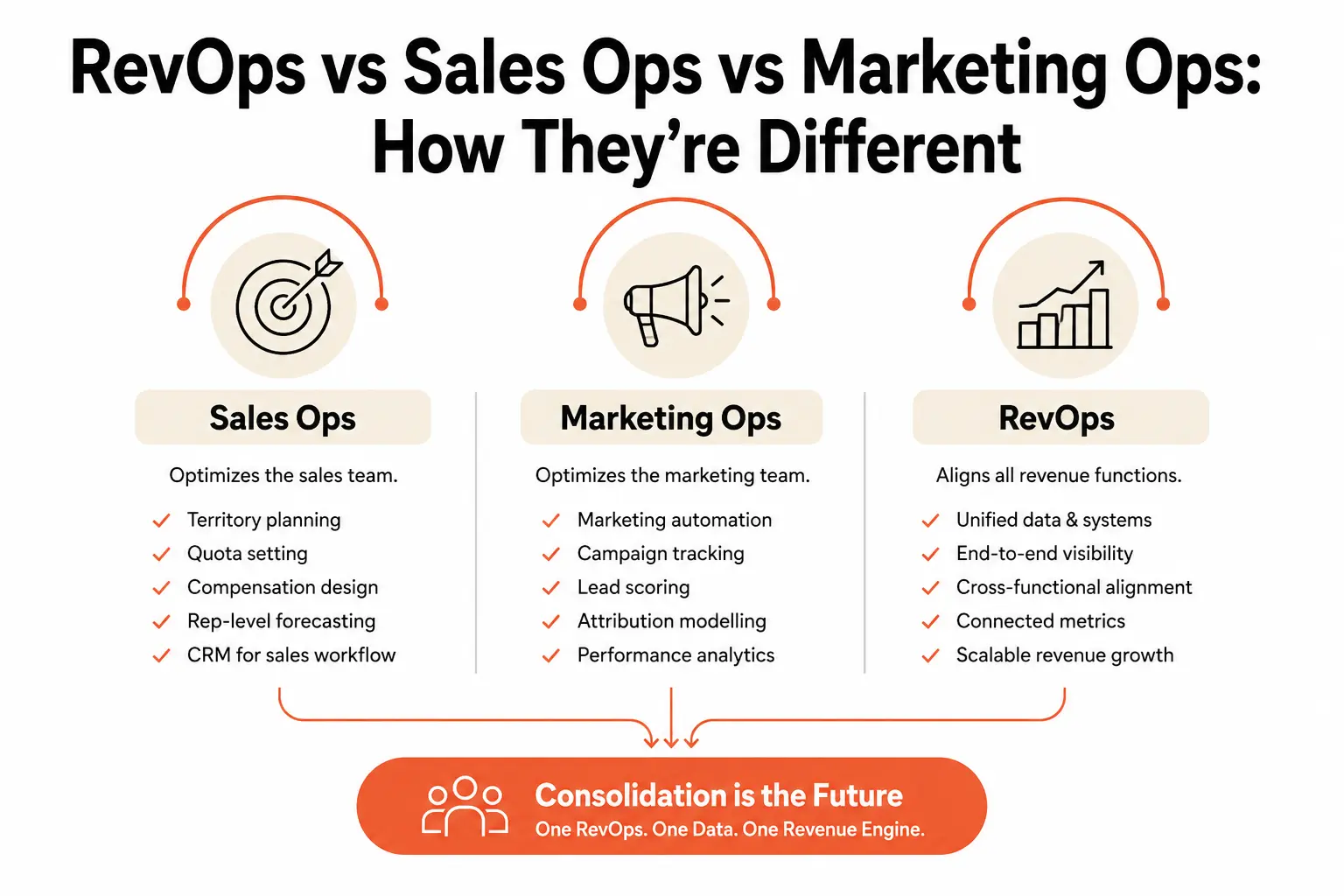
Sales Operations focuses on the sales team specifically. Territory planning, quota setting, compensation design, rep-level forecasting, CRM configuration for the sales workflow. It doesn't own marketing attribution or CS renewal playbooks.
Marketing Operations focuses on the marketing team. Marketing automation, campaign tracking, lead scoring, attribution modelling. It doesn't own the sales pipeline or the customer success health framework.
Revenue Operations sits above both. In smaller companies, one person or team covers all three. In larger organisations, sales ops and marketing ops operate as sub-functions inside RevOps, reporting into a Head of RevOps or CRO.
The direction in 2026 is consolidation. More companies are folding all three under a single RevOps leader. The data is shared. The metrics are interconnected. Keeping them separate creates exactly the kind of friction RevOps was supposed to remove.
The Four Things Every RevOps Function Needs to Work
1. Data Governance
Data is the foundation. RevOps owns the definitions that every downstream process depends on. What is a marketing qualified lead? What converts it to a sales accepted lead? What constitutes a closed-won deal? How is churn calculated?
These sound like administrative details. They're not. Every forecast, every attribution report, every AI-generated account priority score runs on these definitions. When the definitions are inconsistent across teams, every report downstream is unreliable.
AI-ready B2B data is the 2026 version of this problem specifically. AI tools operating on bad contact data produce confident wrong outputs at scale. RevOps has to get the data foundation right before the AI layer on top of it can deliver anything worth trusting.
2. Process Design
Process is how work moves through the revenue lifecycle. RevOps maps every stage from initial demand generation through to renewal and expansion, identifies where handoffs happen, documents who owns each step, and monitors whether the process is being followed.
Without documented process, every handoff is a guess. Guesses at handoffs are where pipeline leaks.
3. Technology
RevOps evaluates, selects, integrates, and maintains the revenue tech stack. CRM data enrichment, sales intelligence, engagement platforms, and forecasting tools all need to connect and refresh data in real time. RevOps is the function that makes sure they do and that the connections don't silently break.
4. Alignment Architecture
Alignment is a structure problem, not a relationship problem. RevOps designs the operating rhythm that keeps teams coordinated. Weekly revenue reviews. Monthly pipeline deep-dives. Quarterly GTM planning sessions. Shared dashboards. Clear escalation paths when handoffs break. This creates coordination that runs on infrastructure rather than on goodwill.
What RevOps Looks Like at Different Company Sizes
Under 50 People
At this stage, RevOps is usually one person. Often someone from a sales ops background who picks up CRM ownership, tech stack management, and basic reporting. The title varies. The scope doesn't.
Two priorities dominate: getting the CRM set up correctly before bad habits calcify, and defining what a qualified lead actually means before marketing generates thousands of the wrong ones.
50 to 500 People
This is where a dedicated RevOps function pays off clearly. Two to four people covering data governance, tech stack, forecasting, and GTM coordination. A Director or Head of RevOps owns the function and reports to the CRO or VP of Sales.
Almost every company at this stage carries significant CRM debt from the startup phase. Fixing it is rarely glamorous. But a clean data foundation built at this stage saves hundreds of hours of debate in every QBR for the next three years.
Over 500 People
At scale, RevOps becomes a full department. Sales ops, marketing ops, and CS ops all sit under the RevOps umbrella. The team includes specialists: a RevOps analyst, a CRM admin, a data engineer, a revenue enablement manager, and in 2026, an AI operations specialist who owns the agentic tools running on top of the data stack.
The RevOps Metrics That Actually Drive Decisions
I've looked at a lot of RevOps dashboards. The ones that actually change behaviour tend to track the same things.
- Pipeline velocity tells you how fast deals move through the pipeline, combining deal count, deal size, win rate, and cycle length into one number. When it drops, RevOps breaks it down to find the actual cause. Fewer deals entering the pipeline needs a different response than a drop in win rate or a lengthening sales cycle.
- Win rate tells you what percentage of opportunities close. When it falls, the question is whether it's an ICP problem, a data problem, or a handoff problem. Each of those has a different fix. Confusing them wastes months.
- CRM data health is the metric most teams skip and later regret. What percentage of active contacts have valid emails? How many direct dials are current? How complete are account records for the top 100 opportunities? Every point of improvement here improves every other metric downstream.
- Pipeline generation rate, customer acquisition cost, churn rate, and net revenue retention round out the picture. The critical thing isn't which metrics you track. It's that every team tracks the same ones from the same source. The moment each team runs its own version of these numbers, the QBR becomes a dispute about data instead of a conversation about what to fix.
How to Build a RevOps Function When You're Starting From Zero
Step 1: Run the Audit Before You Build Anything
Before adding headcount or tools, map what you already have. Which tools does each revenue team use? Which data does anyone actually trust? Which metrics get disputed in every planning meeting?
In my experience, every audit surfaces the same two problems: the CRM is a bigger mess than anyone has admitted out loud, and nobody agrees on what a qualified lead actually looks like. Those are the two places to start.
Step 2: Get the Definitions Agreed and Locked
Before you can align teams on metrics, align them on definitions. What is a marketing qualified lead? What makes it a sales accepted lead? What is closed-won versus closed-lost? What counts as churn?
Write every definition down. Get every team to agree. Lock them in the CRM as non-negotiable field standards.
This is tedious work. It's also the most valuable RevOps work there is, because every forecast, every revenue attribution model, and every AI output depends on these definitions staying stable.
Step 3: Fix the Contact Data Before Building on Top of It
Revenue data lives across multiple systems. CRM, sales engagement platform, marketing automation, product, and finance. RevOps needs to connect these into a single view.
But before building that architecture, there's a more urgent problem sitting underneath it: the contact records in your CRM need to be accurate. Run CRM data enrichment against your active accounts. Remove duplicates. Update stale records.
What to do: Pull a sample of 200 contacts from your active pipeline. Check job title accuracy, email deliverability, and mobile connectivity. An error rate above 15% means your entire RevOps infrastructure is working with compromised inputs from day one.
Step 4: Build the Operating Rhythm
Set a weekly revenue review. A monthly pipeline deep-dive. A quarterly GTM planning session. Each one uses the same shared dashboard. Each one produces owners for every action item.
The rhythm is what turns RevOps from a one-time restructure into a living function.
Step 5: Add AI Last, Not First
AI in sales has matured fast. AI sales agents that prioritise accounts, surface churn risk, and personalise outreach at scale are real and they work. But every single one of them depends on accurate contact data to reason correctly.
Data foundation first. AI layer second. Flip that order and you get sophisticated AI producing polished outputs nobody trusts because the inputs are wrong. (This happens far more often than the vendors selling AI tools want to acknowledge.)
Why Clean Data Is the Part Nobody Talks About
Here's what most RevOps guides skip entirely.
All four pillars run on contact records. When a deal enters the pipeline, RevOps needs to know who the actual decision-makers are and whether they're reachable. When an account shows early churn signals, RevOps needs to know whether the original champion is still at the company or moved on six months ago.
If the underlying data is wrong, every system built on top of it produces wrong outputs. Forecasts model stale opportunities. Buying signals fire on contacts who left before the signal even triggered. Ideal customer profile scoring runs against incorrect job titles. AI agents send personalised outreach to roles that no longer exist at the account.
RevOps built on clean, current data operates precisely. The same function built on decayed data is doing sophisticated things with incorrect inputs. The outputs look polished. They're just wrong.
SMARTe's 283M+ verified contacts run through real-time verification, not a quarterly batch snapshot. When an account enters your pipeline, the contact data feeding your CRM, your sequences, and your AI agents reflects who is actually there right now. That's the 90%+ CRM match rate and 60%+ reduction in RevOps manual work in practice.
RevOps Is a System, Not a Title
Renaming your Sales Ops manager "Head of RevOps" without changing the data infrastructure, the ownership model, or the process architecture doesn't create a RevOps function. It creates a person with a new title and the same broken system underneath.
Building RevOps properly takes six to twelve months. It requires fixing the CRM before adding more tools, agreeing on definitions before aligning on metrics, and designing handoffs before expecting teams to execute them cleanly. That work pays back faster than most companies expect once the compounding starts.
Your go-to-market strategy runs on infrastructure. Build the infrastructure first. Everything else gets easier.
Try SMARTe free and see what RevOps looks like when the data underneath it is actually verified.