TL;DR:
The RevOps flywheel is a circular growth model where sales, marketing, and customer success form a connected loop, each stage feeding momentum into the next rather than starting over every quarter.
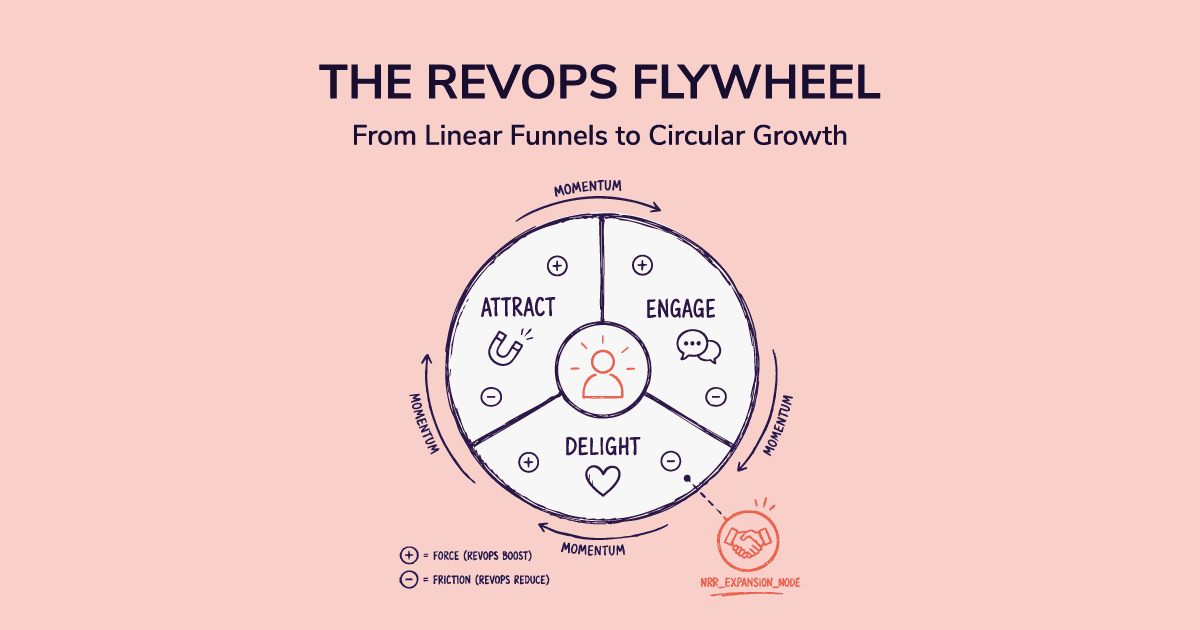
- The flywheel has three stages: Attract, Engage, and Delight, each feeding back into the others
- Two variables determine everything: force (what speeds the flywheel) and friction (what slows it)
- Not all friction is bad. The goal is removing friction that does not serve the customer, not eliminating all of it
- Data quality is the most powerful force driver because bad data creates friction at all three stages simultaneously
- RevOps sits at the center of the flywheel, owning four pillars: people, process, data, and technology
- Building one takes five steps: audit friction points, align on ICP, define handoff SLAs, pick a north star metric, build the feedback loop
- NRR above 100% means your existing customers are growing your revenue without a single new logo
The RevOps flywheel is what happens when sales, marketing, and customer success stop running alongside each other and start running in a loop.
Most B2B companies still operate like funnels. Leads come in at the top, move through qualification and selling, and exit as customers at the bottom. Every quarter starts from scratch. The insights from the previous quarter, the win patterns, the churn signals, rarely make it into how the next one gets planned.
The flywheel stores that energy instead of losing it. A customer who gets a great experience becomes a referral. That referral enters the Attract stage already sold. They close faster, onboard better, and expand sooner. Each stage feeds the next and the whole system compounds over time.
It only works when the operational layer underneath it is built to support it. Most aren't.
What the RevOps Flywheel Actually Is
HubSpot introduced the flywheel model in 2018, drawing on physics to make a simple point: funnels waste energy, flywheels store it. A flywheel stores rotational energy and the more force applied with the less friction it encounters, the faster it spins and the harder it becomes to stop. That same principle holds in a revenue system.
Understanding the flywheel model also requires understanding what revenue operations actually owns versus what it influences, because that shapes how the whole thing gets built.

SMARTe GTM Intelligence
Start Smarter Prospecting Today
Flywheel vs. Funnel: The Fundamental Difference
The core distinction is where the customer ends up.
In a funnel, the customer exits at the bottom. The deal closes and the cycle resets. In a flywheel, the customer never exits. They become part of the engine. Their renewal adds to the retention number. Their referral feeds the pipeline. Their expansion revenue funds the next sales hire. The energy from closing one deal flows directly into generating the next.
Most practitioners describe the funnel-to-flywheel shift as a mindset change. And it is. But it is more of a systems change than a mindset one. The thinking is easy. Building the operational infrastructure to make it work is the hard part.
The Three Stages of the RevOps Flywheel
The flywheel runs on three stages. Each one has a specific job, a specific owner, and a specific set of friction points that RevOps is responsible for clearing. Understanding where each stage starts and ends is where practical implementation begins.
Attract
The Attract stage is where marketing works to bring the right accounts into the system.
Demand generation programs, content, and paid channels sit squarely here. Outbound prospecting sits at the boundary between Attract and Engage. SDRs and BDRs create initial awareness but also qualify and book meetings, and which stage owns that motion depends on how your team is structured.
What keeps Attract healthy is targeting precision. Sloppy ICP targeting here creates friction everywhere downstream. Sales wastes time on accounts that were never a fit. CS inherits accounts that churn inside six months. Layering intent data on top of your targeting, so you can identify which accounts are in an active buying window right now, is what separates high-quality Attract motion from volume for its own sake.
Engage
The Engage stage is where sales takes a qualified prospect and moves them toward a decision.
The biggest friction source here isn't messaging. It's data. Sales reps chasing contacts who've changed roles. Sequences hitting bouncing email addresses. Mobile numbers that go to voicemail because nobody verified them before the sequence launched. These aren't sales problems. They're data problems that show up as sales problems.
The handoff from marketing to sales is also where flywheels lose the most momentum. When a lead arrives in the CRM without the context a rep needs to act on it (and this happens more often than most marketing teams realize), the Engage stage stalls before it starts.
Delight
The Delight stage is where customer success takes over after the deal closes.
In a funnel, this stage doesn't connect back to anything. In a flywheel, it connects back to everything. A customer who gets genuine value becomes a reference. They appear in case studies that help close deals in the Engage stage. They refer colleagues who enter Attract as warm leads. They expand their contract, feeding NRR and Delight metrics directly. Each of those outcomes adds force to a different stage of the flywheel, which is what makes the model compound rather than reset.
The Delight stage is where most flywheels quietly fail. Not because customer success teams do poor work. Because the handoff from sales leaves the CS team without the context they need to deliver a strong onboarding experience.
Force and Friction: The Two Variables That Decide Everything
The flywheel model runs on one operating principle: speed is determined by how much force you apply and how much friction you allow. Get the balance right and the system builds momentum on its own. Get it wrong and you have three teams working hard while the revenue number stays flat.
Force is anything that speeds the flywheel:
- A well-defined ICP that marketing, sales, and CS all use
- Automated lead routing that gets the right lead to the right rep quickly
- A customer referral program with actual tracking behind it
- Buying signals that surface accounts actively researching your category right now
- Clean, verified contact data feeding every stage consistently
Friction is anything that slows it:
- Siloed teams using different definitions of a qualified lead
- Handoffs that take days because no SLA says otherwise
- Sequences hitting bad email addresses nobody cleaned
- A CRM full of stale contacts from a list nobody updated
- Misaligned metrics where marketing celebrates MQLs that sales won't touch
One thing worth saying clearly: not all friction is bad. Strict lead qualification criteria slow volume but improve quality. A thorough security review in an enterprise deal slows the cycle but protects the close. The goal isn't zero friction. It's removing friction that doesn't serve the customer or the revenue outcome, while keeping friction that does.
"Flywheels deliver outsized impact," says Anil Somaney, SVP of Revenue Operations at Island. "Put in a dollar and you get $7 back." That multiplier requires applying force and removing bad friction deliberately, and doing both continuously rather than once per quarter.
Why Data Quality Is the Most Powerful Force Driver
Most RevOps teams treat data quality as a maintenance task. They run a CRM cleanup, import a fresh list, move on. Six months later the problem is back.
I'd argue data quality is the primary force driver in a RevOps flywheel. The reason is straightforward: bad data creates friction at every stage simultaneously.
- At Attract, stale contact data means sequences hit the wrong people at the wrong companies
- At Engage, bad CRM data means reps waste time on wrong numbers and dead email addresses
- At Delight, inaccurate account records mean CS teams can't segment, prioritize, or spot expansion opportunities accurately
One bad data layer creates friction at all three stages at once. One clean, continuously verified data layer adds force at all three at once.
Running CRM data enrichment as a continuous workflow rather than a periodic project is what keeps that foundation current. SMARTe does this at scale: 283M+ verified contacts globally and 90%+ CRM match rates, with real-time verification rather than batch processing. The data feeding the flywheel stays current at the point of use, not current as of last quarter's cleanup run.
RevOps as the Engine at the Center
The flywheel has three stages at its outer edge: Attract, Engage, Delight. RevOps doesn't live at any one of them.
It lives at the center. It's the operational layer that keeps all three stages connected, aligned, and moving in the same direction. Without it, each team runs its own version of the flywheel, uses its own data, measures its own metrics, and creates friction for every team that follows.
The Four Pillars RevOps Owns Inside the Flywheel
RevOps owns four things that determine whether the flywheel spins cleanly or grinds through every stage transition.
- People: Making sure the right roles exist, the right skills are in place, and everyone understands how their work affects the stages they don't directly own. A CS team with clearly defined revenue operations roles understands how their expansion metrics feed back into ICP refinement. One that just manages renewals doesn't.
- Process: Defining handoffs, SLAs, escalation paths, and the workflows that move prospects and customers through each stage. Every gap between process steps is a place where the flywheel loses speed.
- Data: Keeping the CRM clean, contact records verified, and the reporting layer accurate enough that every team makes decisions from the same source. The RevOps tech stack your team owns determines how well this actually holds together in practice.
- Technology: The integrations that connect each stage and ensure data flows between them without manual work. A marketing automation platform that doesn't sync cleanly with the CRM creates a gap every time a lead crosses from Attract into Engage.
How Handoff SLAs Connect the Stages
If the four pillars are what RevOps owns, handoff SLAs are how RevOps connects them across stage boundaries.
A handoff SLA is a written agreement between two stages: how quickly a lead or customer crosses the boundary and what information transfers with it. Marketing commits to passing a lead within a defined timeframe when it hits a qualifying score. Sales commits to passing an account to CS within a set period after close, with a defined set of context attached.
Without these SLAs, handoffs happen whenever someone gets around to it, with whatever information they feel like including. That's not a process. It's a gap wearing a process's clothes.
In my experience, most flywheel failures trace back to missing or unenforced handoff SLAs rather than to the quality of work done within each stage. Fix the handoffs first. A lot of the other friction resolves itself.
How to Build a RevOps Flywheel: Five Practical Steps
Most articles about the RevOps flywheel spend their time explaining what it is. The harder and more useful question is how to build one, and what order to do it in.
The sequence below works whether you're starting from scratch or cleaning up a flywheel that's already running badly.
Step 1: Audit Your Current Friction Points
Before adding anything new, map where the flywheel is currently grinding.
Three questions that surface the biggest friction sources quickly:
- Where do leads slow down or disappear between marketing and sales?
- Where do customers churn earliest, and what do those accounts have in common?
- Where do teams disagree on what a metric actually means?
The answers tell you where to apply force first. Don't skip this step to get to the interesting parts. The audit is the interesting part.
Step 2: Align on a Shared ICP
Nothing else moves cleanly until marketing, sales, and CS are working from the same ICP document.
Firmographics, technographics, buying triggers, and disqualifying signals. One page. One version. Owned by RevOps. If the three teams currently target different company profiles, the flywheel can't spin cleanly. Marketing fills the pipeline with accounts sales doesn't want. Sales closes accounts CS can't retain. The friction starts before the first handoff even happens.
Step 3: Define Handoff SLAs Between Every Stage
Write down the SLA for every stage boundary and measure it weekly.
- Marketing to sales: what qualifies a lead, what information must transfer with it, how quickly sales must follow up
- Sales to CS: what information transfers at close, what the onboarding kickoff timeline looks like, who owns the first 30 days
Every violation is a place where momentum leaks. If you're not measuring violations, you don't have an SLA. You have a suggestion.
Step 4: Pick One North Star Metric
The flywheel needs a single metric that all three functions run against together.
Net revenue retention works well for most SaaS companies. It measures expansion, contraction, and churn from your existing customer base in one number. When it sits above 100%, your existing customers grow your revenue on their own. When every team tracks it, the incentive to help the next stage increases significantly.
Gartner predicts that 75% of the highest-growth companies will operate on a RevOps model by 2026. The ones doing it well almost always share one metric across all three functions rather than running three separate scorecards. The breakdown of which RevOps metrics to track at each stage is worth going through once you've agreed on the north star.
Step 5: Build the Feedback Loop
The flywheel improves over time because each stage passes data back to the one before it. Without this loop, every stage learns only by trial and error within its own walls.
- CS tells marketing which ICP attributes correlate with long-term retention
- Sales tells marketing which lead sources produce deals that actually close
- Marketing shares which content was consumed before the best opportunities converted
The tools that support this data flow between stages determine whether the loop runs automatically or relies on someone remembering to pull a report. And the way the full GTM infrastructure sits together underneath the flywheel determines how clean that data flow actually is.
The Metrics That Tell You If Your Flywheel Is Spinning
Metrics in a flywheel model work differently from funnel metrics. They're connected across stages. A problem in one stage almost always surfaces as a metric problem in the next one, which is why you need to track all three layers together.
Attract Stage Metrics
These tell you whether the top of the flywheel is pulling in the right accounts or just generating volume.
- Qualified pipeline generated, not total lead volume
- Cost per pipeline dollar
- Marketing-sourced revenue as a percentage of total new business
- ICP match rate on inbound leads
If MQLs are up but qualified pipeline is flat, the Attract stage is producing noise rather than force.
Engage Stage Metrics
These tell you how efficiently sales is converting the accounts marketing sent over.
- Lead-to-opportunity conversion rate
- Sales cycle length
- Win rate by ICP segment
- Time to first meeting from lead handoff
A long time-to-first-meeting after a lead crosses from marketing to sales is almost always a handoff SLA problem, not a sales execution problem. Fix the SLA before changing the sales process.
Delight Stage Metrics
These tell you whether the customers you closed are becoming a source of momentum or a drag on it.
- Net revenue retention
- Churn rate
- Expansion revenue as a percentage of total ARR
- Customer health scores
NRR above 100% means the expansion and upsell revenue from your existing customer base exceeds what you lost to churn and contraction. Your existing customers are growing your revenue without a single new logo.
That is a flywheel spinning at full speed.
Three Things That Kill Flywheel Momentum
Understanding what breaks the flywheel is as useful as knowing how to build it. These three problems show up across almost every team that struggles to sustain momentum after the initial build.
Inconsistent Data Feeding Different Teams
Marketing pulls from one database. Sales pulls from another. CS works from whatever's in the CRM, which may not match either of the first two.
When teams run on different data sources, they can't agree on what's happening or why. Every cross-functional meeting becomes an argument about whose numbers are right rather than a conversation about what to do next. A single source of truth in the CRM, fed by continuously verified contact data, is what makes those conversations productive instead of territorial.
Handoff Points Without SLAs
I've watched this issue slow more flywheels than anything else. A well-qualified lead sits in a queue for three days because no SLA requires it to be touched. A closed deal reaches CS with no context because no standard requires it to transfer.
Friction compounds quietly. One slow handoff delays onboarding. Delayed onboarding reduces the chance of a strong first renewal. Lower renewals slow expansion. The cause and the effect are separated by months, which is why most teams never connect them.
Measuring Teams on Metrics That Only Cover Their Own Stage
Marketing measured only on MQL volume. Sales measured only on new ARR. CS measured only on churn rate. This produces three teams hitting their own numbers while the flywheel slows down.
Marketing lowers qualification standards to hit MQL targets. Sales overpromises to close ARR. CS reclassifies at-risk accounts to protect the churn metric. Each team wins its number. The flywheel loses.
Shared metrics that cross stage boundaries align the incentives. NRR requires all three functions to contribute. CS-sourced pipeline, which includes expansion ARR from existing accounts and referrals from satisfied customers, requires CS to act as an active growth contributor rather than a retention function. These aren't easy to implement. But they're the difference between a flywheel and three separate funnels with the same logo on the wall.
Revenue That Compounds
The flywheel doesn't fail because teams aren't working hard. It fails because the operational layer underneath it hasn't been built to keep them working in the same direction.
Bad data creates friction everywhere at once. Handoffs without SLAs bleed momentum at every stage boundary. Metrics that only cover one function create incentives to win your own stage at the expense of the next one.
Revenue that compounds rather than resets every quarter isn't the product of better people. It's the product of a better system. One where the data is clean, the handoffs are defined, and the metrics pull all three functions toward the same outcome.
Build the operational layer first. The flywheel follows.
Try SMARTe free and see how 283M+ verified contacts and real-time enrichment reduce friction across every stage of your RevOps flywheel. No credit card required.