TL;DR:
A RevOps tech stack is the set of tools and integrations a revenue operations team owns, configures, and is responsible for keeping clean. It is not every tool the GTM team uses. It is the specific layer of platforms that connect data, process, and reporting across sales, marketing, and customer success.
- A RevOps tech stack has six layers: CRM, data foundation, sales engagement platform, marketing automation, revenue intelligence, and analytics or BI
- Each layer depends on the one beneath it being accurate
- The data foundation layer matters most and gets built last by most teams
- B2B contact data decays at 25 to 30% annually, batch enrichment does not fix this
- The average company uses only 42% of its GTM software capabilities, audit before buying anything new
- Four audit questions for every tool: who owns it, does it integrate with the CRM, is the data trusted, is it actually used
- Build order by stage: three tools at Seed, add data enrichment and sales engagement at Series A, specialize and consolidate at Series B
- Clean data underneath the stack is what makes every other tool perform
Your RevOps team just got budget for a new BI tool. Before that, it was a sales engagement platform upgrade. Before that, a new set of CRM modules. The forecast still doesn't match reality. The pipeline is still murky. And the SDRs are still hitting email bounce rates that nobody can explain.
The tool isn't the problem.
Most RevOps teams spend years adding layers to a broken data foundation. Bad contact data goes into the CRM. The engagement platform picks it up and runs sequences against it. The BI tool reports on the results. Every layer reports inaccurate information more efficiently than the last.
That's not a tech stack problem. That's a data problem with a very expensive stack sitting on top of it.
Getting the RevOps tech stack right means building it in the right order. Not just picking the right tools.
What a RevOps Tech Stack Is (And What It Is Not)
For the full picture of what revenue operations does, the revenue operations guide covers it in depth. Here is the short version on tooling.
A RevOps tech stack is the collection of platforms and integrations the revenue operations team owns, configures, and is accountable for keeping clean. It is not every tool the GTM team touches. The broader GTM tech stack covers the tools used across all go-to-market functions. RevOps owns a specific slice of it.
What RevOps specifically owns: the CRM, the data foundation layer, reporting and analytics, lead routing logic, and the integrations connecting all of them. The sales engagement platform, marketing automation tool, and customer success platform often get configured by RevOps, but they belong operationally to the teams using them every day.
The distinction matters because it clarifies accountability. If everyone owns the stack, nobody owns it. And a stack with no clear owner turns into disconnected tools, duplicate data, and workflows nobody updated after the last reorg.

SMARTe GTM Intelligence
Start Smarter Prospecting Today
The Six Layers of a RevOps Tech Stack
Not all tools sit at the same level. Some are foundational. Others depend entirely on what is underneath them. I've watched RevOps teams invest $40,000 a year in revenue intelligence software and get almost nothing from it because the CRM it relied on was full of stale contacts and deals nobody had marked as closed-lost.
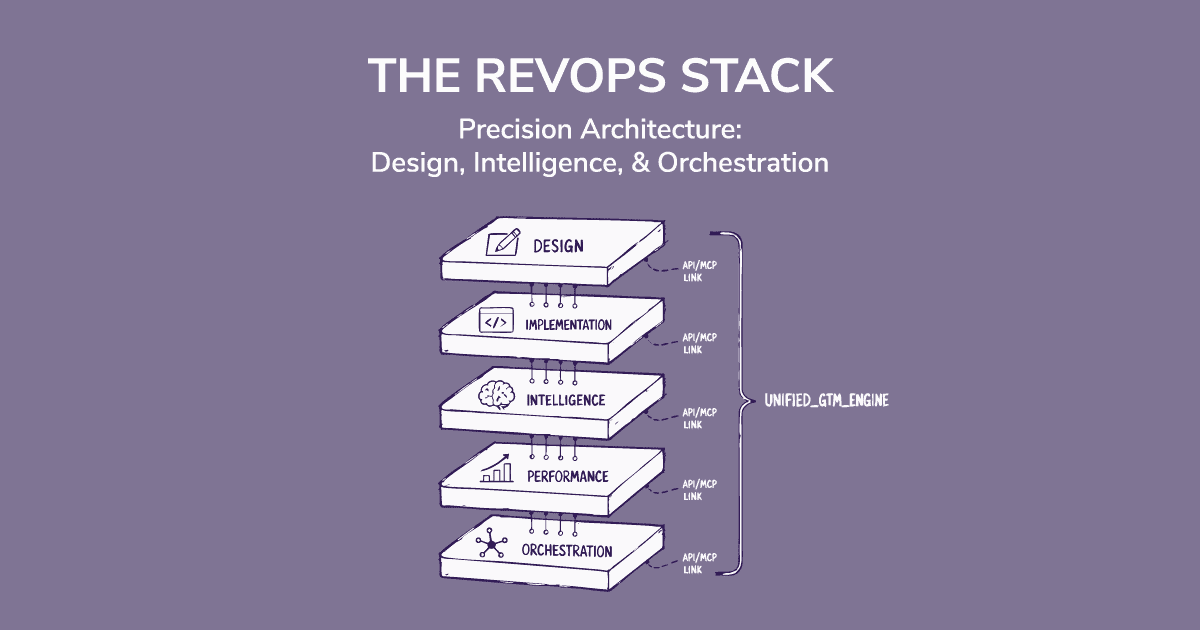
The right way to think about a RevOps tech stack: six layers ordered by dependency. Each layer is only as good as the one beneath it.
Layer 1: The CRM
The CRM is the record system for the entire revenue operation. Every other tool in the stack either feeds data into it, pulls data from it, or reports on what is inside it. Salesforce and HubSpot dominate this category. Which platform you choose matters less than how reliably you maintain it.
A CRM that does not reflect actual pipeline behavior is not a single source of truth. Deal stages that have not been updated, contacts with no activity in eighteen months, and duplicate records nobody has merged are the three most common ways CRMs become unreliable. Every other tool in the stack inherits that problem.
Layer 2: The Data Foundation
This is the layer most RevOps teams build last. It is the one they should build first.
The CRM is only as reliable as the contact and account data going into it. B2B contact data decays at roughly 25 to 30% annually. A list of 10,000 contacts built eighteen months ago has around 3,750 records that are no longer accurate. People have moved jobs. Phone numbers have changed. Email addresses now bounce.
Without a data foundation layer, a platform that continuously verifies and enriches contact records, the entire stack above it runs on bad inputs. B2B data enrichment built into the RevOps workflow (not run as a quarterly cleanup) is what keeps the foundation current. The CRM data enrichment guide covers how this works in practice.
Layer 3: Sales Engagement Platform
This is where SDRs and AEs run outbound sequences, manage cadences, and track response rates. Outreach and Salesloft are the dominant platforms in this category. The contact data feeding into these tools comes directly from the CRM and the data layer beneath it.
If your bounce rates are above 5%, the problem usually is not the engagement platform. It is the bad CRM data feeding into it. Fixing the sequence rarely solves the problem. Fixing the data does.
Layer 4: Marketing Automation
Marketing automation handles lead nurturing, campaign operations, attribution modeling, and the handoff from marketing to sales. The RevOps team owns the integration between the marketing automation platform and the CRM, which is where demand generation data either flows cleanly into the pipeline or gets lost in transit.
Most lead routing failures trace back to a broken MAP-to-CRM sync, not to the tools themselves. When a lead scores high in the marketing platform and lands in the CRM as a duplicate, or without the context a sales rep needs to act on it, the problem is almost always the integration.
Layer 5: Revenue Intelligence and Forecasting
Revenue intelligence tools analyze sales activity, conversation data, and pipeline health to give leaders a more accurate view of what will close and when. Or at least, that is what they do when the CRM feeding them is reliable. When it is not, they tell a very confident story about numbers nobody should trust.
Gong and Clari sit at this layer. They are the most visible, often the most expensive, and the most dependent on the accuracy of everything below them. Buying signals and intent data connect into this layer too. When intent signals feed revenue intelligence, the team prioritizes based on actual buying behavior rather than just rep activity or gut feel.
The sales forecasting software guide covers what to look for when evaluating tools in this category.
Layer 6: Analytics and BI
The analytics layer pulls data from the CRM, engagement platforms, and marketing tools to report on the full revenue funnel. Looker, Tableau, and native CRM reporting all serve this function at different stages of company scale.
If you are buying a BI tool before the layers beneath it are clean, you are investing in reports that display inaccurate numbers more clearly. The RevOps KPIs and metrics guide covers what this layer should be measuring and which metrics matter at each stage.
The Layer Most RevOps Teams Build Last (But Should Build First)
The data foundation layer does not come with a slick demo. It does not show up on most "best RevOps tools" lists with screenshots and star ratings. It does not generate the same internal excitement as a new forecasting platform or a revenue intelligence dashboard.
But it determines whether everything else works.
I've watched RevOps teams spend six figures on Salesforce customization and Gong licenses while their SDRs were hitting 15% email bounce rates. The problem was not the tools. It was the data: contacts who had left their companies, phone numbers years out of date, and job titles nobody had verified since the original import.
Companies using integrated revenue intelligence tools report 69% higher revenue growth compared to companies without them. That number assumes the data feeding into those tools is accurate. When it is not, the benefit largely disappears.
What Real-Time Enrichment Does That Batch Enrichment Does Not
Most companies that run data enrichment do it in batches. They buy a list, run an enrichment job, upload the results to the CRM. Six months later, 15% of those records are stale again. The cycle repeats and the underlying problem never gets solved.
Real-time enrichment verifies contact data at the point of use. When a rep pulls up an account in Salesforce, the mobile number is current. When a campaign launches, the email addresses are verified before sequences go out. The B2B data feeding into the stack does not have a freshness problem because it is never sitting still long enough to go stale.
Where SMARTe Fits in the Data Layer
SMARTe is built for exactly this layer. 289M+ verified contacts globally, 90%+ CRM match rates, and real-time verification rather than batch processing. Revenue operations teams using SMARTe report a 60%+ reduction in manual RevOps work, which frees the team to work on the parts of the job that require human judgment rather than data cleanup.
75%+ US mobile coverage and 50%+ global direct dial coverage are the numbers that matter for outbound-focused teams. Most data platforms cover the US adequately. Global coverage is where the gap becomes visible, and where most teams discover their data layer has been underperforming for a long time.
The sales intelligence tools guide covers what to look for when evaluating options in this category.
How to Audit the RevOps Tech Stack You Already Have
Before buying anything new, audit what you have.
The average company uses only 42% of its GTM software capabilities. That means a typical RevOps team is paying for tools it barely uses while still buying new ones to fill gaps the existing tools already cover. An audit is not glamorous work. But I'd put it in the top three highest-ROI activities most RevOps teams could do right now.
Four Questions to Ask About Every Tool in the Stack
Run each tool through these four questions.
Who owns it? If the answer is unclear or "everyone," it is not being maintained properly. Ownership has to be specific and named.
Does it integrate with the CRM? A tool that lives outside the CRM creates a data silo. Every silo makes forecasting less reliable and reporting less accurate.
Does anyone trust the data it produces? If your team builds reports from a tool and then fact-checks those reports against a spreadsheet, the tool is not working.
Is it actually used? Login data tells the truth. A $15,000-a-year tool with twelve active users last quarter is a subscription waiting to be cancelled.
Any tool failing two or more of those questions needs to be fixed or removed. The revenue operations software guide has a full breakdown of what each tool category should deliver and how to evaluate alternatives.
Signs of SaaS Sprawl
SaaS sprawl happens when tools accumulate faster than they get integrated. The warning signs are predictable: three different tools doing variations of the same job, reports that do not match between systems, and a tech stack that takes half a day to explain to a new hire.
Consolidation does not mean replacing everything with one platform that tries to do it all. It means removing tools that create more integration overhead than they save in time. Every tool in the stack should earn its cost in time saved or accuracy gained. Most stacks have at least two that cannot.
The RevOps Tech Stack by Company Stage
The right stack for a 30-person startup is not the right stack for a 300-person Series B company. Most "best RevOps tech stack" guides ignore this entirely and produce a list that works for nobody specifically.
Seed / Pre-PMF: Three Tools Max
CRM, a free or low-cost marketing tool (HubSpot's free tier handles most of what early-stage companies actually need), and a verified data source for outbound prospecting.
That is it for now.
At this stage, you are figuring out what works, not scaling it yet. Adding a sales engagement platform before you have a repeatable sequence is a budget drain and a distraction from the actual work of finding product-market fit.
Series A: The First Real Stack
This is when the stack starts to matter. You have a sales team of five to fifteen reps. You are running outbound sequences. Bounce rates and connect rates are now numbers you track and care about.
First additions at this stage: a sales engagement platform, a data foundation tool with real-time enrichment, and reliable reporting inside the CRM before going anywhere near a standalone BI platform. Companies implementing RevOps see 10-20% greater sales output when the function is properly resourced. At Series A, "properly resourced" means data and process before additional tooling.
Series B and Beyond: Specialize and Consolidate
By Series B, the stack has usually grown faster than it has been managed. This is when the audit becomes non-negotiable and the structure model decision starts to shape which tools get added.
Add revenue intelligence once the CRM is clean enough to trust. Add a BI layer once the team needs reporting the CRM cannot produce natively. Add intent data once you have a clear ICP and enough pipeline to prioritize against.
And cut whatever nobody is using. The audit always surfaces something (usually a tool someone bought two years ago, forgot about, and is still paying $1,500 a month for).
For the team structure decisions that sit alongside these stack decisions, the revenue operations team structure article covers how to organize the people responsible for owning each layer.
Three RevOps Tech Stack Mistakes That Cost Pipeline
Buying Before Auditing
A forecast problem appears. Someone recommends a new forecasting tool. The tool gets bought. The forecast does not improve.
Because the problem was not the forecasting tool. It was the data feeding the old one.
Buy after audit. Every time.
Adding BI Before Fixing Data Quality
Beautiful dashboards built on bad data give you confident wrong answers. In my experience, this is the mistake that causes the most lasting damage because the reports look credible. Clean layout, professional design, and completely unreliable numbers underneath.
Fix the data layer first. Build the dashboards after.
No Single Owner for the Stack
A RevOps tech stack with no clear owner collects tools faster than it removes them. Ownership has to be assigned to one person with accountability for the full audit, the integration health, and the decision to cut tools that are not earning their place.
This is not a "RevOps team" responsibility. It is one person's job. Without that accountability, the stack grows in every direction and nobody has the authority to stop it.
What a Clean Stack Actually Gives You
The RevOps tech stack is not a list of tools. It is a set of layers where each one depends on the one beneath it being reliable.
Most RevOps teams spend years adding to the wrong layers. More engagement tools. More BI seats. More intelligence licenses. The data foundation underneath stays broken, and the stack gets more expensive without getting more accurate.
The teams that get this right start with the data. They verify contacts before sequences launch. They enrich CRM records continuously, not once a quarter. They build dashboards after they have fixed what those dashboards measure.
A stack built in the right order, with a clean data layer at its base, is what turns a RevOps function from a cost center into the part of the business that makes revenue predictable.
Try SMARTe free and see how 289+ verified contacts and real-time enrichment give your RevOps tech stack a data foundation it can actually run on. No credit card required.