TL;DR:
A revenue operations team structure organizes the roles, reporting lines, and operating model that connects sales, marketing, and customer success under one unified function. It defines who owns what, how decisions get made, and what the whole function sits on top of.
- RevOps unifies sales ops, marketing ops, and customer success ops under one function
- Two structure models: stakeholder-based (organized by department) or function-based (organized by capability)
- Function-based scales better at Series B and beyond
- Core roles: VP of RevOps, RevOps Manager, Sales Ops Specialist, Marketing Ops Specialist, Data and Analytics Lead, Systems Admin
- First hire trigger: 50 to 100 employees or your first 20 to 30 closed deals
- Start with a RevOps Manager before hiring a VP
- Companies with an established RevOps function are significantly more likely to exceed revenue goals
- Clean data underneath the structure, verified contacts, CRM enrichment, and intent signals, is what makes the whole thing work
Revenue operations is one of the fastest-growing functions in B2B right now. But having a RevOps team and having one that actually works are two very different things.
Most companies building RevOps for the first time think they have a structure problem. What they actually have is a data problem wearing a structure problem's clothes.
The org chart looks right. Smart people fill the roles. Dashboards go live. Six months later the forecast still doesn't add up and nobody agrees on what "pipeline" actually means in the CRM.
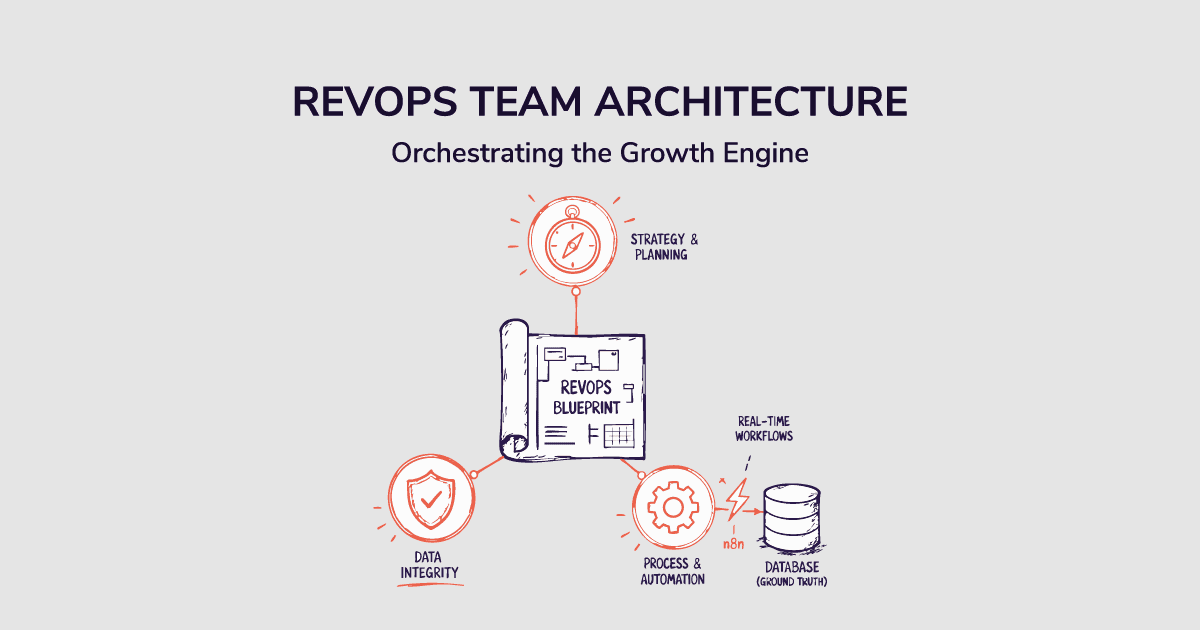
Getting it right means knowing which roles to hire, which structure model fits your stage, and what the whole function needs to sit on top of to work.
Here's how to build it.
What a Revenue Operations Team Actually Does
Before building the org chart, it helps to be precise about scope. For the full breakdown of the function, the what revenue operations means and how it works guide covers it in depth. Here's what matters for this conversation.
The Three GTM Functions RevOps Unifies
RevOps sits at the intersection of three functions: sales, marketing, and customer success. Its job is to align them around a shared view of the customer and a common set of metrics. Without that alignment, you get what most B2B companies have. Marketing celebrates MQLs that sales ignores. Sales blames lead quality. Customer success has no visibility into what was promised during the sales cycle.
Forrester research shows that companies aligning people, processes, and technology across their revenue teams achieve 36% more revenue growth than those running siloed operations. That gap is real. And it closes when RevOps actually works.

SMARTe GTM Intelligence
Start Smarter Prospecting Today
Where RevOps Sits vs. Sales Ops and Marketing Ops
This trips a lot of companies up.
Sales ops manages the sales function: territories, compensation plans, CRM workflows, pipeline reporting. Marketing ops manages the marketing function: campaign operations, lead scoring, attribution. RevOps owns the connective tissue between all three. It ensures a shared definition of a qualified lead, a unified funnel view, and a single source of truth for data.
Renaming your sales ops function "RevOps" doesn't make it RevOps. I've watched companies do this and wonder why nothing changes. The scope is genuinely different.
For a go-to-market strategy to execute well, someone has to own the operational layer that connects all the moving parts. That's what RevOps is for.
Core Roles in a Revenue Operations Team
Not every company needs all of these roles at once. Which ones you need and when depends entirely on your stage, and I'll cover the hiring sequence below. But here's what a mature RevOps team looks like and what each role actually owns.
1. VP or Head of Revenue Operations
This person reports to the CRO or CEO. They own the revenue strategy, set priorities across all GTM functions, and carry responsibility for forecasting accuracy at the board level. They're not in the CRM every day. Their job is to make sure the people who are have what they need to work from.
The best heads of RevOps I've worked alongside came from operations backgrounds, not pure sales backgrounds. Sales leaders default to optimizing their own function. RevOps leaders default to optimizing the system.
2. RevOps Manager
The operational center of gravity on any RevOps team. This person runs day-to-day operations: process design, cross-functional alignment, and keeping the GTM tech stack from becoming a sprawling mess. They're the ones who notice when marketing and sales are using different definitions of a qualified lead and fix it before it breaks the forecast.
3. Sales Operations Specialist
Owns pipeline management, territory design, compensation modeling, and CRM administration for the sales team. This role directly supports pipeline generation by keeping the data feeding into the outbound motion clean and current.
At most companies, this is the first dedicated ops hire. The pain is most visible there first.
4. Marketing Operations Specialist
Runs the marketing automation platform, attribution modeling, lead scoring, and the handoff process between marketing and sales. Also responsible for measuring demand generation performance at the campaign level.
If your MQL-to-SQL conversion rate is consistently low, this person either hasn't been hired yet or hasn't been given the access they need to fix the root cause.
5. Data and Analytics Lead
Builds and maintains dashboards, runs scenario modeling, and owns reporting across the full revenue funnel. Most companies hire this role too late (and then wonder why their forecasts are always wrong by a wide margin). You can't improve what you can't measure reliably.
The specific metrics this role should own are covered in the RevOps KPIs and metrics breakdown.
6. Systems and CRM Administrator
Owns tech stack configuration, integrations, and user administration. Think of them as the technical person who actually understands the business context behind every tool. Without someone in this seat, tools accumulate, integrations break quietly, and the CRM drifts into a state nobody fully trusts.
Many early-stage teams absorb this work into the RevOps Manager role. That works until the tech stack becomes complex enough that it doesn't.
Two Revenue Operations Team Structure Models
There are two main models. Every other RevOps org design is a variation of one of them.
Structure by Stakeholder
Each operations function has its own team or specialist: sales ops, marketing ops, customer success ops. They report to a central RevOps leader but maintain close working relationships with the departments they support.
This model works well when you're transitioning from siloed ops into a unified RevOps function. The people already embedded in each department don't have to rebuild every working relationship from scratch. It's a lower-friction migration, especially at Series A when you likely already have ops people sitting inside each team.
The risk is predictable: you recreate silos inside the RevOps team itself. If the sales ops specialist and the marketing ops specialist never actually collaborate, you've moved the problem one level up in the org chart without solving it.
Structure by Function
Here, the team is organized by what it does, not who it supports. One group owns data and analytics. One owns systems and tools. One owns process design and enablement. Each functional group supports all three GTM departments.
This model produces better cross-functional visibility. It's harder to maintain data silos when the same analytics team is building reports for both the marketing funnel and the sales pipeline.
I think this is the stronger long-term model for most companies. That said, it requires a team large enough to staff each function meaningfully. Trying to run this structure with two people means everyone is stretched too thin and nothing gets owned properly. It's not a model that works before Series B.
Which Model Fits Which Stage
Under 50 employees: neither. One generalist is handling everything, and that's the right call.
50 to 200 employees: start with the stakeholder model. Unify existing ops people from across the business under a single RevOps Manager before redesigning anything else.
Series B and beyond: evaluate moving to the functional model as the team grows past four or five people. The functional model scales better and creates clearer career paths for the specialists you'll need to hire.
When to Make Your First RevOps Hire (Stage by Stage)
Most articles on RevOps hiring give you headcount ranges. What you actually need are operational triggers.
Under 50 Employees
You don't need a RevOps team. You need RevOps thinking applied by whoever is closest to the problem.
At this stage, someone on the founding team is already doing RevOps work without the title: setting up the CRM, building the first dashboards, deciding which deal stages reflect reality versus what someone hoped would happen. The question isn't whether to hire. It's whether the person doing that work has enough time and context to do it well.
Most practitioners suggest the 50-employee mark as the standard hiring trigger. My honest take is that the better signal is your first 20 to 30 closed deals. Once manual tracking starts breaking down and you can't reliably tell what's actually in your pipeline, you need someone whose job is to fix that specifically.
Series A / Around $5M ARR
This is the right point to make the first dedicated RevOps hire. Not a VP. A RevOps Manager or senior analyst who can operate across systems, data, and process without a team behind them to make it work.
The right hire here is a strong generalist. They need to be able to set up CRM workflows, build attribution reports, and redesign the lead handoff process independently. Gartner predicts that by 2026, 75% of the highest-growth companies will operate on a RevOps model. Most of those companies formalized the function at exactly this stage, not after they'd already missed two quarters.
Series B and Beyond
The team starts to specialize. Your RevOps Manager needs dedicated support in at least two or three of the role areas above. The data and analytics function becomes especially important once the board expects accurate forecast models, not optimistic guesses.
This is also when the model decision becomes real. Don't wait until the team has eight people to decide between stakeholder and functional structures. By then it has already calcified and changing it is politically painful.
The Data Foundation Every RevOps Team Needs
Most articles about RevOps team structure stop at the org chart. They don't cover what the org chart sits on top of.
A RevOps team running on bad data can't do its job. Period.
CRM as Single Source of Truth (And Why Most CRMs Aren't)
The CRM is supposed to be the authoritative record for pipeline, forecast, and customer data. In practice, it's often a collection of stale records and aspirational deal stages that nobody fully trusts.
Bad CRM data is one of the most common reasons RevOps teams fail to deliver on what was promised. When the data going in is unreliable, everything built on top of it, forecasting models, territory design, compensation plans, all of it becomes unreliable too. You can redesign the org chart a dozen times and still not fix a forecast that's built on records nobody believes.
Verified Contact and Account Data
RevOps teams can't route leads accurately, build territory models, or score accounts against an ideal customer profile if the underlying contact data is outdated.
B2B contact data decays at roughly 25 to 30% annually. A company list that's 18 months old is missing roughly one in four decision-makers who've changed roles since it was built. B2B data enrichment built continuously into the RevOps workflow keeps the foundation current. Running it as a one-time cleanup project doesn't.
SMARTe handles this at scale. With 283M+ verified contacts globally and 90%+ CRM match rates, SMARTe keeps enrichment running in real time rather than in batch cycles that go stale the day they complete.
Intent Signals and Buying Triggers
Contact data alone gives you a static picture of your database. It tells you who's in your system. It doesn't tell you who's actively evaluating a solution right now.
Intent data and buying signals built into the GTM motion let RevOps teams prioritize pipeline based on actual buying behavior, not just account fit. That changes how territories get designed, how leads get routed, and how accurately the team can forecast demand from one quarter to the next.
For the tools that support this layer, the revenue operations software guide covers what to look for and what to skip. The GTM tech stack breakdown shows how the full data stack fits together underneath a RevOps function. And for teams actively working on CRM quality, the CRM data enrichment guide is worth reading alongside this one.
Four Structural Mistakes RevOps Teams Keep Making
Building the Org Chart Before Deciding the Data Model
Most teams pick their structure first and figure out the data flow afterward.
That's backwards.
Before deciding who reports to whom, know where your single source of truth lives, how data moves between your systems, and which team owns data quality day to day. The org chart should reflect those decisions. When it precedes them, you end up with a clean org chart sitting on top of a chaotic data environment, and the org chart doesn't help.
Promoting a Sales Ops Person and Calling It RevOps
This is the most common mistake at Series A and early Series B companies. A strong sales ops person does not automatically become a strong RevOps leader. Sales ops is optimized for the sales team. RevOps is optimized for the full revenue cycle. The skills overlap. The orientation doesn't.
I've seen this decision set companies back six to twelve months while the person in the role gradually realizes their mandate is much wider than what they were hired for originally.
Hiring a VP Before Proving the Function at Manager Level
A company brings in an expensive VP of Revenue Operations before there are any operational processes worth scaling. The VP spends the first six months building what a RevOps Manager should have built in year one.
Prove the function works at manager level first. Get the CRM in order. Get the reporting reliable. Get the lead handoff process documented and followed. Then hire the VP to scale what's already working.
Deloitte's 2024 B2B sales research found that companies with established RevOps functions were 1.4 times more likely to exceed revenue goals by 10% or more compared to companies without. That result requires a function genuinely built for cross-functional alignment, not a sales ops team with a bigger job title.
Treating CRM Hygiene as Maintenance Rather Than Strategy
Data quality is not a housekeeping task. It's what determines whether the RevOps function can do its job at all.
Teams that treat sales intelligence tools and data enrichment as afterthoughts consistently end up with forecasts they can't stand behind and territories built on numbers nobody fully believes. CRM hygiene is a revenue strategy decision. The RevOps leader should own it at that level, not delegate it to whoever has the most time.
What Good RevOps Actually Enables
The org chart gets you organized. The structure model gets you aligned. The hiring sequence gets you staffed at the right pace.
None of it produces predictable revenue if the data underneath the function is unreliable.
RevOps exists to make revenue predictable. That mission fails the moment the underlying contact data goes stale, CRM records drift, or intent signals aren't part of how the team prioritizes pipeline. Most RevOps failures aren't really structural failures. They're data failures with structural consequences.
The teams that get this right treat data quality as part of the RevOps mandate from day one. Not an IT task. Not a quarterly cleanup. A core function of the revenue operations team itself, owned by someone with accountability for keeping it current.
Try SMARTe free and see how verified contact data and real-time enrichment change what your RevOps team can actually deliver.