Here is something I see all the time.
A B2B company has their targeting perfectly locked in. The ideal customer profile (ICP) is clearly defined. LinkedIn ads are actively running to the exact right job titles.
The sales development rep (SDR) is following up. Marketing just sent over a highly relevant case study. Sales gets a discovery call booked.
And then?
The deal goes absolutely nowhere.
It doesn't stall because your product was bad. It doesn't die because the timing was off.
It dies because the prospect felt like she was talking to three completely different companies.
Marketing sent one message. The SDR referenced something totally different. The account executive (AE) jumped on the call having zero clue what content she had already read or what specific questions she had actively researched.
Meanwhile, that buyer was already three-quarters of the way through her buying decision. She was making up her mind with or without them. And nobody on the selling side even knew it.
This is not a sales problem.
This is not a marketing problem either.
This is an experience problem.
And it is exactly the problem that Account-Based Experience, or ABX, was built to fix.
Let's get into it.

SMARTe GTM Intelligence
Start Smarter Prospecting Today
What ABX Actually Is
Account-Based Experience, or ABX, is not just a fancy rebrand of Account-Based Marketing (ABM).
I want to make that clear right up front. The B2B marketing space loves to rename old ideas and call them revolutionary. This is not that.
ABX is a complete structural shift in how a go-to-market team actually operates. It tears down the massive walls between marketing, sales, and customer success.
The goal?
To make sure a target account gets one coordinated, consistent, and smart engagement from the very first impression all the way through their renewal and expansion.
If that sounds obvious, it is only because we all know what a good buying journey should feel like. But the hard part is actually building it.
The simple formula looks like this:
ABM + Customer Experience = ABX
- ABM gives you the precise targeting.
- Customer Experience makes sure every single interaction feels coherent, relevant, and respectful of where the buyer actually sits in their journey.
Put those two together, and you have ABX.
Why Traditional ABM Keeps Failing You
Don't get me wrong. I am not saying ABM is bad. In fact, it is genuinely one of the best things that ever happened to B2B marketing.
It replaced the awful spray-and-pray logic of mass outbound emails with focus, precision, and account-level thinking. That was a massive improvement.
But somewhere along the way, the system broke.
Here is what went wrong:
- The list became the entire strategy. Teams would pick 500 target accounts at the start of a quarter. Then, they would blast the exact same campaign at all of them for 90 days straight. It didn't matter if those accounts were actively in-market. It didn't matter if the timing made sense. It didn't matter if anything changed at those companies. The static list was the only plan.
- Handoffs destroyed all context. Marketing would create a lead and hand it off. Sales would take over. Customer success would eventually start completely fresh. Three different teams meant three totally different views of the exact same account. There was zero continuity. When a prospect finally became a customer, all the context about their objections and concerns just vanished. Customer success had to start from zero.
- Metrics lied to everyone. Teams tracked MQL volume, click-through rates, and email open rates. Those are real numbers, sure. But they don't explain why you actually won or lost a deal. And because the team reported on those metrics, the team optimized for them.
The data proves this is a massive issue.
According to Forrester's State of Business Buying 2024, 86% of B2B purchases stall during the buying process.
Even worse, 81% of buyers are completely dissatisfied with the provider they ultimately chose.
Read that again.
These aren't prospects who walked away. These are closed deals. These are customers who signed a binding contract and instantly felt let down.
That is an experience failure happening at a massive scale across the entire industry. And it is exactly what ABX fixes.
The 3 Core Ideas Behind ABX
If you want to win B2B deals today, you need to understand three core truths.
Idea 1: Most of your accounts are not buying right now
Research consistently shows only about 5% of your total addressable market is actively looking to buy at any given moment.
If your list has 1,000 target accounts, roughly 950 of them are simply not ready.
Running aggressive sales campaigns at all 1,000 accounts at the same time is wildly wasteful. It also actively damages your brand with the 950 people who aren't ready yet.
ABX uses intent data to find that active 5%. It saves your best coordinated plays for them, while keeping everyone else in a light nurture track.
Idea 2: Buyers research without you
6sense's 2025 B2B Buyer Experience Report found that buyers don't talk to sellers until they are about 61% of the way through their journey.
And 95% of the time, the winning vendor was already on the buyer's Day One shortlist. This shortlist is formed before a single sales call ever happens.
You cannot force your way onto that list with aggressive outbound tactics.
You earn that spot by being highly visible, credible, and genuinely useful during their independent research phase. ABX builds the exact conditions for that.
Idea 3: You are selling to a crowd
The average B2B deal involves 10 to 13 different stakeholders.
For deals over $250K, 6sense says it is always 10+ people. Forrester notes that internal complexity is the number one reason deals stall. It is not vendor performance.
Every person has a different motive. The CFO wants proof of ROI. The IT lead wants integration clarity. The end-user just wants to know the software won't make their daily job worse.
Your buying group is not a monolith. Treating it like one is the fastest way to kill a deal.
What Actually Changes With ABX?
So, what does this look like in real life?
The shift from ABM to ABX is not just a change in mindset. It changes how your team works every single day.
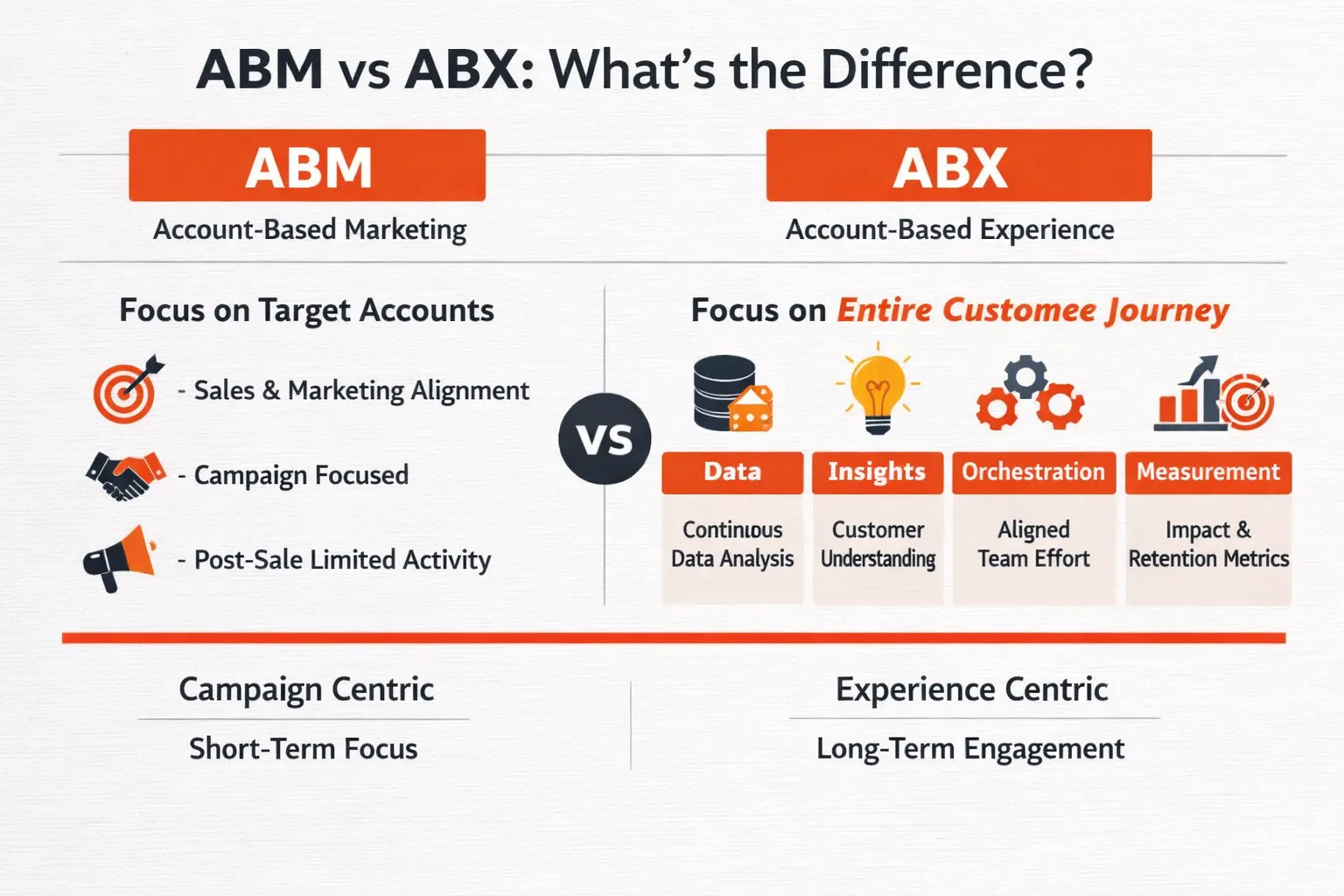
- Lists become live signals. ABM builds a static list and runs it. ABX uses a dynamic list that updates based on real-time signals. An account can be totally cold one month and hot the next because three people suddenly started researching your category.
- Campaign timing becomes buyer timing. ABM runs on an internal marketing calendar. They launch a Q2 campaign in April, no matter what is happening at the account. ABX triggers plays the second an account shows intent signals. Not because April arrived, but because the account is ready.
- Handoffs become shared ownership. In ABM, marketing creates an MQL, hands it over, and moves on. In ABX, marketing, sales, and CS share one view and co-own the outcome. When a deal closes, CS already knows the context.
- Marketing metrics become revenue metrics. ABM tracks MQLs and clicks. ABX tracks pipeline velocity, win rates, and net revenue retention. When you measure revenue, you build plays that actually make money.
ABM is your targeting strategy. ABX is the operating system your whole company uses to actually deliver it.
The 4 Stages of the ABX Journey
ABX breaks down your strategy into four clear stages.
These aren't linear steps on a conveyor belt. Accounts will stall, loop back, and accelerate randomly. But your team must know exactly where an account sits at all times.
Stage 1: Attract
The account is a perfect fit, but they don't know your brand. Nobody has engaged.
Your only job here is building presence. Do not try to generate a lead. Do not try to book a meeting. You just want your name to feel familiar when they finally start evaluating solutions.
Account-based ads are your best tool here. Use LinkedIn ads and programmatic display. And never gate your best educational content behind forms. Be useful before you ask for anything.
Stage 2: Engage
Now something is happening. Someone hit your site. Intent data is showing activity.
Marketing takes the lead here. The goal is deep relevance.
Do not send a generic newsletter. Send content tailored to what they are researching. Send case studies from their specific industry. Help them define their actual problem. Sales should just watch for now. No cold emails yet. You are building trust.
Stage 3: Close
This is where ABX looks very different from traditional ABM.
Multiple people from the committee are active. They are looking at your pricing page and researching competitors. Intent data is spiking fast.
Now, sales reaches out. But not with a generic cold email. They reach out with a message tailored to what that specific account has been researching.
Marketing backs this up with account-specific ads. CS previews what a successful onboarding looks like.
You win here because you actually understand the account better than the competition.
Stage 4: Grow
The contract is signed.
In traditional demand gen, marketing vanishes and CS starts over. In ABX, you double down.
CS already knows everything about the account's context. Onboarding feels like a natural continuation of the buying experience.
When you see expansion signals—like new departments getting involved, or product usage going up—you trigger targeted upsell plays.
If your champion moves to a new company, track it. That is the warmest lead you will ever get, and most teams completely ignore it. The close is where the real revenue relationship begins.
Stop Treating Every Account the Same (The 3 Tiers)
You cannot run intensive 1:1 plays for 300 accounts. It will destroy your team.
ABX uses three tiers to match your effort with the potential return.
Tier 1: 1:1 Accounts
These are your absolute best accounts. They represent $1M+ in lifetime value. You should only have 10 to 20 of these.
Treat them like a market of one. Build custom landing pages specifically for that company. Send direct mail to the economic buyer. Have your AE record personalized videos. Share a 30-60-90 day onboarding preview early. The investment is huge, but so is the upside.
Tier 2: 1:Few Accounts
These are clusters of 15 to 30 accounts that share a meaningful trait. Maybe they are in the same industry or use the same tech stack.
Create content for the whole cluster instead of each account. For example, build one campaign for mid-market fintech and another for enterprise logistics. This tier works best for deals between $100K and $1M.
Tier 3: 1:Many Accounts
These are broad programs that use automation for scaled personalization. Use dynamic ads that swap out industry terminology automatically. Set up website personalization.
This fits deals from $25K to $100K.
Remember: A program covering 10 Tier 1 accounts perfectly will always beat a program covering 200 accounts superficially.
How to Build Your ABX Program Today
Most guides just give you a framework. Here is the exact Monday morning playbook.
Step 1: Get Your Data Right
Do not skip this step.
If your teams use different systems with bad data, you cannot do ABX. You will just create a chaotic experience for the buyer.
You need verified contact data for every single role in the buying committee. You need firmographic and technographic context.
This is exactly why we use SMARTe's database. With 290M+ verified contacts and 75%+ mobile coverage, it lets us map out the entire committee. It surfaces the technical evaluators and end users who never show up in basic CRM enrichments.
Data sits underneath everything. Without it, your outreach hits half the people it should.
Step 2: Define Your ICP and Tier Accounts
Your ideal customer profile (ICP) must be extremely tight. Define the industry, revenue range, tech stack, and pain points clearly.
Then, tier your accounts ruthlessly. Be honest about who belongs in Tier 1. If your Tier 1 has 200 companies, it's just your whole list with a new name.
Step 3: Map the Buying Committee
For every Tier 1 account, find out who actually buys.
Find the champion, the economic buyer, and the technical evaluator. Don't forget procurement. Find the internal blocker before they ruin your deal.
Each person has different questions. Your plays need to speak to all of them naturally.
Step 4: Build Your Scoring Model
Stop relying on gut-feel. Score the whole account, not just single contacts.
Use this exact formula:
- Fit (0-30 points): Does the account match your ICP? Look at industry, size, and tech stack.
- Intent (0-40 points): Are they actively researching you? Look for topic surges or competitor visits. This gets the most weight because it shows real timing.
- Engagement Velocity (0-30 points): How much are they engaging with you? Are multiple roles interacting?
Combine these for a heat score. Bucket them into Hot (65+), Warm (35-64), and Watch (under 35). Hot gets immediate outreach. Warm gets nurture content. Watch gets thought leadership.
Step 5: Build the Plays
Start with three simple plays:
- Attract play: Run LinkedIn ads for Tier 1 and 2 accounts. Ungate your best educational content.
- Engage play: When an account hits Warm, send a nurture sequence matched strictly to their intent signals. Be specific.
- Close play: When they hit Hot, sales must reach out within 24 hours. Marketing shifts to account-specific ads, and CS shares onboarding previews.
Everyone moves in the same direction at once.
Step 6: Start a Weekly ABX Stand-up
This is the most underrated tactic in existence.
Get one marketer, one SDR, and one AE together for 15 minutes a week.
The only agenda: What is happening at our Hot accounts, and what are we doing about it together this week?
It isn't glamorous. But it builds real alignment and stops bad habits.
The Only ABX Metrics That Matter
Stop reporting on MQL volume. It does not tell leadership why you win or lose deals.
ABX gives you the obligation to upgrade your metrics. Track these instead:
- Account Coverage: What percentage of Tier 1 and 2 accounts have active engagement? If it is below 70% on Tier 1, a pipeline gap is coming.
- Engagement Breadth: How many distinct roles are talking to you? Single-threaded deals die when that one person goes on holiday.
- Pipeline Velocity: Are your target accounts moving faster than normal accounts? They should be. If they aren't, something is broken.
- Win Rate by Tier: Tier 1 should close at a much higher rate than Tier 3 because you invest more in them. If win rates are the same, your execution needs work.
- Net Revenue Retention (NRR): This is the ultimate number. NRR over 100% means accounts grow faster than they churn. 120-130% is elite. If NRR is flat, your sales-to-CS handoff is broken.
- Time to Value: How fast does a new user hit a success milestone? Fast value drives strong retention.
The Mistakes That Will Kill Your Program
I have watched enough ABX programs flame out to spot the patterns. Here is what you must avoid:
- Treating mail merge as personalization. Swapping [COMPANY NAME] in an email template is not real personalization. True personalization speaks to their exact industry challenges and role. A VP of Engineering and a CFO need entirely different messages.
- Launching without a shared view. If sales uses a CRM, marketing uses an automation platform, and CS uses a spreadsheet, you will fail. Get everyone looking at the same account view before you launch.
- Escalating every single intent spike. Intent data is very noisy. One person reading a blog is not a buying signal. Four people visiting your pricing page is a real signal. Build a cool-down rule so you don't startle accounts.
- Buying tech before strategy. The tech category is loud. But software is just a multiplier. Strategy comes first. Tools come second. Every single time.
- Stopping at the signature. This is the most expensive mistake. The deal closes and marketing disappears. Research shows 80% of lifetime revenue comes after the initial deal. Treat the post-sale experience like it matters.
The Ultimate ABX Tech Stack
You do not need every tool in the category on day one.
While I haven't used every single prospecting tool on the market, here is what you actually need at each stage:
- Contact and account intelligence: The absolute foundation. You need verified data for the full buying committee. Again, SMARTe's 290M+ database gives you the depth to actually make personalization work across North America, APAC, and LATAM.
- Intent data platform: Without this, your scoring model is just guessing. You need behavioral signals to know when to engage.
- CRM: The shared record that everyone works from. If this is broken, fix it first.
- Marketing automation: For intent-triggered nurture sequences.
- Sales engagement platform: For running smart, signal-triggered outreach.
- Account-based advertising: LinkedIn and programmatic ads for reaching accounts at each stage.
The data layer is where most programs quietly fail. The difference between buying committee maps that are 60% complete and ones that are 90% complete is the difference between reaching the economic buyer and missing them completely. That is the deal.
What AI Actually Changes in ABX
AI is very real, but there is a lot of hype that makes teams buy tools before they have a strategy.
Here is what AI genuinely changes:
- Signal processing at scale: AI can process behavioral signals across thousands of accounts simultaneously and surface the real buying patterns.
- Personalization at volume: AI can generate role-specific messaging variants, personalize landing page copy, and customize email content fast. This makes 1:Few programs feel closer to 1:1.
- Predictive fit scoring: AI-driven models learn from your historical win/loss data to predict who will genuinely buy next.
But here is what AI does not change:
You still need a clear ICP, a shared account view, a coordinated team, and a commitment to measuring the right outcomes. AI applied to a broken strategy just produces better-looking broken results.
Where to Start This Week
Five years from now, nobody will even call it ABX. We will just call it how B2B marketing works.
Because the alternative—siloed teams, handoffs that drop all context, campaigns that run on the vendor's timeline—will look obviously wrong.
The buyers expect you to know them. They expect your SDR to know what your marketer sent last week. They expect the onboarding to feel like a continuation of the conversation that started six months ago.
You can build this standard. Not all at once, but week by week.
Here is what I would do this week:
- Audit your systems. Are all teams actually working from the same account record? If not, that is your task.
- Pick 10 strategic accounts. Map out their buying committees.
- Set up a simple heat score for Fit, Intent, and Engagement.
- Book a 15-minute weekly stand-up with your SDR, AE, and CS rep.
- Replace one MQL-focused report with a pipeline velocity or win rate report.
Start with ten accounts. In 30 days, you will have momentum. In 90 days, you will have proof.
And in 12 months, your competitors will be trying to reverse-engineer your exact playbook.
ABX works because it treats the account how the account deserves to be treated.
And that is how you win in 2026.