Finding new customers is one of the biggest challenges for any business. Your website gets traffic, but not every visitor becomes a lead. That’s where lead magnets come in.
A lead magnet is a tool that offers value to your audience in exchange for their contact information. It helps turn casual visitors into leads you can nurture and guide through your sales funnel.
Lead magnets are not just for collecting emails—they build trust, demonstrate expertise, and qualify your audience. When done right, they become a key part of your marketing strategy, attracting the right prospects and helping your business grow.
In this guide, you will discover:
- A clear definition and purpose of lead magnets
- The advantages of using them to grow your audience
- The key traits that make a lead magnet effective
- 20 practical examples you can use across industries
- A step-by-step approach to creating your own lead magnet
- How to align your lead magnets with different funnel stages
- Common pitfalls to avoid for better results
Whether you’re a small business owner, marketer, or entrepreneur, this guide will show you how to use lead magnets to generate more qualified leads and build lasting relationships with your audience.
What Is a Lead Magnet?
A lead magnet is a marketing tool designed to attract potential customers by offering something valuable in exchange for their contact information, usually an email address. The goal is to turn anonymous website visitors into identifiable leads who can enter your sales or marketing funnel.
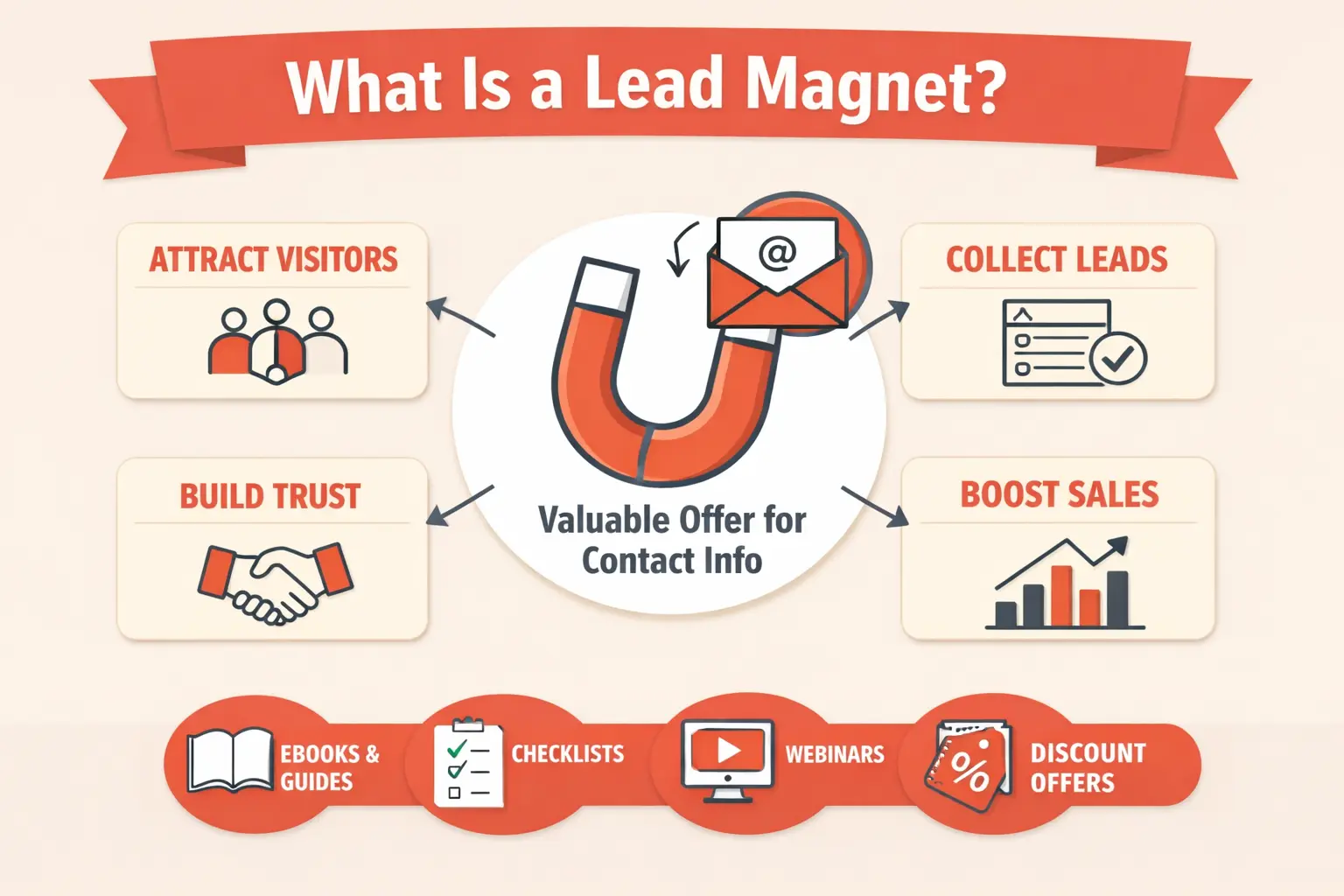
Lead magnets work by solving a specific problem or answering a pressing question your audience has. They don’t sell your product directly. Instead, they educate, inform, or provide a useful resource, helping prospects build trust in your brand.
Common examples of lead magnets include:
- Ebooks and guides – provide in-depth knowledge on a topic relevant to your audience
- Checklists and templates – give practical, actionable tools to save time or avoid mistakes
- Webinars or video training – teach a skill or explain a process while establishing expertise
- Quizzes and assessments – help users evaluate their situation or knowledge
- Case studies or whitepapers – demonstrate real-world results and success stories
The best lead magnets are specific, high-value, and easy to consume. They address a real need, match the audience’s stage in the buyer journey, and naturally connect to the solution your business provides.
By offering value upfront, lead magnets not only generate leads but also start building a relationship with potential customers, increasing the likelihood of future engagement and conversions.

SMARTe GTM Intelligence
Start Smarter Prospecting Today
Benefits of Lead Magnets for Sustainable Growth
Lead magnets are not just a way to find email addresses. When designed and used correctly, they support long term growth across marketing, sales, and customer relationships. Below are the core benefits that make lead magnets essential for modern businesses.
1. Turn anonymous traffic into identifiable leads
Most website visitors leave without taking action. A lead magnet creates a reason for them to engage and identify themselves.
By offering relevant value, you convert passive traffic into leads you can nurture. This gives your marketing and sales teams visibility into who is interested and what they care about, instead of relying only on page views or clicks.
2. Attract higher quality, intent driven prospects
A strong lead magnet filters your audience.
When someone opts in for a specific resource, they are signaling intent. The topic they choose tells you what problem they are trying to solve and how close they are to making a decision.
This results in fewer but better leads. Leads that are easier to qualify, segment, and convert.
3. Build trust and authority before the sales conversation
Lead magnets allow you to demonstrate expertise without selling.
By helping prospects understand a problem, avoid mistakes, or make better decisions, you position your brand as knowledgeable and reliable. This reduces skepticism and shortens the sales cycle.
Trust built through value is stronger than trust built through claims.
4. Support lead nurturing and personalization at scale
Once a lead enters your system, a lead magnet becomes the foundation of your nurturing strategy.
You can tailor follow up content based on what they downloaded, how they engaged, and where they are in the buyer journey. This makes your emails, ads, and outreach more relevant and less intrusive.
Personalized nurturing improves engagement and conversion rates over time.
5. Improve conversion rates across the funnel
Lead magnets warm up prospects before they reach sales.
Educated leads understand their problem better, recognize the cost of inaction, and are more prepared for a solution. This leads to higher demo bookings, better sales conversations, and fewer unqualified calls.
The result is a more efficient funnel from first visit to purchase.
6. Create reusable assets with long term value
A well built lead magnet is not a one time effort.
It can be repurposed into blog posts, email sequences, webinars, social content, sales enablement material, and partnerships. Over time, it becomes a core asset that continues to generate leads without constant rework.
This makes lead magnets one of the highest ROI pieces of content you can create.
7. Reduce reliance on paid acquisition
Organic traffic, referrals, and partnerships work better when there is a clear value exchange.
Lead magnets help capture demand you are already generating, reducing dependence on paid ads alone. Even when you do use paid campaigns, lead magnets improve performance by giving users a clear reason to click and convert.
What Makes a Good Lead Magnet
A good lead magnet is not defined by its format or design. It is defined by how well it aligns with user intent, solves a real problem, and moves the right people into your funnel. Most lead magnets fail because they focus on volume instead of relevance.
Here are the characteristics that actually determine whether a lead magnet converts and supports long term growth.
It aligns with a real, validated demand
A strong lead magnet is built on existing demand, not assumptions.
This demand usually shows up in search queries, sales conversations, customer objections, and repeated questions asked before a purchase decision. If people are already searching for the topic or asking about it, the lead magnet has a much higher chance of converting.
This is why high performing lead magnets often map directly to:
- Informational search intent
- Early evaluation questions
- Decision blocking uncertainties
If the problem is not actively felt, even well designed lead magnets will struggle.
It focuses on one problem and one outcome
Effective lead magnets are narrow by design.
They do not try to educate broadly or cover an entire category. Instead, they help the user achieve one clear outcome or make progress on one specific problem.
This clarity improves both conversion rate and lead quality. The visitor knows exactly what they are getting, and you know exactly why they opted in.
Broad content attracts curiosity. Focused content attracts intent.
It matches the decision stage, not just the funnel label
One common mistake is treating lead magnets as purely top of funnel assets. In reality, high converting lead magnets exist across multiple decision stages.
- Early stage lead magnets reduce confusion and provide context.
- Mid stage lead magnets help compare options or avoid mistakes.
- Late stage lead magnets reduce risk and support justification.
What matters is not where the asset sits in your funnel, but whether it matches the user’s mental state and readiness to act.
It provides practical value, not surface level education
A good lead magnet helps the user do something better, faster, or with fewer mistakes.
This is why practical formats consistently outperform theoretical ones. Checklists, templates, calculators, and structured guides work because they reduce effort and cognitive load.
Educational lead magnets still work, but only when they help the reader make a clearer decision or avoid a costly error. General awareness content rarely converts well behind a form.
It is credible, accurate, and experience backed
Trust is a conversion factor.
Lead magnets that perform well are grounded in real experience, industry knowledge, or data. They reflect an understanding of how things work in practice, not just in theory.
This aligns directly with E E A T principles. Experience shows in examples. Expertise shows in structure. Trust is built when the content avoids exaggeration and explains trade offs honestly.
People opt in when they believe the information will help them make a better decision.
It naturally connects to your product or service
A good lead magnet does not exist in isolation.
It should attract people who could realistically benefit from what you offer. If the topic is disconnected, you may grow your email list but damage conversion efficiency downstream.
The best lead magnets educate the user in a way that makes your solution feel relevant, without explicitly selling it. The transition to the next step should feel logical, not forced.
It is easy to access and easy to consume
Conversion friction kills performance.
High performing lead magnets use simple opt in forms, clear value propositions, and instant delivery. The content itself is structured for readability, with clear sections and logical progression.
Length is not the issue. Cognitive effort is. If the content feels easy to consume and apply, engagement increases and trust compounds.
It supports segmentation and follow up
A lead magnet should tell you something about the lead.
The topic, format, and depth all provide signals about intent and readiness. This information enables better segmentation, more relevant follow ups, and stronger lead nurturing.
When a lead magnet improves targeting and personalization, it increases lifetime value, not just sign ups.
20 High-Converting Lead Magnet Ideas to Explode Your Email List
Whether you are in SaaS, eCommerce, or consulting, here are 20 proven lead magnet strategies.
1. The Interactive Quiz
People love learning about themselves. Quizzes are engaging, fun, and offer instant gratification. By promising a personalized result (e.g., "Which skincare routine fits your skin type?" or "What is your management style?"), you create a curiosity gap that can only be closed by entering an email address.
- Why it works: It feels like entertainment rather than a transaction.
- Best for: Lifestyle brands and service providers.
2. Ready-to-Use Templates
Starting from scratch is painful. Offering a "fill-in-the-blank" solution saves your audience time and mental energy. This could be anything from email marketing scripts and social media content calendars to website layout templates.
- Why it works: It provides immediate utility and solves a "blank page" problem.
- Best for: B2B services, designers, and marketers.
3. Free Shipping Unlock
For eCommerce, shipping costs are the number one cause of cart abandonment. By offering free shipping in exchange for an email signup, you kill two birds with one stone: you capture a lead and you remove a friction point for the sale.
- Why it works: It has a tangible monetary value that the customer understands immediately.
- Best for: Online retail stores.
4. The "Inspiration" Swipe File
Creative blocks are common. An "Inspiration File" or "Lookbook" curates high-quality examples to get your prospect’s creative juices flowing. For example, an interior designer might offer a PDF of "20 Living Room Layouts," or a web agency might share "50 Best Landing Page Designs."
- Why it works: It positions your brand as a tastemaker and helpful resource.
- Best for: Creative industries and agencies.
5. Exclusive Discount Codes
The classic "Sign up and get 10% off" is ubiquitous for a reason: it works. Shoppers are often price-sensitive. Offering a unique, first-time buyer code is often the nudge they need to complete a purchase while simultaneously joining your newsletter.
- Why it works: It appeals to the universal desire to save money.
- Best for: eCommerce and retail.
6. Free Utility Tools
If you can solve a small problem with software, give it away for free. Think of calorie calculators, business name generators, or headline analyzers. This establishes your authority and introduces users to your ecosystem without a paywall.
- Why it works: It offers high practical value and encourages repeated visits.
- Best for: SaaS and tech companies.
7. The 14-Day Free Trial
Common in the software world, the free trial is the ultimate "try before you buy." It removes the risk for the user. The key is to limit the timeframe (e.g., 7 or 14 days) to create a sense of urgency to explore the product.
- Why it works: It builds trust by letting the product speak for itself.
- Best for: SaaS and subscription services.
8. Live Webinars & Workshops
Webinars utilize the "Fear Of Missing Out" (FOMO). Because they happen at a specific time, they compel users to register immediately. They allow you to demonstrate deep expertise and interact with potential leads in real-time.
- Why it works: High perceived value and establishes personal connection.
- Best for: Consultants, coaches, and B2B sales.
9. Curated Bundle Offers
Sometimes a single discount isn't enough. A "Bundle Offer" groups benefits together—such as a discount plus free shipping plus a free sample. This increases the perceived value of the offer significantly without costing the business much more.
- Why it works: It makes the offer feel like a "VIP" package.
- Best for: eCommerce brands looking to increase Average Order Value (AOV).
10. Viral Contests
"Spin-to-win" wheels or sweepstakes can generate leads rapidly. The allure of a high-value prize (like a pair of expensive sneakers or a tech gadget) encourages users to trade their data for a chance to win.
- Why it works: Gamification creates excitement and lowers the barrier to entry.
- Best for: Rapid list growth for consumer brands.
11. The Mini-Course
Instead of a massive textbook, break your knowledge down into a digestible email or video series (e.g., "The 5-Day SEO Bootcamp"). This keeps your brand top-of-mind every day for the duration of the course.
- Why it works: It builds a habit of opening your emails and establishes long-term authority.
- Best for: Educators and experts.
12. Digital Gift Cards
Similar to discounts but psychologically different. A "$10 Gift Card" feels like cash in hand, whereas a "10% Discount" involves math. It creates a feeling that the money is "wasted" if not spent.
- Why it works: It incentivizes higher spending to utilize the "free money."
- Best for: Lifestyle and fashion retailers.
13. Comprehensive Ebooks
The Ebook is a staple of B2B marketing. It allows you to tackle a complex problem in depth. If your audience is struggling with a specific pain point, a well-written guide promising a solution is highly attractive.
- Why it works: It serves as a reference material that users save and return to.
- Best for: B2B companies and agencies.
14. Original Industry Reports
Data is power. If your company conducts original research, surveys, or market analysis, compile that data into a formal report. Decision-makers love unique statistics they can use in their own presentations.
- Why it works: It attracts high-quality, professional leads.
- Best for: Data firms and B2B enterprise.
15. Printable Planners
In a chaotic world, organization is a luxury. Printable daily planners, habit trackers, or project checklists are simple to create but highly coveted by people looking to get their lives or businesses in order.
- Why it works: It is a low-tech tool that offers tangible productivity benefits.
- Best for: Productivity coaches and lifestyle blogs.
16. Exclusive Community Access
Humans are social creatures. Offering access to a private Slack group, Facebook community, or LinkedIn network allows leads to network with peers. You are selling "belonging."
- Why it works: The value comes from the network effect, not just your content.
- Best for: Niche industries and professional groups.
17. Free Consultation Call
For high-ticket services, a generic PDF isn't enough. Offering 15 or 30 minutes of your time for a "Strategy Session" or "Audit" demonstrates massive value and moves the prospect further down the sales funnel.
- Why it works: It provides personalized value and builds immediate rapport.
- Best for: Agencies, realtors, and lawyers.
18. "Sneak Peek" Samples
If you sell expensive reports or books, give away the first chapter or the executive summary for free. It’s the "teaser trailer" approach to content marketing.
- Why it works: It hooks the reader and proves the quality of the paid product.
- Best for: Research firms and authors.
19. Real-World Case Studies
Case studies go beyond theory. They show exactly how someone achieved a result. By offering a detailed breakdown of a success story (e.g., "How Client X Generated $1M in 30 Days"), you provide a roadmap that users want to copy.
- Why it works: It offers social proof and actionable steps simultaneously.
- Best for: Marketing agencies and SaaS.
20. Surveys with Data Access
People love sharing their opinions, but they love knowing what others think even more. Ask users to take a survey, but gate the results. To see how they compare to the industry average, they must enter their email.
- Why it works: It leverages curiosity and ego.
- Best for: News outlets and trend-focused industries.
How to Create a Lead Magnet That Converts in 5 Practical Steps
A lead magnet only works when it solves a real problem and fits naturally into your buyer journey. It is not about giving away content. It is about earning permission to continue the conversation with the right audience.
The framework below is based on how high intent lead magnets are actually built and used across B2B and service based businesses.
Step 1. Understand your audience and their buying context
A lead magnet fails when it is built around assumptions instead of evidence. Before you decide what to offer, you need to understand what your audience is trying to achieve and what is blocking progress.
Start by analyzing:
- Questions prospects ask during sales calls or demos
- Objections that delay or prevent decisions
- Support tickets and onboarding friction
- Search queries bringing people to your site
- Competitor content that already attracts attention
Do not aim to solve everything at once. Identify one problem that appears repeatedly and sits early or mid funnel. This ensures your lead magnet attracts people who are qualified but not yet ready to buy.
A strong lead magnet addresses uncertainty, not urgency. People opt in when they want clarity, not pressure.
Step 2. Select a format that matches intent, not trends
The format of your lead magnet should reflect how your audience prefers to consume information at that stage of the journey.
- Use a checklist when the task feels overwhelming and needs structure.
- Use a template when the user wants to take action quickly.
- Use a guide or ebook when the decision requires understanding and confidence.
- Use a webinar or video when trust and explanation matter more than speed.
- Use a tool or calculator when the value is tied to personalization or data.
Avoid choosing formats based on popularity. A webinar will not convert if the audience is still researching basics. Likewise, a short checklist will not work when the problem is complex and high risk. Match depth to intent.
Step 3. Create focused content that delivers one clear outcome
High converting lead magnets do not try to educate broadly. They solve one problem clearly and completely.
Define the outcome before you write a single word. Ask what the reader should know or be able to do after consuming the content.
Structure the content logically. Introduce the problem. Explain why it exists. Show the correct approach. Provide practical steps or examples. Remove anything that does not support the outcome.
Clarity matters more than length. Use short paragraphs where it improves readability, but allow ideas to develop when explanation is required. The content should feel helpful, not rushed.
Design should support comprehension. Clean layouts, consistent branding, and simple visuals are enough. Overdesign often distracts from the value.
Step 4. Build a friction free delivery and follow up system
The lead magnet experience does not end at the download.
You need a clear and simple flow:
- A landing page that explains the value in plain language
- A form that asks only for essential information
- A confirmation or thank you page that sets expectations
- An automated email that delivers the asset immediately
Once the lead is captured, follow up with intent. The first few emails should continue helping, not selling. Use this stage to deepen understanding of their situation and guide them toward the next logical step.
If your lead magnet is effective, the follow up should feel like a natural extension of the content, not a sudden pitch.
Step 5. Distribute strategically and personalize through segmentation
A lead magnet only performs when it is visible to the right audience.
Promote it where intent already exists. Blog posts targeting relevant search queries, key service pages, and your homepage are strong starting points. Support this with social media, partnerships, events, and paid campaigns when appropriate.
Once people opt in, segmentation becomes critical. Not all leads are equal, and treating them the same reduces conversions.
Segment based on:
- Which lead magnet they downloaded
- Their stage in the buyer journey
- Actions taken after opt in
This allows you to send relevant follow ups that reflect their needs and readiness. Personalization here is about relevance, not names.
Finally, repurpose your lead magnet. One well researched asset can fuel blog content, email sequences, presentations, collaborations, and sales enablement material. This increases return without creating more work.
Lead Magnet Strategy by Funnel Stage
Not all lead magnets serve the same purpose. Their effectiveness depends on where the prospect is in the buying journey and what they are trying to figure out at that moment. A common mistake is using one lead magnet for everyone, which usually attracts either low intent leads or the wrong audience entirely.
A better approach is to align lead magnets with funnel stages so each asset supports a specific decision mindset.
Awareness stage lead magnets
At the awareness stage, prospects are just starting to recognize a problem or opportunity. They are not comparing vendors or looking for pricing yet. Their primary goal is understanding.
Lead magnets at this stage should reduce confusion and provide context without pushing a solution.
Effective awareness stage lead magnets include:
- Educational guides that explain a problem space
- Checklists that highlight common mistakes
- Industry primers or beginner resources
- Glossaries or foundational explainers
- High level assessments that surface gaps
These lead magnets work best when mapped to informational search intent and early research queries. The goal is to attract relevant traffic and establish credibility, not to qualify aggressively.
Consideration stage lead magnets
At the consideration stage, prospects understand the problem and are evaluating different approaches or solutions. They want help making sense of options and trade offs.
Lead magnets here should help with comparison, evaluation, and decision framing.
Effective consideration stage lead magnets include:
- Comparison guides or frameworks
- Buyer checklists and evaluation criteria
- Case studies focused on similar use cases
- Process walkthroughs or implementation guides
- Calculators that estimate impact or effort
These assets signal stronger intent. They also help position your approach as thoughtful and well suited to the problem, without forcing a sales conversation too early.
Decision stage lead magnets
At the decision stage, prospects are close to taking action. Their concerns shift toward risk, justification, and confidence.
Lead magnets at this stage should reduce uncertainty and support internal buy in.
Effective decision stage lead magnets include:
- Detailed case studies with outcomes
- ROI calculators or business case templates
- Pilot programs or trials
- Readiness assessments
- Consultation preparation guides
These lead magnets attract fewer leads, but the leads are highly qualified. They often shorten sales cycles and improve conversion rates because the prospect is already aligned with the next step.
Why funnel alignment matters
When lead magnets are aligned with funnel stages, three things improve at once. Lead quality increases. Follow up becomes more relevant. Sales conversations start with better context.
Instead of treating lead magnets as a single tactic, this approach turns them into a system that supports the entire customer journey.
Common Lead Magnet Mistakes That Hurt Conversions
Many lead magnets fail even when traffic is strong. The reason is usually not the idea itself, but small strategic mistakes that reduce relevance, trust, or intent. Avoiding these issues can significantly improve both lead quality and conversion rates.
- Targeting too broad an audience: Creating a lead magnet for everyone results in low intent leads. High converting lead magnets are built for a specific buyer, role, or situation.
- Choosing topics without validated demand: If people are not actively searching for or asking about the topic, the lead magnet will struggle. Strong lead magnets align with real questions and decision blockers.
- Gating low value or generic content: Users will not exchange their email for information they can easily find elsewhere. The content must feel curated, structured, or experience driven.
- Solving too many problems at once: Lead magnets that try to cover everything often feel unfocused. One clear problem and one clear outcome convert better.
- Asking for too much information too early: Long forms reduce opt ins, especially at early funnel stages. Form length should match intent and perceived value.
- Misalignment with the core offer: When the lead magnet topic is disconnected from what you sell, conversion suffers later in the funnel. The next step should feel natural.
- No follow up or nurturing plan: Capturing an email without a clear next step wastes opportunity. Lead magnets should feed into a defined nurturing or sales process.
- Ignoring performance and lead quality data: Tracking only sign ups hides deeper issues. Conversion rate, engagement, and downstream impact matter more.
Most lead magnet problems come down to misalignment between audience intent, content value, and funnel design. Fixing these gaps often leads to immediate improvement without creating new assets.
Conclusion
Lead magnets work when they are built with intent, not just for traffic or email sign ups. A strong lead magnet solves one clear problem for the right audience at the right stage of the funnel. It earns attention. It earns trust.
The most effective lead magnets are simple, focused, and useful. They align with real search behavior. They match buyer intent. They connect naturally to what you offer next.
If you treat a lead magnet as a strategy, not a one time asset, it becomes a growth system. It attracts qualified leads. It supports your funnel. It compounds over time.
When done right, a lead magnet does more than capture emails. It starts a relationship.