High-ticket sales does not mean selling expensive things. It means selling things where the buying process itself becomes the challenge.
Most reps figure this out the hard way. They land a promising enterprise account. The discovery call goes well. The champion is enthusiastic. And then the deal disappears into a six-month loop of "we are still evaluating" with no clear next step.
That is what high-ticket sales actually looks like in B2B. Not one decisive conversation. A long, multi-stakeholder process where the reps who win are almost never the ones with the best pitch. They are the ones with the best process.
This guide covers high-ticket sales from the ground up. What it is, how it differs from regular selling, what the full process looks like, and what you need to do at each stage to close deals worth $10,000, $100,000, or more.
What Are High-Ticket Sales?
High-ticket sales is the process of selling products or services at a price point high enough that it changes how buyers make decisions.
In most B2B contexts, that means deals worth $10,000 or more. Some teams draw the line at $5,000. At the enterprise level, meaningful contracts often start at $50,000 and run into six or seven figures. The specific number matters less than what it triggers on the buyer's side.
When the purchase crosses a certain threshold, the decision stops being one person's call. It gets escalated. Budget approval gets involved. Legal reviews the contract. Procurement wants three competing quotes.
Suddenly, you are not selling to one person. You are navigating an entire organization.
That shift in complexity is what defines a high-ticket sale. Not just the price. The process behind it.

SMARTe GTM Intelligence
Start Smarter Prospecting Today
The Price Threshold Question
You will see different thresholds depending on who you ask. Some say $1,000. Others say $5,000. In B2B SaaS and enterprise software, the number that makes the most practical sense is $10,000 and above.
Why? Because that is roughly where the buying process changes.
Below that number, one decision-maker can often approve the purchase without escalating. Above it, you are dealing with budget cycles, procurement involvement, legal review, and multiple people who all need to agree before anyone signs.
What Actually Makes a Sale "High-Ticket"
A lot of people define high-ticket sales by price alone. I think that is too narrow.
Four things actually separate high-ticket from regular selling.
- Multiple decision-makers. You are not convincing one person. You are building consensus across a group. According to Gartner, the typical B2B buying group involves 6 to 10 stakeholders. For enterprise deals, that number climbs even higher.
- A longer sales cycle. High-ticket B2B deals do not close in a week. For deals over $100,000, sales cycles routinely run 6 to 12 months. In some categories, longer.
- Higher buyer scrutiny. These buyers have been burned before. They are checking references, running pilots, comparing vendors side by side, and getting legal to review contracts before anyone moves forward.
- Greater revenue impact per deal. One high-ticket client can generate more revenue than 50 smaller ones. That changes how you resource the pursuit and how much you invest in winning it.
Why Teams Pursue High-Ticket Sales
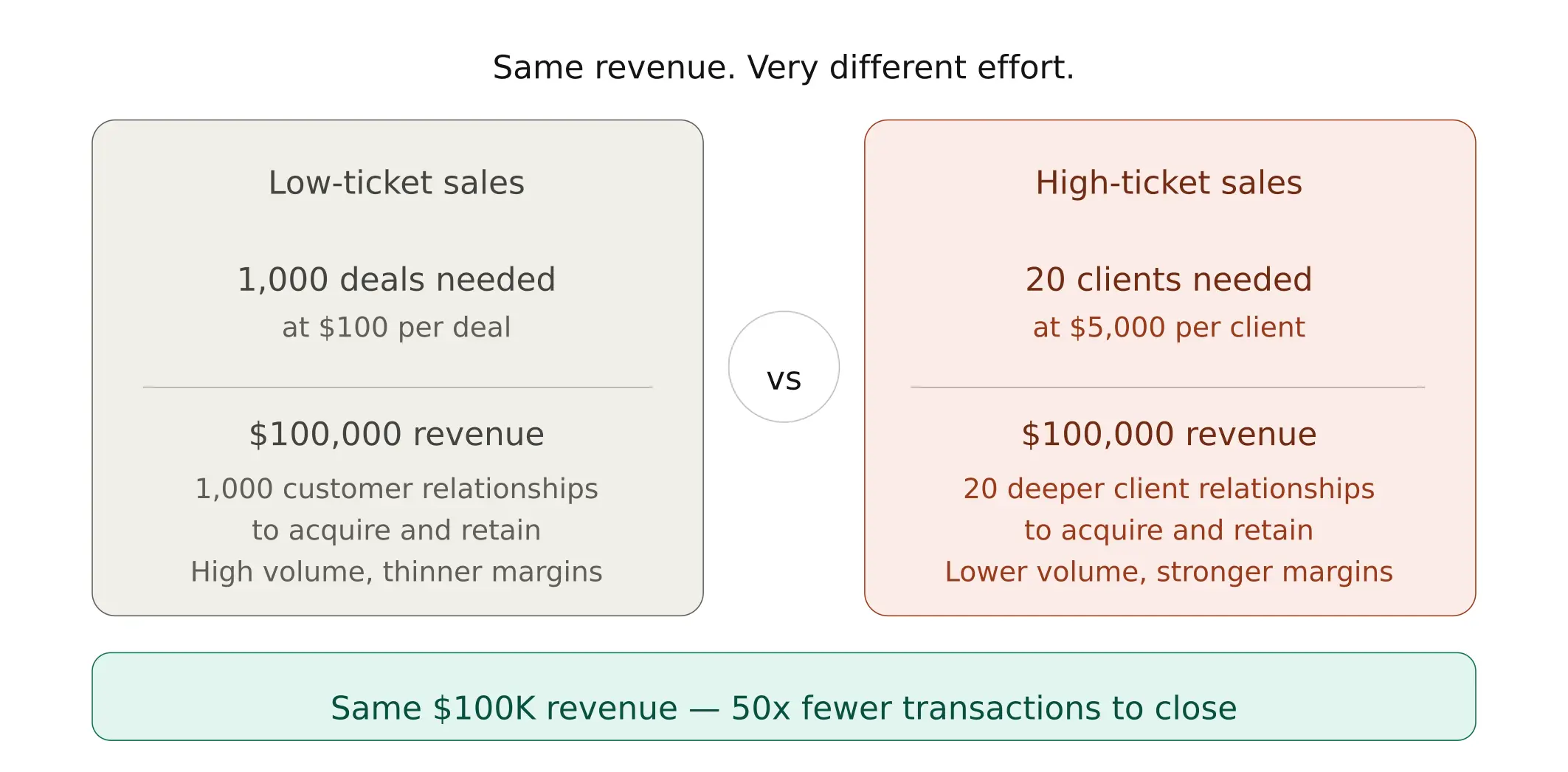
The math is compelling. And it is worth laying out plainly.
If you sell a $100 product, you need 1,000 sales to generate $100,000 in revenue. If you sell a $5,000 solution, you only need 20. That is 980 fewer transactions, 980 fewer support interactions, and significantly lower operational overhead for the same top-line number.
When the deal size is large enough, even a single win can be transformative. One high-ticket enterprise client can equal the revenue of dozens of smaller accounts. And they tend to stay longer. They expand. They refer others.
The Real Advantages
Higher profit margins are the obvious one. But there are less obvious benefits too.
High-ticket buyers are more committed. They have done the research. They have evaluated the risk. When they say yes, they are in. That makes them easier to work with post-sale.
Better client retention comes with the territory. A company that signs a $150,000 annual contract is not canceling on a whim. They have skin in the game. So do you. That shared investment tends to produce better outcomes for both sides.
Brand positioning improves too. Landing a marquee enterprise client opens doors that no marketing campaign can. Competitors notice. Prospects notice. It signals that you can operate at the highest level.
The Honest Challenges
High-ticket sales is not for every team or every stage of a business.
The buyer pool is smaller. Not every company has the budget or the problem that justifies a six-figure purchase. That means your addressable market is narrower and your outreach needs to be far more precise.
The skills required are higher. Consultative selling, multi-stakeholder navigation, business-level conversations with CFOs and VPs, handling objections over months rather than a single call. These take time to develop.
The cost of a lost deal is real. A six-month pursuit that ends in no decision is a significant investment with zero return. Bad targeting and poor qualification make this happen far more often than it should.
Go in with eyes open. The upside is real. So are the requirements.
High-Ticket vs. Low-Ticket Sales: Where the Process Actually Breaks
These are not just different price points. They require entirely different approaches.
Sales Cycle and Stakeholder Count
Low-ticket sales moves fast. One buyer. One conversation. One decision. The risk is low, and if the product does not work out, the buyer cancels. The relationship is transactional and the cycle is short.
High-ticket is the opposite in almost every way.
The average B2B win rate hovers around 21%, according to HubSpot's State of Sales research. For enterprise deals specifically, it drops closer to 15%. Most deals that stall do not die because the buyer said no. They die because the process broke down somewhere in the middle.
Stakeholder count is a huge part of that. You might have a champion inside the account who loves your product. But if you have not reached the CFO, the IT lead, and the procurement team, you do not have a deal. You have a conversation.
Understanding how B2B buying groups are structured is essential at this level. Relying on one contact to carry the deal internally is one of the most common reasons high-ticket opportunities fall apart.
What Buyers Actually Need From You
Low-ticket buyers need a product that works and a price they can justify.
High-ticket buyers need something harder to deliver: confidence that they made the right call.
They are going to justify this purchase to their CFO, their board, or their own team. They need a business case. They need to see ROI projections. They need case studies from companies similar to theirs. And they need to trust that if something goes wrong after the deal closes, you will still be there.
That is why consultative selling is the foundation of every high-ticket sale. You are not pitching features. You are building a case alongside the buyer that makes their internal approval process easier.
High-Ticket Sales Examples in B2B
Let me ground this with real categories.
- Enterprise SaaS platforms. Think CRMs, revenue intelligence tools, data infrastructure, and marketing automation at scale. Enterprise contracts often run $50,000 to $500,000 or more annually, depending on usage and customization.
- Consulting and professional services. A strategy engagement with a top-tier firm or a performance marketing retainer can cross six figures annually. The client is not buying deliverables. They are buying expertise and accountability.
- Custom implementation and integration services. These deals are often attached to a software purchase, but the services contract alone can dwarf the license fee. The buying process is more complex because poor implementation can sink the entire investment.
- Sales intelligence and GTM data platforms. For teams running serious outbound programs, the data platform they choose has a direct line to revenue. That makes it a strategic purchase, not a tool purchase. It gets treated accordingly by the buyer.
How to Build Trust Before the First Meeting
This is something most high-ticket guides skip. And it is a real mistake.
By the time a high-value prospect takes your cold call or replies to your email, they have often already looked you up. They checked your website. They Googled your name. They may have read a piece of your content or looked at your LinkedIn profile.
That research happens before you ever speak. And it shapes whether they take you seriously when you do.
McKinsey research shows that more than 70% of B2B buyers now complete purchases above $50,000 entirely through digital channels. That means your digital presence does real sales work whether you are aware of it or not.
There are a few things that build trust before the first conversation.
- Case studies with real numbers. High-ticket buyers do not trust vague claims. They trust data. A case study that says "we helped a company like yours cut churn by 30% in 90 days" does more than any pitch deck. Show the problem, the solution, and the measurable outcome.
- Client logos and social proof. Seeing recognizable company names associated with your brand reduces perceived risk. It tells the prospect that others like them have already made this bet and won.
- Thought leadership content. Content that demonstrates deep expertise in the buyer's specific problem builds credibility over time. If a prospect has read three of your blog posts before your first call, the conversation starts from a very different place.
- Sales rep LinkedIn profiles. High-ticket prospects often check the profile of the rep reaching out. A profile that looks professional and shows genuine industry knowledge matters more than most reps realize.
Trust is not built on the call. It starts long before that.
The High-Ticket Sales Process, Stage by Stage
High-ticket deals do not follow the same funnel as transactional sales. Here is how the process actually works.
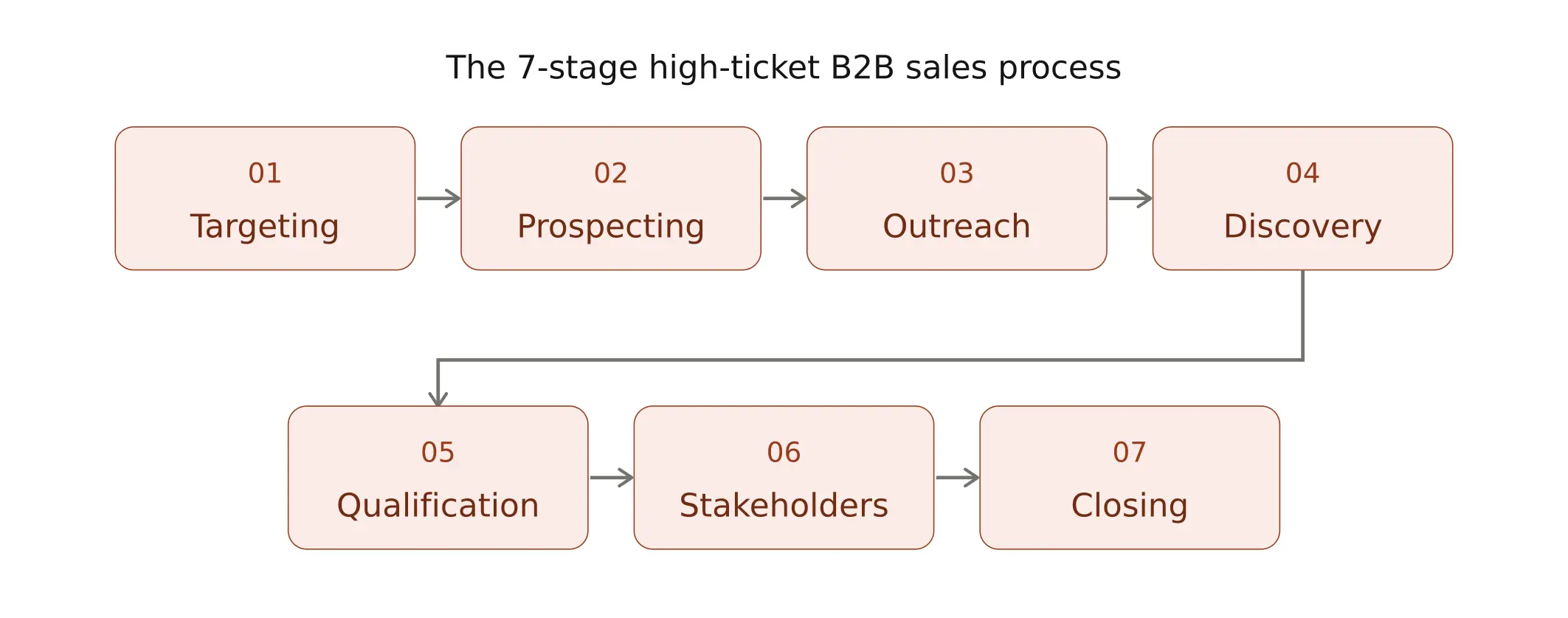
Stage 1: Targeting
The first mistake most teams make is casting too wide a net.
A generic outbound list and a high-ticket strategy do not mix. The accounts worth pursuing at this level share specific characteristics. The right industry. The right company size. The right internal structure. And ideally, an active reason to be evaluating a solution like yours right now.
Your ideal customer profile needs to be more precise than "mid-market SaaS companies." It should define the exact type of organization that has the problem you solve, the budget to pay for it, and the structure to actually make a buying decision.
Beyond firmographics, timing matters enormously. A company that just raised a funding round, just hired a new VP of Sales, or just expanded into a new market is a very different prospect from that same company six months earlier.
Watching for buying signals is how you identify which accounts are worth prioritizing now versus which ones to revisit later.
Stage 2: Prospecting
Once you have identified the right accounts, the challenge is finding and reaching the right people inside those accounts.
This is where a lot of high-ticket campaigns quietly fall apart before they even start.
B2B data decay is a real and constant problem. Contact data goes stale at roughly 25 to 30% per year. People change roles. They leave companies. They get promoted. If your contact list is six months old, a meaningful portion of it is already wrong.
In high-ticket outbound, where you invest significant time per account, sending sequences to outdated contacts is not just inefficient. It kills momentum on deals that took real effort to build.
The reps who win consistently at this level do not find one contact per account. They map the full buying committee before they start outreach. They identify the economic buyer, the technical evaluator, the end-user champion, and whoever will eventually need to sign. Then they build a multi-threaded outreach strategy that engages all of them.
Outbound prospecting at the high-ticket level is research-intensive. It is slower than volume prospecting. But the conversion rate and deal quality more than justify it.
Stage 3: First Outreach
You are reaching out to a VP or C-suite executive who gets dozens of cold pitches every week. Generic does not work.
What works is specificity.
A cold email that references something specific about the prospect's company gets read. A recent hire. A product launch. A challenge their industry is facing right now. Something that shows you actually looked.
A cold call that opens with a relevant insight earns a conversation.
The goal of first outreach is not to pitch. It is to earn a discovery call. That is it.
Do not try to close anything on the first touch. Give them a compelling reason to take the next step. Nothing more.
Building a consistent sales cadence matters here too. Most responses in high-ticket outbound come after the third or fourth touchpoint. Reps who give up after one or two attempts leave a lot of pipeline on the table.
Stage 4: Discovery
The discovery call is not a demo warm-up. It is where the deal actually begins.
Done well, discovery is how you understand the buyer's situation better than they have articulated it themselves. What is the core problem they keep running into? What have they already tried? What does it cost them, in time or money, to leave this unsolved? Who else in the organization feels this pain?
Ask about the business, not the product. Let them talk. Take notes on everything they say.
The SPIN Selling methodology is worth understanding here. SPIN selling uses four types of questions: Situation, Problem, Implication, and Need-Payoff. These questions guide the buyer toward understanding the full weight of their problem and the real value of solving it.
In high-ticket sales, where buyers are cautious and deliberate, structured questioning moves deals forward faster than any pitch.
Stage 5: Qualification
Not every opportunity that looks right on paper is worth pursuing. In high-ticket sales, time is your most limited resource.
BANT (Budget, Authority, Need, Timeline) is still a useful framework. Do not treat it like a checklist you run through on the first call. Think of it as a set of things you need to understand well before investing heavily in a pursuit.
The most important early question is Authority. Are you talking to someone who can actually move a decision forward?
A supportive contact with no real influence is one of the most dangerous situations in enterprise sales. They feel like progress. They are not.
A strong sales qualified lead at the high-ticket level has a real, active problem, demonstrated budget access, and the ability to drive internal consensus. If all three are not present, you are either too early or in the wrong place in the organization.
Stage 6: The Multi-Stakeholder Middle
This is the stage that kills most high-ticket deals.
The pitch went well. The champion loves it. And then nothing happens for three weeks.
A new stakeholder surfaces with questions no one mentioned before. The CFO wants a second look. Procurement gets involved.
This is normal. It is not a sign the deal is dying. But it requires active management.
The teams that navigate this stage well do three things consistently.
First, they map every stakeholder early and engage them proactively. They do not wait for new decision-makers to surface. They find them first and address their concerns before those concerns become blockers.
Second, they build mutual action plans with their internal champion. A mutual action plan is a shared timeline that shows what needs to happen, in what order, and who owns each step. It keeps both sides accountable and makes it easier for the champion to drive internal alignment.
Third, they know their sales objections cold. In a long-cycle deal, you will hear "it is too expensive," "the timing is not right," and "we need to think about it" many times, from many different people. Each requires a different response depending on who is saying it and why.
Stage 7: Closing
High-ticket deals do not close on a single call. They close through a series of smaller agreements that build toward the final one.
Value-based selling is what makes the final close easier. When you have spent months building a concrete, credible picture of the ROI tied to their specific situation and their own numbers, the price becomes the easy part. The buyer has already done the internal math. They know what staying with the status quo is costing them.
The final proposal should contain no surprises. Everything in it should be something you have already aligned on. Pricing. Scope. Implementation timeline. Success metrics.
If something in the proposal requires significant negotiation, something earlier in the process was not properly addressed.
Skills You Actually Need for High-Ticket Sales
A few things matter more in high-ticket selling than in any other type of sales.
- Active listening. The ability to hear what a buyer is actually saying, not just what they say on the surface, is the single most valuable skill in consultative selling. Most reps talk too much. The best high-ticket sellers ask one good question and then get out of the way.
- Business acumen. You need to talk to a CFO about ROI, a VP of Engineering about implementation risk, and an end user about daily workflow. That requires understanding the buyer's business at a level most reps never bother to reach.
- Patience and resilience. A nine-month deal cycle means handling a lot of silence. A lot of "we need more time." A lot of moments where the deal looks dead and then comes back. Reps who take every stall personally do not last long in enterprise selling.
- Process discipline. High-ticket sales requires tracking. Who have you talked to? What did each stakeholder say? What are the outstanding concerns? What is the agreed next step? Without a disciplined CRM habit, long cycles become impossible to manage.
- The ability to build internal champions. Your champion is the person inside the account who believes in your solution and has enough credibility to sell it internally when you are not in the room. Finding, developing, and equipping that person is often the single biggest lever in any high-ticket pursuit.
The Metrics That Actually Matter
High-ticket sales is not a volume game. And tracking the wrong numbers will make you feel productive when you are not moving deals forward at all.
In high-ticket environments, these are the metrics worth tracking.
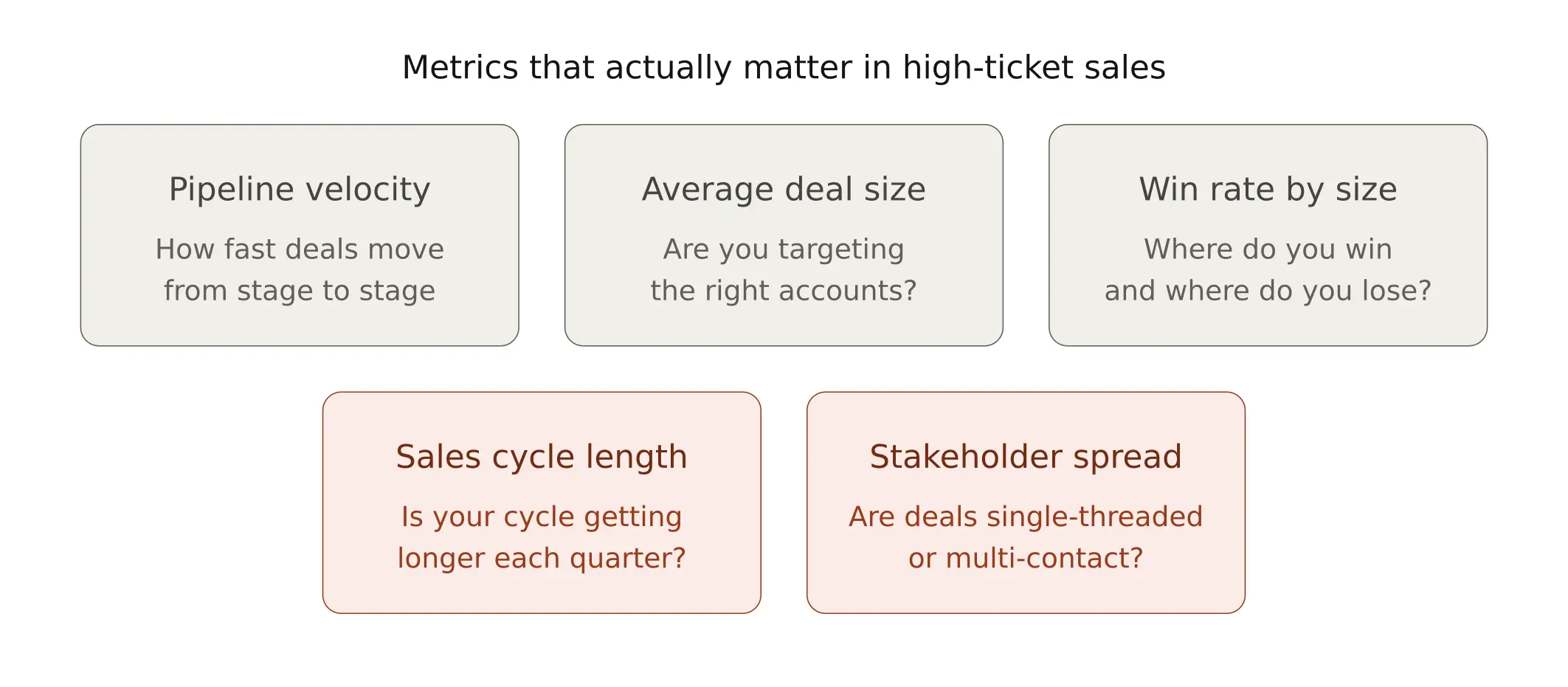
- Pipeline velocity. How quickly are deals moving from stage to stage? A deal stuck in discovery for two months is a warning sign, not just a data point.
- Average deal size. Are you targeting the right accounts? If your deal sizes are consistently below your target, you are either going after the wrong companies or not reaching senior enough contacts.
- Win rate by deal size. Your win rate for $10K deals is probably very different from your win rate for $100K deals. Knowing where you win and where you lose tells you where to spend your time.
- Sales cycle length. Long cycles are expected. But if cycles are getting longer quarter over quarter, something in the process is broken.
- Multi-stakeholder engagement rate. Are you reaching multiple contacts at target accounts, or are most of your pursuits single-threaded? Single-threaded deals at the enterprise level are fragile by definition.
Calls made and emails sent are activity metrics. In high-ticket sales, activity metrics are not the point. Revenue efficiency is.
The Data Foundation No One Talks About
Here is something most high-ticket guides will not say directly.
You can have the best sales process in your category. You can run perfect discovery calls. You can multi-thread across every account you pursue. And you will still lose deals consistently if you are working from bad contact data.
This is the foundational problem. And most teams ignore it because it is not glamorous.
B2B data decay means that a meaningful percentage of your contact list is wrong right now. When you are mapping a ten-person buying committee at a target account, every wrong contact is a wasted touchpoint. Every missing stakeholder is a deal risk you did not see coming.
SMARTe's 290M+ verified contact database with 75%+ US mobile coverage exists for exactly this problem. Real-time verification, not batch processing, means the contacts you pull are accurate at the point of use. The AI Agents map buying groups across target accounts automatically, so you know who you need to reach across finance, IT, procurement, and the C-suite before you send a single message.
If you are running high-ticket enterprise campaigns and working from a static or outdated data source, you are making every other part of the process harder than it needs to be.
Try SMARTe free and see how it maps your target accounts before your next enterprise outreach campaign.
The Bottom Line
High-ticket sales is hard. The win rates are lower than most people expect. Around 21% on average, and closer to 15% in enterprise. The cycles are long. And the deals that fall apart after six months of real work are genuinely painful.
But a single high-ticket win can equal the revenue of 50 smaller deals. The clients who buy at this level tend to stay longer, expand their contracts, and refer others. And the skills you build in high-ticket selling are some of the most durable in any sales career.
The teams that win consistently here are not the most aggressive. They are the most prepared.
They know their ICP precisely. They map accounts thoroughly before they reach out. They listen more than they pitch. And they treat the buying process as something to understand and guide, not something to rush.
Get the foundation right. The closing part takes care of itself more often than you would think.