TL;DR:
SPIN selling is a question-based sales methodology for complex B2B deals, built by Neil Rackham from research on more than 35,000 sales calls. Instead of pitching features, reps ask four types of questions in sequence to help buyers understand their own problem and the value of fixing it.
- SPIN stands for Situation, Problem, Implication, and Need-payoff, the four question types asked roughly in that order.
- Situation questions gather context and should stay few. Ask two to five at most and research the rest beforehand.
- Problem questions uncover the buyer's pain. No problem found means no real need to sell into.
- Implication questions expose the full cost of that pain and are where most deals gain urgency.
- Need-payoff questions get the buyer to describe the value of a solution in their own words.
- It is a discovery method, not a full sales process. SPIN uncovers need but does not qualify the deal or close it.
- It works best for complex, high-value deals, not small transactional sales where simpler approaches close faster.
- SPIN pairs with a qualifier like MEDDIC. SPIN runs the conversation, MEDDIC grades whether the deal is real.
- Most failures come from delivery, not the framework. Scripted, robotic questioning kills trust on the call.
A rep opens a discovery call with "So, what's keeping you up at night?" The prospect pauses, then asks if he's reading from a script. The call's over before it started.
That's SPIN selling done wrong. The framework didn't fail. The delivery did.
I've sat in on calls like that. The problem is always the same. Reps memorize the four question types, then fire them off like a checklist instead of having a real conversation. SPIN selling isn't a script. It's a way of thinking about discovery, built on one idea: in big deals, the rep who asks the best questions beats the rep with the slickest pitch.
Here's how it works, the four questions with real examples, where reps blow it, and whether any of this still holds up in 2026.
What is SPIN selling?
SPIN selling is a question-based discovery method for complex B2B sales. The four letters stand for Situation, Problem, Implication, and Need-payoff, the four kinds of questions you ask, roughly in that order, to help a buyer understand their own problem before you pitch a solution.
Neil Rackham built it. His team at Huthwaite studied more than 35,000 sales calls across 23 countries over 12 years, tracking more than a hundred behaviors to see what actually moved big deals. That still makes it the most heavily researched sales approach ever published. The book landed in 1988 and somehow still gets handed to new reps almost 40 years later.
The research went against everything sales training taught at the time. Closing tricks that worked on small deals hurt large ones. Pitching features didn't move buyers. The top performers weren't talking more. They were asking better.
One thing I want to flag early, because most guides blur it. SPIN is a discovery method, not a full sales process. It uncovers and builds need. It doesn't qualify the deal, map the buying committee, or handle procurement. Treating SPIN as your entire sales motion is a mistake. It's the discovery engine inside a bigger machine. If you want the wider picture, here's how it fits the full B2B sales process.
Why SPIN broke the old rules of selling
SPIN still gets taught because Rackham's data overturned things every sales manual preached, and the corrections held up.
Take closing. The old wisdom said more closing attempts meant more wins. Rackham found the opposite in big deals. Heavy closing pressure lowered success rates with experienced buyers. The bigger the purchase, the more pushy closes backfired.
Then the open-versus-closed-question debate. Trainers obsessed over it for decades. The research showed it barely mattered. What mattered was the type of question, not whether it was technically open or closed.
And the big one: features don't sell large deals. Reps who led with features did fine on cheap, simple sales and poorly on complex ones. In a major purchase, the buyer needs to feel the problem first. Lead with features and you're answering a question nobody asked yet. (This is also why a feature-dump kills a winning sales pitch before it starts.)
The proof wasn't just theory. In early field tests at companies like Xerox, IBM, and Motorola, reps trained on the model posted roughly 17% higher sales volume than matched control groups. The lift came from structured call coaching, not pep talks.
The 4 SPIN selling questions (with examples)
The four question types build on each other. Skip a stage or rush one and the whole thing loses its grip. Here's the quick view, then each one in detail.
1. Situation questions
These gather context. The basic facts about how the buyer works today: their tools, team size, current process. They set the stage for everything after.
A couple you might ask a RevOps lead:
- How are you handling contact data across your CRM right now?
- Who owns list-building for the SDR team?
Situation questions bore people fast. Rackham's own finding was that top reps ask fewer of these, not more. So do your homework first. If you can find the answer on LinkedIn or the company site, you've wasted a question. Walk in knowing the basics and you spend the call on what matters.
2. Problem questions
Now you dig into pain. Problem questions surface the difficulties, gaps, and frustration the buyer lives with. This is where the conversation gets real.
Try:
- Where does your current process slow down?
- What happens when a rep can't reach the right contact?
If the buyer can't name a single problem, pay attention. That's a red flag, not a green light. No problem means no need, and no need means you're talking to someone who was never a real sales qualified lead in the first place. Good problem questions are really just a structured way to dig into customer pain points.
3. Implication questions
Here's where SPIN earns its reputation. Implication questions take a problem the buyer already named and pull on it. They explore the cost, the ripple effects, the price of leaving it alone.
For example:
- When your forecast is off because pipeline data is stale, how does that hit your headcount planning next quarter?
- If reps burn two hours a day chasing bad numbers, what's that costing across the team in a month?
The point isn't to trap anyone. It's to help the buyer feel the size of a problem they'd shrugged off. A small annoyance, traced to its real impact, often turns out expensive. That shift creates urgency.
4. Need-payoff questions
The last stage flips the energy from negative to positive. Need-payoff questions get the buyer to say out loud what solving the problem would be worth.
Something like:
- If your team reached the right decision-maker on the first call, what would that do to your close rate?
- How much time would you get back if your CRM data stayed clean automatically?
The magic is who's doing the talking. When the buyer describes the value, they're selling themselves. You're not pushing benefits. They're naming the payoff in their own words, which sticks far harder than anything on your slide. This is the heart of value selling: the buyer connects the fix to their own outcome.
How to run SPIN on a discovery call
The order matters. You move from Situation to Problem to Implication to Need-payoff because each stage sets up the next. Jump to need-payoff before the buyer feels any pain and it falls flat. This sequence is the backbone of a strong B2B sales discovery call, the part of the cycle where most deals are won or lost.
Don't treat the sequence as rigid, though. Real calls loop. A problem question surfaces something, you follow with an implication, the buyer mentions another issue, you circle back. The four types are a map, not a railroad.
A few things separate reps who run SPIN well from reps who recite it:
- Talk less than the buyer. If you're doing most of the talking, you're pitching, not discovering.
- Use micro-commitments. Small agreements through the call ("does that sound right?") confirm you're on track.
- Do your homework first. Average reps blow 60% to 70% of discovery time on low-impact situation questions. Top performers keep it to 20% to 30% and spend the rest mapping pain.
What to do: Before your next call, write down two implication questions specific to that account. Not generic ones. Questions tied to a problem you already suspect they have. A solid bank of sales prospecting questions helps you build the habit.
Also Read: How to fix the most common sales call mistakes.
Where SPIN selling goes wrong
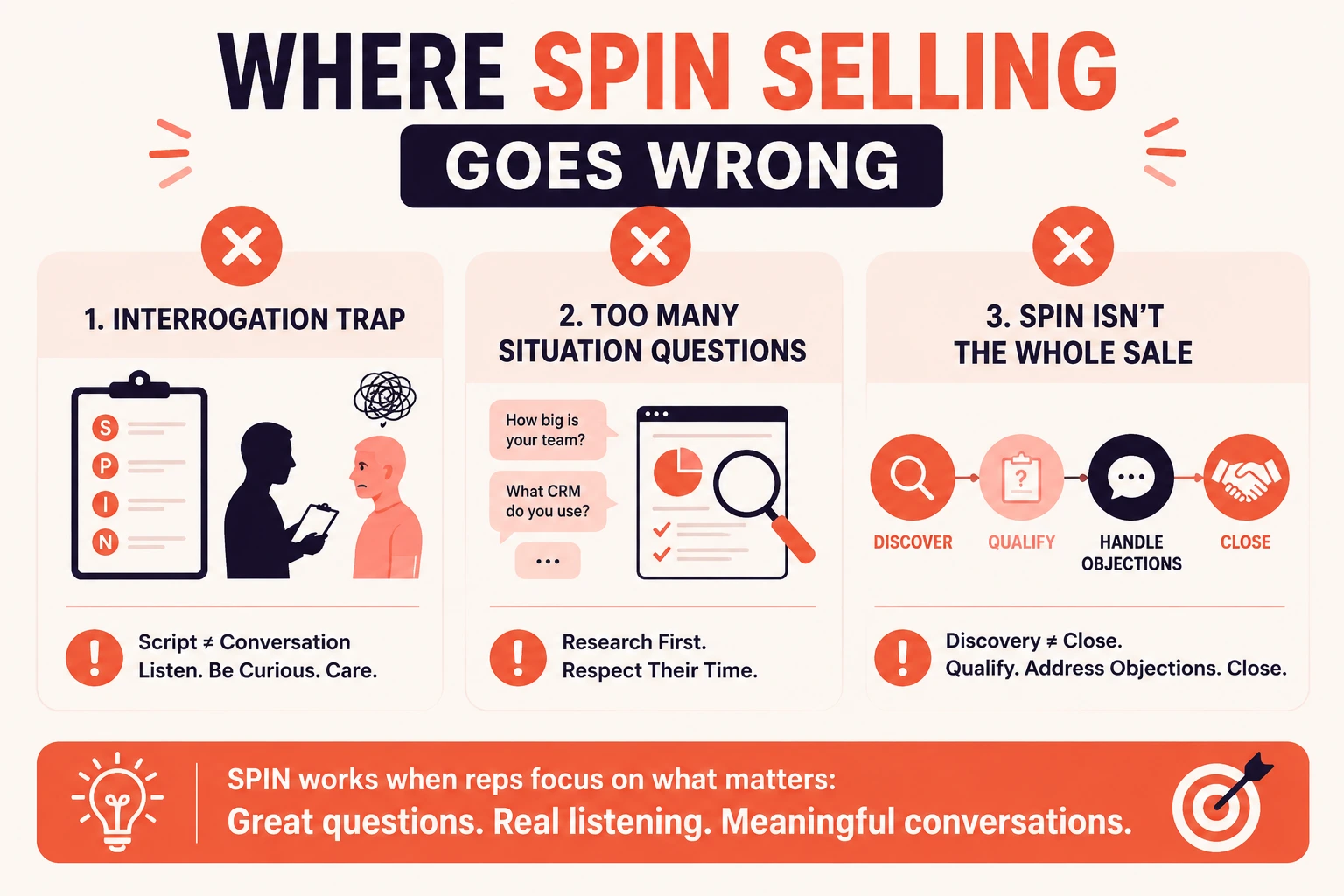
The method is sound. Most failures come from how reps run it. Three show up again and again.
The interrogation trap
A rep treats the four question types as a form to complete, firing them in order with no warmth, no listening, no curiosity. The buyer feels processed, not understood. That's the "are you reading from a script" call from the top of this article.
This relapse is common. Most SPIN rollouts stall inside the first year as reps drift back to old habits, struggle to build sharp implication questions, or buckle under logging a dozen CRM fields per deal. Teams that make it stick lean on automated post-call coaching, which cuts time to mastery from about a year to roughly 90 days. The fix isn't more questions. It's caring about the answers.
Front-loading situation questions
Reps who skip prep ask basic questions they could have answered themselves. How big is your team? What CRM do you use? Each one wastes the buyer's patience and signals you didn't research. By the time you reach the questions that matter, they've checked out.
Treating SPIN as the whole sale
SPIN handles discovery. It does not qualify the deal or close it. Reps who lean on it for everything end up with a buyer who feels understood but a deal that never advances, because nobody checked for budget, a real decision-maker, or a buying process. Discovery and qualification are different jobs. Objections still need real answers too, so pair it with solid sales objection handling.
Is SPIN selling still relevant in 2026?
This gets argued a lot. The Challenger Sale crowd more or less declared solution-selling methods like SPIN dead, arguing modern buyers want reps to teach them something, not just ask questions.
I think that's half right.
The delivery had to change. Buyers now do most of their research before they ever talk to you, so opening with basic situation questions feels insulting. But the core engine, helping a buyer understand and name their own problem, is more durable than any trend. People still buy when they feel the weight of a problem and picture life without it. That hasn't changed since 1988, and it won't change because a new framework got a book deal.
So no, SPIN isn't dead. The lazy version is. The thoughtful version, where you've done your homework and ask sharp questions about problems that matter, works as well as it ever did. It maps cleanly onto the modern B2B buyer journey, where buyers self-educate first and expect you to meet them further along.
SPIN selling vs other sales frameworks
SPIN doesn't compete with most other frameworks. It does a specific job and pairs with the rest.
The smartest move most teams make is pairing SPIN with a qualifier. Use SPIN-style questions to run the conversation and uncover pain, then apply a framework like the MEDDIC sales methodology to grade whether the deal is real. One handles the talk. The other handles the verdict.
Where SMARTe fits
I'll be straight. SMARTe doesn't replace SPIN selling. No data tool does. SPIN is a skill, and the conversation is still yours to lead.
What SMARTe fixes is the step Rackham flagged as the difference between good reps and average ones: doing your homework. He found top performers ask fewer situation questions because they show up with the basics already in hand. In 2026, that means having accurate account and contact data before you dial.
Here's the connection. Every situation question you're forced to ask on the call is one you could have answered with good data beforehand. Burn the first ten minutes asking who owns the budget or how big the team is, and you've spent your best discovery time on facts a clean dataset would have handed you.
That's the gap SMARTe closes:
- 289M+ verified B2B contacts so you walk in knowing who you're talking to and who else is in the room.
- 75%+ US mobile and direct dial coverage so you reach the right decision-maker live, not their voicemail. Even the best cold calling techniques only pay off when the number connects.
- Real-time verification so the data is fresh when you call, not whenever the list was last built.
- 66M+ company profiles so your situation research is done before the call, freeing the conversation for problem, implication, and need-payoff.
Good questions plus good prep separate a discovery call that advances from one that stalls. SPIN gives you the questions. SMARTe makes sure you've done the prep.