TL;DR:
Outbound sales is the practice of proactively reaching out to potential buyers instead of waiting for them to come to you. An outbound sales strategy is the system behind that outreach: who you target, when you contact them, which channels you use, and how you follow up until a meeting books.
10 outbound sales strategies that work in 2026:
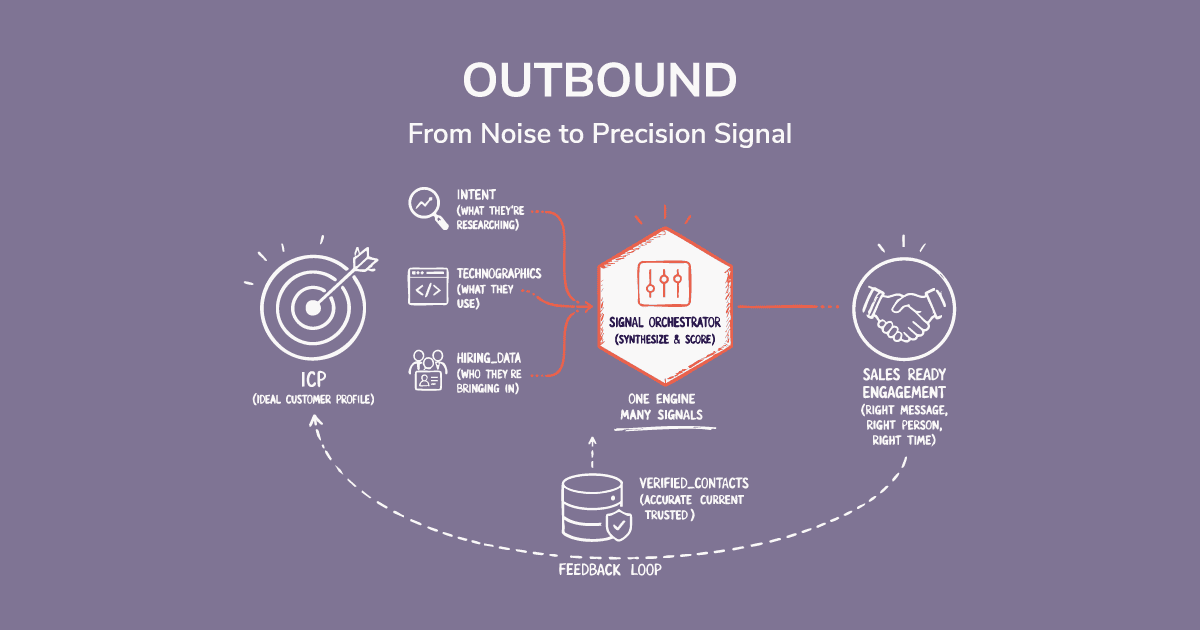
- Build your prospecting list using firmographic fit, technographic data, and intent signals
- Time outreach to real buying triggers: funding rounds, leadership hires, and hiring surges
- Verify contact data before any campaign runs to protect sender reputation and deliverability
- Run coordinated sequences across email, phone, and LinkedIn rather than three separate motions
- Follow up through at least 6 to 8 touches before stopping, which is where most meetings actually book
- Use verified direct dials so cold calls reach decision-makers, not switchboards
- Contact former champions at new companies for the warmest outbound opportunities in your pipeline
- Personalize around a specific trigger, a role-based insight, and a proof point rather than a template
- Define your ICP from closed-won data and narrow it further for better conversion at every stage
- Measure positive reply rate and pipeline generated, not sends and dials
Most outbound sales teams aren't failing because they picked the wrong strategy.
They're failing because they're running the right strategy on a broken foundation. Stale lists. Generic sequences that look identical to every other AI-assisted email in the inbox. No trigger logic. Follow-up that stops at two touches. And nobody asking why the bounce rate is at 18%.
The channel isn't broken. The execution is.
The B2B outbound sales strategies that work in 2026 share a common thread: they're built around precision, not volume. The teams consistently generating pipeline from cold outreach are sending fewer messages — to better-targeted accounts, at the right moment, through coordinated channels.
Below are 10 outbound sales tactics used by those teams. Some are foundational. Some are specific execution details that produce outsized results. All of them are things most teams know they should be doing and most aren't doing consistently.
1. Build Your Prospecting List on Three Data Layers, Not Just Firmographics
The most common outbound prospecting mistake isn't a messaging problem. It's a list problem.
Most teams build prospecting lists on firmographic data alone — industry, company size, job title, geography. That's a baseline. It tells you a company could theoretically buy from you. It doesn't tell you whether they're set up to buy, whether they're actively looking, or whether anyone there will pick up the phone.
The outbound teams producing consistent results layer three things:
Firmographic fit is layer one. Company size, industry, revenue range. Your baseline ICP filters. This is table stakes, not a targeting strategy.
Technographic data is layer two. Which tools does this company already run? If you sell a sales intelligence platform, an account running Salesforce plus Outreach has a different conversation readiness than one running spreadsheets and a shared Gmail inbox. Tech stack reveals budget allocation, operational sophistication, and adjacency to the problem you solve. SMARTe tracks over 64,000 products, which means you can filter to accounts with the exact stack profile that predicts product fit rather than working a list where 70% of the contacts will never be a real opportunity.
Intent signals are layer three. Buying signals tell you which accounts are actively researching your category right now. An account in layer one and layer two that's also showing high intent is where your outreach should go first, today, before the signal fades.
Teams using all three layers report that 70–80% of their prospected contacts actually fit their ICP. Teams relying on firmographic filters alone average 20–30% fit rates. Working from a 20% fit list means 80% of your sales development rep's time goes to accounts that were never going to buy.
What to do: Pull your last 20 closed-won deals. Find the firmographic and technographic patterns that appear most consistently — industry, headcount range, tech stack profile, funding stage. Those are your real targeting criteria. Rebuild your prospecting list around them.

SMARTe GTM Intelligence
Start Smarter Prospecting Today
2. Time Every Outreach to a Buying Trigger
Reaching the right person at the wrong time produces the same result as reaching the wrong person. Nothing.
Timing is the most underinvested variable in outbound sales tactics, and it's the one that moves reply rates more than any other single factor. Signal-triggered outreach — messages timed to a specific real-world event at the target account — achieves 5–18% reply rates. Generic cold outreach without a trigger sits at 1–3%.
That gap is not a copy problem.
Buying triggers are events that create urgency inside an account. A company that closed a Series B last week is under pressure to scale and show growth to investors. A new VP of Sales starting in week two has no loyalty to existing vendors and is actively evaluating the full tech stack. A company posting 12 new SDR roles is signaling pipeline pressure and an infrastructure need.
Reach people during those windows and the conversation starts from a completely different place. Reach them six months later and you're starting cold regardless of how good your email is.
Intent data adds another layer. It tracks which accounts are consuming content in your category right now — researching vendors, comparing solutions, reading competitor content. An account showing strong intent that also fits your ICP is a same-day outreach priority. SMARTe surfaces funding events, leadership changes, headcount signals, and Bombora intent data in one view, so your team sees the trigger the moment it's relevant.
Outbound tip: Define the three to five triggers most predictive of closed-won deals in your history. Pull your last 30 won opportunities and look at what happened in those accounts in the 60 days before the first meeting. Those events are your trigger list. Build same-day response workflows around them.
3. Clean Your Contact Data Before You Run Any Campaign
I've watched outbound teams spend months optimizing copy while running a 20%+ bounce rate. Everything downstream of bad data is wasted — not just the one campaign, but the sender domain reputation that affects every campaign after it.
B2B data decay runs at roughly 30% per year. A list built 12 months ago has lost about a third of its accuracy. Those stale records don't sit quietly. Emails bounce, which damages your sending domain. Once domain reputation degrades, inbox placement drops across your entire send volume — including the good records on the list.
Top-performing outbound teams keep bounce rates under 1.5%. Bottom performers run above 12%, according to Cleanlist's 2026 analysis of outbound platform data. The difference in pipeline output between those two groups isn't mainly copy or cadence. It's deliverability.
Real-time B2B data enrichment fixes this at the source. Not quarterly batch refreshes. Not static exports from a database updated six weeks ago. Verification at the point of use — so the email address and mobile number in front of your SDR when they reach out is current right now. SMARTe verifies records in real time, which is why teams using it report 90%+ CRM match rates at scale rather than the degraded coverage that comes from working a stale database.
Outbound tactic: Before running any outbound campaign, check your bounce rate in your email platform. Above 5%? Stop sending and run CRM data enrichment first. Copy optimization on a list with a 20% bounce rate is a distraction from the real problem.
4. Run Multi-Channel Sequences That Coordinate, Not Just Coexist
Email-only outbound in 2026 is a starting point, not a strategy.
Multi-channel outreach — email, phone, and LinkedIn in a coordinated sequence — generates 287% more replies than single-channel outreach. Not 287% better on email. 287% more responses total. The math on email-only stops compounding quickly. Add phone and LinkedIn to the same motion and the compounding restarts.
The mistake most teams make is running channels in parallel without coordination. Email team sends emails. SDRs make calls. LinkedIn requests go out based on who someone remembered to connect with. The prospect sees three separate, unrelated messages from the same company.
Building a sales cadence that actually works means each touch references the last and adds something new. The LinkedIn connection note mentions the email. The follow-up call adds a data point the email didn't include. The second email tries a different angle rather than repeating the first.
A workable sequence structure in 2026: Day 1 personalized email referencing a specific trigger. Day 3 LinkedIn connection request with a two-sentence contextual note (not a pitch). Day 5 phone call — leave a voicemail only if you have a genuinely specific reason. Day 8 follow-up email with a new angle. Day 11 LinkedIn direct message (LinkedIn DMs average a 10.3% response rate versus cold email's 5.1%). Day 14 a short breakup email that creates real stakes.
That's six coordinated touches across three channels over two weeks. It's also the minimum structure that the data supports for cold outbound sales in most B2B segments.
5. Follow Up Far More Than You Think You Need To
44% of sales reps give up after a single follow-up.
Most booked meetings from cold outreach come from touch 6 through 8.
Those two facts in the same paragraph explain why most outbound teams have a pipeline problem. They're abandoning sequences at exactly the point where the conversion window opens. 80% of closed B2B deals require five or more touches. Most teams stop at three. The difference in outcome between those two groups — same list, same ICP, same copy — is dramatic.
Follow-up works when each message adds new context rather than repeating the same ask. "Just checking in" is not a follow-up. It's a reminder that you're still there without giving the prospect a reason to respond. Add something: a relevant stat, a short customer story, a question you haven't asked yet, a different framing of the problem.
The breakup email — typically touch 8 to 10 — consistently gets the highest reply rate in the sequence. It creates genuine stakes for the first time: "I'm going to stop reaching out, unless this is actually relevant." Prospects who were waiting for the right moment to respond often do at this point. Not because of urgency you manufactured. Because you gave them a clear binary.
Outbound tip: Audit your current sequence length. If it's under six touches, extend it. If the touches are all in the same channel, add phone and LinkedIn. If none of them reference the previous touch, rebuild the sequence so it reads like a conversation rather than a batch of separate messages.
6. Use Verified Direct Dials — Not Switchboard Numbers
Cold calling is not dead. Cold calling from a list of switchboard numbers and general office lines is.
Cold call average success rate sits at 2.3% dial-to-booked-meeting across the industry in 2026. That number sounds bleak. But the conversation success rate — once you actually reach a live decision-maker — is 65.6%, per Gradient Works' analysis of 204,000 calls. The phone converts when it connects. The problem is that most outbound calling lists don't connect to the right people.
Verified direct dials change the math entirely. A call to a VP of Revenue's verified mobile number has a categorically different outcome probability than a call routed through a switchboard to whoever answers. Cold calling works as an outbound sales tactic when you have accurate contact data underneath it. Without that, you're measuring dial volume while wondering why meetings aren't booking.
McKinsey research shows inside sales reps cover four times more prospects at half the cost of outside sales. That efficiency assumes the outreach actually reaches people. On switchboard numbers, it mostly doesn't.
SMARTe covers 75%+ of US contacts with verified direct dials across 289M+ profiles. That coverage rate exists because the B2B direct dial is the variable most teams underinvest in and most high-performing teams obsess over.
7. Turn Job Changes Into a Warm Outbound Channel
Most outbound teams focus all their effort on new accounts. The warmest opportunities in their database are sitting ignored: former champions who just changed companies.
When a key contact moves from a company where they knew your product to a new employer, they're a warm outbound opportunity at two organizations simultaneously. They already understand your value. They're in a new role, under pressure to make an impact fast, and actively evaluating the tools they want to bring in. The credibility gap that makes cold outreach hard doesn't exist here.
Tracking job changes in real time is one of the highest-ROI outbound tactics most teams don't systematize. The window to reach someone in their first 30 to 45 days at a new company is finite. After that, they've made their decisions and the warm moment has passed.
Beyond former champions, job change tracking surfaces trigger events at existing target accounts. A new VP of Sales at a company on your list is a net-new opportunity. They bring no loyalty to the existing vendor stack. They're actively evaluating everything. Reaching them in week two of their tenure is a completely different conversation than reaching them in month seven.
What to do: Set up automated alerts for job changes at your top 50 target accounts and for your most recent churned customers. SMARTe tracks this in real time and flags the change the day it happens, not weeks later when the window is already closing.
8. Personalize Around Real Triggers — Not Just Name and Company
Generic personalization is now worse than no personalization. Buyers have seen "Hi [First Name], I noticed [Company] recently raised funding — congrats!" thousands of times. It's identifiable as a template in two seconds. And being identified as a template gets you deleted faster than being identified as a cold email.
Hyper-personalized outreach generates 2–3x higher reply rates compared to generic outreach. Only 5% of sales reps actually do it consistently. That gap is where most of the competitive advantage in cold outreach lives right now — and it's available to anyone willing to do real research before sending.
What real personalization looks like in outbound sales: a specific trigger plus a role-specific insight plus a proof point. A company posted 12 new SDR roles? That's a trigger. The person you're emailing is VP of Sales Ops? They're about to deal with ramp time and data quality problems at scale. That's the insight. You helped a similar company cut SDR ramp time by 40%? That's the proof point.
Three sentences, one email, one genuine reason to reply. Compare that to "I saw you work in sales and thought you might be interested in our platform."
Cold email subject lines worth writing are short (under eight words), specific to a trigger event or company detail, and don't try to be clever. Clarity outperforms cleverness at every seniority level in B2B. The B2B cold email templates that get replies in 2026 contain a detail about the account that the recipient didn't expect you to have.
And emails under 80 words — according to Instantly's 2026 Benchmark data — consistently outperform longer formats across industries. Most cold emails are at least twice that long.
Outbound tip: Find the sentence in your current best-performing email that contains the actual reason you're reaching out. Move it to line one. Delete everything before it. You'll shorten the email and improve it at the same time.
9. Define Your ICP by Closed-Won Patterns, Then Narrow It Further
A broad ICP produces a large list and a thin pipeline. I've seen this pattern more often than I'd like to admit — teams resist narrowing their ICP because "we don't want to miss opportunities," then work a list of 10,000 accounts where 7,000 of them were never going to buy.
A sharper list with 200 accounts that closely match your actual buyers consistently outperforms a sprawling list of 2,000 loose fits. The math works because the conversion rates compound. Better ICP fit means higher reply rates, better meeting-to-opportunity conversion, and shorter sales cycles. Every stage of the funnel improves when you start from the right account profile.
The most reliable way to define a sharp ideal customer profile is backwards from closed-won data. Pull your last 30 deals that closed fastest and at the highest ACV. Find the company characteristics they share: not just industry and size, but tech stack, hiring patterns, funding stage, growth rate, org structure. Those shared characteristics are your real ICP.
Then narrow further using technographic filters. If your closed-won customers predominantly run Salesforce, filter your next list to Salesforce shops. The fit rate on your outbound list will jump from 20–30% to 70–80%, which means the same SDR capacity produces substantially more qualified pipeline.
Review the ICP quarterly. Not annually. B2B prospecting against a stale ICP produces declining returns over time as your best-fit accounts get saturated and your definition of fit drifts from market reality.
10. Measure Positive Reply Rate and Pipeline — Not Sends and Dials
Most outbound teams optimize for the wrong metrics. Emails sent, calls dialed, sequences launched. These are activity metrics. They can look healthy while pipeline quietly flatlines.
In my experience, the single most useful metric in outbound is positive reply rate — not total reply rate. A high total reply rate with a low positive rate means your list is bad and you're reaching the wrong people at scale. A high positive reply rate means your ICP is sharp and your message is relevant. The diagnostic information in that distinction is significant.
The outbound sales benchmarks worth knowing for 2026: cold email reply rate of 3–8% for generic outreach; 8–15% for signal-triggered or warm outreach. Cold calling connect rates of 6–12%. Meeting-to-opportunity conversion of 40–60%. If your numbers sit consistently below those benchmarks, the fix is almost always list quality or trigger logic — not copy.
Gartner projects that 75% of B2B organizations will close their highest-revenue deals through digital channels by 2028. The teams that aren't building data-driven, multi-channel outbound motions now are going to be structurally behind in a market where their competition already is.
Pipeline generated from outbound lead generation — total, monthly, per rep, by channel — is the number that connects every outbound activity to actual business outcomes. Build your metrics model backwards from it.
What to do: Build a weekly outbound scorecard with four columns: reply rate by channel, positive reply percentage, meetings booked, and pipeline added. Run it for 90 consecutive days without changing more than one variable at a time. The patterns that emerge will show you exactly what to fix and in what order.
Conclusion
Outbound sales isn't a single tactic. It's a system. And systems fail when any layer is broken — even if every other layer is working correctly.
The 10 outbound strategies above are not independent. They reinforce each other. Verified contact data improves cold calling connect rates and cold email deliverability simultaneously. Signal-based timing improves personalization relevance and reply rates. A sharper ICP improves multi-channel sequence performance at every stage. None of them works in isolation as well as they work together.
I think the most important shift in B2B outbound right now is treating data quality as a revenue function, not a RevOps cleanup task. The teams producing consistent pipeline aren't necessarily better at writing cold emails. They're better at knowing who they're reaching, when to reach them, and whether the contact data they're sending to is actually current.
Sales intelligence is the foundation underneath all of it. Verified contacts, real-time intent signals, and buying trigger alerts don't make outbound easier. They make it possible to produce results at a level that volume-based outbound can't replicate.
Try SMARTe free and see what 289M+ verified contacts, 75%+ US mobile coverage, and built-in Bombora intent signals do to your outbound performance. No credit card needed.