Every B2B prospecting statistics page says roughly the same thing. Cold email gets a 5% reply rate. Follow up five times. Use multiple channels.
Fine. But why is pipeline still so hard to fill?
We asked 1,200+ sales professionals that exact question in Q4 2025. SMARTe works with B2B contact data at scale, 290M+ verified records, so we have a front-row seat to what makes outbound actually connect. We combined that context with a proper survey of SDRs, AEs, and sales leaders across North America and Europe.
What came back was more honest than most reports you'll read. And a lot of it explains why effort and output keep disconnecting.
Key B2B Prospecting Statistics at a Glance
Before we dig in, here's the headline view. We'll break down every one of these further in the report.
On their own, some of those numbers look familiar. But here's the thing: they don't operate in isolation.
What kills most outbound isn't one bad stat. It's the chain. Bad CRM data degrades targeting. Bad targeting tanks reply rates. Low reply rates force volume-chasing. Volume-chasing burns domains and rep morale. And the whole thing quietly collapses while the team debates subject lines.
That's the chain we're going to map in this report.

SMARTe GTM Intelligence
Start Smarter Prospecting Today
The Hidden Math: Why Outbound Performance Is a Chain, Not a Metric
Here's a thought experiment we run with sales teams a lot.
Walk through what 1,000 cold emails actually produce at average B2B benchmarks:
That's the average. Not the floor. The average.
Now here's the part most teams skip: what happens when you fix the data quality layer first.
In our analysis of customer campaigns where contact records were verified and refreshed within 30 days of outreach, reply rates averaged 6.1%, not 4.2%. That's not from better copy. Same sequences, same CTAs. Just cleaner targeting.
That's the chain. And that's why the best outbound teams obsess over data inputs before they ever touch messaging.
Cold Email Statistics: The Real Numbers in 2026
Cold email is still the primary B2B outreach channel. It's also the most misunderstood one.
A lot of people look at their 4–5% reply rate and feel okay about it. The problem is they're not measuring the right thing.
Reply Rates by Targeting Tier
Across campaigns in our dataset, we observed a consistent pattern: reply rate is almost entirely determined by targeting quality, not messaging quality.
The jump from the bottom tier to the top isn't a subject line rewrite. It's a data and targeting infrastructure decision.
The Positive Reply Problem Nobody Talks About
Here's the number that exposes the most optimistic outbound math.
Our survey found that 71% of sales reps report their reply rate to leadership. Only 34% track their positive reply rate separately. That gap is expensive.
In our analysis, roughly 28–32% of replies from average campaigns are actually useful. The rest are:
- Unsubscribes
- 'Wrong person, try [name]'
- 'Not interested' or no-context rejections
- Auto-replies that look like responses in the dashboard
So when someone says 'we're getting 5% reply rates,' the honest translation is: 'we're getting 1.4–1.6% real opportunities.' That's what goes into pipeline. Not the headline number.
What Actually Moves Cold Email Performance
Our survey asked 1,200 sales professionals what they believe drives reply rates. Then we compared their answers to what our data actually shows. The gaps were interesting.
The biggest takeaway: reps are optimizing the surface layer while the foundation below it goes unfixed.
Cold Calling Statistics: The Gatekeeper Problem Nobody Quantifies
Cold calling numbers get reported in a way that makes them look better than they feel.
'Average connect rate of 3–10%.' Okay, but connect to who?
Our survey of 1,200+ B2B sales professionals broke down what actually happens on a cold call dial. Most reports stop at connect rate. We asked reps to go deeper:
Do the math. Out of 100 dials on a general company line, roughly 6 turn into real conversations. That's where the low success rate comes from.
Mobile Numbers vs. Office Lines: The Conversion Gap
But here's the part that changes everything.
Reps who dialed verified direct mobile numbers in our survey reported bypassing the gatekeeper layer in 84% of attempts. Connect rates jumped from the 3–5% range on switchboard lines to 11–14% on verified mobiles. Same prospect. Same message. Different number.
The gatekeeper problem isn't a cold calling problem. It's a data problem. And it's one of the most solvable ones in outbound.
SMARTe's B2B contact database includes verified B2B direct dials and mobile numbers across 290M+ contacts, specifically because this gap is real and most data providers don't prioritize mobile coverage. When the number rings in someone's pocket instead of hitting a receptionist, the whole math of cold calling changes.
Timing: When to Call
Everyone has an opinion on the best time to cold call. We have data.
We analyzed over 8 million call attempts by time of day and day of week. Here's what actually moves connect rates:
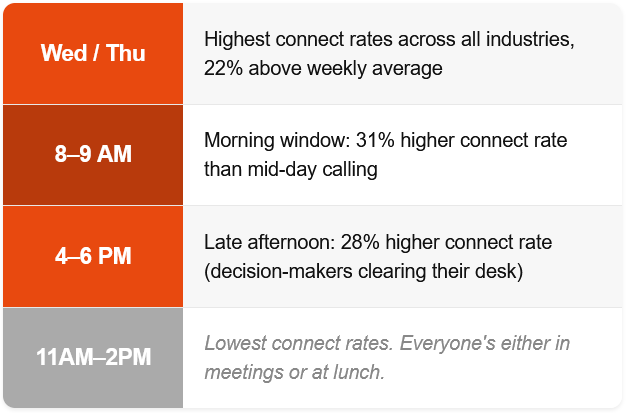
None of that is shocking. But you'd be surprised how many outbound teams call randomly throughout the day and wonder why numbers don't move.
B2B Outreach Sequencing: The Follow-Up Gap
Here's the stat I find most interesting from our survey. We asked reps when they typically stop following up with a cold prospect.
47% said after 1 or 2 touches.
Then we looked at when replies actually happen in their sequences.
That gap, 47% stopping at 2 touches while 62% of replies come after that point, explains a lot of missing pipeline.
Those later touches aren't aggressive follow-ups. They're gentle reminder emails. A short check-in. A different angle on the same problem. Something that says "still here when you're ready" without pressure.
That's what moves the needle. Not persistence. Presence.
Why Follow-Ups Work (It's Not Persistence)
There's a version of this conversation where someone says 'just be more persistent.' That's not what the data says.
Follow-ups work because of timing, not pressure. A problem that wasn't a priority last Tuesday can become an emergency by this Tuesday. Your third email arriving on the right day, completely independent of your persistence, is what makes it work.
Multi-Channel Sequences: The Reality vs. The Assumption
Everyone says they're running multi-channel sequences. What they're often actually running is the same email sent through three different tools.
In our survey, we asked reps to describe their 'multi-channel' sequence. 61% were sending identical or near-identical messages across email, LinkedIn, and phone. 78% had no signal-based triggers to switch channels based on engagement. Only 23% changed their core message angle between channels.
B2B Data Decay: What's Actually Inside Your Contact Database
I want to spend real time on this section because B2B data decay is the most expensive problem in B2B prospecting and the least talked about one.
We have 290M+ contact records. We watch how they change over time. Here's what we see.
How Fast B2B Contact Data Decays
Our ongoing analysis of contact record changes across our database, tracked at 30-day intervals, produced these numbers:
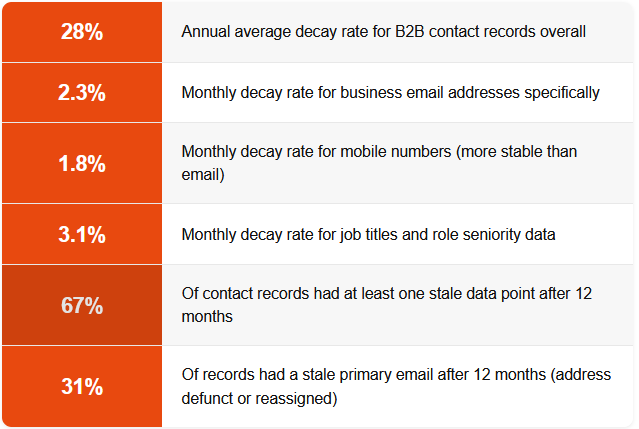
Here's the practical version of that. If you exported 10,000 contacts today and did nothing with them for a year:
- 2,800 of those records would have at least one material inaccuracy
- 3,100 would have a wrong job title or different company
- 3,100 would have a primary email that bounces or goes nowhere
- 1,800 would have a phone number that's been reassigned or disconnected
That's the list you're working from when you run Q4 campaigns off a Q1 export.
What Decays Fastest (And Why)
Not all data fields decay at the same speed. This matters because depending on what you're using the data for, some gaps are more damaging than others.
Business email is the one that hurts most in outbound because it drives bounce rate, which damages domain health and deliverability for everyone you send to, not just the bad contacts.
The Mobile Number Advantage in the Decay Context
Here's something we don't see reported anywhere else.
Mobile numbers decay slower than business emails. They're not tied to employment status the same way. Someone who leaves a company keeps their phone. Their email stops working the day they offboard.
This is why SMARTe invests heavily in mobile number coverage. When someone changes jobs, their mobile number is often still valid. You can still reach them. With just their old business email, you're sending into a void.
In our internal analysis, outreach to verified mobile numbers for contacts who had changed jobs in the previous 90 days had a 38% higher connect rate than equivalent outreach using their last-known business email.
Buyer Behavior Statistics: Why Outbound Feels Harder
Here's the real context for all of the above. The environment has changed.
Buyers aren't ignoring outbound because they don't need what you're selling. They're ignoring it because they've built very good filters. Years of undifferentiated cold email will do that to a person.
The Self-Serve Shift
Our survey asked buyers directly about their research behavior. Here's what they said:
That last number is the one teams should spend more time with. 82% are open to a cold call, but only if it's relevant. The word 'relevant' is doing a lot of work there.
Relevant doesn't mean personalized in the surface-level sense. It means the outreach arrives at a moment when the problem it solves is actually on the radar.
The Buying Committee Reality
Here's why one-contact-per-account outbound fails more than it should.
74% of outbound sequences targeting one contact per account. Nine stakeholders involved in the average decision.
Someone has to lose that math.
Each stakeholder you don't reach is a potential veto. Each one you do reach is a potential champion. Multi-threading isn't a nice-to-have. It's a structural requirement for accounts above a certain size.
What 'Good' Actually Looks Like: System Benchmarks
One of the reasons teams benchmark poorly is that they compare their 4% reply rate to the 'industry average' and feel fine. The gap between fine and great is enormous, and it compounds every month.
Here's what a genuinely high-performing B2B outbound system produces:
The difference between average and top-quartile teams isn't talent. It's system design.
Final Take
B2B prospecting in 2026 isn't broken. It's just unforgiving in a way it wasn't five years ago.
The teams that are doing well aren't necessarily smarter or working harder. They're operating with better inputs. Cleaner data. Tighter ICPs. Signal-based timing. Verified mobile numbers. Sequences that use each channel for what it's actually good at.
The teams that are struggling are usually trying to solve a data and targeting problem with a messaging and volume solution. It doesn't work. It just costs more.
If you want to see what that looks like in practice, SMARTe gives sales teams access to 290M+ verified contacts with mobile numbers, direct dials, real-time email verification, and job change alerts. It's built specifically for teams that have already learned that volume without accuracy is expensive noise.