Here's a scenario most revenue leaders know too well.
You run a campaign. Traffic comes in. Leads fill the form. The team gets excited. Then... silence. Those leads vanish somewhere between "entered CRM" and "closed deal," and nobody can quite explain where they went.
That's sales funnel leakage. And it's more common, more expensive, and more preventable than most companies want to admit.
The frustrating part isn't the leakage itself — it's that it often goes unnoticed for months. Nobody's alerting you to the problem. Your dashboards look busy. Activity is happening. But underneath all that motion, real revenue is quietly slipping through the cracks.
Let's talk about why this happens and, more importantly, how to actually fix it.
What Sales Funnel Leakage Actually Is
Think of your sales pipeline like a plumbing system. You've got pipes, valves, pressure points — all designed to move water from one end to the other cleanly and efficiently. When everything works, leads flow in, get nurtured, and eventually convert.
But when there are cracks in the system? Water escapes. Pressure drops. Things stop working the way they should.
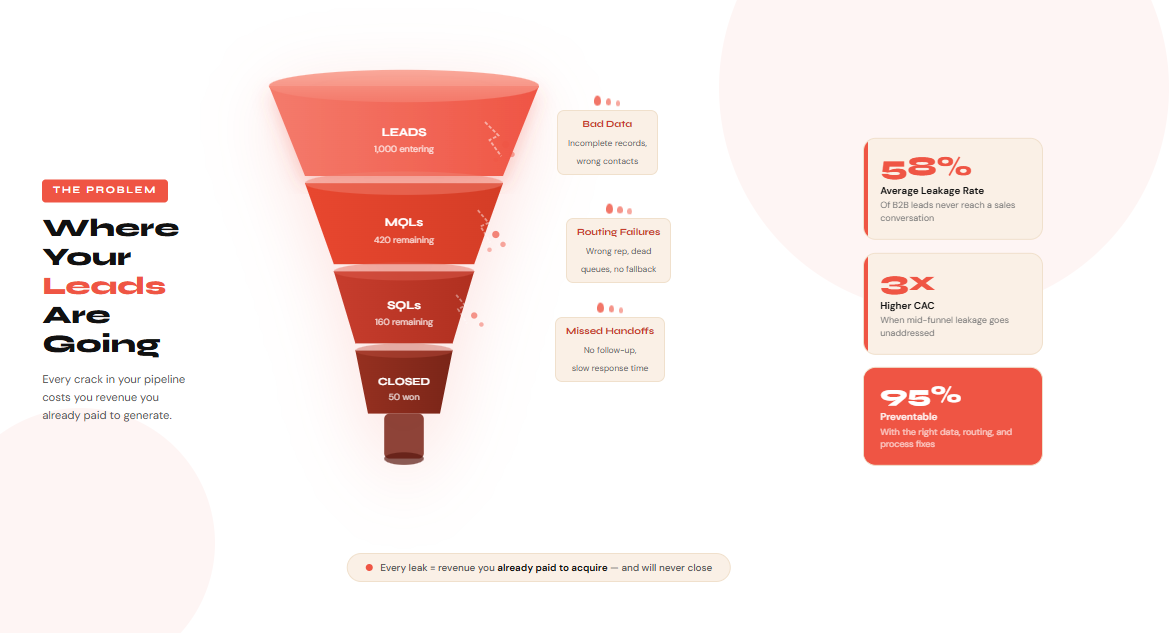
Sales funnel leakage is exactly that — leads escaping before they ever get a real shot at converting. Sometimes it's bad data. Sometimes it's a broken routing rule. Sometimes it's a handoff that never happened. But every leak, no matter how small, represents a missed revenue opportunity.
And here's what makes it genuinely costly: you already paid to acquire those leads. The ad spend, the content, the SDR time — that investment happened. Leakage means you're paying for leads you'll never close.
No business can afford that for long. Not with the cost of acquisition where it is today.

SMARTe GTM Intelligence
Start Smarter Prospecting Today
Where the Leaks Come From
Before you can fix the problem, you need to understand what's actually causing it.
The hidden irony of leaky funnels is that most of the damage happens quietly — not in big, obvious failures, but in small inefficiencies that compound over time.
Here are the warning signs to watch for.
- Leads with incomplete or inaccurate data. If your CRM records are full of gaps — missing job titles, wrong company sizes, outdated contact info — your team can't qualify or route those leads properly. They end up in limbo.
- Leads assigned to inactive users. This one is criminally underreported. Someone leaves the company. Their leads don't get reassigned. Those prospects are now sitting in a dead queue with no one following up.
- Leads stuck in routing queues. Sometimes the automation breaks. Or the rules conflict. Or nobody built a fallback. Either way, the lead goes nowhere.
- Leads assigned during vacation or leave. Your rep is out for two weeks. A hot lead comes in. Nobody picks it up. By the time your rep is back, the prospect has already signed with a competitor.
On the sales side, you know something's wrong when reps are regularly getting leads outside their territory, responding days after the initial inquiry, or operating completely blind to what actions a prospect took before the conversation.
That last one matters more than people realize. If a rep gets on a call with zero context — no idea what the prospect read, clicked, or downloaded — the conversation starts at zero. That's a massive conversion killer.
1. Start With Your CRM Data
Alright, let's get into the fixes. And the right place to start is the foundation: your data.
Bad CRM data is the silent killer of pipeline performance. Incomplete records, duplicate contacts, outdated job titles — when any of these exist, every downstream process breaks. Lead scoring misfires. Routing sends leads to the wrong rep. Nurture sequences miss the mark entirely.
Here is the part most teams get wrong. They treat it as a cleanup problem. They run a scrub, feel good about it, and watch the same issues return within weeks. That is because B2B data decays constantly. People change jobs. Buying committees shift. Accounts evolve. No one-time fix keeps up with that.
The real solution is continuous data enrichment built directly into your workflow. That is where SMARTe earns its place in your stack.
SMARTe automatically enriches CRM records in the background so your data stays accurate without your team lifting a finger. Here is what that means in practice:
- Fills missing contact and company fields the moment a lead enters your CRM
- Covers 55+ B2B data attributes including B2B direct dials, verified emails, firmographics, and technographics
- Tracks job changes so you never lose a champion who moved to a new account
- Keeps historical records fresh so old campaigns and dormant leads stay workable
The result is not just cleaner data. It is a funnel that stops leaking at the source.
See SMARTe working on your actual CRM records. Book a demo today.
2. Audit Your Lead Routing
Here's where most companies find their biggest leaks — and least often look.
Lead routing sounds boring. It's not. Routing is literally the process that decides which rep gets which lead and when. Get it wrong, and everything downstream falls apart.
Start by mapping your lead lifecycle. Not the theoretical version from your onboarding doc — the actual version. Where does a lead come in? What happens next? Who touches it? What system makes the routing decision? What happens if that system hits an exception?
Walk through every touchpoint where your people, processes, and technology interact with a lead. You'll almost certainly find gaps you didn't know existed.
Then audit the mechanics of your routing system: assignment rules, round-robin settings, exception handling, and any custom code that governs how leads move through the system.
Some routing platforms offer detailed audit logs that show exactly why a specific lead was sent to a specific rep. That level of visibility is invaluable. If you don't have it, you're essentially flying blind — and guessing at your leakage sources instead of diagnosing them.
Regular routing audits aren't a one-and-done project. As your team grows, territories change, and campaigns evolve, your routing logic needs to keep up. Treat it like you'd treat any other critical system: check it regularly, document the logic, and build in fallbacks for edge cases.
3. Build a Real Lead Management Strategy
A lot of companies have lead management in theory. Very few have it in practice.
What's the difference? Theory is a diagram on a slide deck. Practice is a living, documented process that every revenue team actually follows — consistently.
A real lead management strategy spans Marketing, Sales, and Customer Success. It's not a handoff document. It's an end-to-end system with clear rules at every stage.
Start with the basics. Where are leads coming from? How are they being captured? What qualifies a lead to move from one stage to the next? When does marketing hand off to sales — and exactly what does that handoff look like?
The qualification criteria piece is where most teams struggle. If marketing thinks a lead is ready at 50 points and sales wants 80, you've already got misalignment. And misaligned handoffs create leakage.
From there, build out your lead scoring model. It should account for fit (does this person match your ICP?), behavior (what have they done on your site and with your content?), and intent (are there external signals suggesting they're actively evaluating solutions?).
Automate what you can — routing, nurturing sequences, alert triggers for high-intent signals. The goal is to make sure no qualified lead sits idle because someone forgot to follow up.
Then measure. Track conversion rates at every stage of the funnel. Where are leads advancing? Where are they stalling? That data will tell you where to focus your optimization efforts.
The companies that run this process well don't just plug leaks. They build pipelines that compound over time — where each iteration of the process performs better than the last.
4. Get Sales and Marketing Actually Aligned
Sales and marketing alignment is one of those phrases that gets used so often it's lost all meaning. Everyone says they're aligned. Almost nobody actually is.
Real alignment isn't a joint Slack channel or a monthly check-in meeting. It's shared definitions, shared metrics, and shared accountability.
Here's what that looks like in practice.
Both teams need to agree on the exact criteria that makes a lead "qualified." Not a vague description — a specific set of conditions. Title, company size, behavior, intent signals, whatever's relevant to your Ideal Customer Profile (ICP). Write it down. Make it official. Revisit it every quarter.
Both teams need to operate under the same metrics. When marketing is measuring MQLs and sales is measuring SQLs with different definitions, reporting becomes a mess and blame becomes inevitable. Unified dashboards with unified definitions remove the ambiguity.
And both teams need to collaborate on funnel performance — not just report on it separately.
Here's a real example of what good alignment looks like in action.
Marketing notices a key campaign is driving solid traffic to a product demo page, but the conversion rate is below 1%. They bring the data to sales. Sales shares feedback from actual calls — turns out, prospects care far more about data compliance than ease of use, which is what the page was focused on.
Together, they rewrite the headline, rework the value prop, and add a short video from a sales rep speaking directly to the compliance concern. Sales tests the updated messaging in follow-up sequences. Marketing A/B tests CTA placement and form length.
Two weeks later, conversion is up 40%.
That's what aligned teams do. They solve problems together instead of assigning blame separately. And when that happens, leakage drops fast.
5. Follow Up — And Follow Up Well
Not every lead that hits your funnel is ready to buy. That sounds obvious, but a lot of sales teams treat unreadiness like rejection and move on.
That's a mistake. A lead who isn't ready today might be your best customer in six months. The question is whether you'll still be relevant when they get there.
This is where nurture programs do their best work. The goal is simple: stay present, stay useful, and make sure that when a prospect's timing changes, you're the first brand that comes to mind.
What does good nurture look like? Content that matches where the prospect is in their journey. Emails that speak to their specific role and pain points. Touchpoints that feel helpful rather than pushy.
The technology part matters here too. Sales intelligence tools can surface buying signals — things like job changes, funding announcements, or specific intent data that suggests a prospect is actively evaluating solutions. When those signals appear, you want your reps to know immediately, not three weeks later.
And here's a step that often gets skipped: feedback loops between sales and marketing on leads that didn't convert.
If a lead goes to sales and doesn't progress, why not? Was the timing wrong? Was there a budget issue? Was the qualification criteria off? That information is gold for refining your nurture strategy. Build a formal feedback process so those insights don't get lost in post-call notes nobody reads.
Not every lead will convert — that's just the reality of sales. But every lead deserves a proper process before you write them off.
The Bigger Picture
Here's what's worth stepping back to appreciate: B2B sales funnel leakage isn't a single problem with a single fix.
It's a systems problem. And systems problems require systems thinking.
The five areas above — data quality, lead routing, lead management, sales and marketing alignment, and lead nurturing — are all interconnected. A fix in one area will often surface a new issue in another. That's normal. That's how you know the system is working the way it should.
The companies that consistently win on pipeline performance aren't the ones who found the magic tool or ran the perfect campaign. They're the ones who built disciplined, documented processes and kept improving them over time.
The leaks don't stop because you plugged one hole. They stop because you built a culture of accountability around pipeline health — where everyone from marketing ops to the AE team has visibility into where leads are going and why.
Where to Start
If you've made it this far and you're wondering where to actually begin, here's the honest answer: start with the data.
Pull your last 90 days of lead records. Look at completeness rates, routing accuracy, and time-to-follow-up. Those three numbers will tell you where your biggest leaks are.
From there, work outward. Fix the data foundation. Tighten the routing rules. Align on definitions. Build the nurture infrastructure. Measure obsessively.
It's not glamorous work. But it's the work that turns a leaky pipeline into a consistent revenue engine.
And in a market where every lead costs more to acquire than it did two years ago, that matters more than ever.