TL;DR:
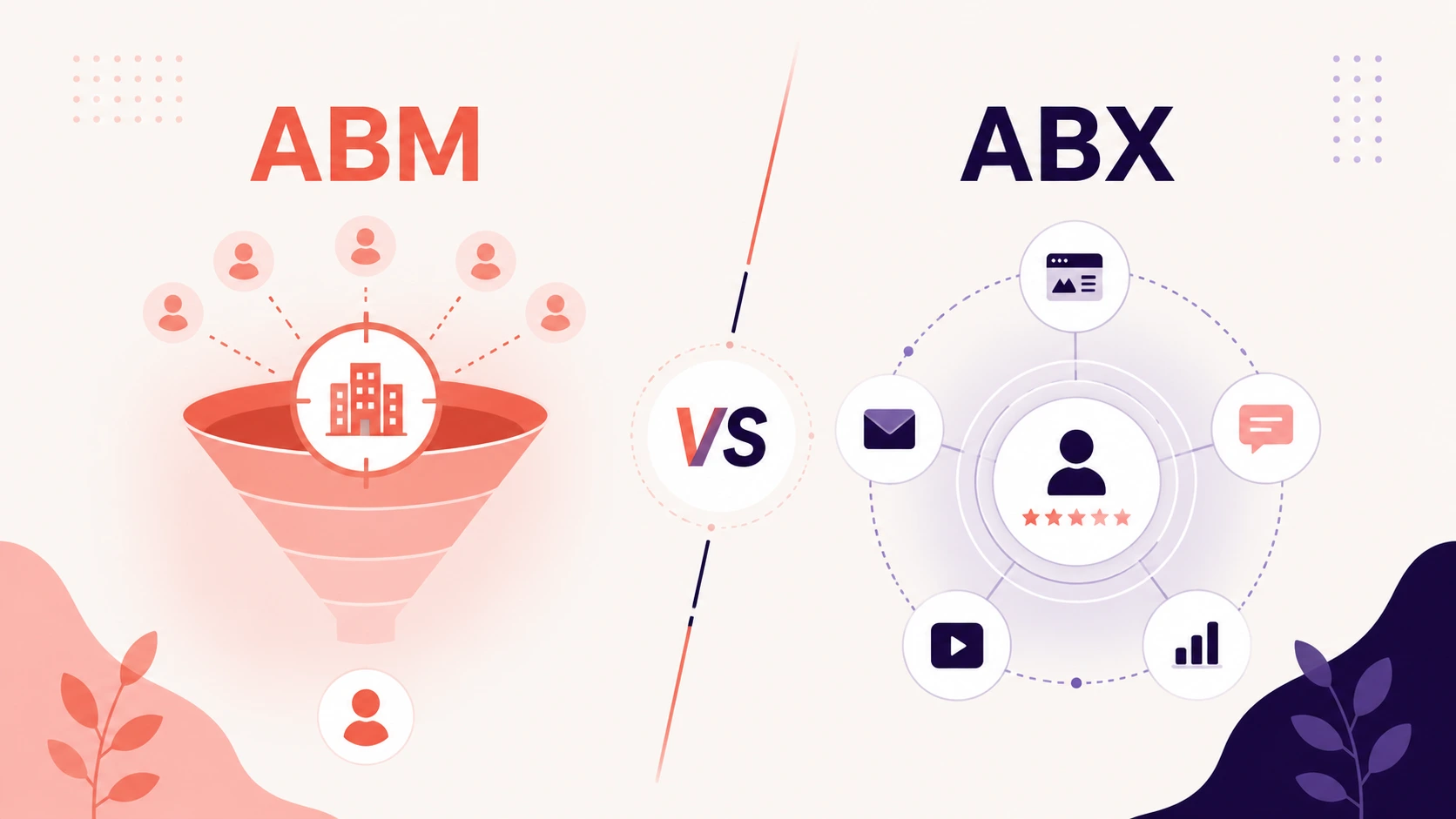
ABM (account-based marketing) targets high-value accounts to win new pipeline through marketing and sales, and it ends at the closed deal. ABX (account-based experience) uses the same account targeting but extends it across the full customer lifecycle, from first touch to renewal, and adds customer success. In short, ABM wins accounts, while ABX wins, keeps, and grows them.
ABM vs ABX:
- Goal: ABM wins new accounts. ABX wins, retains, and expands them.
- Teams: ABM aligns marketing and sales. ABX adds customer success as a third team.
- Lifecycle: ABM runs from first touch to closed-won. ABX runs from first touch through renewal and expansion.
- Data: ABM works from static target lists. ABX runs on live intent signals.
- Metrics: ABM tracks pipeline and deals won. ABX also tracks retention, expansion, and satisfaction.
- Relationship: ABX includes ABM. It evolves ABM rather than replacing it.
Account-based marketing (ABM) and account-based experience (ABX) both focus your go-to-market effort on a defined set of high-value accounts instead of the whole market. The difference is scope and timing.
ABM targets accounts to win new pipeline. It runs from first touch to closed-won, driven by marketing and sales. ABX keeps the same account targeting but carries it across the full customer lifecycle, from first touch to renewal and expansion, and adds customer success to the team.
The one-line version: ABM wins accounts. ABX wins, keeps, and grows them.
Below is a full breakdown of what each strategy does, how they compare side by side, and how to decide which one fits your team.
What Is ABM (Account-Based Marketing)?
Account-based marketing is a B2B strategy where marketing and sales pick a defined list of high-value accounts and target each one with personalized campaigns. Instead of chasing lead volume, you treat each account as a market of one.
The goal is quality over quantity. You spend budget on accounts that fit your ideal customer profile, not on a wide net of unqualified leads. ABM aims to win accounts, and it stops at the deal.
Types of ABM
Teams usually run ABM at three levels of personalization:
- One-to-one: Deep personalization for a small set of top-tier accounts, with custom content and named account plans.
- One-to-few: Grouped campaigns for accounts that share an industry, company size, or pain point, with lighter personalization at the cluster level.
- One-to-many: Programmatic ABM across a larger list, using firmographic and intent filters to scale targeting.
What ABM Measures
ABM reports on acquisition. The metrics track how well you engage and close target accounts:
- Pipeline created from target accounts
- Account engagement and coverage
- Meetings booked and opportunities won
- Average deal size and win rate
If you want the full list of numbers to track, see these account based marketing metrics and how the account based marketing funnel moves accounts from cold to closed.
What Is ABX (Account-Based Experience)?
Account-based experience extends account-based targeting across the full customer lifecycle. It uses the same target accounts as ABM, but the effort does not end at the sale. Marketing, sales, and customer success work from one shared view of each account, from first touch through onboarding, renewal, and expansion.
ABX treats the experience itself as the product. Every touchpoint, whether a marketing email, a sales call, or a customer success review, connects back to the account's context.
How ABX Works
- One account view: Every customer-facing team sees the same data, signals, and history for each account.
- Live signals over static lists: Real-time intent data updates account priority as behavior changes, instead of waiting for a quarterly list refresh.
- Full-lifecycle coverage: Targeting continues through post-sale stages, not just acquisition.
- Role-based personalization: Messaging adapts to each stakeholder in the buying group, not a single contact.
What ABX Measures
ABX reports on the whole relationship, so the metrics reach past pipeline:
- Pipeline and deals won (the same acquisition numbers as ABM)
- Net revenue retention
- Expansion and upsell revenue
- Customer satisfaction and renewal rate
Customer success also acts on marketing buying signals, which means they can spot an account researching an expansion use case before anyone opens a support ticket.
ABM vs ABX: The Key Differences
Both strategies share a target account list and a data foundation. What separates them is how far the effort runs and who owns it. Here is the side-by-side comparison.
1. Scope: Acquisition vs Full Lifecycle
This is the main difference. ABM aims at winning the account. Once the deal closes, the ABM program moves on to the next target.
ABX keeps the same account in focus after the sale. It covers onboarding, adoption, renewal, and expansion with the same coordinated attention that won the deal.
2. Teams: Two Functions vs Three
ABM aligns marketing and sales around a shared account list. ABX adds customer success and gives all three teams the same account view.
The Handoff Gap ABX Closes
In a lot of ABM programs, the experience breaks at the handoff. Marketing runs a strong campaign, the account engages, then the lead drops into the CRM and a rep sends a generic follow-up. The account-based work falls apart at the seam. ABX closes that gap by keeping every team on the same context from first touch through renewal.
3. Data: Static Lists vs Live Signals
ABM often works from a target list that gets refreshed on a schedule. ABX runs on live signals. Buying intent, engagement, and firmographic changes move accounts up or down the priority order in real time, so teams act on what is happening now rather than last quarter's list.
Why B2B Teams Are Shifting from ABM to ABX
Two drivers push this shift, and both trace back to revenue.
Buying Committees Have Grown
The single decision-maker is gone. Gartner found that B2B buying groups now range from five to sixteen people across as many as four functions.
ABM aimed at the marketing contact leaves the rest of that committee untouched: the CFO, the security lead, the end users. ABX engages the whole group with role-specific messaging, which is why larger deals already lean this way. Enterprise account based marketing has looked a lot like ABX for years.
Post-Sale Revenue Drives Growth
For many B2B SaaS companies, renewals and expansion bring in more revenue than net-new deals. ABM ignores everything after the contract. ABX treats a signed customer as an account that keeps getting coordinated attention, which turns customer retention strategies into a shared goal across marketing, sales, and CS rather than a customer success afterthought.
When to Use ABM vs ABX
You do not have to pick one forever. Match the strategy to your goal and your maturity.
Use ABM If:
- Your priority is net-new pipeline and acquisition.
- Your team is small and still proving that account targeting books meetings.
- Your buying deals involve one or two contacts, not a full committee.
- Your data foundation needs work. Fix accuracy before you scale the motion.
Use ABX If:
- Renewals and expansion make up a large share of your revenue.
- Your deals run through large, cross-functional buying committees.
- Marketing, sales, and customer success can align on shared account goals.
- You have clean, current account data to power a live account view.
A quick reality check: ABX on a broken data foundation just spreads bad records across three teams instead of one. Get the data right first, then extend the motion.
Can You Use ABM and ABX Together?
Yes, and many teams do. The two strategies share a target list and a data layer, so they stack well.
A common setup runs ABM campaigns to acquire new accounts, then shifts those accounts into an ABX motion for onboarding, retention, and expansion. Treated as one connected go to market strategy, ABM handles the front of the relationship and ABX handles the rest.
If you plan to run both, align your metrics before you buy tooling. Agree on what counts as success across all three teams, then look at account based marketing software to carry the load.
Both Strategies Depend on Data Quality
ABM or ABX, the win depends on the same thing: accurate data about who the account is and who inside it makes the decision. A live account view built on stale records is guesswork with a nicer dashboard.
That is the foundation SMARTe provides. With 289M+ verified B2B contacts and 75%+ US mobile coverage, your target accounts and buying committees stay accurate at the point of use, so both strategies run on real data instead of decay.
See how SMARTe finds verified contacts inside your target accounts before you build out your account-based motion.