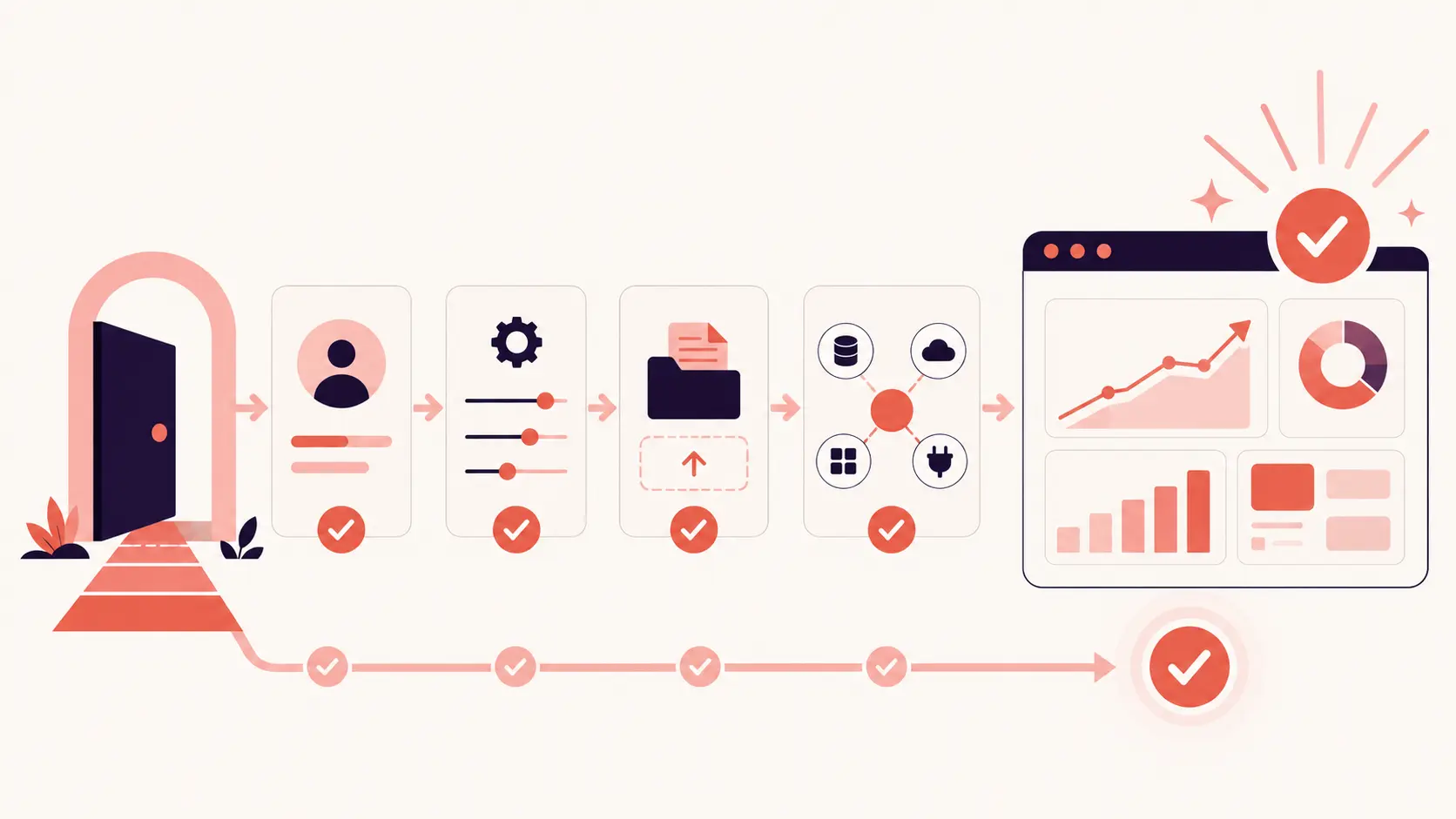
TL;DR:
2B customer onboarding is the structured process that moves a new customer from signed contract to real, measurable value. Cutting the time this takes, known as time to first value (TTFV), is one of the strongest predictors of renewal in the entire customer lifecycle.
- Time to first value (TTFV) is the gap between contract signature and the customer's first real win, not the day training ends.
- Onboarding runs through five stages: handoff, kickoff, implementation, first value, and adoption. Skipping any of them adds weeks.
- The sales-to-CS handoff is where the clock usually starts losing time, often before a kickoff call is even scheduled.
- The buying group problem: the stakeholders who signed the deal are rarely the exact people who show up to onboarding, and almost nobody checks for that.
- Somewhere between 60% and 70% of B2B SaaS churn traces back to what happened, or didn't, in the first 90 days.
- The right metrics (handoff completeness, activation by stakeholder, 90-day churn rate) predict retention. Checklist completion doesn't.
A deal closes on a Friday. Everyone claps in the sales Slack channel. The AE sends a bottle of something nice. Then the CS team inherits a customer they've never spoken to. Six weeks later, that customer still hasn't logged in for a second time.
That gap, between "signed" and "actually using this thing," is where B2B customer onboarding programs fail. Not with a dramatic support ticket or an angry email. Customers rarely announce that they're checking out. They just stop logging in, and a customer who stops logging in almost never renews.
I've watched onboarding get treated like a formality: a kickoff call, a training deck, a shared Slack channel, and a bit of hope. None of that is wrong exactly. It's just not what decides whether a customer sticks around. Time to first value is.
This guide covers what a lot of onboarding checklists skip:
- The five stages every onboarding process actually moves through.
- The buying group problem almost nobody checks for.
- A 90-day framework, with a table you can copy into your own onboarding plan.
- The metrics that predict renewal, and the ones that just look tidy on a dashboard.
- Early churn signals, common mistakes, and a full quick-reference checklist at the end.
1. What Is B2B Customer Onboarding? (And What "First Value" Really Means)
B2B customer onboarding is the structured process a company uses to move a new customer from a signed contract to full, confident use of the product or service. It covers the handoff from sales, initial setup, training, and the first meaningful result the customer experiences.
Time to first value, or TTFV, measures the time between that signed contract and the moment a customer experiences a real, specific outcome. It is not the day training technically ends.
What counts as "first value":
- A live workflow running in production, not a sandbox demo.
- A report or dashboard delivered to a real stakeholder who uses it.
- A task that used to take hours now taking minutes, with proof.
- A specific number the customer can point to as proof the product is working.
What does not count as "first value," even though teams often score it that way:
- Logging in for the first time.
- Completing an onboarding checklist item.
- Attending a training call.
- Configuring a setting nobody has used yet.
That distinction matters, because plenty of teams measure something easier instead: days to launch. Days to launch tracks how long it takes to get a customer configured, trained, and live. TTFV tracks how long it takes them to benefit. The two numbers should sit close together. In a lot of companies, days to launch finishes and TTFV keeps going, like a runner who crossed the wrong finish line and kept jogging anyway.
Plenty of SaaS companies treat "onboarded" and "activated" as the same word. They aren't. A customer can finish every training module and attend every call, and still never reach the point where the product solves the problem they paid for. That's not an activated customer. That's a customer with a tidy completion badge and no reason to renew.
If you only track completion rates, you're measuring effort, not outcome. Effort has never once stopped a customer from churning in month four.
2. The 5 Stages of a B2B Customer Onboarding Process
Every onboarding program, however it's branded internally, moves through the same five stages. Naming them clearly, with a defined owner and exit condition for each, is what makes the process repeatable instead of improvised account by account.
A few things worth calling out about this table:
- Stage 1 and Stage 2 are where delays typically start, not Stage 3, even though implementation is the one that usually gets blamed.
- Exit criteria should be outcomes, not dates. A stage without a real exit condition tends to run long without anyone noticing, because there's no clear signal that it's actually finished.
- Stage 5 technically never ends. That is exactly why so many teams stop measuring it the moment onboarding gets marked complete.
What to do: Give each stage a named owner and write down its exit criteria before the account ever reaches that stage. If you can't name who owns Stage 1 in your organization right now, that's usually your first real answer for why onboarding runs long.
3. Why B2B Onboarding Takes Longer Than It Should
Ask five different CS leaders why their onboarding runs long, and you'll get five different answers. Underneath the specifics, a lot of them come down to the same three root causes.
1. The Sales-to-CS Handoff Loses Time First
The handoff from sales to customer success is supposed to work like a relay baton. In practice, it's often a Slack message that says "closed, go get 'em," attached to a CRM record nobody has touched since the first discovery call.
What typically goes missing in a weak handoff:
- The specific outcome the customer expects, in their own words.
- Any commitment the AE made verbally but never logged (a particular integration, a hands-on rollout, a specific go-live date).
- The full list of stakeholders involved in the decision, not just the signer.
- Technical prerequisites the deal already assumed were in place.
Promises made on slide seven of a sales deck don't automatically land in the CS team's task list. Customers remember every one of those promises anyway, even the ones nobody wrote down.
What to do:
- Build one handoff document that pulls from the CRM automatically. Don't rely on an AE remembering to fill out a form on a Friday afternoon.
- Require a short recorded call, or a written summary, between the AE and the CSM before the customer's kickoff, so nothing gets relayed secondhand.
- Flag any commitment made in the sales cycle as a task with an owner, not a footnote in a deal note.
If your CRM data is already inconsistent going into the handoff, you're not handing off information. You're handing off a guess. That's part of why bad CRM data causes onboarding delays weeks before anyone notices a churn number move.
2. Every Customer Gets the Same Onboarding Plan
A lot of onboarding programs get built for the average customer. The trouble is, the average customer doesn't exist. A 50-person startup buying your product to fix one workflow doesn't need the same six-week sequence. A 3,000-person enterprise account, with four business units and a security review pending, does.
Signs your onboarding isn't actually segmented:
- Every account gets the same email cadence regardless of deal size.
- The same training deck covers a five-user account and a five-hundred-user rollout.
- Nobody can tell you, without checking, which onboarding "track" a given account is on.
Plenty of CS teams still run one playbook for everyone, mostly because building five playbooks feels like more work than building one. It is more work. It's also the difference between a customer who reaches value in twelve days and one who's still stuck on step four of a generic checklist in week seven.
What to do: Segment onboarding paths by deal complexity, not just contract size. Two customers can pay the same amount and still need completely different onboarding motions. Building around a shared ideal customer profile from the start gives CS a head start. It shows which accounts need the fast lane and which ones need the full escort.
3. Nobody Agreed on What "First Value" Looks Like
Here's a question worth asking before kickoff ever gets scheduled: does the customer's definition of value match yours?
When those three definitions don't match, the customer basically gets onboarded twice, once by sales' definition and once by yours. That's b2b sales and marketing alignment breaking down in a new place, well after the contract instead of before it.
Across B2B SaaS, average activation rates sit around 37.5 percent, according to Userpilot's onboarding benchmark research. Read that number again. Roughly two out of three new customers never reach the value they paid for. Plenty of them never complain. They just don't renew.
4. The Buying Group Problem Onboarding Guides Never Mention
Nearly every onboarding guide on page one of Google walks you through kickoff calls, training cadences, and adoption checklists. Almost none of them ask a more basic question: is the buying group you're onboarding the same one that bought?
1. The Buying Group That Signed Isn't Always the One That Shows Up
B2B deals close slower and involve more people than they used to. The average b2b buying group now runs somewhere between six and thirteen stakeholders, depending on deal size, and that number has been climbing for years. By the time legal, IT, procurement, and three separate department heads have all weighed in, the sales cycle alone can stretch past four months.
Reasons a buying group looks different by kickoff than it did at signature:
- The champion got promoted into a different role.
- The technical evaluator changed teams or left the company.
- A reorg moved the account to a different business unit.
- The executive sponsor delegated the relationship to someone new, without telling anyone on your side.
Kickoff calls with three of the wrong five people on the invite happen more often than teams want to admit.
I'll be honest, this part surprised me the first time I dug into onboarding data closely. Sales teams spend months carefully mapping buying group intelligence during the deal. Then that map gets filed away. Nobody checks it again. All that stakeholder work expires, somewhere between signature and kickoff, without anyone deciding it should.
2. What to Verify Before You Ever Book the Kickoff Call
Before a single kickoff invite goes out, someone on the CS side should confirm the following:
- Who's still at the company. People leave, get promoted, or move teams during a four-month sales cycle more often than plenty of CS teams plan for.
- Who's still in the role that mattered during the sale. A title change can quietly remove your champion's authority to approve anything.
- Who's actually going to use the product day to day. In my experience, that list is rarely the same as who signed off on the budget.
- Whether the contact data itself has decayed. Track job changes on key contacts, and check whether b2b data decay has already made part of your handoff record stale.
- Whether you're relying on a single point of contact. Multi-thread the account early, the same way you would during multi-threaded selling in the sales cycle itself.
A ten-minute check here can save a two-week detour later. Imagine finding out the champion left three weeks before your kickoff call, and nobody thought to mention it. Nobody's trying to catch the sales team doing something wrong here. Contact data simply ages fast, and a deal that took four months to close gives it plenty of time to go stale before onboarding even begins.
5. SMB vs. Enterprise Onboarding: Why One Playbook Never Works
Deal size changes what onboarding is supposed to accomplish, and it changes how long that should reasonably take.
A 50-person company buying a point solution to fix one workflow can often reach first value in under a week, sometimes without a single human touch from your team. A 3,000-person enterprise account with a security review, four integrations, and a phased rollout plan is a different animal entirely. Trying to force either one through the other's timeline is where a lot of "why is onboarding taking so long" complaints actually start.
What to do: Set TTFV targets by segment, not company-wide. An enterprise account hitting first value in 45 days might be ahead of schedule. An SMB account taking the same 45 days is almost certainly behind.
6. A 90-Day Framework to Cut Time to First Value
Frameworks are everywhere in onboarding content. A lot of them are just a checklist with day numbers stapled on. Strip the jargon away and the useful ones boil down to one idea: confirm before you commit, then get to one real win as fast as possible.
1. Days 1 to 7: Confirm, Don't Assume
The first week isn't about training. It's about confirming everything sales assumed was still true.
- Confirm the stakeholder map.
- Confirm the specific outcome the customer expects, not the outcome sitting in your onboarding template.
- Confirm technical prerequisites: SSO setup, data migration scope, integration dependencies, and any pending security sign-off.
What to do: Send one short, specific email in week one. Ask the customer to confirm three things: their primary contact, their success metric, and their target go-live date. You'd be surprised how often those three answers don't match what's already sitting in the CRM. Some teams handle this well by keeping their RevOps tech stack connected end to end, so confirmation stops being a manual scramble every time a deal closes.
2. Days 8 to 30: Get to One Undeniable Win
This is where onboarding plans usually try to do too much. They walk the customer through every feature and every setting before that customer has felt a single real result.
Pick one outcome. Choose the smallest, fastest, clearest win available, based on what this specific customer cares about. Get them there before anything else. A customer who's seen one real result will sit through the rest of the setup. A customer who's only seen a dashboard tour is already checking out.
I've seen teams resist this because it feels incomplete, like skipping steps. Nothing gets skipped. The work just gets sequenced so the customer feels the product working before you ask them to learn everything it does.
3. Days 31 to 90: Widen Usage Without Widening Confusion
Once that first win lands, expand. Bring in the second use case, the additional users, the more advanced features. Do it in order of what's easiest to adopt, not what looks impressive in a demo.
This is also the window where customer retention strategies start mattering more than onboarding tactics. The goal shifts from "get them to value" to "make that value repeatable," which is a different skill than the one that got them through week one.
7. The Onboarding Metrics That Actually Predict Retention
Onboarding dashboards love to track completion. Completion feels comforting and tells you almost nothing. Here are five numbers that genuinely predict whether a customer sticks around.
A few of these deserve more context:
- Time to first value vs. days to launch. Days to launch tells you how long implementation took. TTFV tells you how long it took the customer to benefit. Track both, separately, for every account. If you only track one, you're missing the half that predicts churn.
- Handoff completeness. Mapping the full customer journey from first sales touch through onboarding and beyond makes these gaps visible. Otherwise they stay buried across three systems that never talk to each other.
- Activation by stakeholder. Pair this with a broader look at RevOps KPIs, so onboarding metrics don't live in a silo, cut off from the rest of the revenue funnel.
- 90-day churn rate. Somewhere between 60% and 70% of B2B SaaS churn happens within the first 90 days. Customers who don't complete structured onboarding churn at meaningfully higher rates than those who do.
Amplitude's 2025 benchmark research looked at more than 2,600 companies. It found a direct line between how fast a product delivers value and how well it retains users over time, according to Amplitude's product benchmark findings. Products that got customers to value quickly saw stronger long-term retention across every cohort measured. Onboarding speed isn't a nice-to-have metric. It's a retention lever.
8. Early Churn Signals to Watch For During Onboarding
Health scores catch problems late. By the time a health score turns red, the customer has usually already made up their mind. A handful of signals show up earlier, if anyone's looking for them:
- Login frequency drops in week two or three, even if the account "completed" kickoff on schedule.
- The champion goes quiet. A stakeholder who was active during the sale and kickoff stops responding to check-in emails.
- A single task stalls for more than a week. One blocked task, left unresolved, typically delays full onboarding by 8 to 14 days on its own.
- The false progress problem. A CSM marks a step "complete" because they sent the training video, not because the customer watched it. The dashboard looks healthy. The customer has no idea what value they're supposed to be getting.
- Executive sponsor disengagement. The senior stakeholder who joined the kickoff call stops showing up to anything afterward.
- A shared Slack or email thread goes silent across multiple stakeholders at once, not just one person going quiet.
- Support tickets shift in tone, moving from setup questions ("how do I configure X") to frustration ("this still isn't working").
What to do: Build this list into your onboarding tracker as flags, not footnotes. Assign a specific person to act on each one within 48 hours. Waiting for the health score to catch up costs the account weeks it doesn't have.
9. Onboarding Mistakes That Add Weeks to Time to First Value
A handful of the same habits show up across the slowest onboarding motions.
- Waiting for a "perfect" kickoff date instead of starting confirmation work the day the customer signs the contract. Every day between signature and first outreach is a day the customer's initial excitement cools off.
- Treating every touchpoint the same, whether it's a kickoff call or a two-line support reply. Map customer touchpoints by how much each one matters instead.
- Building onboarding content for feature completeness instead of outcome speed. Nobody's job depends on knowing every setting in your product on day one.
- Letting the sales handoff sit in a queue for a week because someone will get to it eventually. Someone rarely gets to it in time.
- Measuring success by internal milestones (contract signed, kickoff held, training complete) instead of customer milestones (first result achieved, second use case adopted). A completed checklist has never once convinced a CFO to renew a contract.
- Marking tasks complete on assumption, not confirmation, the false-progress problem described above. It's one of the least discussed reasons "healthy-looking" accounts still churn at renewal.
- Skipping the buying group refresh before kickoff, then finding out three weeks in that half the invite list has changed roles.
- Running onboarding entirely inside the CRM, when a CRM is built for sales tracking, not for collaborating with the customer on a shared plan.
10. Where Onboarding Software Fits (and Where It Doesn't)
A wave of dedicated onboarding and implementation platforms has shown up over the past few years, built to replace the spreadsheet-and-email approach a lot of teams start with. Broadly, they fall into three categories:
- Implementation and project platforms that manage tasks, timelines, and a shared customer-facing view of progress.
- Digital adoption tools that layer in-app guidance, tooltips, and product tours directly into the software itself.
- Customer success platforms that track onboarding as one phase inside a broader health-scoring and renewal workflow, often supported by AI in customer service for monitoring and follow-up.
None of these tools fix a handoff built on stale contact data or an unverified buying group. They organize the work. They don't verify who the work is for. That verification step comes first: confirming the people, the roles, and the account context before the tooling ever gets involved. It's the piece a lot of B2B teams skip, and it's the one this guide has spent the bulk of its time on.
11. A Quick-Reference B2B Onboarding Checklist
Use this as a working checklist across the first 90 days. It's deliberately short enough to actually use.
Before kickoff:
- Confirm the handoff document is complete and reviewed by CS.
- Verify the buying group is still accurate: roles, titles, and who's still at the company.
- Confirm the customer's definition of "first value" in their own words.
- Flag any commitment the AE made during the sales cycle as a task with an owner.
Days 1 to 7:5. Send the week-one confirmation email covering contact, success metric, and go-live date.6. Confirm technical prerequisites: SSO, integrations, and data migration scope.7. Assign a named owner and exit criteria for every remaining stage.
Days 8 to 30:8. Identify the single fastest path to one real result.9. Sequence training around that one outcome, not the full feature set.10. Track activation by stakeholder, not just by account.
Days 31 to 90:11. Introduce the second use case and additional users.12. Monitor the early churn signals from Section 8 on a weekly cadence.13. Confirm the account's health score and its expansion or renewal path.
Cutting Time to First Value Is a Trust Problem, Not a Speed Problem
Cutting time to first value isn't really about speed for its own sake. It's about respecting the fact that a customer just spent budget, political capital, and trust on a decision. They now have to defend that decision internally. The faster they can point to something real and say "this is already working," the safer that decision feels. That's true for them, and for whoever signed off on the budget above them.
A lot of onboarding programs fail without any single dramatic moment. It's rarely because anyone was careless. The handoff, the buying group, and the plan itself all get built for an account that doesn't quite match the one that walked through the door. Fix that mismatch first. The training, the checklists, and the kickoff decks all work better once the foundation underneath them is accurate.
Is your CS team starting onboarding with contact data that's already a few months stale? Fix it before your next kickoff call, not after your next renewal conversation. See how SMARTe keeps buying group and contact data accurate from handoff through renewal.
The onboarding programs that work best don't feel like programs at all. They feel like someone paid attention to what this specific customer needed, and got them there without wasting a single week proving it.