TL;DR:
The B2B sales cycle is the step-by-step process a sales team follows to move a prospect from first contact to a closed deal. It runs across defined stages, each with a specific goal and exit condition. Most B2B cycles are getting longer, not shorter, and most deals stall not because a competitor wins but because the buying committee loses alignment.
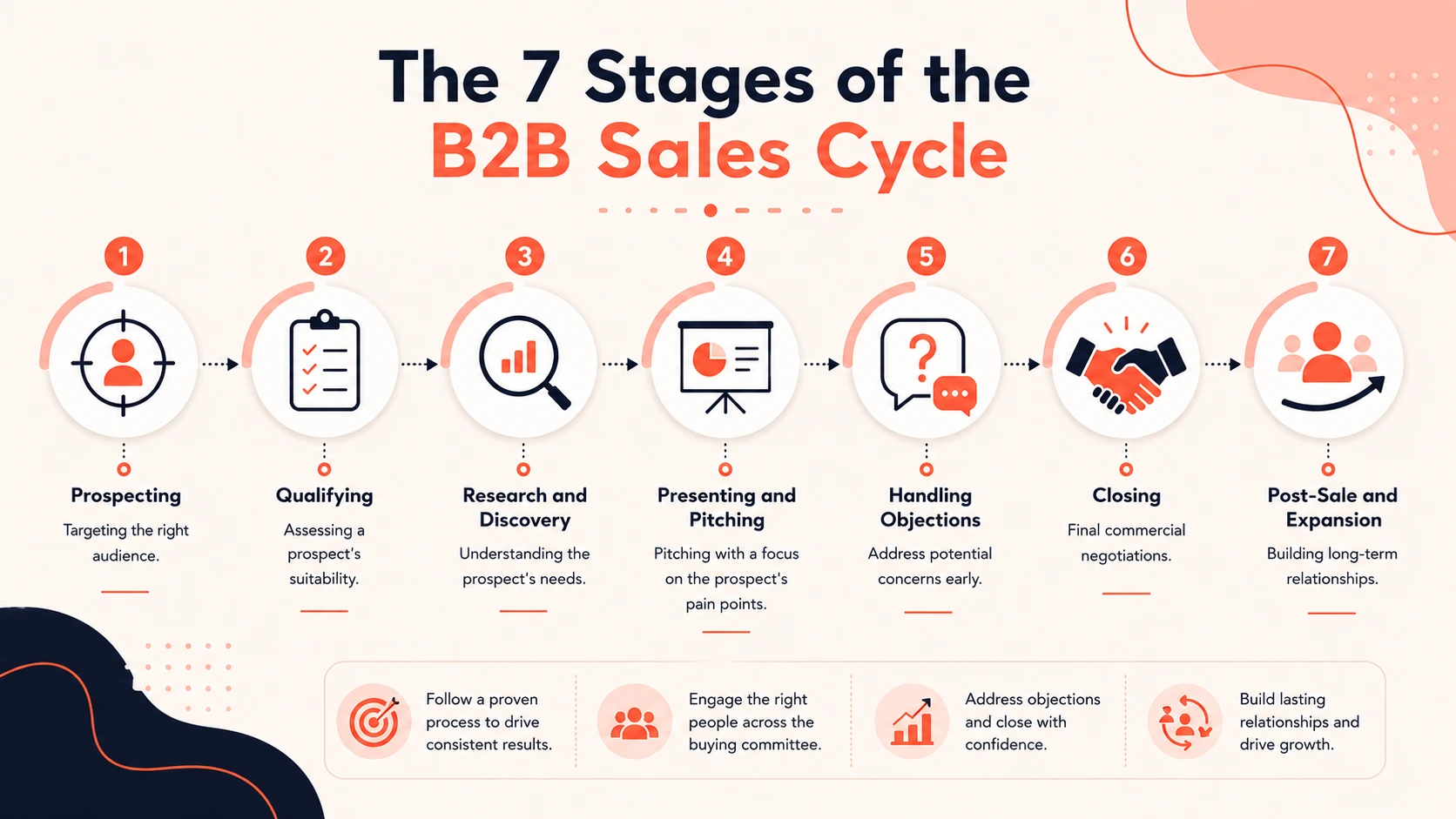
- The 7 stages: prospecting, qualifying, research and discovery, presenting, handling objections, closing, and post-sale expansion
- Cycle length varies by deal size: SMB deals close in weeks, mid-market in 1 to 3 months, enterprise deals above $100K commonly run 6 months or longer
- Cycles are lengthening: Ebsta's analysis of 4.2 million opportunities found B2B sales cycles running 38% longer than in 2021
- Most deals stall internally: Forrester found 86% of B2B purchases stall at some point, usually from committee misalignment or budget hesitation, not a competitor winning
- Buyers spend very little time with reps: Gartner research shows buyers spend only 17% of their purchase journey meeting with suppliers. When comparing multiple vendors, each rep gets just 5 to 6% of that time
- Buying committees are large: the average B2B buying decision involves 6 to 10 stakeholders (Gartner) and around 13 people across two or more departments (Forrester)
- Multi-threading is the biggest cycle lever: Gong's analysis of 1.8 million opportunities found closed deals carry roughly twice the buyer contacts of lost ones, with a 130% win rate lift on deals above $50K when reps go wide early
- 5 proven ways to shorten the cycle: fix contact data quality first, qualify harder at stage two, multi-thread from the first discovery call, prioritize in-market accounts using intent signals, and standardize the SDR-to-AE handoff
- Three metrics that diagnose a broken cycle: sales velocity (opportunities × deal size × win rate ÷ cycle length), pipeline coverage ratio (target: 3x to 4x), and average age of open deals by stage
- Data quality affects every stage: B2B contact data decays fast. Stale records compound into bounced emails, missed dials, and pitches landing on people with no authority, slowing every stage of the cycle, not just prospecting
Everyone blames the B2B sales cycle when a quarter goes wrong. Long timelines. Missed quota. Reps who can't close. But in most stalled pipelines I've looked at, the breakdown is in the process itself. Stages blur into each other. Nobody holds the qualification gate. Handoffs drop context. The contact list is full of people who changed jobs six months ago.
Most B2B deals don't die because a competitor won. They stall because the buying committee loses alignment, runs out of budget clarity, or simply runs out of momentum. The status quo kills more pipeline than any rival vendor.
A well-run B2B sales cycle won't prevent all of that. But it tells you which stage is breaking and when, instead of leaving you guessing after the quarter closes.
What Is the B2B Sales Cycle?
The B2B sales cycle is the structured sequence of stages a sales team follows to take a prospect from first contact to a signed deal and beyond. Each stage has a defined goal, a set of actions, and an exit condition that has to be met before a deal advances.
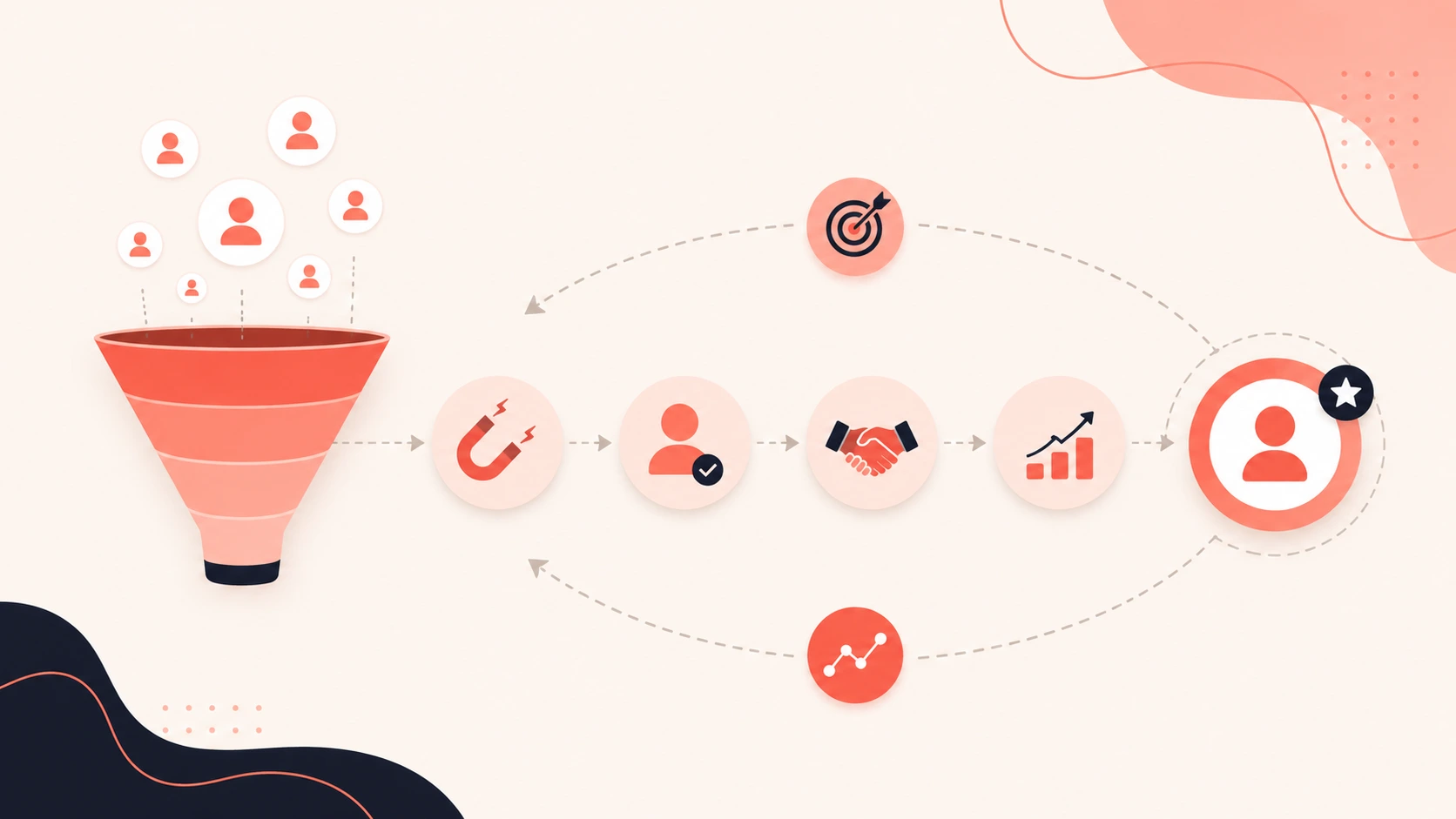
Three terms get tangled here, so it helps to separate them. The B2B sales funnel describes the deal from the buyer's side, awareness through decision. The B2B sales process is the methodology your team uses to sell. The sales cycle is the stage-by-stage map you run against each live opportunity.
The distinction matters because most teams measure the cycle in aggregate and miss which stage is actually stretching. A clear cycle gives managers visibility into where deals stall, gives reps a repeatable map, and gives revenue ops a shared way to measure what moves pipeline.
The cycle has also changed shape. Gartner research shows B2B buyers now spend only 17% of their total purchase journey meeting with potential suppliers, and when they compare multiple vendors, any single rep gets just 5 to 6% of that time. The rest happens in self-directed research you never see. That shift sits underneath everything below.

SMARTe GTM Intelligence
Start Smarter Prospecting Today
The 7 Stages of the B2B Sales Cycle
Every team shapes the cycle a little differently based on product, market, and deal size. The core stages stay consistent. Here's what each one involves and where teams lose the most time.
1. Prospecting
Prospecting starts the cycle. Reps identify accounts that match your ideal customer profile, build a target list, and open outreach.
The quality of prospecting sets the ceiling for everything downstream. Wrong titles, dead emails, and direct dials connected to people who left months ago don't just slow this stage. They poison every stage after it.
Most teams treat B2B prospecting as a research problem. It's a data problem. The fastest outbound cycles run on verified, real-time contact data, not a static export pulled from a CSV last quarter.
Cold calling and cold email are the two primary channels here. Both live or die on data quality. Verified mobile numbers lift connect rates. Verified emails protect your domain reputation and keep bounces low. A useful cadence rule to steal: three follow-ups, across three weeks, on three different channels. One touch almost never lands a meeting anymore.
What to do: Before you touch the script or rewrite the sequence, confirm your data source verifies contacts in real time, not in batches. Stale data wastes dial time, and it compounds into deliverability problems and lower connect rates across every later stage.
2. Qualifying
Once a prospect responds, qualifying decides whether the deal earns more of your team's time.
The most used framework is still BANT: Budget, Authority, Need, Timeline. Newer ones like MEDDIC sharpen the same core questions. Does the company have budget? Is your contact the actual decision-maker? Is there a real problem you solve? Are they planning to act anytime soon?
Here's where I'll plant a flag. Skipping hard qualification is the most expensive habit in B2B sales. Across the industry, roughly four in five deals end in a loss or no decision, and a big chunk of that comes from bad-fit deals advancing through pipeline they never belonged in. Every hour a rep spends on a deal that was never going to close is an hour stolen from one that might.
A sales qualified lead is only worth something if someone actually qualified it. Set the criteria. Hold the line.
3. Research and Discovery
This is the stage most reps treat as a formality. It's the stage that decides the deal.
Before the discovery call, the rep needs the account mapped. Current setup. Who sits on the buying committee. What tools they run today. What changed recently that makes this problem urgent now instead of next year.
The call itself isn't a pitch. It's a structured conversation built to surface the gap between where the prospect is and where they want to be (and that gap is almost always wider than they admit on the first call). Sharper discovery means a more targeted pitch and far fewer objections later.
Discovery also fights a structural problem. B2B buying is non-linear. Committees loop back, change requirements, and redefine the problem as they learn more. Your discovery can't be a one-time event. It has to keep recalibrating as the committee's understanding shifts.
This is where intent data earns its keep. If you know an account has been researching your category in the last 30 days, your discovery starts from a completely different position. You're not guessing at relevance anymore.
What to do: Build a pre-call research checklist reps run before every discovery call. Firmographics, tech stack, recent company news, active intent signals. Fifteen minutes of prep changes the entire conversation. Reps who walk in with context close at higher rates than reps who wing it.
4. Presenting and Pitching
Now you show the product. But a B2B pitch isn't a feature tour. It's a story that maps your solution to the problem you uncovered in discovery.
The best pitches open with the prospect's situation, not your product's capabilities. If discovery revealed their outbound motion is choked by stale data and weak qualification, the pitch opens there. Not with a company timeline or a logo wall.
In mid-market and enterprise deals, that pitch has to work for several audiences at once. Which is exactly why multi-threaded selling stops being optional. On average, 13 people are now involved in a B2B buying decision, and most purchases span two or more departments. Single-threading through one champion is how deals die quietly.
The data on going wide is hard to argue with. Gong's analysis of 1.8 million opportunities found that deals which close carry roughly twice as many buyer contacts as deals that don't, and multi-threading lifts win rates by 130% on deals over $50K (Gong, 2025). Their largest won deals average 17 contacts. Engaging the committee early, not late, is the cheapest win available to most teams right now.
5. Handling Objections
Every deal hits objections. Good reps read them as progress.
Most B2B objections fall into four buckets: too expensive, bad timing, already using a competitor, and we need more people involved. Each one is addressable once you diagnose the real concern.
"Too expensive" usually means the value isn't visible yet. "Bad timing" usually means there's no urgency, which loops back to weak discovery. "Already using a competitor" means you haven't differentiated. "We need to loop in more people" often means your contact lacks the authority to move alone, which is a qualification miss surfacing late.
Objections carry information. One from the right decision-maker at the right stage is more promising than silence from a disengaged contact. And the outcome you should fear most isn't a competitor. It's no decision at all. With most purchases stalling at some point and the majority of buyers ending up unhappy with the vendor they finally pick, the committee's inability to commit kills more pipeline than any rival. Surfacing objections early is how you keep a deal from quietly dying in that gap.
6. Closing
Closing is the commercial conversation. Pricing, terms, contract review, timeline.
In most B2B deals there's more than one close. The verbal yes. Then legal review. Then procurement. Then the signature. Treating the verbal agreement as the win is how solid deals slip in the final stretch, often at the legal-and-security checkpoint or when a champion changes roles.
Stay active. Send a written summary of agreed terms after every call. Track the contract timeline. Know who owns the decision on their side. And give your champion the materials to sell internally, because they're doing most of the work in a room you'll never enter. A security packet, an ROI summary finance can validate on its own, talking points for the risk-averse executive.
The SDR-to-AE handoff earlier in the cycle sets the tone for this whole phase. Context transferred cleanly means faster closing. Context dropped means the AE restarts discovery that already happened, adding weeks to the deal.
7. Post-Sale and Expansion
Most teams treat the signature as the finish line. The best ones treat it as the start of a longer revenue relationship.
Expansion, upsell, and renewal is where a large share of real B2B revenue lives. A customer who renews and grows across three years is worth far more than a churned logo you chased for four months. That's not a motivational quote. It's the unit economics of nearly every SaaS business.
Reps who stay connected, watch for job changes, and reach out before renewal season consistently outperform reps who consider the deal done at signature. And post-sale feeds your next cycle. A happy customer refers, and a referred deal usually enters at stage three or four, skipping weeks of cold prospecting.
How Long Is the Average B2B Sales Cycle?
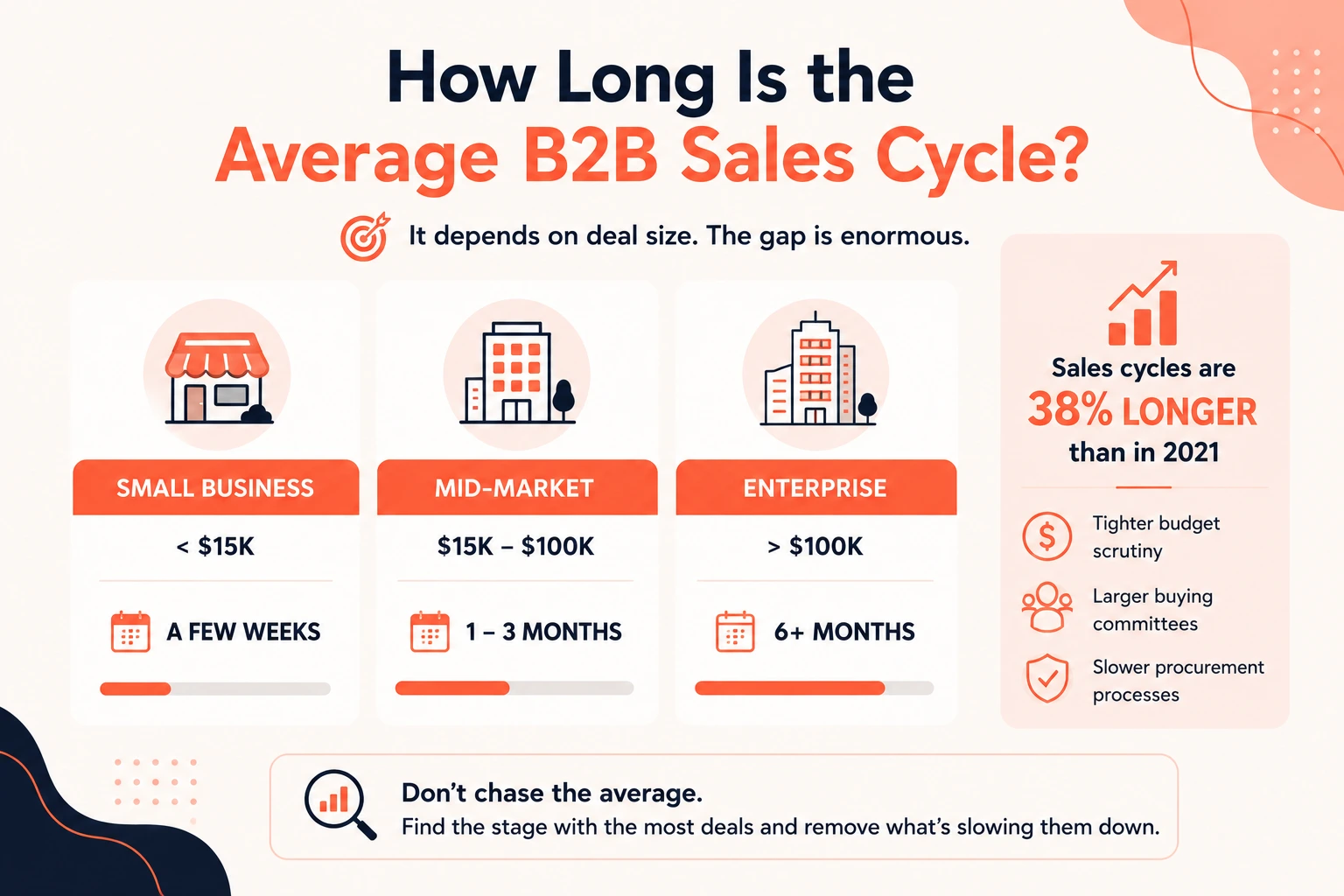
The honest answer: it depends on deal size, and the gap between segments is enormous. Blending them into one number describes nothing useful.
As a directional guide, smaller deals close fast and larger ones drag. SMB deals under roughly $15K often close in a few weeks. Mid-market deals land somewhere in the 1-to-3-month range. Enterprise deals above $100K commonly run six months or longer, because that's where procurement, legal, and security reviews stack up. Treat those as rough bands, not benchmarks. Your real number depends on your segment and motion.
What's clear is the direction. Cycles keep getting longer. Ebsta's analysis of 4.2 million opportunities found sales cycles running 38% longer than they did in 2021, driven by tighter budget scrutiny, larger committees, and slower procurement. Companies still planning around 2021 cycle times are forecasting on broken assumptions.
The aggregate number is the wrong thing to chase anyway. Don't ask how long your average cycle is. Ask which stage holds the most deals and what's stalling them there. That's where the real diagnosis lives.
The Metrics That Actually Tell You What's Wrong
Most teams track activity (calls made, emails sent) and stop there. Activity tells you reps are busy. It doesn't tell you the cycle is healthy. Three numbers do.
Sales velocity. This is the one metric that ties the whole cycle together. The formula:
Sales velocity = (number of opportunities × average deal size × win rate) ÷ sales cycle length
Run the math and you see why cycle length matters so much. Forty open opportunities, $10K average deal, a 25% win rate, and a 30-day cycle gives you about $3,333 a day in velocity. Stretch that cycle to 60 days and your daily velocity halves, even though nothing else changed. Cycle length is the denominator. Shrinking it is often easier than winning more deals.
Pipeline coverage ratio. This is open pipeline value divided by your revenue target. Most B2B teams need 3x to 4x coverage to hit their number. If you're sitting below that, the problem is top-of-funnel, not closing. You're walking into the quarter already behind.
Average age of open deals by stage. Here's the metric almost nobody watches, and it's the most useful. The average cycle length of closed deals is a lagging number. By the time it moves, the damage is done. Instead, track how long your currently open deals have sat in each stage compared to your historical norm. When deals in "discovery" are aging 40% past normal, you've found your bottleneck while you can still do something about it. Decent sales forecasting software tracks this automatically, but a CRM report and a benchmark do the job too.
One honest caveat. These benchmarks shift by segment. A two-week inside-sales motion and a twelve-month enterprise motion need different targets, and comparing yourself to a generic average is how you end up panicking over a cycle that's actually normal for your market.
Why the B2B Sales Cycle Is Longer Than B2C
A consumer deciding on a $50 purchase takes minutes. A company evaluating a $50,000 annual contract takes months. The gap comes from concrete, structural factors.
Bigger buying committees. The average B2B buying group runs 6 to 10 stakeholders, and a typical buying decision now involves around 13 people spread across two or more departments. More people who can say no, more calendars to align, more chances to stall.
Larger financial commitment. When a purchase ties up quarterly budget and locks a multi-year contract, scrutiny is the rational response. Procurement isn't obstruction. It's doing its job.
Internal consensus, not external selling. This is the one most reps underestimate. With buyers spending only 17% of their time with suppliers, the bulk of any B2B decision gets made in rooms you'll never enter. The deal advances at the speed your champion can build agreement inside their own organization. Your job is to arm that champion, because most of the selling happens when you're not there.
Switching costs. B2B software isn't just a line item. It carries implementation time, data migration, training, and a parallel-run period where old and new systems coexist. Buyers price all of that in before they say yes.
5 Ways to Shorten Your B2B Sales Cycle
These are the moves that actually compress cycle time. Backed by data, not vibes.
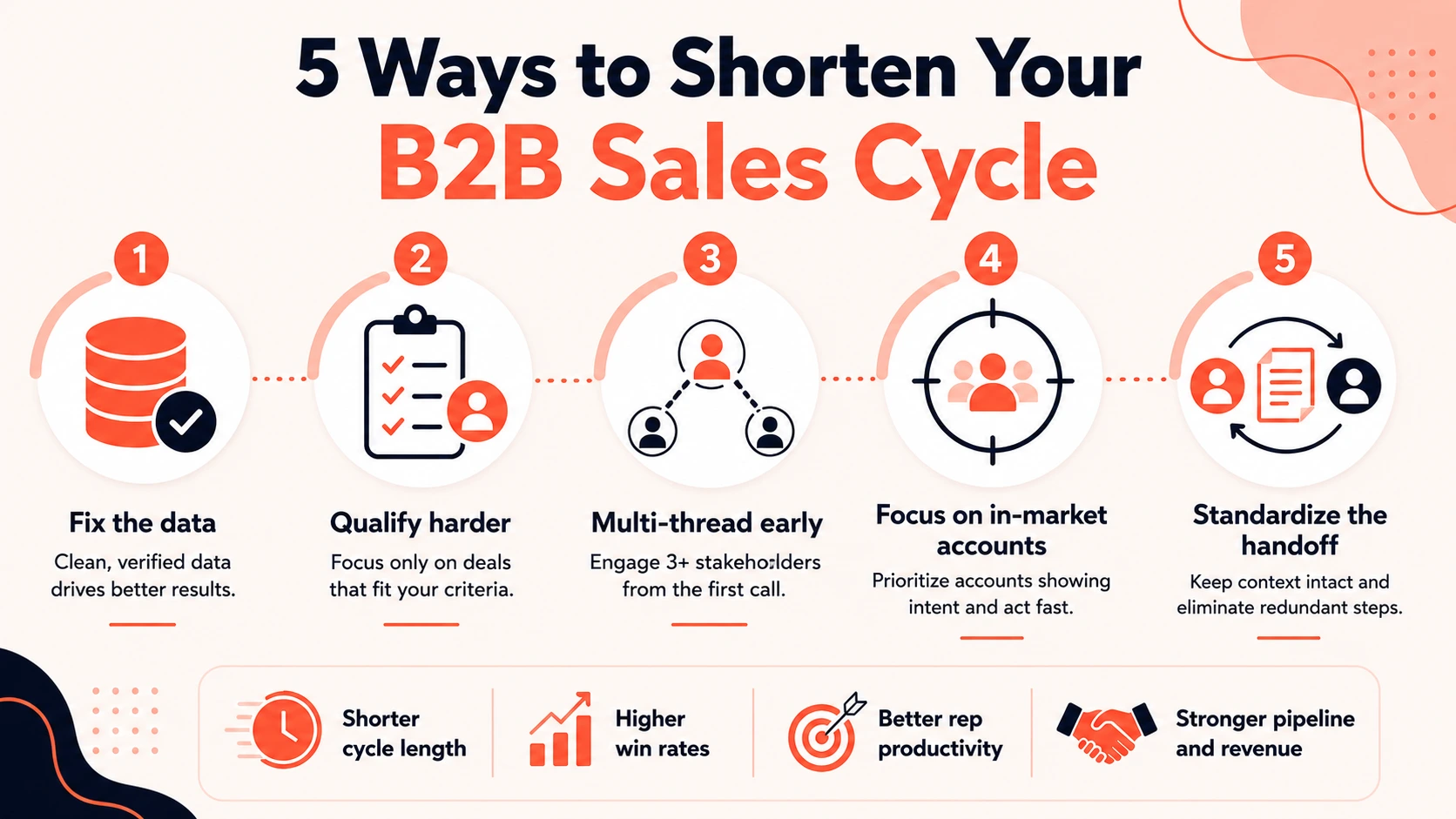
1. Fix the data before you fix the messaging.
The fastest outbound cycles run on clean, verified contact information. If a quarter of your emails bounce and a third of your dials reach the wrong person, you don't have a 90-day cycle. You have a 90-day cycle on a broken foundation. Most outbound teams treat contact data as a one-time input, then wonder why connect rates crater by month two. Fixing the data first does more for your cycle than anything else on this list, and almost nobody starts there.
2. Qualify harder at stage two.
No deal should pass qualification without meeting your minimum criteria. Bad-fit deals reaching discovery are the biggest driver of inflated cycle averages and the source of most preventable losses. A 90-day cycle on a real deal is fine. A 90-day cycle on a deal that was never going to close is expensive theater.
3. Multi-thread from the first discovery call.
Don't wait for one contact to become a champion before engaging the rest of the committee. Map the buying group at discovery and run parallel conversations from there. The sequencing matters: build a champion first, then expand around the third touchpoint. Engaging three or more stakeholders early is one of the clearest predictors of a won deal, and it protects you when your main contact goes dark or changes jobs mid-deal.
4. Prioritize in-market accounts using intent signals.
Not every prospect is ready at the same moment. Spending equal effort on cold accounts and accounts actively researching your category is how average cycle length balloons. Focus your team on accounts that are actually in market, not just accounts that look good on a target list. Speed matters too: the faster you respond to a fresh inbound signal, the better your odds, because buyer attention fades fast once the research moment passes.
5. Standardize the SDR-to-AE handoff.
The transition from prospecting to discovery is where context disappears most often. Build a standard handoff document. Make sure the AE has the qualification data, discovery notes, and the prospect's stated timeline before the first pitch. That one change removes a full redundant discovery cycle from your average deal.
How Data Quality Shapes Every Stage of the Cycle
I want to be specific here, because this gets underestimated constantly.
Actually, let me sharpen that. Data quality doesn't just affect cycle length. It decides whether your cycle is running on real deals or on manufactured activity that was always going to die.
Bad data compounds across every stage. Bounced emails slow sequencing and damage domain reputation. Wrong direct dials waste dial time and grind down reps. Outdated titles mean pitches land on people with no authority. Missing stakeholder contacts mean your champion sells internally with zero support from your side, which is exactly the kind of gap that stalls deals before they ever reach a vote.
And the decay is constant. B2B contact data goes stale fast, by widely cited industry estimates somewhere around a quarter to a third of records each year, as people change jobs, get promoted, leave, or sit through a reorg. A list that was accurate in January is meaningfully wrong by summer. That's the whole reason B2B data decay is a cycle problem and not just a list-hygiene chore.
This is the problem SMARTe was built for. The platform gives outbound teams 289M+ verified B2B contacts with 75%+ US mobile coverage, plus 66M+ company profiles across 200+ countries. The verification runs in real time, not in batches. When a rep dials a number or hits send, the contact is current at the point of use, not stale from a list pulled six months ago. That difference compounds across the entire cycle, not just prospecting.