TL;DR:
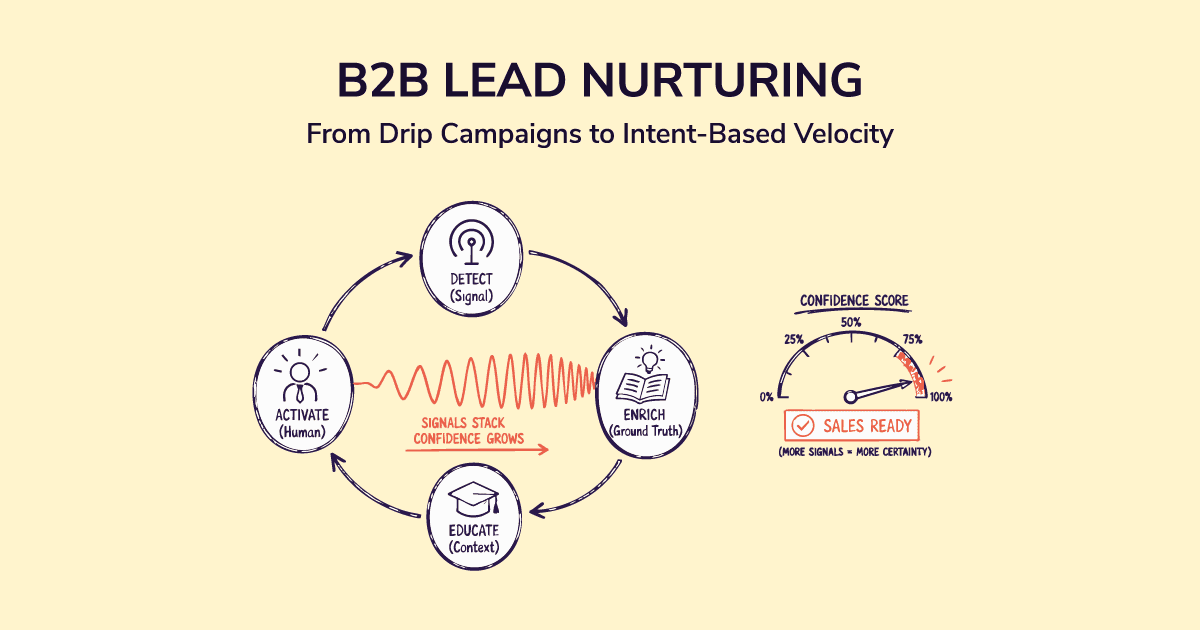
A B2B lead nurturing strategy is the system you use to move prospects toward a buying decision through targeted, behavior-driven engagement across email, LinkedIn, and direct outreach. The goal isn't to send more touches. It's to send the right ones, to the right people, at the right moment in their process.
Here's what this article covers:
- Segment leads by behavior and ICP fit, not just job title or company size
- Build sequences that advance on buyer actions, not calendar timers
- Score every lead on two separate numbers: fit and engagement
- Sequence your channels in order: email first, LinkedIn second, phone after both have run
- Use intent signals to identify when a lead is ready for sales, not more content
- Nurture every stakeholder in the buying committee, not just the one contact you found
- Re-engage cold leads by switching channels and asking one direct question
Your nurture program is running. Emails are going out on schedule. Open rates look decent. Every automation is firing.
And your pipeline is mostly empty.
I see this constantly. Marketing teams spend weeks building sequences, writing copy, tagging leads, setting up automation workflows — and produce almost no pipeline from any of it. The content isn't the problem. The logic underneath is.
Most nurture programs make the same three mistakes: they treat all leads the same, they move contacts forward on a calendar instead of on buyer behavior, and they touch one person at an account when five people are involved in the decision. Fix those three things, and everything else starts working.
Here's how.
Segment by Behavior, Not Just Who They Are
Firmographic data is a starting point. Job title, company size, industry, geography. These tell you whether a lead could be a fit. They tell you almost nothing about whether they're ready.
A VP of Sales at a 200-person SaaS company who visited your pricing page twice this week and downloaded a comparison guide is not the same prospect as a VP of Sales at the same company who unsubscribed from your newsletter two months ago. In your CRM, they're probably in the same segment. They shouldn't be.

SMARTe GTM Intelligence
Start Smarter Prospecting Today
ICP fit as the entry filter
Before any lead enters a nurture sequence, they should pass an ICP fit check. This is the firmographic gate: does the company match your ideal customer profile? If it doesn't, no sequence will fix that. Nurturing a bad-fit lead burns budget and fills your pipeline with contacts that waste sales time.
I think this is where most RevOps teams quietly fail. They skip ICP filtering at the sequence entry point, then spend months wondering why MQL-to-SQL conversion is stuck below 10%.
Behavioral signals that actually predict intent
Once a lead clears the ICP gate, their behavior determines which sequence they enter and how quickly the sequence moves. The signals worth tracking:
- Pricing page: any visit, especially a repeat visit within 7 days
- Case study or customer story: which industry and which outcome they read about
- Feature-specific pages: the specific problem they're trying to solve
- Email click patterns: are they consistently clicking the same content category?
- Webinar registration and attendance (not just registration)
- Demo page view without booking
A lead who hits your pricing page twice in one week should not sit in the same 14-day welcome drip as someone who only opened your first email. They go into a faster, more direct sequence immediately. This is what behavioral marketing in practice actually looks like, and it's one of the highest-leverage changes most teams can make without touching a single piece of content.
Technographic segmentation
The tools your prospect already uses shape how they'll evaluate you. A team running Salesforce and Outreach cares about CRM match rates and native workflow integration. A HubSpot shop wants ease of setup and marketing alignment. Technographic segmentation lets you adjust messaging before the first email goes out, rather than discovering stack misalignment on call three.
Build Stage-Based Sequences, Not Time-Based Drips
Time-based drips assume every lead moves at the same pace. They don't. Waiting seven days to follow up with a lead who just visited your demo page isn't a nurture strategy. It's leaving a warm conversation to go cold.
Stage-based sequencing advances a lead when they take an action. Not because a timer fired.
What content earns trust at each stage
Match content to what the lead is actually trying to figure out, not to what you want to sell them.
Awareness stage: the lead is diagnosing a problem. They need educational content — industry benchmarks, frameworks, peer data. Not product overviews. Send them something that makes them smarter, not something that makes them want to close a browser tab.
Consideration stage: they're comparing options. Case studies, ROI proof, head-to-head comparisons. This is where you earn preference. Understanding the full B2B buyer journey matters here, because the same lead can slip back into awareness if you move too fast with bottom-of-funnel content.
Decision stage: they're justifying a choice internally. ROI calculators, implementation guides, security documentation, and answers to the questions procurement will ask. This is also when direct sales involvement should start — not earlier.
Trigger events that reset the sequence
Certain events should advance a lead regardless of where they are in a sequence:
- A job change at a target account (new buyer, new budget cycle, fresh decision)
- Funding event at the company
- A second contact from the same account enters your database
- A lead replies to any email, even to say "not now"
- Pricing or demo page visited for the first time
These are buying triggers. When one fires, the lead moves forward. Trigger-based marketing works because it responds to real buyer behavior instead of assuming that 14 days of silence means a lead is still in the same place.
Progressive profiling
Each form in your sequence should ask for one thing you don't already know. Not 10 fields on a gated PDF. One question.
First form: company size. Second download: budget cycle. Webinar registration: what's the biggest challenge you're trying to solve right now? Each touchpoint adds a data point that sharpens the next one. Over time you build a lead profile from engagement, not from a single form fill that most people rush through.
Score Leads on Two Numbers, Not One
A single composite score collapses two completely different signals into one number. That's where the model breaks down.
The fit score
Fit measures how closely the lead matches your ICP: job title, seniority, company size, industry, geography. It's mostly static. It doesn't change much once you've established it. A perfect-fit lead might start at 80. A partial fit at 40. Use this as a multiplier, not the final answer.
The engagement score
Engagement measures how much they're paying attention: email opens, clicks, page visits, content downloads, webinar attendance. It goes up with activity and drops with inactivity. Subtract 10 points for 30 days of silence. Add 20 for a pricing page visit. Add 15 for a case study read in the decision category.
The two scores serve completely different purposes. A high-fit, low-engagement lead needs a campaign that earns attention. A high-engagement, low-fit lead needs to be suppressed or deprioritized — not handed to sales. (That second type is often a job seeker, a student, or a competitor. Worth knowing before a rep burns 30 minutes on the call.)
What to do: Run these as two separate fields in your CRM rather than combining them. Set separate thresholds: a lead should hit a minimum fit score AND a minimum engagement score to become an MQL. Either alone isn't enough.
Knowing what actually qualifies as an MQL and how SQL and MQL thresholds should differ is the foundation of a handoff process your sales team will actually trust.
Setting the MQL threshold that sales trusts
Most teams set a threshold number (say, 70) without involving sales in the decision. Sales gets the leads, finds them underwhelming, and the "MQLs are garbage" complaint starts immediately. That complaint is usually accurate.
Do this instead: pull your last 20 closed-won deals and look at what score they carried when sales first contacted them. That's your real threshold. It's almost never the number someone entered during the initial automation setup. Recalibrate around actual wins, then revisit it every quarter as your ICP evolves.
In my experience, this calibration conversation between marketing and sales is the one everyone knows they should have and almost no one schedules until something breaks.
Sequence Your Channels in the Right Order
Multi-channel nurturing works. Hitting every channel at once without a sequencing logic doesn't. The order shapes how each touchpoint lands.
Email first
Email establishes context before you ask for attention anywhere else. It's low friction, it's expected, and it lets you share content without social pressure. Your first three to five nurture touches should run through email only. Build name recognition before you move to a more personal channel.
Email marketing automation at this level isn't about sending generic sequences — it's about sequences where every email responds to a specific behavior and arrives at the right moment in the lead's journey.
LinkedIn as the reinforcing layer
After two or three emails, a LinkedIn connection request adds a human face to the name that's been appearing in the inbox. The connection message doesn't need to reference the emails. Something specific to their role works better: "Noticed you've been looking at [topic area] — thought it was worth connecting." Short. No pitch at this stage.
Once connected, a content share in DMs or a thoughtful comment on their posts keeps you visible without pushing. You're reinforcing without selling. That distinction matters more than most teams give it credit for.
Phone and retargeting ads
Retargeting runs in the background the whole time. It keeps your brand visible between active touches without requiring any rep effort.
Phone comes after email and LinkedIn have both run. A rep calling a lead who's received four emails, connected on LinkedIn, and seen your retargeting ads for two weeks is not making a cold call. The context already exists. That conversation starts somewhere completely different from a dial into an account with no prior contact.
Use Intent Signals to Know When to Stop Nurturing
Nurturing is not the goal. Pipeline is. The signal to stop nurturing and start selling is the one most programs miss.
According to Forrester, B2B buyers complete 57 to 70 percent of their purchase decision before ever engaging a sales rep directly. The work nurturing does in that window is real and measurable. But there's a moment when the lead has gathered enough information and needs a conversation, not more content. Miss that window, and they buy from someone who showed up at the right time.
First-party signals you already have
These are actions in your own ecosystem:
- Demo page visit (even without a form fill)
- Pricing page: a second or third visit in the same 30-day window
- Case study consumption from your decision-stage folder
- Any email reply, even a short one
- Return visits to the same feature page within five days
Any single signal might not be enough. Two or three in the same week almost always are.
Third-party intent data
First-party signals tell you what's happening on your site. Intent data tells you what's happening everywhere else. Bombora topic surges surface when an account is actively researching your category across the web, not just on your domain. G2 category views. Competitor comparison searches running in parallel.
A lead who's been sitting in your nurture sequence for 60 days but just spiked on Bombora for "sales intelligence" or "B2B prospecting tools" is not in the same place they were last month. That's a real buying window. The response isn't another nurture email. It's a call.
The pivot threshold
Here's how I'd define it: two first-party signals, or one first-party signal combined with any third-party intent spike, should trigger an immediate outbound move. Not in 48 hours. That day. Watch buying signals as your early warning system, not a data point that rolls into a score and eventually tips a threshold three weeks later.
What to do: Build a Slack alert or CRM task that fires when a lead crosses this combination. Route it directly to the rep who owns the account, not to a queue.
Nurture Everyone in the Buying Group
B2B deals don't fail because one person said no. They fail because four other people in the room never got what they needed to say yes.
According to Gartner, the average B2B buying committee involves 6 to 10 stakeholders. Most nurture programs touch one. That's not a nurture program. That's a newsletter with good segmentation.
Mapping the five stakeholder types
Every deal typically has some version of these five roles, and each one needs something different from your nurture content.
Champion: your internal advocate. They want the problem solved and they'll carry your case in internal meetings. Give them business outcomes, ROI proof, and language they can repeat to the CFO without you in the room.
Economic Buyer: controls the budget. They want financial justification and risk reduction. Give them ROI calculators, cost comparison data, and evidence that the investment is defensible.
Technical Evaluator: assesses implementation and integration risk. They want API documentation, security specs, and case studies from teams with a similar tech stack. Send them something technical early rather than waiting for them to surface in a late-stage security review.
End Users: have to live with the decision every day. They want to know the product is usable and won't make their job harder. Product walkthroughs and quick-start guides belong in their sequence, not the Economic Buyer's.
Procurement: wants contract terms, data compliance certifications, and vendor risk documentation. Give it to them before they ask. Procurement showing up at the 11th hour with questions they needed answers to six weeks ago is how deals slip quarters.
Understanding how B2B buying groups make decisions is the difference between reps who lose committee votes and reps who go in having already addressed every objection in the room.
Identifying stakeholders you haven't found yet
The Champion you're in contact with knows who else is involved. Ask them directly and early: "As this moves forward, who else typically gets pulled in from your side?" Most will tell you. Some won't.
Champion tracking helps surface new contacts at the account when champions change roles or when new stakeholders enter the process from your side. SMARTe's buying group mapping auto-discovers the full stakeholder set at a target account, so your sequences reach the full committee rather than just the contact who filled out a form.
Re-Engage Cold Leads Without Being Annoying
Cold leads aren't dead leads. They're leads whose timing was wrong. Budget froze. A priority shifted. Someone left the company. That doesn't mean the fit was wrong or that the need went away.
When to re-engage vs. when to suppress
Re-engage when ICP fit is high, the lead showed meaningful engagement at some point in the last 12 months, and something relevant has changed: a new product release, a pricing update, industry news they'd actually care about, or a trigger event at their account.
Suppress when ICP fit is low, they've explicitly opted out, or they've shown zero engagement across multiple channels over a full year. Continuing to contact suppressed leads hurts your email deliverability and trains your scoring model on bad data. Review where your sales funnel leaks before you build a re-engagement campaign, because if a particular stage consistently produces cold leads, the problem is a content gap there, not a re-engagement problem.
The channel switch
If they went cold on email, the re-engage doesn't go through email. It goes through LinkedIn or a direct call. Same message, same channel, same result.
A LinkedIn DM that says "We haven't connected in a while, and I don't want to keep sending emails that aren't useful. Is this still relevant for your team right now?" gets replies. It's honest. It respects their time. And it performs better than a five-email win-back sequence with a subject line every prospect recognizes immediately.
One honest ask
The most effective re-engagement isn't a new piece of content or a fresh offer. It's a direct question.
"Is this something you're still thinking about, or has it moved to the back burner?"
Either answer is useful. Yes means you have a live conversation and they're back in an active sequence. No means you suppress cleanly and stop burning budget on a lead that isn't going anywhere. Either way you know more than you did yesterday. Pair re-engagement outreach with follow-up email templates that give reps a starting point they can actually make personal, rather than something generic that reads like automation.
The Part Nobody Wants to Admit
Most nurture programs fail quietly. Open rates look fine. Click rates are acceptable. Nothing is obviously broken. But the leads aren't converting.
That's the hardest kind of problem to fix, because there's no single failure to point to. It's usually a combination of five or six small structural issues: bad segmentation, time-based sequencing, a scoring model nobody trusts, single-contact outreach on multi-stakeholder deals, and no clear threshold for when to stop nurturing and start selling.
Fix those, and the program you already built starts producing the results you expected when you built it.
Try SMARTe free — no credit card required. See what verified contact data and built-in intent signals do to a nurture program that's been running on assumptions.