
TL;DR:
Outsourced demand generation means paying an external partner to build and run your pipeline programs: paid media, syndication, webinars, nurture, and reporting. It scales a motion you have proven. It rarely invents one you have not.
- Managed retainers run $3,000 to $12,000 a month, with turnkey programs past $15,000
- Coordination overhead adds another 15% to 25% of program budget, and tool add-ons another 30% to 50%
- Year one in-house lands near $163,000 with first pipeline around month five
- Paid media, syndication, and webinar production outsource well. Positioning, lead routing, and contact data do not
- Run a 90 day pilot with written gates before you sign anything annual
Outsourced demand generation fails for a boring reason. The agency inherits your targeting.
Picture a $9,000 a month retainer. The partner builds the campaigns, buys the media, writes the nurture flows, and reports every Friday. Then they pull the target list out of your CRM and go to work. If a third of those records have gone stale, you just paid specialist rates to reach people who left the building.
Nobody spots it for two quarters. The agency reports leads. Sales reports silence. Someone rewrites the copy.
I think this decision gets argued at the wrong level. Teams line up a retainer against a salary and pick the smaller number. Neither number decides the outcome. What decides it is how much of your buyer knowledge exists in a form you can hand to a stranger.
What a Demand Generation Agency Sells You
An agency sells capacity and channel depth. That is the honest version of the pitch, and it is worth real money when you need it.
What no retainer buys is context. The partner starts every campaign by asking you who to target, what to say, and what counts as a good lead. Your answers become the ceiling on the whole program.
The three things a partner can own
- Distribution. LinkedIn, Google, Meta, programmatic, publisher networks, sponsored newsletters
- Production. Landing pages, gated reports, webinar funnels, creative, email builds
- Measurement plumbing. Tracking setup, dashboards, and weekly reporting
Good partners are better at these than you will ever be, because they run them across twenty accounts and you run them across one. That is the case for outsourcing, and it is a strong one.
The three things it inherits from you
- Your ideal customer profile and segment priority
- Your positioning and the messages that convert
- Your contact data and CRM hygiene
Hand over weak versions of these and the agency amplifies the weakness at scale. There is no version of this where a vendor fixes your strategy from the outside. The retainer does not fund that work, and no agency can afford to do it for free.
Demand Generation Outsourcing vs Lead Generation Outsourcing
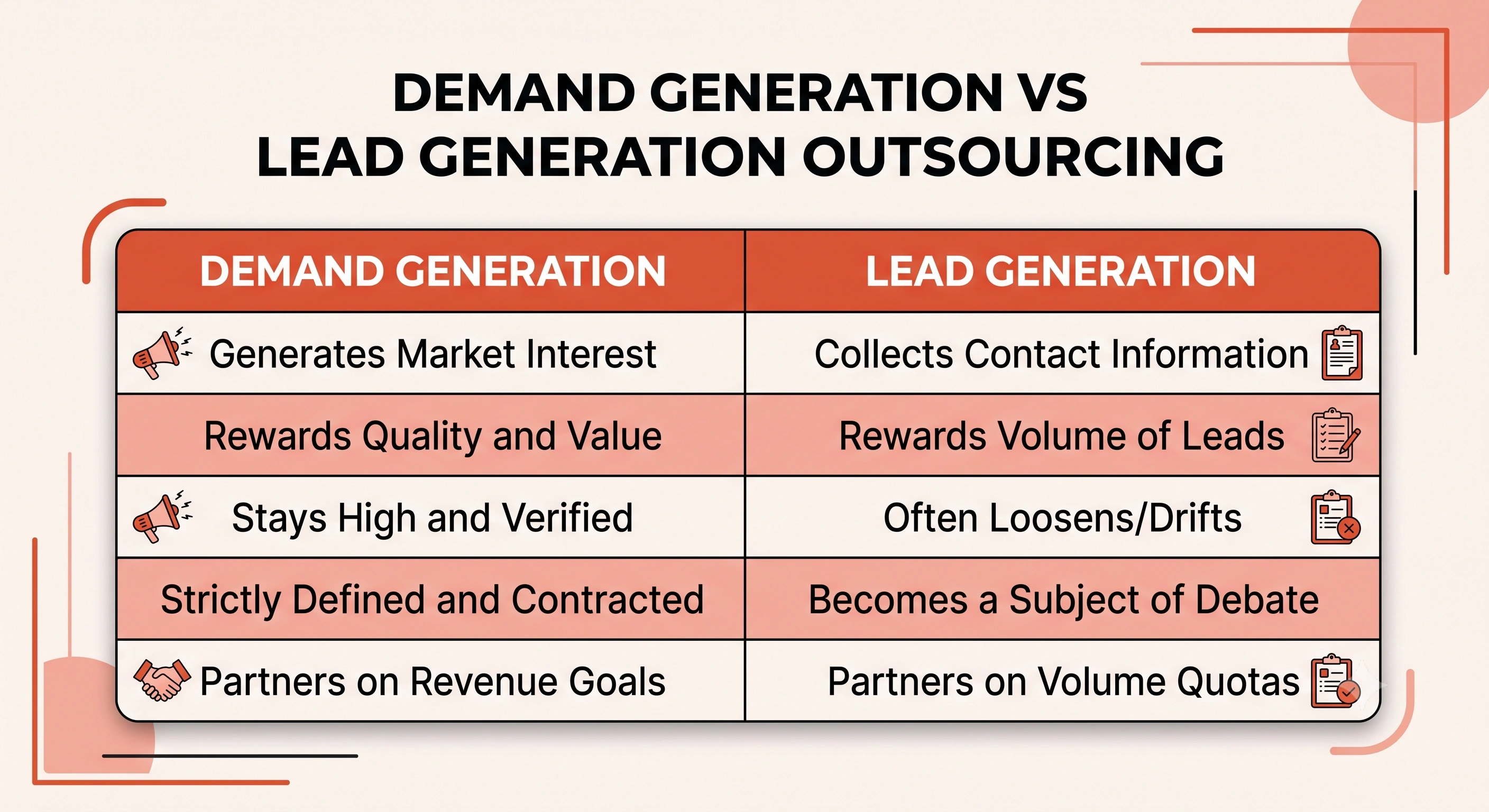
A vendor promising 400 MQLs a month at a fixed cost per lead is running lead generation. Useful as a tactic. Sold as something else entirely.
Demand generation builds the want. Lead gen collects the form fill. The demand generation vs lead generation distinction sounds academic until you read the contract, because the pricing model decides which one you get.
Per-lead pricing pays the partner more for volume. Your revenue target wants fewer, better records. Those pull against each other from day one. The partner is not the villain in that story. The contract is.
Watch what happens to your definition of a marketing qualified lead about ninety days in. It loosens. Someone argues that a whitepaper download from a director at a target account should count. Then quality drifts, and the argument moves to whether sales is following up properly.
What to do: write the qualified lead definition and the rejection process into the agreement, before kickoff, with a named person who arbitrates.
What Outsourced Demand Generation Costs in 2026
Agency pricing models
Pay-per-lead deals sit around $200 to $500 per qualified lead. Pay-per-appointment runs $150 to $600 a meeting, with enterprise targets past $900. Commission-only offers look brilliant and behave badly, since no partner funds infrastructure on deals that close in nine months.
Setup fees of $1,500 to $5,000 cover domain configuration and sending infrastructure. Extra domains, enrichment credits, and tool subscriptions add 30% to 50% on top of the retainer.
The in-house comparison teams get wrong
Glassdoor puts the average demand generation manager salary in the US near $116,000. Comparing that to a retainer is where the reasoning breaks, because it ignores ramp and it ignores the tool stack.
Here is the year-one version, honest in both directions.
That last row is the one people underweight. A year of campaign learning sits in an account manager's head: which titles reply, which offer converts, which segment burns money. When the contract ends, so does your access to it.
The costs nobody puts on the quote
- Briefing and QA time from your marketing lead, every week
- Data reconciliation between agency reporting and your CRM
- Context translation for each new campaign, compounding as scope grows
- Waste from bad records, which nobody meters at all
Those first three run 15% to 25% of effective program budget. Budget pressure makes that sting more than it used to. Gartner's 2025 CMO Spend Survey found marketing budgets flat at 7.7% of company revenue, with 39% of CMOs planning to cut agency spend.
Which Functions to Outsource First
Not everything in the demand generation funnel carries the same risk. Top-of-funnel reach is specification work. Bottom-of-funnel judgment is not.
Two rows deserve a caveat. Syndication outsources well only when you police the ICP filters yourself, because the vendor's incentive is fill rate. And nurture flows built by an agency tend to drift generic by month four unless someone internal reads them.
If you sell software, the split shifts. SaaS demand generation programs lean harder on product-led signals and trial behavior, which sit in systems an agency will not have access to. Keep more of the middle in-house than this table suggests.
When Outsourced Demand Generation Goes Wrong
1. You have no proven motion yet
Proven means something specific. Two consecutive quarters where the same playbook produced pipeline. At that point your B2B demand generation strategies live on paper instead of in someone's head.
An agency arriving before that has to invent strategy on a retainer that does not fund strategy. So they reach for generic tactics: a gated ebook, a broad title filter, a blast at the whole addressable market.
Leads appear. Sales calls them. Nobody remembers signing up. Sales and marketing alignment takes six months to recover from that. The agency wears the blame for a decision you made during procurement.
2. Your list decayed before the campaign launched
This is the failure I care about, and almost nobody audits for it before signing.
B2B data decay runs fast. People change roles, companies restructure, direct dials get reassigned. Hand a partner a two-year-old export and every dollar of media spend targets a version of your market that no longer exists.
The cruel part is the diagnosis. Reply rates sag, connect rates drop, and the symptoms look exactly like a messaging problem. So the team rewrites the copy, launches again, and gets the same result at the same cost.
Pull a sample of 200 records from the list you plan to hand over. Check how many have current titles and working numbers. If it is under 70%, fix the inputs before you spend anything on distribution.
3. The learning walks out with the contract
Ask for documented playbooks and raw performance data as a contractual deliverable, not a favor at the end. Partners who intend to keep you long term have no reason to refuse.
Are You Ready to Outsource? Four Checks
- Can you name your ICP in one sentence, with three firmographic filters?
- Do you know which message converts, from evidence rather than opinion?
- Do sales and marketing agree, in writing, on what qualified means?
- Do you have someone internal with five hours a week for briefing and QA?
Four yeses and you can brief a partner properly. Two or fewer and you would be paying someone to guess at answers only your team can produce.
One caveat to my own scoring. If you are pre-product-market-fit and burning runway, skip all of this and go talk to twenty customers.
How to Run a 90-Day Pilot
Annual contracts signed on a pitch deck are how teams end up locked into a partner they stopped trusting in month three. A paid pilot with written gates costs less than a bad year.
Weeks 1 and 2. Access, tracking, suppression lists, and a documented baseline. Nothing goes live. If the partner cannot complete setup in two weeks, that tells you about their bench depth.
Weeks 3 and 4. One channel live. Not four. A single channel makes attribution readable and keeps the diagnosis simple when something misfires.
Weeks 5 to 8. Message iteration based on reply and engagement data. First meetings should appear around week six. Anyone promising meetings in week one is skipping deliverability setup.
Weeks 9 to 12. Read cost per qualified opportunity, not cost per lead. Compare partner-sourced conversion against your own baseline.
Set the gate before you start: an agreed number of sales-accepted opportunities by day 90. Write it down. Pilots without a written gate always get extended, because everyone can find a reason the next thirty days will be different.
How to Measure the Program
Cost per lead rewards cheapness and hides the rest. The demand generation metrics that survive a CFO conversation look different.
- Cost per qualified opportunity. The only figure that connects spend to revenue
- Sales acceptance rate by source. If sales rejects half a channel's output, that channel has a targeting problem
- Lead to opportunity conversion, partner vs internal. A wide gap points at data or targeting, not creative
- Pipeline velocity by source. Do these deals move faster or slower than your baseline
- Reachability. What share of delivered records carry a working email and a valid number
Your revenue attribution model has to match your sales cycle. B2B cycles run six to eighteen months. A thirty-day window flatters paid search and buries content, and both readings will be wrong.
If the partner runs intent data as part of targeting, ask which provider and how they score it. Vague answers here usually mean the signal is doing less work than the invoice suggests.
Contract Clauses Worth Fighting For
- Data ownership in plain language. Raw records delivered with source and consent documentation
- A 90 day exit after any initial term, with no penalty
- Playbook handover at termination, including creative files and campaign performance history
- A written qualified lead definition with a rejection process attached
- A named strategist with a cap on how many other accounts they carry
None of that is aggressive. Partners who resist all five are telling you how the relationship ends.
Where Better Data Changes the Math
An agency working from verified, current records produces different results than the same agency working from a stale export. Same team, same budget, same creative.
SMARTe covers that side. 289M+ verified B2B contacts and 75%+ US mobile and direct dial coverage, with real-time B2B data verification rather than a static file. CRM data enrichment matches at 90%+, so records get corrected instead of duplicated. Coverage spans 200+ countries with 50%+ global direct dial. That matters when regional reach was the reason you outsourced.
Being straight about the limits: SMARTe does not run campaigns, pick your segment, or write your positioning. It fixes one input. That input happens to be the one that quietly decides whether the other three were worth paying for.
The Part That Decides It
The build-or-buy framing implies two doors. There is one door, and the lock on it is how well you can explain your buyer to a stranger in an hour.
Teams that can do that get value from a partner inside a quarter. Teams that cannot will pay for the same pipeline generation twice, once to the agency and once to whoever cleans up after them.
Write the brief first. The operating model sorts itself out after that.
See how SMARTe finds verified mobile numbers in your target accounts