
TL;DR:
Revenue attribution models assign credit for closed deals to the marketing and sales touchpoints that influenced the buyer's journey. They show you which channels, campaigns, and content actually drive pipeline, so budget decisions stop being guesswork.
- Single-touch models (first-touch, last-touch) set up fast but only see one moment of the journey
- Multi-touch models (linear, time-decay, U-shaped, W-shaped, full-path) split credit across the path
- Data-driven attribution uses machine learning, but needs high deal volume and clean data to work
- For B2B cycles over 90 days, W-shaped or full-path is the practical default
- Account-level tracking is non-negotiable when deals involve a buying committee
- Your data quality matters more than which model you pick
Revenue attribution models decide which marketing and sales touchpoints get credit when a deal closes. Pick the wrong one and you'll defend the wrong channels in your next budget review. Pick the right one, feed it messy CRM data, and you'll still defend the wrong channels, just with more confidence.
That second scenario is the one nobody warns you about.
Most attribution guides hand you a list of seven models, a few diagrams, and a "choose what fits your business" shrug. That advice skips the part that actually determines whether your reports mean anything. So this guide covers the models, yes, but also the two things that break them: contact-level tracking in a world of buying committees, and contact data that goes stale faster than your sales cycle closes.
Let's get into it.
What Revenue Attribution Models Actually Do
A revenue attribution model takes a closed deal and traces it backwards. It maps every touchpoint in the buyer's journey, then assigns each one a share of the credit.
How that credit gets split depends on the model:
- First-touch: 100% to the first interaction
- Last-touch: 100% to the final interaction before conversion
- Multi-touch: credit spread across several touchpoints, weighted differently by model
- Data-driven: machine learning decides the weights from your historical deals
The point is to learn which channels and campaigns drive revenue. Not clicks. Not form fills. Closed deals.
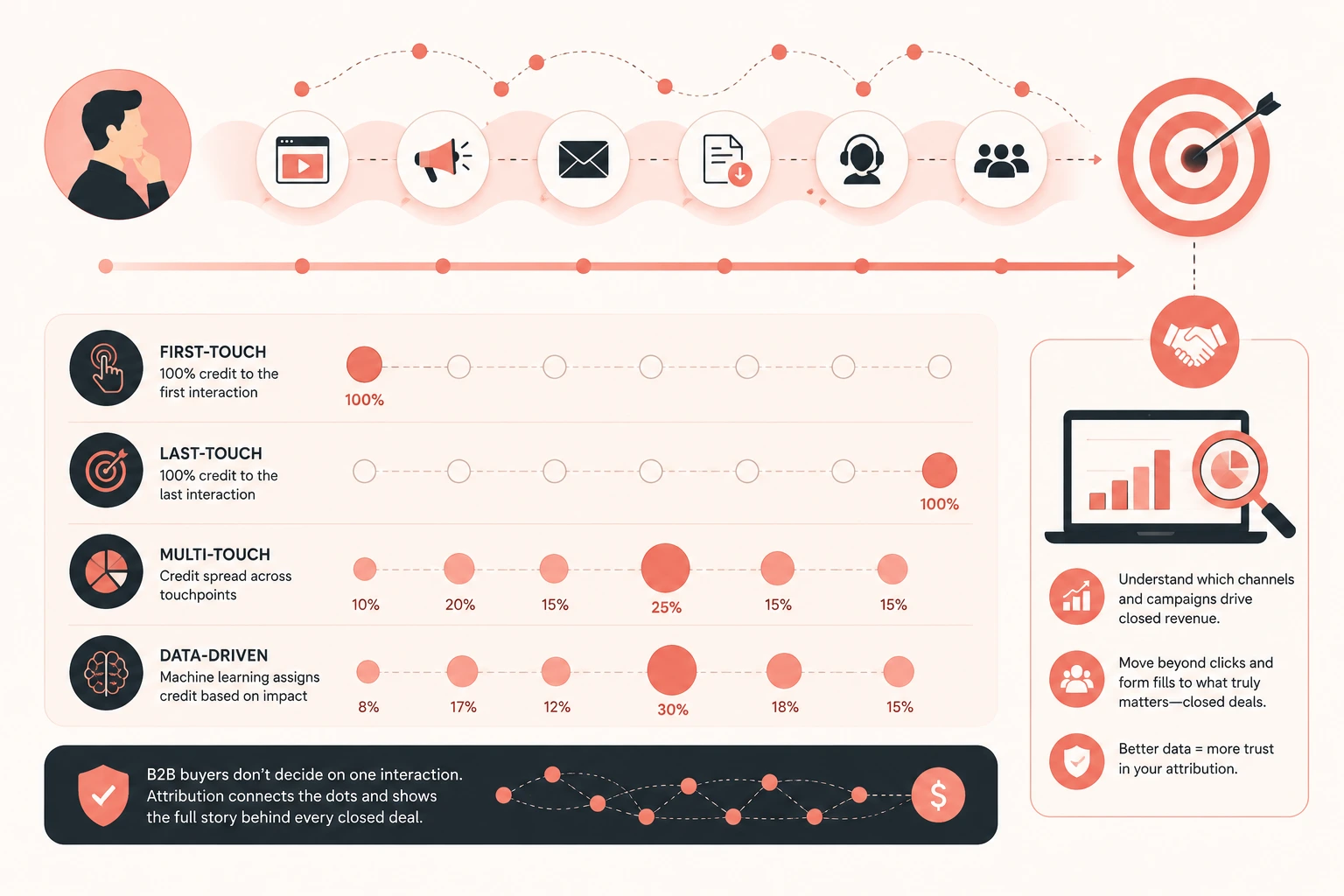
This matters because B2B buyers don't decide on one interaction. A single deal can touch dozens of webinars, ads, emails, content downloads, and sales calls before anyone signs. Single-source attribution flattens that whole story into one lucky touchpoint and calls it the winner.
There's a confidence problem hiding underneath all of this. While most marketers say attribution is essential to their success, far fewer trust the accuracy of the model they're actually running, according to marketing attribution data compiled by Marketing LTB. That gap between "we need this" and "we believe this" is the real story of B2B attribution. And it almost always traces back to the data, not the model.
The 7 Revenue Attribution Models, Compared
Here's the quick version before the detail. Skim the table, then read the sections that match your sales cycle.
First-Touch Attribution
The first touchpoint gets all the credit. Whatever channel introduced the buyer to your brand wins the deal, no matter how long ago that happened.
This works well when you want to know where your best buyers come from. If you're deciding how to spend top-of-funnel budget, first-touch tells you which channels open the most valuable relationships.
The catch: it ignores the entire middle and end of the journey. In a nine-month enterprise deal, that's almost everything. The prospect who joined four webinars and had six sales conversations didn't buy because of one LinkedIn ad from January.
Last-Touch Attribution
The final touchpoint before conversion takes everything. Usually that's a demo request, a pricing page, or the email that triggered the sales conversation.
Good for understanding what closes. It shows which offers and pages turn interest into pipeline.
The catch: it credits the paperwork, not the persuasion. Every brand campaign, every nurture email, every piece of content that built trust over months becomes invisible. Last-touch is the default in most ad platforms, which is exactly why so many teams overvalue bottom-funnel channels.
Linear Attribution
Equal credit to every touchpoint. Eight touches, 12.5% each.
It's a fair starting point and easy to explain to leadership. For long nurture cycles where consistency matters, it captures the full path without playing favorites.
The catch: not every touch did equal work. The demo that sealed the deal pulled more weight than the third newsletter the prospect skimmed. Linear erases that difference entirely.
Time-Decay Attribution
Recent touches get more credit on a sliding curve. The demo request earns far more than the ad from eleven months ago.
Useful for shorter cycles and for promotional pushes where late-stage urgency closed the deal.
The catch: it punishes top-of-funnel work. If your content quietly warms up accounts over a year, time-decay makes that content look worthless. Content-led teams will misread their own results.
U-Shaped Attribution
First touch gets 40%, lead creation gets 40%, and the remaining 20% spreads across everything in between.
A solid middle ground when you care about both how buyers find you and what converts them into leads, but you don't have clean mid-funnel tracking.
The catch: that 20% middle covers months of nurture, events, and sales activity. Cramming all of it into a fifth of the credit understates the work the middle does.
W-Shaped Attribution
Three milestones each get 30%: first touch, lead creation, and opportunity creation. The leftover 10% spreads across the rest.
I think W-shaped is the right default for most mid-market B2B teams. Assuming your CRM stages are clean, it credits marketing across the three moments that matter most: how buyers found you, when they became a lead, and when they became real pipeline. Specific enough to act on, without the full-funnel discipline the next model demands.
The catch: it stops at opportunity creation. Late-stage case studies, executive briefings, and ABM plays that help close the deal get no credit at all.
Full-Path Attribution
Four milestones each get 22.5%: first touch, lead creation, opportunity creation, and closed-won. The final 10% covers middle interactions.
This is the most complete standard model. For teams measured on revenue rather than pipeline, it credits marketing all the way to the signature.
The catch: it needs all four pipeline events tracked accurately, every time. Actually, let me be precise about that. Full-path doesn't need a perfect CRM. It needs a consistent one. Perfection is impossible. Consistency in how reps log activity and how lifecycle stages update is achievable with governance. Run full-path on a messy CRM and you don't get more accuracy. You get more confident errors.
Data-Driven Attribution: When Rules Run Out
The seven models above run on rules a human sets. Someone picks the weights, and the model applies them to every deal the same way.
Data-driven attribution skips the manual weighting. It uses machine learning to study your historical deals and assigns credit based on which touchpoints actually showed up most often before deals closed. The algorithm finds the pattern instead of you guessing it.
This is where attribution is heading. According to performance data tracked through Google's Marketing Platform and reported by Giant Partners, companies that move to automated, AI-powered attribution see an average 27% lift in campaign performance across channels. The model spots inefficiencies a rules-based setup would miss.
But it's not for everyone yet:
- Works when: you have high deal volume (think 1,000+ closed deals), clean conversion tracking across every channel, and an analyst who can maintain the model as patterns shift
- Struggles when: you close a few hundred deals a year, or your inputs are messy. The model learns from your history, so sparse or dirty data teaches it the wrong lessons
In my view, data-driven attribution earns its keep past roughly $50M ARR with mature RevOps behind it. Below that, W-shaped or full-path will serve you better for far less effort and cost.
How to Choose a Model for Your Sales Cycle
No model fits everyone. Match it to how you actually sell.
That last row deserves a note, because it's where the most sophisticated teams have landed.
Running two models at once is now standard practice for teams that need numbers they can defend. Research from Digital Applied shows the strongest teams pair multi-touch attribution (MTA) for daily tactical calls with marketing mix modeling (MMM) for long-term strategic budget decisions. One answers "which campaign drove this opportunity?" The other answers "what's the marginal return on this channel at current spend?" Different questions. Different models. Used together.
You don't need both on day one. But if your channels are sprawling and your QBR keeps turning into an argument, the parallel approach is worth understanding.
Why Revenue Attribution Keeps Breaking
Here's what I see most often with RevOps teams building attribution for the first time.
They pick a model. They set it up in Salesforce or HubSpot. They run the first report. And the data looks wrong. Deals credited to "direct traffic." Contacts floating free of any account. Channels showing zero touches that everyone knows drove deals.
The model isn't broken. The data feeding it is.
Attribution models need a few things to function:
- Contacts linked to the right accounts
- Lead sources tagged completely, not defaulted to "direct"
- Lifecycle stages that update as deals actually move
- Reps logging activity consistently, which almost never happens without governance
Miss any of these and your attribution chain snaps. The problem compounds in B2B because contact data decays fast. People change jobs. Champions leave. Titles go stale. By the time a 12-month deal closes, the records that started the journey may not match reality anymore. This is the quiet reason bad CRM data stops being a hygiene issue and becomes a revenue measurement problem. B2B data decay means a quarterly attribution report built on static records is already measuring a past that no longer exists.
Fix the foundation first. Pick the model second. SMARTe's real-time CRM enrichment keeps contact and account records current, so when your attribution tool pulls from the CRM, it's working from verified inputs instead of six-month-old guesses.
What to do before you buy an attribution platform: Run a three-question audit.
- What percentage of records have a complete lead source field?
- How many contacts sit unlinked to any account?
- Do lifecycle stages update automatically, or depend on a rep remembering?
If those answers worry you, that's your starting point. Not the model.
Also Read: How sales funnel leakage drains pipeline before deals close
Account-Level vs. Contact-Level Attribution
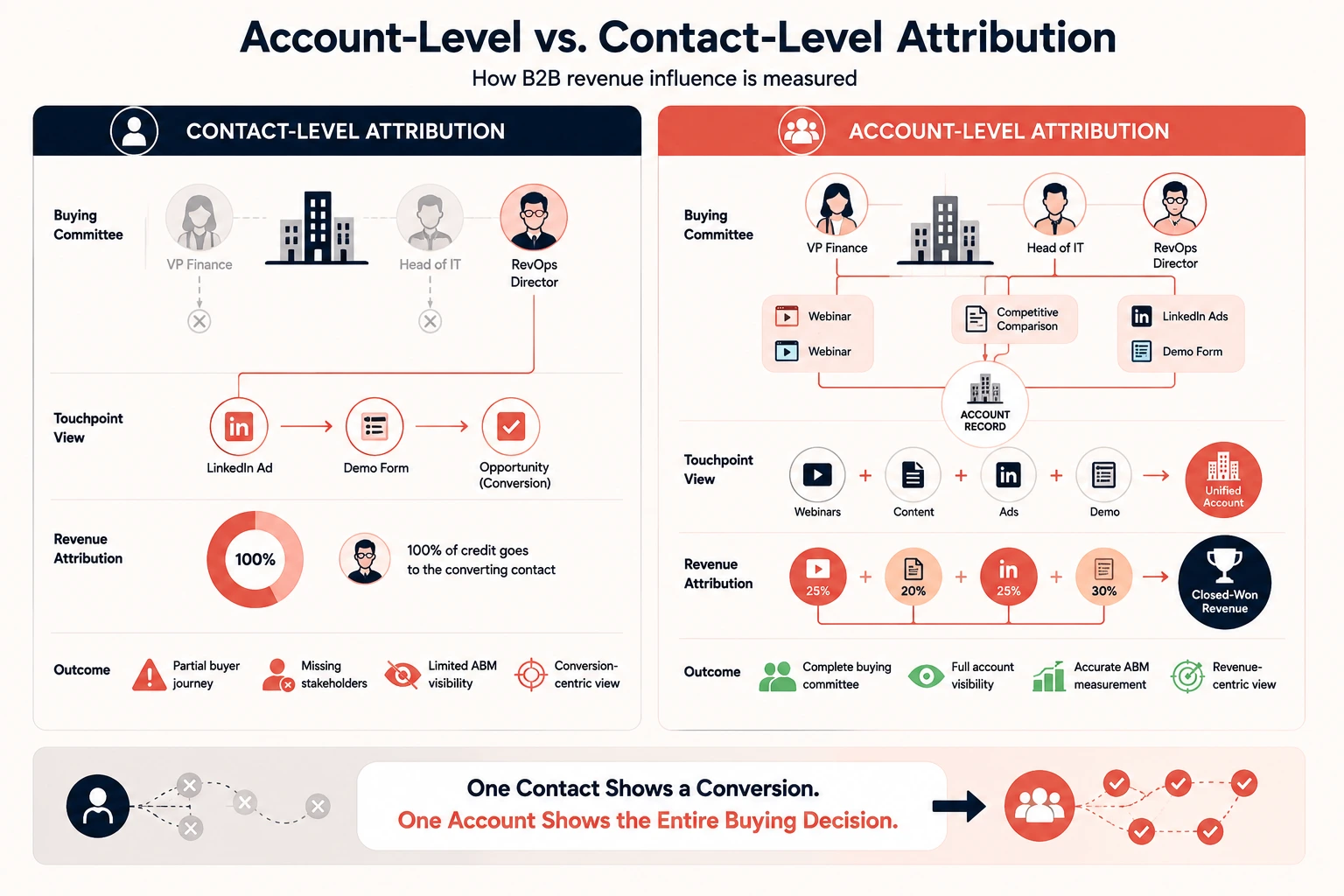
Most attribution platforms default to contact-level tracking. One contact, one journey, one set of touchpoints.
That's a problem in B2B, where nobody buys alone. A complex purchase pulls in a whole committee, each member engaging through different channels at different times. Contact-level attribution only captures the one or two people who filled out forms. The rest stay invisible.
Account-level attribution fixes this. It rolls up every touchpoint from every contact at a company into one account record, then ties that record to pipeline, deal velocity, and closed revenue.
Picture a real deal. A VP of Finance watches two webinars. A Head of IT reads your competitive comparison. A RevOps Director clicks three LinkedIn ads and submits the demo form. Contact-level attribution shows you the RevOps Director and nobody else, because she's the one who converted. The other people who shaped the decision? Gone from your data.
For teams running account-based marketing, this isn't optional. Everyone on that committee is part of the same B2B buying group, and your attribution needs to see all of them. If you're tracking account-based marketing metrics and trying to understand which programs influence specific target accounts, contact-level attribution structurally cannot tell you the full story. You need account-level tracking, clean account-to-contact relationships, and enrichment that maintains those links as people change roles.
Intent Data and the Attribution Gap
Standard attribution tracks what buyers do on your channels. Clicks, form fills, opens, page views.
Intent data tracks what they're doing everywhere else.
When a target account starts researching "revenue attribution software" or "CRM data enrichment" on third-party review sites, that's a signal worth capturing, often before they ever land on your website. B2B buyers do a large chunk of their evaluation before talking to a vendor. If your model only counts post-contact touches, you're measuring the last third of the journey and crediting it as the whole thing.
Intent data layers behavioral buying signals into account records before any direct engagement. SMARTe integrates Bombora intent data natively, so when your attribution tool reads the CRM, account records already carry intent context alongside the form fills and campaign responses.
Why it matters: an account that clicked your LinkedIn campaign, spiked on category intent for two months, then booked a demo did not convert because of the demo CTA alone. The intent signals were part of the path. Attribution that ignores them undervalues your awareness programs every single time.
This ties into broader signal-based GTM approaches, where buying signals from across the web shape how you prioritize accounts and measure what truly drove the deal. Intent-based marketing programs that earn credit in your model look very different in budget reviews than ones that don't.
What Your Attribution Setup Should Connect To
Picking a model is the easy part. The harder, more valuable work is wiring attribution into the rest of your revenue engine.
Fix the CRM foundation first. Run CRM data enrichment to catch decayed records before they distort reports. Make lead source a required field with a defined taxonomy, not an optional dropdown reps ignore.
Commit to one model for at least 90 days before judging it. Models need data volume to produce meaningful signal. Running three at once on thin data just produces noise.
Connect attribution to your revenue metrics, not a separate dashboard. Attribution tells you which channels create pipeline. Your RevOps KPIs tell you whether that pipeline converts, accelerates, or stalls. Read together, they answer a revenue question. Read apart, they're two half-answers that don't reconcile. The same logic applies to your B2B marketing metrics and how you measure pipeline generation.
Agree on what "influenced" means before building the dashboard. Marketing and sales will fight over credit forever unless the definition is settled in advance. The model can only reflect what the CRM captures. If sales won't log early touches, your first-touch data will always look broken.
Here's a useful reality check on what executives actually want out of attribution. A survey of 400 CMOs compiled by Trackier ranked the metrics leadership demands most from revenue attribution systems:
Notice what's missing from that list. Clicks. Impressions. MQLs. The metrics that win budget conversations are the ones tied to money and efficiency. Build your attribution reporting around those, and you're speaking the language the boardroom already uses. This is also why connecting attribution to revenue operations and your broader revenue generation motion pays off: the model stops being a marketing report and becomes a revenue tool.
Also Read: How revenue forecasting models turn pipeline data into predictable targets
Honestly, the teams that get attribution right aren't the ones with the fanciest model. They're the ones who got obsessive about data quality early, agreed on definitions across marketing and sales, and ran a simple model cleanly instead of a complex one badly.
The goal was never a perfect attribution report. It's a report everyone trusts enough to move budget on. That's a data problem and a people problem long before it's a model problem.
Try SMARTe free to see how real-time contact and account enrichment gives your attribution model the accurate CRM data it needs to produce numbers your team actually trusts.