TL;DR:
Demand generation tools help B2B teams find in-market accounts, capture buying signals, and turn that interest into pipeline. Here's the fastest answer by job.
- Best overall for data and signals: SMARTe. 289M+ verified contacts, 75%+ US mobile coverage, native intent, from $15,000 a year
- Best for US database depth: ZoomInfo, if your budget clears roughly $15,000 a year
- Best for predictive ABM: 6sense for buying-stage prediction, Demandbase if you also need account-based ads
- Best marketing automation: HubSpot Marketing Hub under 50 people, Adobe Marketo Engage above it
- Best for custom enrichment: Clay, provided someone on your team enjoys building workflows
- Best website visitor identification: RB2B for US person-level, Leadfeeder for European accounts, Warmly for real-time response
- Best paid media automation: Metadata, once you spend $20,000+ a month on ads
- Best late-stage signal: G2 Buyer Intent, for accounts already comparing you to rivals
- Cheapest way to start: Clay, RB2B, Leadfeeder, and 6sense all have free tiers you can test this week
Demand generation tools promise to show you who's in market before your competitors find them. I spent the last few weeks pulling contracts, pricing pages, and acquisition filings for 14 of them. The picture in 2026 looks nothing like 2024.
Four of the tools I'd have recommended two years ago now belong to somebody else. One is heading for shutdown.
That matters more than any feature comparison. Buy a platform, watch a CRM you don't use absorb it, and your workflow breaks at renewal. So this list covers what each tool does, what it costs, where it breaks, and who owns it right now.
I'll be upfront about one thing before you scroll. I work at SMARTe, and SMARTe is number one on this list. You should read that section with the skepticism it deserves.
What demand generation tools do
A demand generation tool does one of four jobs. Some do two. Almost none do all four well, which is why nearly every B2B team ends up with three or four of them.
- Find the account. Firmographic and technographic filters that build a target list matching your ICP.
- Catch the signal. Third-party research spikes, website visits, job changes, funding events, review site activity.
- Reach the buyer. Verified emails and direct dials, plus the sequencing or ad platform to deliver a message.
- Prove the pipeline. Attribution that connects a campaign to a closed deal instead of a form fill.
The gap that trips teams up sits between jobs two and three. Bombora tells you Acme Corp is surging on cloud security. It won't name which of the nine people in that buying group holds the budget. It won't hand you a mobile number either.
That gap is expensive. And it's the reason a signal-only contract almost never pays for itself alone.
How I picked these 14 tools
I've used nine of these platforms first-hand, either at SMARTe or at the two B2B teams I worked on before this. For the other five, I read the docs, pulled third-party contract data, and worked through G2 and Vendr reviews.
Then I scored every tool against five things.
- Data accuracy in your market. I checked fill rates by region, not headline database size. A 500 million contact count means nothing if your buyers sit in Mexico City.
- Signal timing. Does it catch accounts early, mid-cycle, or at shortlist stage? Each answer suits a different sales motion.
- Cost you can verify. I used published pricing where vendors publish it. Where they hide it, I used contract data from Vendr and G2 and labeled it as an estimate.
- What breaks at renewal. Credit expiry, auto-renewal windows, onboarding fees, and overage rates. These decide your real bill more often than list price does.
- A named weakness. Every entry below has a limitation I can state plainly. When I couldn't name one, I didn't know the product well enough to write about it.
Disclosure: SMARTe employs me, and SMARTe sits at number one. I put it there because the data layer is where demand gen works or quietly fails, and because I use the product every day. Judge my reasoning before you accept my ranking.
One structural note on budget. Five of these tools start free or under $200 a month. The other nine, SMARTe included, start in five figures a year. That split decides more shortlists than any feature does, so read the pricing line before the feature list.
Demand generation tools compared
| Tool | Best for | Core job | Entry price |
|---|---|---|---|
| 1. SMARTeTop pick | Global data plus buying signals | Find and reach | From $15K/yr, no free tier |
| 2. ZoomInfo | US enterprise data depth | Find and reach | Quote only |
| 3. 6sense | Predictive ABM at enterprise scale | Signal | Free tier, then approx $55K/yr |
| 4. Demandbase | ABM plus B2B advertising | Signal and reach | Approx $50K to $80K/yr |
| 5. Bombora | Third-party intent baseline | Signal | Approx $25K to $30K/yr |
| 6. HubSpot Marketing Hub | SMB to mid-market all-in-one | Reach and prove | Free, then $15/seat/mo |
| 7. Adobe Marketo Engage | Enterprise marketing automation | Reach and prove | Quote only |
| 8. Clay | GTM engineers building custom flows | Find and reach | Free, then $185/mo |
| 9. Leadfeeder | European website visitor ID | Signal | Free, then approx $99/mo |
| 10. RB2B | US person-level visitor ID | Signal | Free, then $79/mo |
| 11. Warmly | Real-time signal response | Signal and reach | Free, then approx $10K/yr |
| 12. Qualified | Salesforce-native inbound AI | Reach | Quote only |
| 13. Metadata | B2B paid media automation | Reach | $3,950/mo billed annually |
| 14. G2 Buyer Intent | Late-stage comparison signal | Signal | Approx $10K to $40K/yr add-on |
1. SMARTe

SMARTe is a global B2B data platform built for teams whose buyers don't all sit in North America. The database covers 289M+ verified contacts and 66M+ company profiles across 200+ countries. Bombora intent ships natively rather than as a bolt-on.
The part I care about is coverage depth outside the US. Plenty of providers claim global reach and then hand you a list that's 80% American.
Key features
- 289M+ verified B2B contacts and 66M+ company profiles
- 75%+ US mobile and direct dial coverage, 50%+ global direct dial
- 86% of US decision-makers reachable with a verified work email
- Native Bombora intent, plus funding, headcount, and leadership change signals
- AI Agents that map buying groups per account automatically
- Technographic filters across 64K+ tracked products
- 90%+ CRM match rates for enrichment at scale
- SMARTe MCP, which lets Claude or ChatGPT query verified data live
- SMARTe Prospector, a browser extension for LinkedIn and company sites
What I like
Real-time verification instead of batch refresh. SMARTe checks a number the moment you pull it, not the day it built a quarterly file. That difference shows up fast in connect rates.
The global depth is the other reason I rank it first. LATAM and APAC coverage holds up in markets where the big US vendors thin out badly. I've watched a rep pull direct dials in São Paulo and Singapore from the same list.
Buying group mapping also saves a step many teams do by hand. Instead of finding one champion and guessing at the rest, the AI Agents surface the full committee per account.
What could be better
There's no free tier and no self-serve signup. SMARTe is enterprise only from $15,000 a year, so a small team can't try it the way they can try Clay or RB2B. Evaluation runs through a sales conversation and a sample match against your own records.
SMARTe isn't a marketing automation platform either. There's no email sending, no landing page builder, no ad buying. If you need those, you're pairing SMARTe with HubSpot or Marketo, not replacing them.
There's no website visitor identification. For teams whose main signal source is inbound traffic, that's a hole. You'd run RB2B or Leadfeeder alongside it.
Brand recognition is smaller than ZoomInfo's. In a procurement review where someone on the committee has only heard of one vendor, that costs you.
Pricing
- Enterprise: From $15,000 per year, credits from $0.30 each with volume pricing down to $0.20 at 1M
- No per-seat fees. The whole team draws from one credit pool
- No free or self-serve tier
The no-per-seat structure matters more than it sounds. A twenty-person team and a five-person team pay the same entry price, which is not true of most platforms on this list.
My verdict
Best fit for outbound-first teams selling into more than one region, and for RevOps teams who need enrichment that holds up at scale. It's an enterprise commitment, so if you're testing demand gen for the first time with a small budget, start with Clay or RB2B instead. If your entire market is US mid-market, ZoomInfo's database depth is worth pricing against it.
2. ZoomInfo
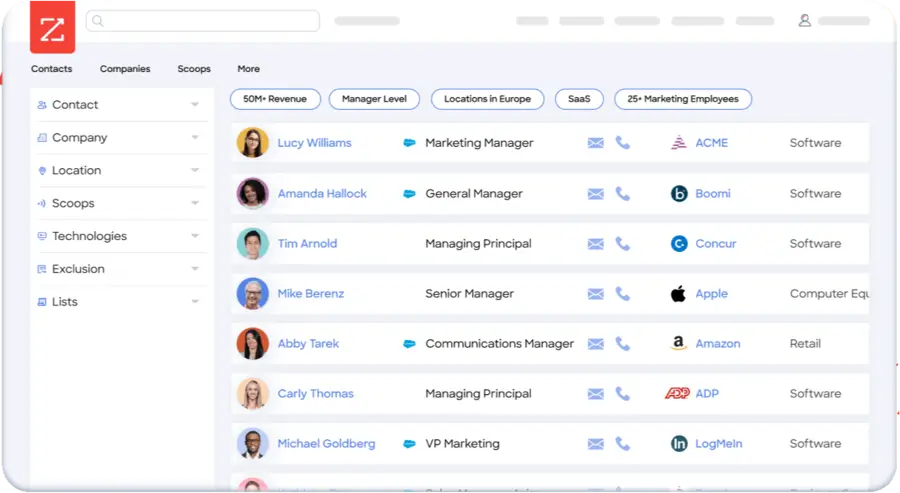
ZoomInfo remains the reference point for US B2B data. The platform reports over 500 million contacts and 100 million companies, and it processes more than a billion buying signals daily. GTM Workspace layers AI recommendations on top of that.
Nobody gets fired for buying it. That's both the pitch and the problem.
Key features
- Contact and company database with verified emails and direct dials
- Intent tracking across web research, content, and technographic change
- WebSights for website visitor identification
- CRM enrichment with automatic flagging of stale records
- Custom intent topics beyond the standard keyword taxonomy
- Native connections to HubSpot, Marketo, Pardot, and Eloqua
- GDPR, CCPA, and SOC 2 Type II certifications
What I like
US coverage really is the deepest in the category. For mid-market and enterprise accounts headquartered in North America, the fill rate beats almost everyone.
Custom signals deserve more attention than they get. Build your own intent topic for your category and the alerts come back cleaner than generic keyword tracking.
What could be better
Pricing. ZoomInfo publishes no list price, and Vendr-reported contract values sit around $33,500 on average. Buyers report multi-year deals and auto-renewal clauses with tight cancel windows.
International coverage thins out fast. EMEA is workable. LATAM and APAC are where I've seen teams get burned after signing on the strength of a US demo.
Credits are also pooled contractually and don't roll over, so unused data expires with your term.
Pricing
Quote only. Third-party contract data puts typical annual spend between roughly $15,000 and $40,000, with enterprise deployments climbing well past that. Reading what ZoomInfo costs across tiers before your first sales call is time well spent.
My verdict
Worth the money when your ICP is US-heavy, your deals justify five figures a year, and someone owns the platform. Sell globally, or need ROI inside a quarter, and the math turns against you fast.
3. 6sense
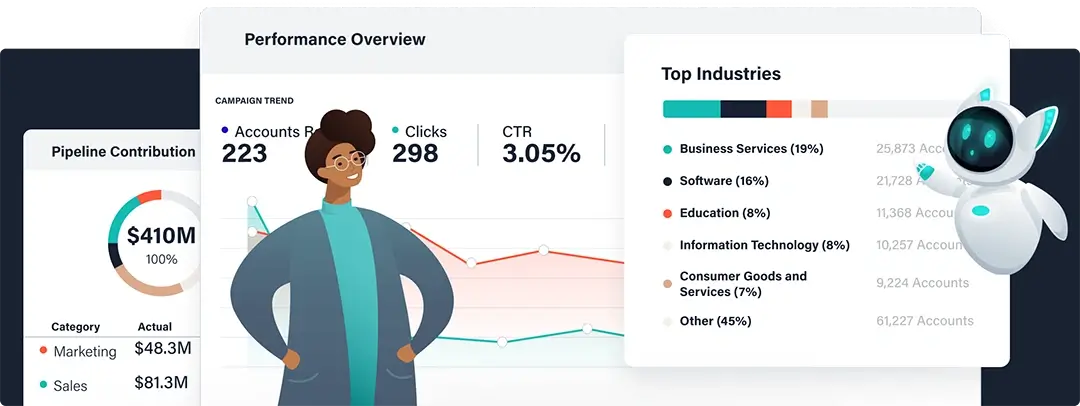
6sense predicts which accounts are in market and what stage they've reached. It blends anonymous web behavior, third-party intent, and ICP fit. The output is a buying stage for each account. RevvyAI, its agent layer, went generally available in 2026.
Key features
- Predictive account identification for in-market buyers
- Anonymous visitor tracking at the company level
- Buying stage classification: awareness, consideration, decision, purchase
- Account scoring combining intent with ICP fit
- Native display advertising with a $100 minimum campaign budget
- Integrations with Salesforce, Marketo, Eloqua, and ad platforms
What I like
The stage prediction is the differentiator. Knowing an account is researching is useful. Knowing they've moved from exploration into requirements building changes what your rep says on the call.
There's also a free tier with 50 credits per month, which is rare at this end of the market.
What could be better
Cost, and the cost behind the cost. Vendr puts the median contract at roughly $55,000 per year, with a range from about $35,000 to well over $130,000. Implementation runs another $10,000 to $50,000 depending on your stack.
Advertising carries a 15% to 18% variable fee deducted from campaign spend, plus another 15% ad services fee on LinkedIn campaigns. Those line items don't appear in the platform quote.
Credits sit in contractual pools and expire at term end. And the learning curve is steep enough that reviewers routinely flag needing a dedicated operator.
Pricing
Free tier with 50 monthly credits. 6sense quotes paid plans per deal on annual contracts. Buyers report a median of roughly $55,000 to $62,000 per year, ranging from about $11,500 to $175,000 depending on modules.
My verdict
Worth it for enterprise ABM teams with an ops resource and deal sizes above $50,000. Map the 6sense competitor set before you commit to a two-year term.
4. Demandbase
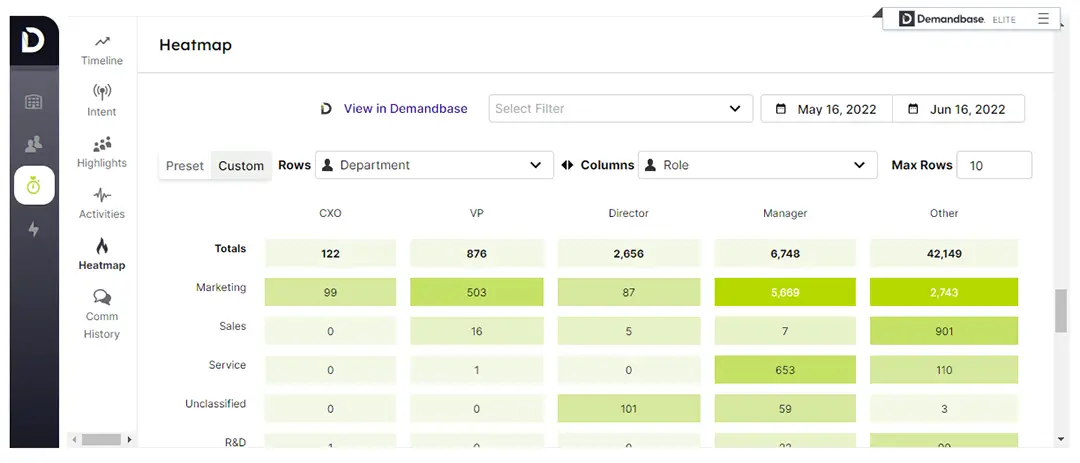
Demandbase One bundles four things into one product. Account intelligence, a native B2B ad platform, website personalization, and intent. It's the result of stitching Engagio, InsideView, and DemandMatrix together. It holds a 4.4 out of 5 rating on G2 across 1,900+ reviews.
Agentbase, its AI agent layer, launched in 2025 and ships to existing customers at no extra cost. That's unusual in a market where everyone charges for AI add-ons.
Key features
- Account identification for anonymous website visitors
- Website personalization keyed to visitor company, industry, or stage
- Native B2B advertising platform for account-level targeting
- Engagement minutes scoring across content consumption
- Intent data pulled from multiple sources including its own media properties
- Agentbase agents for campaign outcomes, account engagement, and intent summaries
What I like
The native ad platform is the real separator. Running account-targeted display inside the same tool that scores the accounts removes a handoff that usually breaks.
Including the AI agents at no charge also reads as confidence rather than a monetization play.
What could be better
Advertising CPMs run 30% to 50% above standard demand-side platforms. You're paying for account precision, which only pencils out if your average deal justifies it.
G2 reviewers consistently describe the platform as feature-heavy for anyone who isn't a power user. Segments and scoring models pile up quickly, and CRM integration takes more effort than the sales cycle suggests.
Website tracking lag also comes up repeatedly in reviews.
Pricing
Quote only. Account Intelligence typically starts around $50,000 to $80,000 per year. Full deployments with the advertising layer commonly exceed $100,000, and enterprise contracts reach past $200,000.
My verdict
Strongest choice for enterprise teams above roughly $50M in revenue running coordinated account based marketing programs with real ad budgets. Mid-market teams routinely underestimate the operating lift and end up with shelfware.
5. Bombora
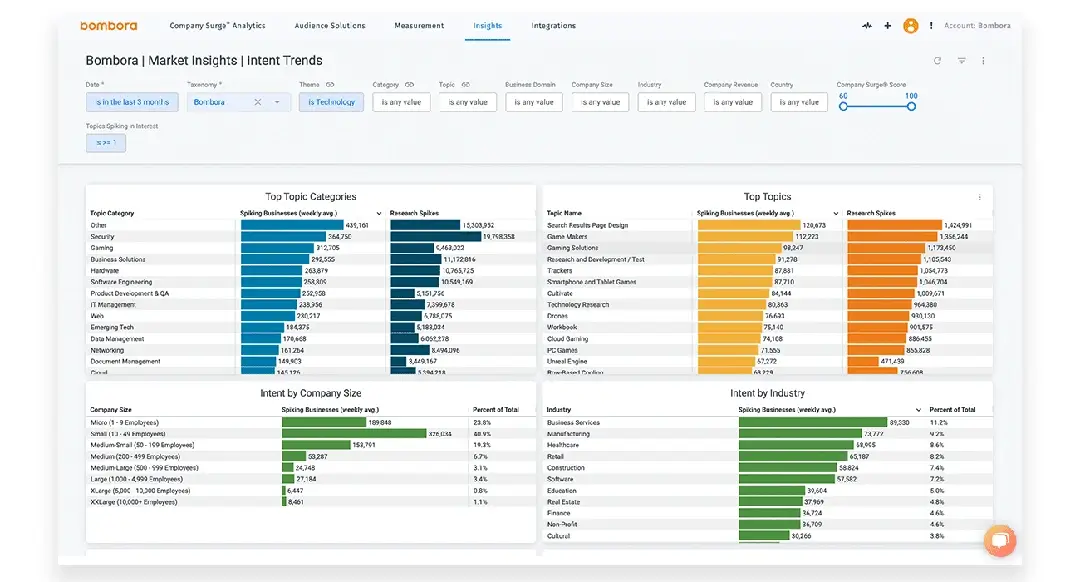
Bombora built the largest consent-based data cooperative in B2B, aggregating anonymized research behavior from more than 5,000 publisher websites. Company Surge scores accounts from 0 to 100 based on how much their research on a topic spikes above baseline.
One fact is worth knowing before you get a quote. Bombora likely already sits inside a tool you own.
Key features
- Company Surge scoring across 14,000+ B2B topics
- Weekly data refresh as standard
- Cooperative model spanning 5,000+ business sites
- API access for custom activation
- Integrations with major CRMs, marketing automation platforms, and ad tools
- Audience Solutions for programmatic activation, priced separately
What I like
The consent-based co-op model is cleaner than bidstream sourcing, and it explains why so many platforms license it. When an independent test by Brixon Group measured intent precision, Bombora landed at 81%, behind Echobot at 92% and G2 Buyer Intent at 87%. Not the leader, but a defensible baseline across a very wide topic taxonomy.
Topic breadth is the other strength. Fourteen thousand topics covers categories that narrower providers ignore.
What could be better
You're probably already paying for it. 6sense, Demandbase, ZoomInfo, Cognism, and SMARTe all license Bombora data. Buying a standalone contract on top of one of those means paying twice for the same signal.
It's also company-level only. You learn Acme is surging on cloud security. You don't learn whether that's the CTO or an intern writing a report. That gap is why first-party and third-party intent data behave so differently in practice.
Weekly refresh is slow for fast-moving categories. By the time the Surge report lands, a buying committee may have shortlisted already.
Pricing
Quote only, annual contracts, no free trial. Company Surge starts around $25,000 to $30,000 per year. Prospeo's analysis of 34 tracked purchases puts the median standalone contract at $24,750, ranging from $12,250 to $80,525. Individual topics run $500 to $2,000 for basic and $5,000 to $25,000 for premium.
My verdict
Buy it standalone only if you want a raw feed to pipe into your own systems. Otherwise, check your existing contracts first. I've seen teams discover they were double-paying six months into a term, which is a rough conversation to have with finance.
6. HubSpot Marketing Hub
HubSpot bundles email, landing pages, forms, workflows, and behavior-based lead scoring on top of a free CRM. For SMB and mid-market teams, it's the default and probably should be.
It also just got a lot more interesting for demand gen. HubSpot announced its agreement to acquire Warmly on June 30, 2026, which adds person-level visitor identification and two AI agents to the platform.
Key features
- Email marketing with A/B testing and personalization tokens
- Landing page builder with conversion tools
- Lead scoring across demographic fit and behavioral engagement
- Workflow builder for nurture sequences and internal alerts
- Native CRM with full contact timeline
- Progressive profiling forms
- Breeze Intelligence for enrichment, the successor to Clearbit
What I like
Time to value. A two-person marketing team can launch a working nurture program in a week without a consultant. Nothing else on this list moves that fast.
The free CRM is really free. No contact ceiling bites you early.
What could be better
The Starter to Professional cliff is brutal. Starter runs $15 per seat per month on annual billing. Professional jumps to $800 per month on annual billing, with three seats and a mandatory $3,000 onboarding fee in year one. The jump is 44x.
Everything that makes email work sits above that cliff. A/B testing, multi-step automation, smart content, and advanced segmentation are all Professional-only.
Marketing contact tiers drive the bill. Seats barely move it. Professional includes 2,000 contacts, and every additional 5,000 adds roughly $224 per month. A growing list raises your invoice automatically.
Breeze Intelligence also only works inside HubSpot. Run Salesforce and that enrichment path shuts. HubSpot retired the standalone product, which pushed plenty of teams toward the Clearbit alternatives worth pricing.
Pricing
- Free: $0
- Starter: $15 per seat per month annually, $20 monthly, 1,000 contacts
- Professional: $800 per month billed annually or $890 monthly, 3 seats, 2,000 contacts, plus $3,000 onboarding
- Enterprise: ~$3,600 per month, plus $7,000 onboarding
My verdict
The right answer for teams under about 50 people who want one system. Budget for Professional from day one, because Starter runs out faster than anyone expects.
7. Adobe Marketo Engage
Marketo is the enterprise marketing automation choice for long, multi-stakeholder cycles. It handles lead management, engagement programs, and revenue attribution. Smart Campaigns handle automation logic that HubSpot workflows can't express.
Adobe spent 2026 rebuilding it around agents. The platform now ships an AI chat interface plus agents for data hygiene and program QA. An MCP server connects Claude or Copilot straight to your instance.
Key features
- Lead scoring plus lead grading against ICP fit
- Engagement programs with content streams that adapt to behavior
- Smart Campaigns for complex trigger and filter logic
- Revenue cycle analytics tracking program influence on deals
- MCP server for connecting external AI tools securely
- AI agents for lead imports, duplicate flagging, and program QA
- Native sync with Salesforce and Microsoft Dynamics
What I like
Lead grading separate from lead scoring is a distinction few platforms make properly. Grading asks whether they fit. Scoring asks whether they're engaged. Treating those as one number is how bad marketing qualified leads reach sales.
The MCP server is a smart move. It means your marketing ops data is queryable from the AI tools your team already opens every morning.
What could be better
Adobe doesn't publish pricing, and the third-party estimates float widely. Complexity is the bigger cost anyway. Marketo assumes a dedicated ops person, and it punishes teams who don't have one.
The interface has aged. Reviewers still describe the campaign builder as dense, and onboarding a new hire takes weeks rather than days.
A few flagship 2026 agent features were still listed as coming soon at launch. Program creation and callable agents both sat in that bucket.
Pricing
Quote only, sized by database volume. Third-party estimates place tiers at roughly $895 per month for Growth up to $3,195 per month for Ultimate. Treat those as orientation only. Get a real quote.
My verdict
Pick Marketo when your buying cycles are long, your data model is complicated, and you have marketing ops headcount. Pick HubSpot when you don't.
8. Clay

Clay isn't a database. It's a spreadsheet-shaped workspace that runs waterfall enrichment across 100+ data providers, so if provider one misses an email, provider two tries. GTM engineers build custom flows in it that no single vendor sells off the shelf.
It also overhauled pricing on March 11, 2026, and the change was substantial.
Key features
- Waterfall enrichment across 100+ integrated data providers
- Unlimited seats on every plan, including free
- AI research agents for custom column logic
- HTTP API integration for any external service
- Web Intent signals, moved down to the Growth tier
- Native CRM sync with Salesforce and HubSpot
What I like
Unlimited seats on a usage-based model is the right structure. Team size doesn't change your bill, which removes an argument nobody enjoys having.
The March 2026 restructure cut data marketplace costs by 50% to 90% across providers. It also moved CRM integrations and Web Intent from the old $800 plan down to Growth at $495. Genuine price relief in a market that mostly moves the other way.
Pairing Clay with a primary data source rather than using it alone tends to work better. The SMARTe and Clay integration exists for exactly that reason.
What could be better
Clay charges Data Credits for every enrichment attempt, whether or not a result comes back. Run a three-provider waterfall on a stale list and you pay for all three misses. On older data, that quietly eats 20% to 30% of your monthly allocation.
Data Credit rollover caps at 2x your monthly allocation. Actions reset monthly with no rollover at all. Seasonal campaign teams lose credits they paid for.
The learning curve is also real. Clay rewards people who think like engineers, and frustrates people who don't.
Pricing
- Free: $0, 100 Data Credits and 500 Actions per month
- Launch: $185 per month, 2,500 Data Credits, 15,000 Actions
- Growth: $495 per month, 6,000 Data Credits, 40,000 Actions
- Enterprise: Custom
Annual billing saves about 10%. Legacy Starter, Explorer, and Pro customers keep their old pricing indefinitely, though the window to switch between legacy tiers closed in April 2026. A fuller breakdown sits in my full Clay review and pricing math.
My verdict
The best tool here for teams with a GTM engineer. The worst tool here for teams without one.
9. Leadfeeder
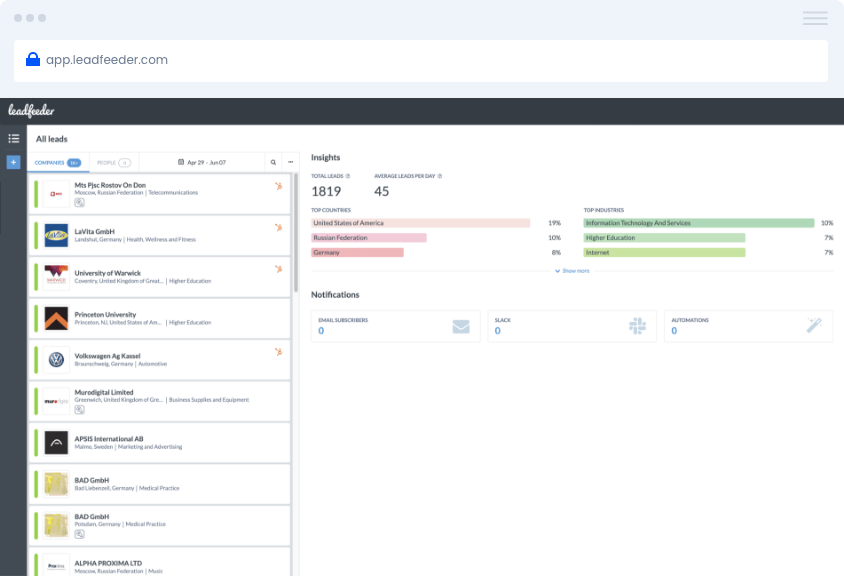
Leadfeeder identifies which companies visit your website by matching IP addresses to business records. If you've been tracking this space, the name may confuse you. Dealfront rebranded back to Leadfeeder on March 24, 2026, reversing the 2022 merger branding, and dealfront.com now redirects.
The visitor identification module now goes by Web Visitors. Promote became Campaigns.
Key features
- Company-level visitor identification via reverse IP and its own data graph
- Page-level tracking showing which content accounts consume
- Free Lite plan with unlimited users
- Custom feeds filtering visitors by company attributes
- Deep European and DACH company data inherited from Echobot
- MCP server and IP APIs for querying from Claude or ChatGPT
- CRM sync with Salesforce, HubSpot, Pipedrive, Zoho, and Dynamics
What I like
European coverage is the strongest on this list. The company is EU-headquartered and sources firmographic data from European trade registers, so GDPR posture is a design choice rather than a retrofit.
The free tier with unlimited users is smart. A whole team can watch inbound traffic before anyone signs anything.
What could be better
Remote work broke the core assumption. Anyone browsing from home or a coffee shop won't resolve to a company IP. In 2026 that's a large share of real buyer traffic.
It's company-level only. You learn a company visited. You still need a contact, a title, and a reason to reach out.
Pricing also moved up after the merger. Legacy free-plan users report $99 to $200 monthly bills for the same function. Verified emails and intent filtering only appear at higher tiers. That price shift is what sent a lot of teams looking at cheaper Leadfeeder alternatives in the first place.
Three years of Dealfront documentation and bookmarks now point at a dead brand name too.
Pricing
Free Lite plan covering up to 100 company identifications per month with 7-day retention and no CRM integrations. Paid visitor identification starts around $99 per month. The prospecting and sales intelligence modules are quote-only.
My verdict
The right pick if your traffic skews European and account-level signal is enough. If you need to know which person visited, look at RB2B instead.
10. RB2B
RB2B does one thing. It identifies the individual behind anonymous US website traffic and pushes that person's LinkedIn profile to Slack in real time. Not the company. The person.
Adam Robinson launched it in 2023, and it created a category. Every other visitor tool on this list resolves at the account level.
Key features
- Person-level identification for US traffic
- Real-time Slack alerts with LinkedIn profile, name, and title
- Filtering by job title, company size, and industry
- First-time versus returning visitor tracking
- Salesforce and HubSpot CRM sync
- Lightweight JavaScript pixel, no form fill required
What I like
RB2B changes what the signal is, not just how strong it is. Knowing that a VP of Sales at a target account read your pricing page twice this week is a reason to call. Knowing "someone from Acme" visited is not.
Pricing transparency is also better than almost anyone in this category. RB2B publishes tiers and identification volumes on its site.
What could be better
US-only, structurally. EU and APAC visitors return zero matches at any tier. If your pipeline is international, this tool does nothing for two-thirds of your traffic.
Match rates land somewhere between 5% and 20% of US traffic depending on your visitor profile. Fifteen percent of your US traffic is a useful number. It's also nowhere near everyone.
The free plan also changed. As of January 2026, it no longer includes contact-level resolution. You see companies. The individual names, the exact thing the product exists for, sit behind the paywall now.
And it stops at identification. No enrichment, no sequencing, no CRM workflow. You're buying a signal and building the rest yourself.
Pricing
- Free: $0, 150 monthly resolutions, company level only
- Starter: $79 per month, 300 resolutions, LinkedIn URLs to Slack or Teams, no email addresses
- Pro: $149 per month, 600 resolutions, business emails, all integrations
- Pro+: $199 per month, same volume with premium resolution for higher match rates
Credits refresh monthly and don't roll over. Overage runs 45 cents per credit on Starter and 25 cents on Pro. A 7-day Pro trial is available.
My verdict
Cheap enough to test in a month, so test it. The one requirement is an SDR who'll act on a Slack alert within the hour. Otherwise the signal decays before anyone touches it.
11. Warmly
Warmly sits between visitor identification and outreach. It de-anonymizes website traffic at the person level and layers intent signals on top. An Inbound Agent then starts conversations and books meetings on its own.
On June 30, 2026, Warmly announced a definitive agreement for HubSpot to acquire it. Existing contracts, pricing, and integrations stay unchanged for now, but the long-term direction points inside HubSpot.
Key features
- Person-level web de-anonymization drawing on RB2B and Vector data
- Inbound Agent for AI chat, qualification, and meeting booking
- TAM Agent for building lists and running outbound
- Bombora intent signals plus job change and funding triggers
- Automated LinkedIn and email sequencing
- Lead routing with custom CRM fields
What I like
Speed to response. The identify-to-Slack-to-action loop beats how 6sense or Demandbase deliver signal. For teams built to react within the hour, those minutes compound.
Bundling identification, intent, and engagement also removes two integrations. That matters more for a five-person team than a fifty-person one.
What could be better
The HubSpot acquisition is the honest caveat. Niche features tend to shrink post-acquisition while integration depth grows. If you run Salesforce, watch the next two or three quarters closely before signing a multi-year term.
Match rates depend heavily on traffic profile. High-traffic B2B SaaS sites see 30% to 40%. Lower-traffic or consumer-leaning sites see 15% to 20%. Below a floor of roughly 3,000 monthly sessions, the math stops working.
There's no dialer. If your reps call, you're adding Orum or Nooks on top.
Coworker AI conversations run on a meter too. High-traffic sites can burn through bundled volume in a quarter.
Pricing
Free tier identifying up to 500 company-level visitors per month, capped at 10 intent signals per week and no automation. Paid components price by output rather than seats, starting around $10,000 per year for web de-anonymization. Inbound and outbound agent tiers run $16,000 to $30,000 per year. Enterprise is custom.
My verdict
Strong fit for mid-market teams with 5,000+ monthly B2B sessions and an SDR team structured to respond fast. If you're already deep in HubSpot, the acquisition makes this an easier call, not a harder one.
12. Qualified
Qualified turns your website into a conversation. Piper, its AI SDR agent, talks to visitors through chat, voice, and video. It scores them against Salesforce data and books meetings without a rep touching it.
Salesforce completed its acquisition of Qualified on April 1, 2026. That closed the loop on a product that was always Salesforce-native anyway.
Key features
- Piper AI SDR agent running chat, voice, and video conversations
- Real-time visitor identification by company
- Native Salesforce integration with full account context
- Automated meeting scheduling inside the conversation
- Personalized follow-up email sequences
- Pipeline attribution showing chat influence on deals
What I like
Conversation quality is the standout. Multiple G2 reviewers note that visitors can't tell they're talking to AI. The product holds a 4.9 out of 5 rating across 1,400+ reviews.
Salesforce's own team configured and launched Piper in 30 days, and reports a 6% conversion rate booking more than 60 meetings per week. Salesforce published those figures about its own deployment, so weigh them with that in view. The setup speed still reads as credible.
What could be better
Salesforce is a hard dependency. Teams on HubSpot, Pipedrive, or anything else get a second-tier experience, and post-acquisition the roadmap consolidates further toward Salesforce-native.
Setup runs in months rather than weeks for anything beyond a basic deployment.
Cost stacks. Third-party estimates put the platform at $40,000 to $68,000 per year, with the required Salesforce stack adding $30,000 to $60,000 on top. Total ownership lands somewhere around $95,000 to $165,000 annually.
It also converts accounts already in your CRM better than it captures net-new ones. Qualified built it that way on purpose. It still changes what you should expect from month one.
Pricing
Quote only across three tiers: Premier, Enterprise, and Ultimate. No public list prices. Salesforce announced the definitive agreement to acquire Qualified in December 2025 and closed it the following April.
My verdict
If you run Salesforce at enterprise scale and inbound volume is high, this is the strongest AI SDR on the list. If you don't run Salesforce, stop reading here.
13. Metadata
Metadata automates B2B paid media across LinkedIn, Meta, Google, and Reddit. AI agents build audiences, run multivariate experiments, negotiate bids, and shift budget toward whatever is working. You supply goals and creative.
Founded in 2015 by Gil Allouche, it stayed narrow while everyone else expanded. I think that was the right call.
Key features
- Automated campaign execution across paid social and display
- MetaMatch identity graph for lead-to-account matching
- Continuous multivariate testing of ad and audience combinations
- Automatic budget shifting based on live performance
- 141 MCP tools any LLM can call
- CRM sync for pipeline attribution
What I like
The experimentation engine does work that would be impossible by hand. Running thousands of ad and audience combinations, then reallocating spend automatically, is a scale problem software should own.
The patented lead-to-account matching also solves a specific irritation. Personal social profiles rarely match business records cleanly, and Metadata bridges it better than native ad platforms do.
What could be better
It's the execution layer only. Metadata doesn't do account selection, scoring, or coordination across email and sales outreach. You need 6sense, Demandbase, or an intent provider feeding it.
That narrowness is also a risk in 2026. Revenue teams are consolidating point tools, and a single-function platform has to justify its own line item every renewal.
Small teams and early-stage startups with modest media budgets won't clear the threshold where automation beats manual management.
Pricing
Metadata publishes no pricing. Capterra lists two packages:
- Base plan: $3,950 per month billed annually, covering ad spend up to $25,000 per month
- Scale plan: $5,650 per month billed annually, covering ad spend up to $40,000 per month
- Onboarding: $2,500 one-time fee on both
That works out to roughly $47,000 to $68,000 a year in platform fees, before you spend a dollar on ads. A 15-day free trial covers the Bid Agent module.
My verdict
Right call for teams spending $20,000+ per month on paid social with someone accountable for experimentation. Below that, a $47,000 platform fee eats whatever the automation saves you.
14. G2 Buyer Intent
G2 shows you which companies are reading your category page, viewing your profile, and comparing you against named competitors. Research surge tells you someone entered the market. This tells you they're building a shortlist.
Later is not worse. Someone comparing you against two rivals on a review site is closer to a decision than someone reading a blog post about the category.
Key features
- Company-level activity on your G2 profile and category pages
- Comparison alerts naming which competitors a buyer is weighing
- Category and alternatives page tracking
- CRM and marketing automation integrations
- Ad targeting activation against in-market accounts
What I like
The precision. That Brixon Group test put G2 Buyer Intent at 87% precision, ahead of Bombora's 81%. Review-site behavior is a narrow signal, and narrow signals tend to be cleaner.
Competitor comparison alerts are the specific thing I'd pay for. Knowing an account is actively weighing you against a named rival changes the conversation completely, and it's the closest thing to reading a shortlist.
What could be better
Your category's traffic caps the volume. If your software category is small on G2, you'll see a handful of accounts per month rather than a working pipeline.
It's company-level, same as Bombora. You still need contact data to reach anyone.
Signal timing also cuts both ways. By the time an account is comparing vendors, your positioning is largely set. Earlier signals give you more room to influence requirements, which is why layering intent sources beats relying on any single feed.
Pricing
You can't buy Buyer Intent on its own. It's an add-on to a paid G2 brand package, so the cost stacks in two layers.
- Base G2 profile: from roughly $299 per month
- Buyer Intent add-on: reported at $10,000 to $40,000 per year for mid-market vendors
- Full bundles: past $87,000 per year once you stack intent with review growth and content licensing
G2 publishes none of this, so treat the add-on figures as buyer-reported estimates.
My verdict
The sharpest late-stage signal on this list, and a poor standalone purchase at $10,000 and up. Pair it with an early-stage source so you catch accounts before the shortlist closes.
How to choose demand generation tools
Four questions, in order. Answer them honestly and the shortlist writes itself.
1. What's your data layer, and does it cover your market?
Everything downstream depends on this. A campaign built on stale records fails no matter how good the automation is, and B2B data decays faster than teams plan for.
Check coverage by region, not overall count. A 500 million contact database is worthless to you if 80% of it sits in a country you don't sell into. Ask for a sample list in your actual target market before you sign.
What to do: pull 100 records from your ICP in your top two regions and check fill rates for mobile numbers, not just emails.
2. Where in the cycle do your signals need to arrive?
Third-party research surge catches accounts early. Website visits catch them mid-cycle. Review site comparisons catch them late.
Long enterprise cycles need early signal, because you're trying to shape requirements. Fast transactional cycles need late signal, because there's no time to influence anything. Getting this backwards is the mistake I see again and again in B2B demand generation strategies.
Teams selling into large committees usually need both, Their reps need buying group mapping as much as they need the signal.
3. Have you budgeted for activation, not just signal?
This is where budgets break. Bombora at $30,000 tells you who's interested. It doesn't give you contact data, sequencing, ad delivery, or routing.
Every one of those needs a separate contract. A signal-first stack with Bombora at the center can reach $75,000 to $200,000 per year. That's once you add the tools needed to act on it.
What to do: price the whole stack before approving any single line item. Then sanity-check whether the demand generation funnel you're building can carry that cost at your current conversion rates.
4. What do you already own?
Check your existing contracts before buying anything. Bombora data ships inside 6sense, Demandbase, ZoomInfo, Cognism, and SMARTe. Breeze Intelligence ships free with any paid HubSpot seat.
I've watched teams sign a five-figure intent contract for data already sitting in a platform they'd been paying for since the previous year. Audit first. It takes an afternoon.
How demand generation fits the rest of your motion
Tool selection sits downstream of strategy. Strategy is where teams get this wrong.
Still working out the split between demand generation and lead generation? Sort that first. The two need different tools, different content, and different scorecards. Buying a predictive ABM platform to solve a form-fill problem wastes both the budget and the quarter.
Product-led companies face a sharper version of this. SaaS demand generation leans harder on first-party product signals than on third-party research surge. That reshuffles my ranking above.
Measurement decides the rest. Pick your demand generation metrics before you pick a platform. Half the tools here justify their price on attribution you may not be ready to read. If you can't currently connect a campaign to a closed deal, adding a sixth tool won't fix that.
For the strategic groundwork underneath all of it, my full breakdown of how demand generation works covers the program design before the software question.
What the tools can't fix
Gartner surveyed 646 B2B buyers in late 2025. It found that 67% prefer a rep-free experience. Another 45% used AI during a recent purchase.
Read that number carefully. Buyers aren't avoiding your product. They're avoiding your process.
Every tool here exists because that distance keeps growing. The ones worth paying for make you useful earlier, to a buyer who never asked to speak with you. The rest just generate more alerts nobody opens.
Pick the two that close your specific gap. Spend the rest of the budget on being worth finding.
Book a demo and ask for a sample match against your own target accounts to see how the mobile coverage and buying signals hold up.