TL;DR:
An AI BDR (Business Development Representative) tool automates outbound sales development: finding prospects, writing personalized outreach, running multichannel sequences, and booking meetings.
- 79% of B2B sales teams now use AI automation tools, but only 30% report hitting their expected ROI. Stale contact data is almost always the root cause.
- AI BDRs split into two categories: fully autonomous agents designed to replace human headcount, and platform-integrated tools that make existing reps faster.
- The best tools in 2026 combine verified real-time contact data with intent signals and multichannel execution.
- Fully autonomous AI BDRs (11x, AiSDR) work best for broad-ICP, volume-first outbound. Tight-ICP enterprise motions still need human judgment in the loop.
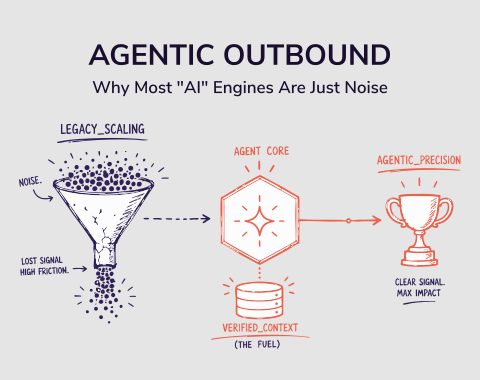
- Data quality is the variable most tools get wrong. If your contact database is stale, no AI will fix your reply rates.
AI BDR tools help sales teams find prospects, write personalized messages, and follow up automatically.
They can save hours of manual work and help teams reach more buyers. But not every tool delivers the same results. A good AI BDR tool needs accurate contact data, not just strong automation. If your prospect list is outdated, even the smartest AI will struggle to book meetings.
In this guide, I'll break down the 7 best AI BDR tools in 2026 and explain what each one does best.
What Is an AI BDR Tool?
An AI BDR tool handles the repetitive front end of outbound sales development: lead sourcing, outreach writing, sequence execution, reply handling, and meeting booking. The best ones do all of this with minimal human oversight. The weaker ones automate one slice of the workflow and call the whole thing AI.
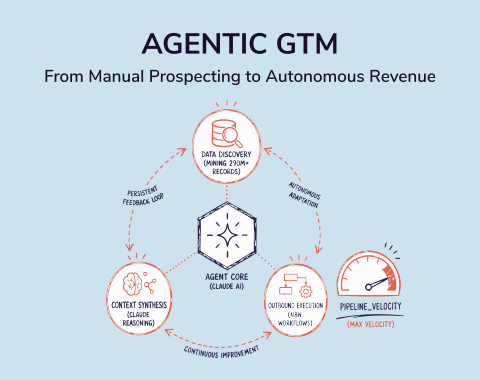
Most tools fall into three types. Fully autonomous agents are supposed to run without a human in the loop. Platform-integrated AI SDRs sit on top of existing sales engagement tools and add an agent layer. And then there's the data and intelligence layer that determines whether any of the above actually performs. That third category does less marketing but arguably does more work.
7 Best AI BDR Tools
Here are the best AI BDR software you can give a try in 2026:
1. SMARTe
Best for: B2B outbound teams that need verified contact data, AI-driven account research, and real-time buying signals to give every AI BDR tool in their stack something worth running on
SMARTe isn't a send-and-book AI BDR the way 11x or AiSDR are. It's the data foundation that determines whether every other tool on this list actually performs. The platform holds 289M+ verified B2B contacts globally, with 75%+ US mobile coverage and 50%+ global direct dial coverage. Real-time verification means you're not pulling from a database that was accurate 18 months ago. B2B data decay runs at roughly 22% per year on average, and faster at the VP and C-suite level. SMARTe's AI Agents handle account research, buying group mapping, and signal monitoring automatically, so your reps or AI systems arrive with context rather than just a name and an email address.
What SMARTe Brings to AI Outbound:
- 289M+ verified B2B contacts across 200+ countries, refreshed in real time, not batch-processed on a quarterly schedule
- 75%+ US mobile coverage and 50%+ global direct dial coverage (the numbers where most AI BDR tools quietly fall apart)
- AI Agents that auto-discover buying groups, monitor job changes, and flag accounts showing signs of active buying mode
- Native Bombora intent data integration to surface accounts researching relevant topics right now, not six weeks ago
- Technographic data across 64,000+ products for targeting accounts based on their current tech stack
- 90%+ CRM enrichment match rate to keep records current without manual cleanup
- SMARTe MCP that gives AI assistants like Claude and ChatGPT direct access to verified B2B data in real time
- Native Salesforce and Outreach integrations, plus SMARTe Prospector, a Chrome extension that works directly from LinkedIn
Where SMARTe Wins:
- Data quality at the source. Most AI BDR failures trace back to stale or unverified contacts. Real-time verification cuts bounce rates before they damage your domain.
- Mobile coverage that actually connects. 75%+ US mobile means direct dials instead of switchboards. That changes connect rate math significantly.
- Built-in intelligence layer. Bombora intent signals, job change tracking, and funding trigger detection mean you're reaching the right accounts at a moment that matters.
- Genuine APAC and LATAM depth. If any part of your pipeline is outside North America, most data platforms let you down there. SMARTe doesn't.
- Credit-based pricing with unlimited seats, so adding reps to the team doesn't add to the bill.
Where SMARTe Is Not the Full Picture:
- SMARTe doesn't write cold emails for you or manage autonomous multichannel sequences. You still need a sending tool or sales engagement platform on top.
- If you need a fully autonomous agent that handles replies and books meetings end to end, SMARTe is the foundation, not the whole structure.
- Enterprise-only pricing. There's no self-serve tier, so small teams testing outbound for the first time won't find an entry point here.
SMARTe Pricing: Enterprise from $15,000/year. Credit-based with volume discounts, no per-seat fees, unlimited users. Book a demo for a quote against your volume.
G2 Rating: 4.6/5
Verdict: Your AI BDR is only as good as the data feeding it. SMARTe is that data. It won't replace a sending platform, but it's what makes the rest of your AI stack perform at actual capacity rather than at the capacity of your least-verified list. For phone-heavy outbound or any team selling outside the US, the mobile coverage alone makes the investment worth it.
2. 11x.ai
Best for: Enterprise sales teams that want a fully autonomous AI sales workforce, including both email outreach and AI phone prospecting, with hands-on implementation support
11x builds what it calls a "digital GTM workforce." The flagship product is Alice, an AI sales agent that sources leads, researches prospects, runs multichannel sequences, and books meetings around the clock. In 2026, they added Julian, an AI phone agent that handles inbound demo requests (calling back within seconds of a form submission) and outbound phone prospecting. The platform now includes native contact data, website visitor tracking, and deliverability infrastructure, so it's moved toward a more complete stack rather than purely an agent layer. Backed by Benchmark and Andreessen Horowitz, 11x has firmly planted its flag in the enterprise market, and the pricing reflects that.
Alice and Julian: What the Platform Does:
- Alice handles lead sourcing, prospect research, personalized email writing, multichannel sequencing, and meeting booking, running continuously without rep management
- Julian manages inbound demo requests (instant callback) and outbound phone prospecting across geographies and languages
- Real-time contact database with verified emails and phone numbers built into the platform
- Website visitor identification that surfaces target accounts landing on your site before they leave
- AI-personalized outreach based on live LinkedIn data, company news, and public signals
- Native CRM integrations and calendar sync for automatic meeting booking with no manual handoff
What 11x Gets Right:
- The autonomous model holds up. Alice runs the full workflow without a human managing each step, which is what the AI SDR category has been promising and mostly failing to deliver for the past two years.
- Julian is a meaningful differentiator. AI phone agents are rare in practice. Having one built into the same platform as your email outreach, sharing context, is a real workflow advantage.
- Onboarding support is consistent. G2 reviewers repeatedly cite the 11x team as responsive and hands-on during implementation. You're not buying software and figuring it out alone.
- Personalization quality holds. The outreach references live LinkedIn data and recent company news, so messages contain actual context rather than generic placeholders.
What to Know Before You Buy:
- The pricing is enterprise-grade. Annual contracts run an estimated $50,000 to $90,000 based on third-party procurement data. 11x doesn't publish pricing publicly, so expect a full sales process.
- Only 31 G2 reviews as of mid-2026. That's a small sample for a category this active, and a few strong or weak implementations can significantly skew the average.
- Works better for broad-ICP outbound than tight-ICP, technically complex motions. When every message needs real domain expertise to land, fully autonomous outreach still produces generic output.
- LinkedIn reply handling has known gaps. If a prospect responds through LinkedIn, the system doesn't always follow up with full context from the original thread.
11x.ai Cost: Custom-quoted only. Based on third-party estimates, annual contracts typically land between $50,000 and $90,000 depending on volume, feature set, and number of digital workers deployed. Expect several weeks of sales process before seeing a number.
G2 Rating: 4.4/5
Verdict: 11x is the right call if you're at a company that can absorb an enterprise contract and you need fully autonomous outbound at real scale. The product has matured enough in 2026 that the core workflow delivers. For smaller teams or lean budgets, the price-to-result math doesn't work in your favor.
3. AiSDR
Best for: Startups and mid-sized B2B sales teams that want a dedicated AI outbound agent with strong personalization, dedicated GTM support, and more predictable pricing than enterprise alternatives
AiSDR launched in 2023 and has grown to 250+ customers by doing one thing consistently well: writing cold outreach that sounds like your best rep wrote it, then sending it without you having to supervise the process. The platform handles lead sourcing, email and LinkedIn outreach, follow-ups, and reply management. Setup takes hours, not weeks. And every account gets a dedicated GTM engineer who actively works alongside you to configure and improve campaigns. (That support model matters more than most comparison articles acknowledge. If you're stuck with an AI tool and there's nobody to call, you churn fast.)
AiSDR's Core Functions:
- Real-time lead sourcing using live intent signals across the web, not static database exports from a monthly batch
- AI-generated email and LinkedIn messages personalized using each prospect's LinkedIn activity, recent company news, and public data
- Automated follow-up sequences that adjust based on how prospects respond (or don't)
- Reply classification and routing: positive interest, objections, and opt-out requests handled without rep involvement
- Direct meeting booking into your calendar, including follow-up if a prospect goes quiet after expressing interest
- Email deliverability monitoring with automatic bounce protection before sends go out
Why Teams Pick AiSDR:
- Personalization that goes past surface-level. Unlike tools that mail-merge a first name and a job title, AiSDR pulls real recent signals and writes messages that reference what's actually happening at a prospect's company right now.
- The dedicated GTM engineer model is a genuine differentiator. Every account gets a named support contact who helps configure campaigns, test messaging angles, and troubleshoot deliverability. It's the closest thing to a managed service in a product that starts at under $1,000/month.
- Fast time to first campaign. Multiple reviewers report launching in under 24 hours. No multi-week implementation process.
- Strong reply rates when targeting intent-active accounts. Teams consistently report reply rates above 3 to 4% on well-targeted lists, which is significantly above cold email averages.
Gaps Worth Knowing:
- Targeting filter combinations have limits. You can't always layer complex conditions (funding round + tech stack + hiring signals simultaneously) with fine-grained control. The team is actively working on this, but it's a real constraint for tight-ICP motions.
- Quarterly billing catches some teams off guard. You pay 90 days upfront. It's not unusual in this category, but it's worth knowing before the first invoice.
- Built for volume-first outbound. If your sale requires deep account-level research and highly customized messaging for individual stakeholders, the automation will feel too broad.
- No free trial. You're committing $900/month before you've seen what it produces in your specific market.
AiSDR Plans and Costs: Explore plan starts at $900/month for 1,200 messages per month (email and LinkedIn combined), billed quarterly. Annual billing available at roughly 20% off. Unlimited seats on all plans. No per-user fees. Higher volume tiers priced on request.
G2 Rating: 4.7/5
Verdict: AiSDR is my first pick for startups and growing sales teams that want genuine AI outbound without a $90,000 annual contract. The GTM engineer support model separates it from tools you configure yourself and then watch underperform. It won't replace a human rep for highly consultative, technical deals. For volume-first outbound with a reasonably well-defined ideal customer profile, it runs well.
4. Artisan (Ava)
Best for: Early-stage teams testing AI-driven outbound for the first time and looking for a low-cost entry point with built-in lead sourcing and multichannel outreach
Artisan relaunched Ava as version 2.0 in May 2026 with one significant change: entry pricing dropped from $2,500/month to $250/month. The product is now generally available with self-serve onboarding and $300 in free credits for new users, no credit card required. Ava sources leads from a database of 300M+ B2B contacts, runs AI-personalized email and LinkedIn sequences, handles a built-in dialer for call steps, and books meetings. The pitch is that you set your ICP once and Ava manages the rest, including re-engaging churned accounts and cold conference contacts automatically.
What Ava Does Out of the Box:
- Lead sourcing from 300M+ B2B contacts enriched across 22+ data sources, filtered by ICP criteria you define in the onboarding conversation
- Personalized multi-channel outreach across email and LinkedIn, with a built-in dialer added in the 2.0 release
- Intent signal monitoring (funding rounds, leadership hires) to prioritize accounts showing buying signals
- Automated reply handling, follow-up sequences, and meeting booking with no human involvement required
- Re-engagement workflows for cold leads, churned accounts, and conference contacts
- Slack-based campaign management so you can adjust settings and review activity without logging into another dashboard
Artisan's Genuine Strengths:
- The $250/month entry price is a real shift. Before May 2026, this was $2,500/month. That 10x reduction brings Artisan within reach for teams that couldn't afford the old price entirely.
- Self-serve onboarding in under 10 minutes is unusually fast for this category. Most AI BDR tools involve a weeks-long implementation.
- The free trial with $300 in credits lets you see actual campaign results before paying. Most tools in this category don't offer that.
- Slack-based management is a workflow detail that experienced ops people will appreciate. Campaign oversight without context-switching.
The Honest Downsides:
- G2 reviews are polarized in a way that should give you pause. The 3.9/5 average across 22 reviews hides a split: 72% five-star and 13% one-star with almost nothing in between. That pattern usually means a product that works well for a narrow set of conditions and fails outside them.
- Some detailed G2 reviews describe serious issues: domain reputation damage from low-quality outreach, cancellation difficulties, and results far below what was promised in sales calls. These are specific, named accounts, not generic complaints.
- Messaging control is limited. Ava writes the emails. You can provide direction, but tight control over tone and angle is harder than with tools where you build the templates yourself.
- The product just launched its 2.0 rebuild. I'd treat it as a trial rather than a production deployment for a high-stakes outbound motion in 2026.
Artisan Pricing: Free trial with $300 in credits (10,000 credits), no credit card required. Paid plans start at $250/month following the May 2026 Ava 2.0 relaunch. Full pricing details including higher tiers are available at artisan.co/pricing.
G2 Rating: 3.9/5
Verdict: Worth testing at the new entry price, especially given the free credits. Not where I'd stake a serious pipeline target right now. The product is rebuilding after a controversial v1 and the 3.9 average with a 13% one-star share tells you real teams have gotten burned. Monitor your domain reputation carefully if you run a pilot.
5. Reply.io (Jason AI)
Best for: Outbound sales teams already running multichannel sequences in Reply.io who want to add an AI agent layer without switching their entire platform
Reply.io has been a reliable multichannel outreach platform for years, 4.6/5 on G2 across nearly 1,500 reviews. Jason AI is their answer to the autonomous SDR category, built directly into the existing product. That integration is both the key strength and the honest constraint of this product. If you're already on Reply, adding Jason AI is the lowest-friction path to AI-driven outbound. If you're not, you're buying a full sales engagement platform primarily to access its AI agent, and the layered pricing makes that a harder case to justify versus dedicated AI BDR tools at a similar price point.
Jason AI's Capabilities:
- Automated lead sourcing from Reply's 1B+ contact database, filtered by ICP criteria
- AI-generated personalized email, LinkedIn, SMS, and WhatsApp outreach running in coordinated multichannel sequences
- Reply classification: Jason distinguishes positive interest, objections, and opt-outs, and routes each accordingly without rep involvement
- Autopilot mode (fully autonomous) and copilot mode (AI drafts, human approves before sending) so teams can start conservative and expand from there
- Meeting booking, follow-up management, and bidirectional CRM sync built in
- A/B testing on subject lines and message variants at scale
Reply.io's Actual Edge:
- Multichannel execution is mature and polished. Email plus LinkedIn plus calls plus SMS in a single conditional workflow, branching based on prospect behavior, is one of the strongest implementations in the category.
- Built on a proven platform. Reply's core sequencing engine has 1,500+ reviews behind it. You're not betting on unproven infrastructure.
- Copilot mode is a practical feature for teams that want AI assistance without full automation. Reps review and approve before anything sends, which protects brand voice and ICP fit.
- Solid deliverability track record for inbox placement and sender reputation management.
What Stacks Up Against It:
- Jason AI is a separate add-on from Reply's base plans. The Starter tier for Jason AI begins at $500/month on top of your existing Reply subscription. Full multichannel at scale pushes past $1,500/month.
- The layered pricing catches people off guard. Base plan plus LinkedIn add-on plus calls and SMS plus Jason AI can reach $187+ per user per month before you're even at the AI agent tier. Read the pricing page with a calculator open.
- G2 reviewers and Trustpilot consistently flag billing disputes, auto-renewal surprises, and cancellation friction. The product itself rates well. The subscription management practices have earned consistent criticism.
- It's more AI-augmented sequencer than truly autonomous agent. Jason handles the heavy lifting, but it works best when a human is still directing strategy and reviewing message direction.
Reply.io Jason AI Pricing: Jason AI Starter starts at $500/month for 1,000 active contacts, including unlimited users, 2 LinkedIn accounts, and full multichannel automation. Jason AI Growth starts at $1,500/month for 5,000 active contacts. Base Reply.io plans are separate and start at $49/user/month for email-only outreach.
G2 Rating: 4.6/5
Verdict: If you're already a Reply.io customer, adding Jason AI is a logical step and the onboarding friction is minimal. If you're starting from scratch, the layered pricing makes it harder to justify compared to dedicated tools at a similar investment. Know what you're buying before you sign.
6. Salesforge (Agent Frank)
Best for: High-volume outbound teams that prioritize email deliverability infrastructure as much as AI automation, particularly teams sending 10,000+ emails per month across multiple domains
Salesforge built its reputation on deliverability. Dedicated IP infrastructure, ESP matching, inbox rotation, and automated email warm-up are built into the platform at a depth most AI BDR tools treat as an afterthought. Agent Frank is their AI SDR running on top of that infrastructure. Frank operates in two modes: auto-pilot (fully autonomous) and co-pilot (human review before each send). The 500M+ contact database is built in. And it runs outreach in 20+ languages, which makes it more useful for teams selling into European or LATAM markets than most alternatives on this list. If agentic outbound is where you're heading and sending infrastructure is the gap in your current stack, Salesforge is worth a serious look.
Agent Frank's Features:
- Autonomous lead sourcing from a 500M+ contact database filtered by ICP criteria set during onboarding
- AI-generated email outreach built on a research-then-write loop (Frank researches each prospect first, then writes, rather than the reverse)
- Auto-pilot and co-pilot modes for teams that need full autonomy or human-in-the-loop control
- 20+ language support for outbound teams running international campaigns
- Dedicated email deliverability infrastructure including dedicated IPs, inbox rotation, and automated warm-up through Warmforge
- Waterfall enrichment compatibility and native Clay and HubSpot integrations
Salesforge's Real Strengths:
- Best-in-class deliverability setup in this category. Most AI BDR tools send emails. Salesforge sends emails and actively manages the sending infrastructure to keep them out of spam. At high volume, that distinction is what separates a 3% reply rate from near-zero.
- The ecosystem approach is coherent if you're committed to using it. Mailforge for shared IP, Infraforge for dedicated IP, and Warmforge for automated warm-up integrate into a working stack rather than disconnected tools.
- Language support is rare in this category. For any team with EMEA or LATAM pipeline, 20+ languages fills a real gap.
- Customer support earns consistent praise. G2 reviewers list it as the top dimension, and the overall 4.6/5 across 85 reviews reflects a real user base with real feedback.
The Complexity Tax:
- The Salesforge ecosystem (Salesforge, Mailforge, Infraforge, Warmforge, Primebox) is confusing to buy. What looks like $48/month in marketing runs closer to $90 to $612/month once you add the infrastructure you actually need to run campaigns properly.
- Agent Frank doesn't include buying signals. It sends personalized emails at scale but can't distinguish a prospect who just raised a Series B from one in a hiring freeze. You need a separate signal-based GTM layer for that intelligence.
- No free trial for Agent Frank. You're committing before seeing results.
- The base Salesforge product and Agent Frank have different feature sets. Read the product pages for each separately. Don't assume features from one carry into the other.
What Agent Frank Costs: Agent Frank starts at $499/month billed annually, covering 1,000 active contacts and 6,000 to 7,500 personalized emails per month. Email infrastructure is separate: Infraforge starts at $33/month for dedicated IP warmup. Calculate your total monthly cost across the stack before comparing to other tools at face value.
G2 Rating: 4.6/5
Verdict: Salesforge earns its deliverability reputation. If you're at high sending volume and infrastructure quality is the thing holding your results back, Agent Frank is worth a serious evaluation. Get a clear picture of the full ecosystem cost before you commit, and plan for the signal intelligence gap if your outbound depends on precise timing.
7. Apollo.io
Best for: SDR and sales teams that want contact data, AI-assisted email writing, multichannel sequencing, and a dialer in one platform, without committing to the price or complexity of a dedicated AI BDR
Apollo is probably the most-used outbound tool in B2B sales right now. 275M+ contacts, email sequences, AI writing assistance, a dialer, LinkedIn automation, and CRM integrations, all starting at $49/user/month. The AI features aren't as autonomous as AiSDR or 11x. You're not buying a replacement BDR here. What you're getting is a well-integrated platform where a competent SDR moves significantly faster, finds better prospects, and writes better first-draft emails than they would without it. I think Apollo is the right starting point for most teams that haven't yet figured out their outbound playbook. The dedicated AI agent tools on this list make more sense once you know exactly what's working and you want to automate it at scale.
Apollo's AI Capabilities:
- 275M+ B2B contacts with verified emails, phone numbers, firmographic and technographic filters for precise list building
- AI-assisted email writing (Professional plan and above) that drafts personalized outreach using prospect data pulled from Apollo's database
- Automated email sequences with conditional branching and A/B testing across subject lines and body copy
- Built-in dialer with call recording and AI call insights for sales coaching (Professional plan and above)
- LinkedIn automation and intent topic monitoring to surface which accounts are actively researching relevant categories
- Enrichment workflows, bidirectional CRM sync, and a Chrome extension for LinkedIn prospecting
Why Apollo Works for Most Teams:
- The free tier actually works. Not the kind of free plan that gives you 10 credits and calls it access. Apollo's free plan includes 10,000 email credits per month and basic prospecting. Enough to actually evaluate whether the data quality meets your needs.
- 9,600+ G2 reviews at 4.7/5 is the most data-backed rating on this list. That volume reflects real at-scale usage across different industries and team sizes, not a handful of early adopters.
- All-in-one convenience actually saves time. When your database, sequencer, and dialer live in one place, reps spend less time switching tools and more time reaching prospects.
- Accessible for teams of any size. $49/user/month for Basic is less than the monthly cost of a single database lookup from some enterprise alternatives.
Apollo's Limits at Scale:
- The AI writing is assistive, not autonomous. Apollo helps with first drafts. Campaign strategy, ICP selection, and sequence logic still need a human.
- Mobile number accuracy has gaps, especially for international markets. Heavy cold callers often report burning through mobile credits faster than expected and finding numbers that no longer connect. (This is precisely where pairing Apollo with a dedicated mobile data source closes the gap.)
- Intent data is topic-based but doesn't surface secondary signals. Apollo identifies companies researching a category. It doesn't surface funding rounds, leadership changes, or hiring surge patterns the way dedicated intent platforms do.
- Credit math can surprise you. Enrichment steps, exports, and AI features all draw from the same credit pool. Teams that use Apollo heavily across multiple use cases burn through credits faster than the headline plan number implies.
Apollo.io Pricing: Free plan available with no time limit. Basic: $49/user/month (annual) or $59/user/month (monthly). Professional: $79/user/month (annual) or $99/user/month (monthly). Organization: $119/user/month (annual) or $149/user/month (monthly). AI-assisted writing features start at the Professional tier.
G2 Rating: 4.7/5
Verdict: Apollo is the right starting point for most sales teams. It's affordable, well-integrated, and backed by more real-world usage data than anything else in this category. Once you've mapped your outbound playbook and want to hand more of it to an autonomous agent, the dedicated AI BDR tools higher on this list are where you go next.
How to Choose the Right AI BDR Tool
Three questions cut through most of the noise.
First: are you replacing headcount or augmenting existing reps? Fully autonomous tools (11x, AiSDR, Artisan) are built for replacement. AI-assisted platforms (Apollo, Reply.io in copilot mode) augment your team. Salesforge and Agent Frank sit between the two depending on which mode you run.
Second: how current is your contact data? I mean this specifically. None of these tools perform well on lists that haven't been re-verified in the last 90 days. If your outreach is landing in spam or generating high bounce rates, the first fix is data hygiene, not a more expensive AI tool.
Third: how broad is your ICP? Broad-ICP, volume-first outbound is where autonomous AI BDRs produce real results. The tighter and more technical your ideal customer, the more human judgment still needs to be in the messaging loop.
Your outbound sales strategies and your RevOps tech stack both shape which tool actually fits. There's no universal right answer, but the wrong answer is usually buying an autonomous agent and pointing it at a stale list.
.png)